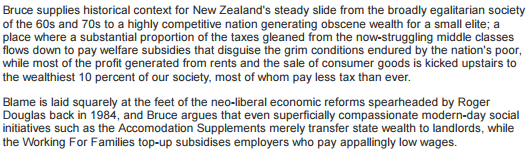
You really are still fighting the 1990 New Zealand general election if Max Rashbrooke makes more sense than you on the good old days before the virus of neoliberalism beset New Zealand from 1984 onwards.
Maybe 65% of the population of those good old days before the virus of neoliberalism. were missing out on that broadly egalitarian society championed by Bryan Bruce.
As is typical for the embittered left, the reactionary left, gender analysis and the sociology of race is not for their memories of their good old days. New Zealand has the smallest gender wage gap of any of the industrialised countries.
The 20 years of wage stagnation that proceeded the passage of the Employment Contracts Act and the wages boom also goes down the reactionary left memory hole.
That wage stagnation in New Zealand in the 1970s and early 80s coincided with a decline in the incomes of the top 10%. When their income share started growing again, so did the wages of everybody after 20 years of stagnation. The top 10% in New Zealand managed to restore their income share of the early 1970s and indeed the 1960s. That it is hardly the rich getting richer.
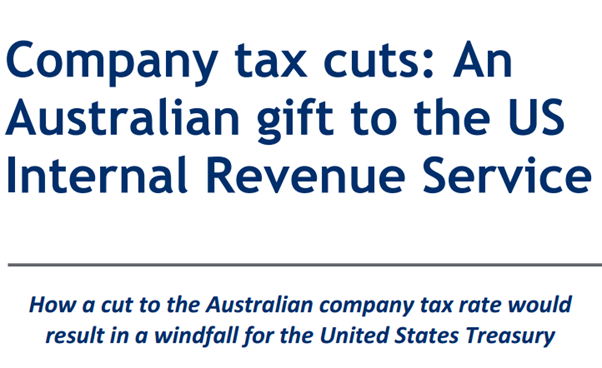
The Australia Institute has been running the line that cutting the Australian company tax rate just means more tax revenue for offshore tax departments. They will tax the larger after-tax Australian dividends in the home country of the foreign investor if Australia were to cut its company tax rate.
The Australia Institute obviously has not picked up on the relentless bullying that Ireland was subject to by the rest of the European Union over its 12.5% company tax.
The Irish company tax rate of 12.5% was initially on export profits. To finesse European Union member state complaints about that 12.5% company tax rate on discrimination grounds, the Irish government extended that low rate to all companies in 1995.
I am yet to see a minister of finance welcoming a company tax cut in a competing jurisdiction, rubbing his hands in anticipation of greater tax revenues on the foreign profits of companies headquartered in his country.
France and Germany are pushing plans to introduce a minimum corporation tax rate across the continent, it was reported today, in a move that could result in higher taxes on British companies.
European officials will debate plans to set a EU-wide floor on corporation tax in order to crack down on tax havens such as Ireland and Luxembourg, it emerged.
If there is an ounce of sense in what the Australia Institute said about foreign taxmen benefiting from low company taxes in Australia, high corporate tax rate countries such as Germany, France and the USA should welcome low company tax rates in destination countries for foreign investment originating in those countries but they do not. Rather than seek tax harmonisation, high tax country should welcome low company taxes in competing investment destinations but they do not.
"Corporate inversions"…"Naked Inversion"… @etoder @NPRATC – Is it OK for American companies avoid paying taxes http://t.co/vZub5Kg1V7
— Tax Policy Center (@TaxPolicyCenter) July 18, 2014
About $2 trillion in profits is held offshore by American businesses because they do not pay company tax in the USA until they actually repatriate the profits to the USA. This is common. You wonder what the purpose of tax havens is if a company tax rate cut in Australia is so easily captured by the IRS?
Studies of the company tax in the USA suggest that a cut in that company tax would lead to large inflows of foreign investment into the USA boosting wages significantly.
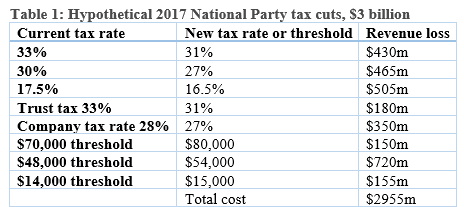
On morning radio on Monday, Prime Minister John Key said "We are not ruling that out for 2017 or campaigning on it for a fourth term in 2017, but having a bigger one, to be blunt, than $1 billion." Asked how much was needed to deliver meaningful tax cuts, he said: "$3 billion, I reckon."
The table below uses the Treasury scoring of how much tax cuts can be delivered through $3 billion if they include changes in the income tax thresholds as well. That scoring is static. That is, no behavioural changes are assumed as the result of the tax cuts on labour supply, investment or entrepreneurship.
In a letter to the editor today in the Dominion Post defending a climate change protest that closed a branch of the ANZ bank, one of the participants Jimmy Green said
Of course our intention wasn’t to intimidate individuals – our intention was to intimidate ANZ into shifting its investments after the bank ignored us asking.
This honesty about the willingness to intimidate to advance a political agenda shows that climate protesters are engaging in plain thuggery. Peaceful protest has its role in any democracy.
What these thuggish protesters forgot about is how we resolve our differences in a democracy. That is by trying to persuade each other and elections. Let the people decide.
These protesters are keen to pass laws to save the environment but they’re more than happy to break laws they disagree with. I wonder if they extend that same courtesy to others they regard as less enlightened than them? They expect others to obey the laws for which they successfully lobbied.
Why do these climate action protesters think they can break laws that others secured through lawful, peaceful democratic action? Is some direct action more equal than others? Why do these climate action protesters think their vote counts more than mine?
John Rawls makes the point that the purpose of civil disobedience is not to impose your will upon others but through your protest to implore others to reconsider their position and change the law or policy you are disputing.
Rawls argues that civil disobedience is never covert or secretive; it is only ever committed in public, openly, and with fair notice to legal authorities. Openness and publicity, even at the cost of having one’s protest frustrated, offers ways for the protesters to show their willingness to deal fairly with authorities.
Rawls argues: for a public, non-violent, conscientious yet political act contrary to law being done (usually) with the aim of bringing about a change in the law or policies of the government; that appeals to the sense of justice of the majority; which may be direct or indirect; within the bounds of fidelity to the law; whose protesters are willing to accept punishment; and although civil disobedience involves breaking the law, it is for moral rather than selfish reasons, and the willingness to accept arrest is proof of the integrity of the act of peaceful protest.
Rawls argues, and too many forget, that civil disobedience and dissent more generally contribute to the democratic exchange of ideas by forcing the dominant opinion to defend their views.
The civil disobedient is attempting to appeal to the “sense of justice” of the majority and their willingness to accept arrest is proof of the integrity of the act as a contribution to democratic persuasion not intimidation says Rawls:
…any interference with the civil liberties of others tends to obscure the civilly disobedient quality of one’s act.
Rawls argues that the use or threat of violence is incompatible with a reasoned appeal to fellow citizens to move them to change a law. The protest actions are not a means of coercing or frightening others into conforming to one’s wishes.
As long as ANZ continues to profit from climate change, they can expect more of this https://t.co/Y7K0ogGOrG
The intimidation by the protesters at the ANZ bank and their promise to do it again as shown in the adjacent tweet is a breach of the principles of a just society. These climate change protesters blockading an ANZ bank branch were attempting to coerce and frighten others into conforming with their political views. That ‘might does not make right’ is fundamental to democracy and the rule of law. As United States Supreme Court Justice Antonin Scalia said
The virtue of a democratic system [with a constitutionally guaranteed right to free speech] is that it readily enables the people, over time, to be persuaded that what they took for granted is not so and to change their laws accordingly.
When the climate protesters lose at the ballot box, they always claim it is rigged by the corporate interests. This is just sore losers.
The great strength of democracy is a small group of concerned and thoughtful citizens can band together and change things by mounting single issue campaigns or joining a political party and running for office and winning elections or influencing who wins.
Yesterday’s majority of the vote sooner or later and often sooner than they expect will break off into different minorities on the next big issue of the day. These newly formed minorities will use that same ability to band together as a minority to block vote to protect what they think is important and advance agendas they think are to be wider benefit despite the opinion of the current majority to the contrary. All reforms start as a minority viewpoint.
Indeed, it is a strength of democracy – small groups of concerned citizens banding together – is what is holding up legislating in many areas. It is not that minorities are powerless and individuals are voiceless. It is exactly the opposite.
Parliaments elected by proportional representation such as in New Zealand, and in Australian upper houses reinforces the ability of small groups of citizens to band together to win a seat.
Nothing stirs up the impassioned (and most other people as well) more than depriving them of their right to support or oppose what is important to them through political campaigns and at an election. The losing side, we all end up on the losing side at one time or another, are much more likely to accept an outcome if they had their say and simply lost the vote at the election or in Parliament. Scalia warned of, for example, the risks of the courts moving in advance of the popular will, and thereby poisoning the democratic process
We might have let the People decide. But that the majority will not do. Some will rejoice in today’s decision, and some will despair at it; that is the nature of a controversy that matters so much to so many. But the Court has cheated both sides, robbing the winners of an honest victory, and the losers of the peace that comes from a fair defeat. We owed both of them better. I dissent.
These climate change protesters want to rob the winners of their honest democratic victory over the balance between oil and coal exploration and other energy options. They are also robbing themselves of a fair defeat.
A fair defeat flows from laws and policies secured through normal democratic means knowing that one day you may be in a majority. Only by respecting the will of the majority when you are in the minority do you have any right to expect future minorities to respect your honest democratic victories as the majority of some future day. Democratic majorities of patched together through give-and-take and the reality that even the most important policies may be reversed in the future.
Climate change protesters should respect the political process because democracy alone can produce compromises satisfying a sufficient mass of the electorate on deeply felt issues so as to not poison the remainder of the democratic process. The losing side, we all end up on the losing side at one time or another, are much more likely to accept an outcome if they had their say and simply lost the vote at the election or in Parliament.
On morning radio this morning, Prime Minister John Key said "We are not ruling that out for 2017 or campaigning on it for a fourth term in 2017, but having a bigger one, to be blunt, than $1 billion." Asked how much was needed to deliver meaningful tax cuts, he said: "$3 billion, I reckon."
The table below uses the Treasury scoring of how much tax cuts can be delivered through $3 billion. That scoring is static. That is, no behavioural changes are assumed as the result of the tax cuts on labour supply, investment or entrepreneurship.
The big sensitivity is how the company tax rate cut scoring treats offsets for dividend imputation credits. If there is no change in the other tax rates, a cut in the company tax forgoes $225 million a year per percentage point because some of it is clawed back through dividend imputation. The costing of the company tax cut by the Treasury when the other income tax rates are changed is assumed to be $350 million per percentage point. When calculating the dividend imputation offset, the Treasury assumes that shareholders are on an average tax rate of 30%.
If the Prime Minister chooses not to match the company tax rate announced by the Liberal National party government in Australia ahead of their election, there is certainly more room for individual income tax cuts.
Joe’s Crab Shack tested a no-tip model in 18 of its 130 restaurants. A 12-15% service charge replaced tips. Joe’s Crab capture is the first major restaurant chain to experiment with a tipping policy to experiment with abolishing it. The tipping minimum wage is far less than the federal, state and local minimum wages.
Joe’s Crab Shack had high hopes. The aims were customers would pay less, get a greater value experience, reduce labour costs and increase profits. The reactionary left represented by Salon and Huffington Post have quite strong views on tipping. Salon says
Tipping is a repugnant custom. It’s bad for consumers and terrible for workers. It perpetuates racism. Tipping isn’t even good for restaurants, because the legal morass surrounding gratuities results in scores of expensive lawsuits.
Tipping does not incentivize hard work. The factors that correlate most strongly to tip size have virtually nothing to do with the quality of service. Credit card tips are larger than cash tips. Large parties with sizable bills leave disproportionately small tips.
According to a 2000 study, a customer’s assessment of the server’s work only accounts for between 1 and 5 percent of the variation in tips at a restaurant.
Salon adds that federal and state law requires restaurants to ensure that tips bring employees up to minimum wage, but few diners know that.
Huffington Post managed to marshal 9 reasons why tipping should be abolished arguing that it was in no one’s interests either employers, employees or customers. The old efficiency at wage argument was rolled out arguing that employers gain in terms of diligent motivate employees by paying a straight wage rather than leaving it up to customer judgements of the services tended.
Not surprisingly this sounded like a business opportunity to Joe’s Crab Shack. Better customer service, better motivated employees and lower labour costs were promised by abolishing tips. You wonder why tipping survived in competition against alternative forms of restaurant service formats for all these decades?
Well, Joe’s Crab Shack got more than it bargained for when it abolished tipping. The pilot restaurants lost an average of 8-10% of customers during the test run.
The restaurant’s research showed that around 60% of customers disliked the policy because it took away an incentive for good service and that they don’t necessarily trust that management is passing along the money to workers.
The no tipping structure worked at four restaurants and will continue to work out why it succeeded there but failed at 14 other places.
What is even more interesting that the abolition of tipping lead to some workers quitting. This outcome at Joe’s Crab Shack is inconsistent with the notion that tipping is a by-product of the inequality of bargaining power between workers and employees. Turnover is supposed to reduce when tipping is abolished rather than increase with the employer losing their best workers.
Lazear found in data for Safelite Glass that average productivity will rise and the firm will attract a more able workforce will rise when it shifts to piece rates. The 44% increase in output per worker suggested the firm previously had a suboptimal compensation system. Half of the increase in labour productivity came from workers quitting when piece rates are introduced and being replaced by workers motivated to apply by the lure of piece rates. The average worker received a 10% increase in pay as a result of the switch to piece rates.
The only economic analysis of any value on tipping was written in 1985 by David Sisk at the Federal Trade Commission. He wrote a paper about both tipping and commissions. Sisk approached tipping not as a motivational device but a form of contracting.
Sisk points out that tipping takes the place of reputation as a way of guaranteeing good services are at a restaurant. Many do not plan to return to a restaurant so an alternative form of contracting emerges to ensure good service because the threat of taking future custom elsewhere does not work.
In the case of a tip, the buyer (or customer) is provided with a final means of automatic redress which serves to prevent unsatisfactory performance on the part of the seller.
The possibility of unsatisfactory performance arises when the brand-name, repeat purchase mechanism is not effective or because employees of the seller are too costly to monitor.
An example is tourists. They are protected from inferior service relative to the locals because they pay tips too and are well able to judge good and bad service.
Sisk argues that once a customer sits down at a restaurant, the customer commits ever increasing amounts of time and the restaurant commits ever increasing amounts of physical resources. As one commits more irrevocable resources, the greater is the incentive of the other to renege on the contract.
A tip allows the customer to withhold a portion of the price without further negotiation. The tip serves to protect the customer from bad service and to protect the restaurant from bad service by an errant employee
The system of tipping provides the motivation for the waiter to properly identify and accommodate the individual desires of customers subject to the profit maximizing constraint of the restaurant owner…
The tip protects the buyer from exploitation by a seller (when the brand-name mechanism is insufficient) or from exploitation by the shirking employees of the seller
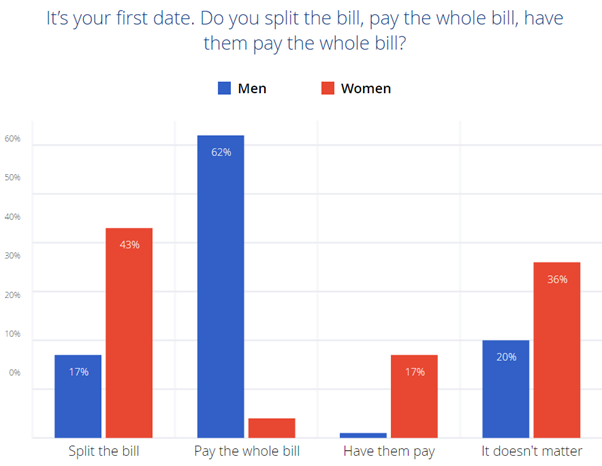
The worst tippers are single males; the best are couples and groups. The biggest tippers are single males on a date.
Why Evolution is True is a blog written by Jerry Coyne, centered on evolution and biology but also dealing with diverse topics like politics, culture, and cats.
In Hume’s spirit, I will attempt to serve as an ambassador from my world of economics, and help in “finding topics of conversation fit for the entertainment of rational creatures.”





Recent Comments