Fed up with Coalition and Labor Budget lies? So is the LDP
14 May 2016 Leave a comment
in liberalism, politics - Australia, Public Choice Tags: 2016 Australian federal election
Most @BernieSanders’ supporters don’t want to #FeelTheBern in their hip-pocket
13 May 2016 Leave a comment
in politics - USA, public economics Tags: 2016 presidential election, Bernie Sanders, expressive voting, Left-wing hypocrisy, rational ignorance, rational irrationality
66 percent of Sanders supporters are unwilling to pay more than $1,000 in higher taxes for universal health care. This includes the 8 percent of Sanders supporters who aren’t willing to pay anything more!
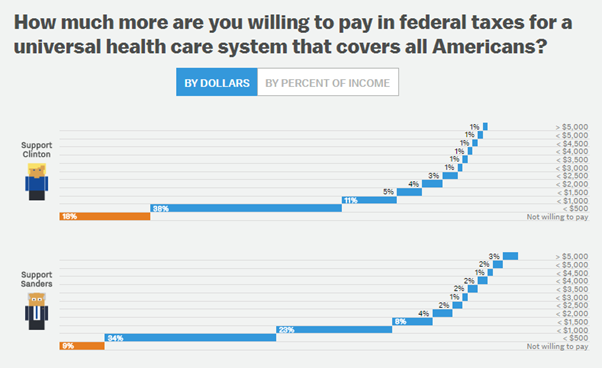
Source: Most Bernie Sanders supporters aren’t willing to pay for his revolution – Vox.
Sanders supporters want free public college tuition but 14 percent said they don’t want to pay additional taxes for it; another half said they would only pay up to $1,000 a year!
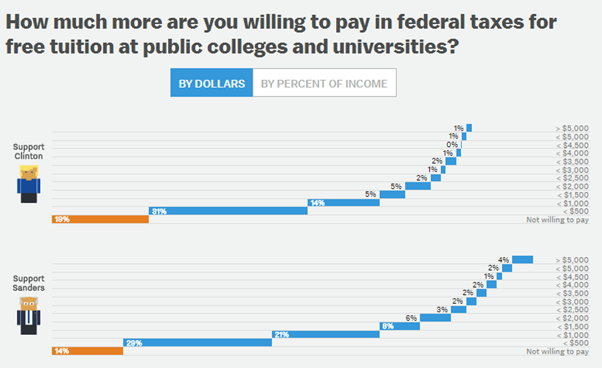
Source: Most Bernie Sanders supporters aren’t willing to pay for his revolution – Vox.
Buying 9 more houses than the Australians = dominating housing market says @nzherald
10 May 2016 Leave a comment
in economics of regulation, politics - New Zealand, Public Choice, rentseeking Tags: antiforeign bias, housing affordability, land supplied, rational irrationality
Chinese tax residents bought 321 Auckland properties (29.5 per cent of the total); Australian tax residents purchased 312 Auckland properties (28.6 per cent).

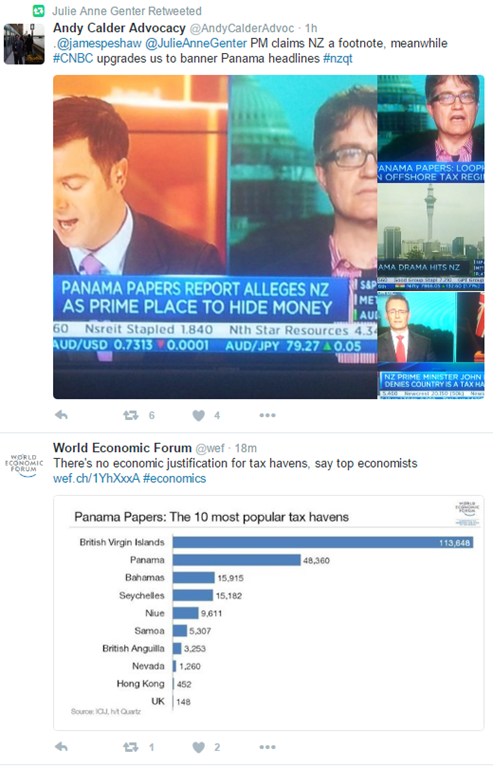
@JulieAnneGenter Twitter feed rules on NZ as top #taxhaven @JordNZ #Panamapapers
10 May 2016 Leave a comment
With friends like these, the #UBI will not live to face its enemies @jordNZ
09 May 2016 Leave a comment
in applied price theory, applied welfare economics, politics - New Zealand, politics - USA, public economics, rentseeking Tags: universal basic income
Running around saying that Universal Basic Income will make work optional leaves open the question of who will be the suckers who actually do the work and pay enormous taxes to fund the idyllic lifestyle of the bohemian rest.

Source: What If Everybody Didn’t Have to Work to Get Paid? – The Atlantic.
@BernieSanders should be the @realdonaldtrump’s running mate
08 May 2016 Leave a comment
in applied price theory, applied welfare economics, international economics, politics - USA Tags: 2016 presidential election, comparative advantage, free trade, left-wing popularism, rational ignorance, rational rationality, right-wing popularism
The dual concepts of Businesses Cannot Discriminate and Her Body, Her Choice have intersected
08 May 2016 Leave a comment
in economics of regulation, health economics, politics - USA Tags: alcohol regulation, meddlesome preferences, nanny state
New York drinking establishments must post warnings against pregnant women drinking but still must serve them.
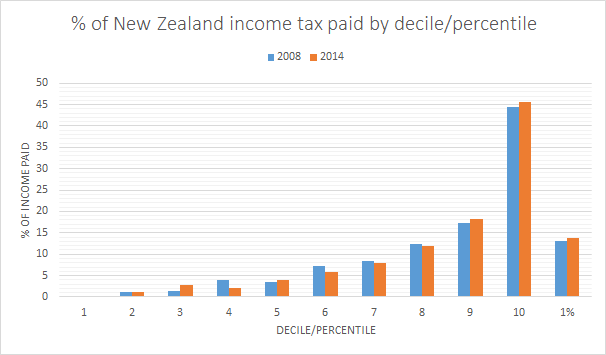
Did top income earners pay less income tax after @JohnKeyMP was elected?
08 May 2016 Leave a comment
in politics - New Zealand, public economics Tags: superstar wagers, superstars, top 1%, top incomes
Blacks shot dead by US police by threat level, January – April 2016
08 May 2016 Leave a comment
in economics of crime, law and economics, politics - USA Tags: crime punishment, law and order, media bias, police shootings
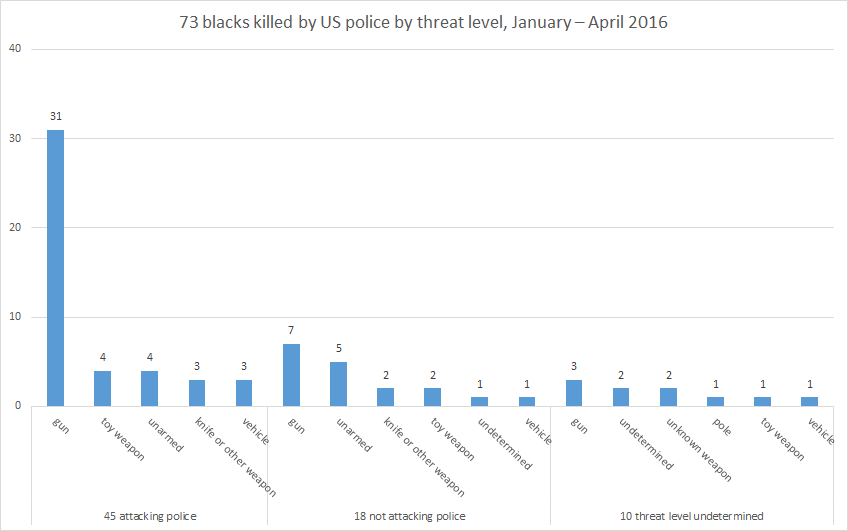
This is what the Washington Post and The Guardian said on the 5 blacks the Washington Post classified as unarmed and not attacking police:
“Antronie Scott, an unarmed 36-year-old black man, was shot on Feb. 4, 2016, in San Antonio, Tex. Undercover San Antonio police officers were monitoring Scott, who had outstanding arrest warrants. When a uniformed officer approached Scott, he spun around with something in his hand. Police later determined that Scott was holding a cellphone.” Source: Fatal force: A Washington Post investigation of people shot and killed by police in 2016 – Washington Post

Source: The Counted: people killed by police in the United States – interactive | US news | The Guardian.
"David Joseph, an unarmed 17-year-old black male, was shot on Feb. 8, 2016, in Austin, Tex. Austin police were responding to reports of an erratic, aggressive person. Joseph, who was naked, rushed toward the officer." Source: Fatal force: A Washington Post investigation of people shot and killed by police in 2016 – Washington Post.

Source: The Counted: people killed by police in the United States – interactive | US news | The Guardian.
"Calin Roquemore, an unarmed 24-year-old black man, was shot on Feb. 13, 2016, in Beckville, Tex. Roquemore fled a traffic stop by a Texas state trooper. Roquemore refused the trooper’s orders to show his hands. No weapon was found at the scene." Source: Fatal force: A Washington Post investigation of people shot and killed by police in 2016 – Washington Post.

Source: The Counted: people killed by police in the United States – interactive | US news | The Guardian.
"Marquintan Sandlin, an unarmed 32-year-old black man, was shot on Feb. 21, 2016, in Inglewood, Calif. The man was a passenger in a car stopped at an intersection. Inglewood police approached the car and noticed that the woman who was driving had a gun. Officers shot and killed Sandlin and the woman, Kisha Michael." Source: Fatal force: A Washington Post investigation of people shot and killed by police in 2016 – Washington Post.

Source: The Counted: people killed by police in the United States – interactive | US news | The Guardian.
"Peter Gaines, an unarmed 37-year-old black man, was shocked with a stun gun and shot on March 12, 2016, in Houston, Tex. A Houston police officer approached Gaines after he vandalized a traffic sign. Gaines lunged at the officer.” Source: Fatal force: A Washington Post investigation of people shot and killed by police in 2016 – Washington Post.

Source: The Counted: people killed by police in the United States – interactive | US news | The Guardian.
I will leave it up to readers to work out how many of these police shootings were suspicious and indicate police misconduct.
#NewZealand’s top 1% is getting even lazier under neoliberal @johnkeyMP
07 May 2016 Leave a comment
in politics - New Zealand, public economics Tags: entrepreneurial alertness, Leftover Left, reactionary left, superstar wagers, superstars, top 1%
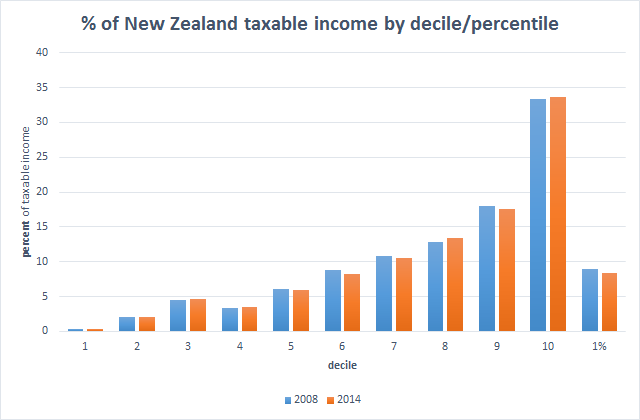
The share of incomes of the top 1% in New Zealand has not increased since the 1950s – they are just bone lazy at extracting labour surplus.
Veteran left-wing grumbler Max Rashbrooke was good enough to collect Inland Revenue Data data that show that getting even lazier under right-wing government elected in 2008. Their share of taxable income has dropped from 9% when labour lost power to 8.4% now. These figures exclude capital gains.

Straight talking from @BernieSanders on #sugartaxes @JordNZ
06 May 2016 Leave a comment
in applied price theory, health economics, income redistribution, politics - USA, Public Choice, rentseeking Tags: 2016 presidential election, do gooders, heavy-handed Samaritans, meddlesome preferences, nanny state, regressive taxes, sin taxes, soda taxes, sugar taxes
How green art thou? #buswaysforelectriccars not #BuswaysForBuses
06 May 2016 Leave a comment
in energy economics, environmental economics, environmentalism, politics - New Zealand, transport economics, urban economics Tags: busways, do gooders, electric cars, expressive politics, global warming, trade-offs, transport lobby
Finally have something nice to say about electric cars. They will put bus lanes to good use.
A trivial percentage of people take the bus to work In New Zealand. The government has a target of doubling electric car fleet every year (from 2000 in 2016 to 64,000 in 2021).
This decision yesterday to allow them to use busways allows us to relish in seeing environmentalists feud over which technologies are green enough to have access to priority lanes on the road such as those allocated to buses.
Which is more important? Saving the planet or saving the buses; most of them are diesel? Busways are empty at the weekends and many other times.
Does invested $1 in retrofitting saves $6 in health expenditure? @PhilTwyford @PeterDunneMP @AndrewLittleMP
05 May 2016 Leave a comment
in economics of regulation, energy economics, health economics, politics - New Zealand, public economics Tags: cost benefit analysis, economics of housing, economics of insulation, energy efficiency gap, The fatal conceit, The pretense to knowledge, valuation of life
Various bold claims have been made about the payoff from investing more in retrofitting insulation into housing. The government recently spent $600 million on such retrofitting of insulation.
https://twitter.com/PhilTwyford/status/728137160113557505
There is a private member’s bill before Parliament to introduce minimum standards for rental properties with regard to insulation and other matters. Little is by the Leader of the Opposition Andrew Little said for the consequences for rents of this additional expense to landlords.
Ian Harrison of Tail Risk Economics initially estimated that the $600 million invested in retrofitting of insulation will save barely half of that:
After correcting for this major error and taking a more realistic view of the benefit estimates in other studies, the net benefits of $630 million disappear.
The $600 million insulation investment will probably generate benefits of closer to $170 million, for an economic loss of $430 million.
After meeting with Ian, I read through the rather dull background documents behind a cost benefit analysis relied upon by the government to spend the $600 million dollars.
The most interesting part of the cost benefit analysis is most of the benefits come from fewer cardiovascular related hospitalisation of the elderly and not from respiratory diseases among children.
I found the error was far more fundamental than a incorrect transfer of a calculation between tables discussed in the first publication by Harrison. I had to read the background documents several times to understand what had been done wrong.
The cost benefit analysis for the Warm Up New Zealand Heat Smart Programme assumes that the number of elderly occupants of the newly insulated house increases by one each year and after 5 years, one of these dies but is replaced by a new elderly occupant.
We have modelled the probability of a vulnerable person avoiding mortality as a result of the intervention. The probability of this is (112.7/1000)*0.27= 0.03 (3%). We treat avoidance of mortality by treatment in each year as independent events.
The multi-year benefit calculated above would accrue based on the life years gained as a result of deaths avoided in year one.
However, we would expect these benefits to accrue in year two for different vulnerable individuals (aged 65 and over with a cardiovascular related hospitalisation in previous 18 months), and for different individuals again in every subsequent year that the treatment continues to have an effect, i.e. an on-going stream of benefits of $1,050.74 per year. This assumes a constant proportion of people aged 65+ who have recently been hospitalised with circulatory problems….( p.38).
In the first year of the new insulation, the first occupant benefits and the net present value is included in the benefit cost analysis calculation – the erroneous benefit cost analysis calculations which its authors still defend.
In the 2nd year, another elderly person moves into that same house and the same calculation is done for them. In the following year, yet another elderly person moves into the same house and the net present value calculation is repeated.
By the end of 5 years, there are 5 occupants in this house all benefiting from the same insulation investment. In the 6th year, the first elderly occupant dies to be replaced by a new elderly occupant who then gains from the insulation upgrade.
There was double counting of the number of people who benefited from the insulation as Iain Harrison explains
The analysis assumed that there was not one, but five occupants who had been hospitalised with a cardiovascular illness in the previous 18 months in each of the relevant insulated houses. There should have been only one such occupant.
The retrofitting of insulation was estimated to cost $600 million. Iain Harrison estimated the benefits to be $300 million, not $1.2 billion. That is a benefit cost ratio of 0.5.
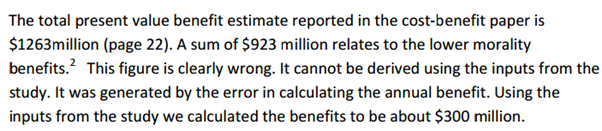
Source: Iain Harrison, The mortality reduction benefits of insulation: the error identified.
How much do you get paid if you can pick winners? @JulieAnneGenter @simonjbridges
05 May 2016 Leave a comment
in applied price theory, comparative institutional analysis, entrepreneurship, fisheries economics, politics - New Zealand Tags: entrepreneurial alertness, hedge fund managers, industry policy, picking winners, superstar wages, superstars
Electric cars have joined the long list of mendicant mendicant businesses that have been backed by the New Zealand government of late. Picking winners again.
The payrolls of entire government departments in New Zealand are not enough to hire a single successful hedge fund manager to pick winners for their political masters. To get on the list of the top 25 hedge fund managers, you need to earn at least $300 million a year.
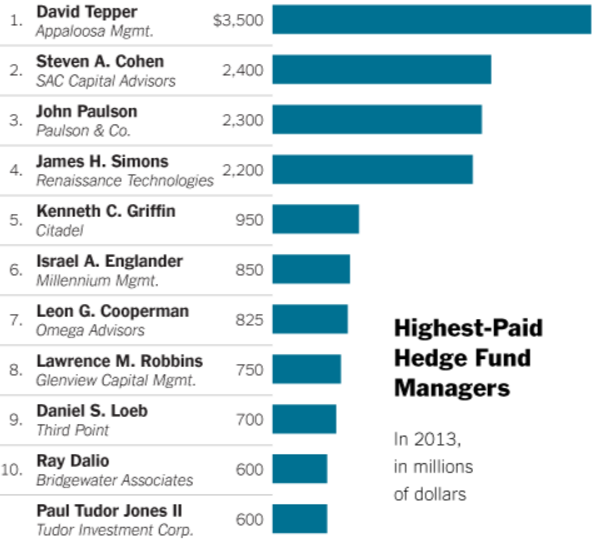
The 25 highest-earning hedge fund managers and traders made a combined $12 billion in 2015, slightly less than the $12.5 billion the 25 top-earning hedge fund managers together made in 2014.
Why do investment advisors sell and often give away their sage advice? If their insights were any good, they could trade on the share market before others caught on and make a killing!
I will give a personal example based on the skills of bureaucracies in picking winners. The test of my hypothesis is based on the transferability of human capital across jobs.
My graduate school professors in Japan included many retired bureaucrats from the Ministry of Finance and MITI. These agencies were heralded by Joe Stiglitz and others for picking winners and guiding Japanese companies to choose the right technologies and what to export.
The skills that my graduate school professors learned at picking winners over their careers with the Ministry of Finance and MITI in the high-growth years in the 1970s would now be available to them in their retirements to trade on their own account.
Page 32 of "An Illustrated Guide to Income" more economic #dataviz at: bit.ly/12SEI9p http://t.co/HYm0II2UNI—
Catherine Mulbrandon (@VisualEcon) May 08, 2013
My graduate school professors should quickly become very rich after retiring because of the skills they learned in picking winners while at the Ministry of Finance and MITI, which should cross over into their private share portfolios. The rich lists world-wide should be full of retired industry and finance ministry bureaucrats.
Instead, my graduate school professors took the train and bus to work and their families lived off their salaries in standard sized Japanese government apartments. All looked forward to their annual bonus of 5.15 months salary.
If governments are any good at picking winners, people should be willing to pay big time to get jobs at ministries of finance and ministries of international trade and industry to get access to their unique and highly secret skills they learn therein on how to pick winners.
I am still waiting for that tell-all book by an insider on these skills. Why is there no Picking Winners for Dummies on Amazon kindle as yet?


Recent Comments