
Source: Investigation: People shot and killed by police this year – Washington Post.
Celebrating humanity's flourishing through the spread of capitalism and the rule of law
01 Feb 2016 Leave a comment
in economics of crime, law and economics, politics - USA Tags: law and order, police shootings
01 Feb 2016 Leave a comment
in politics - Australia, politics - New Zealand, politics - USA, public economics Tags: Australia, Canada, Denmark, France, Germany, Italy, Japan, Social Security taxes, taxation and labour supply, the dish economy
31 Jan 2016 1 Comment
in applied price theory, economics of education, income redistribution, politics - New Zealand, public economics, rentseeking
31 Jan 2016 Leave a comment
in politics - Australia, politics - New Zealand, politics - USA, public economics Tags: Australia, British economy, Canada, Denmark, France, Germany, Italy, Japan, New Zealand, social insurance, Social Security taxes, taxation and labour supply
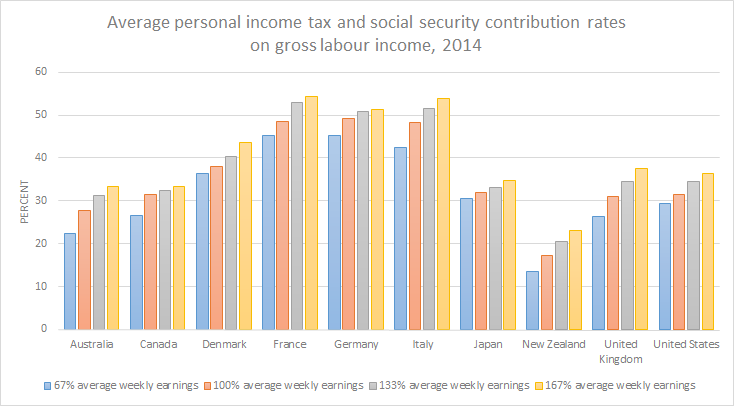
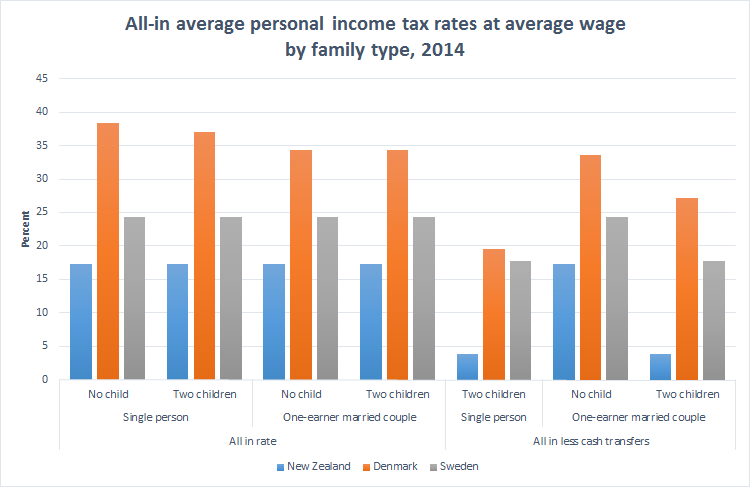
Ordinary French, Germans, Italians and Danish pay much higher marginal tax rates and that is before their high rates of GST.
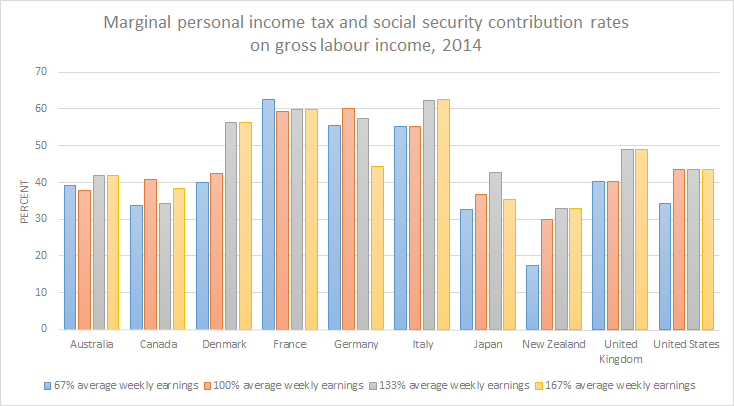
Data extracted on 30 Jan 2016 03:08 UTC (GMT) from OECD.Stat.
31 Jan 2016 Leave a comment
in economic history, international economics, International law, law and economics, politics - Australia, politics - New Zealand, Public Choice, television, TV shows Tags: CER, closer economic relations, Hollywood economics, ISDS, preferential trading agreements, rational irrationality, single market, TPPA, Twitter left

New Zealand filmmakers have used trade treaties to pry open access to foreign markets by challenging failures to honour promises of nondiscrimination in trade and investment in the Federal Court of Australia.
This should please the Twitter Left because they are also a film going left as are most members of the educated middle class as a point of identity and snobbery.
Back in the day, New Zealand television programming was sold cheaply into the Australian market. Many cultural and other products are exported into foreign markets and sold for whatever they can get above the price of shipping or digital transmission. What else explains all that rubbish on cable TV?
Under the Closer Economic Relations agreement that creates a single market between Australia and New Zealand, New Zealand made television programming content must be treated the same way as Australian content so it was included in their 50% local content rules for commercial television back from whenever I remember this story from.
There was a Federal Court of Australia case that ruled that New Zealand television programming was Australian content programming for the purposes of the relevant media regulations because of Closer Economic Relations.
From the late 1990s, with revival of the New Zealand film and television industry, New Zealand content was starting to flood the Australian market, especially in the off-season in the summer when stations were looking for cheap content to fill a low ratings period.
Naturally, this Kiwi invasion did not please the rent seeking Australian television programme production industry and many a mendicant actor, writer and producer
Where there is a will, where there is a way: minimum quality standards are introduced into the Australian content rules defined by price – a price that happen to be above what the television stations used to pay for New Zealand made programming in the off-season.
This court victory in favour of various New Zealand film industry in enforcing a trade and investment treaty puts the Twitter left in a bit of a conundrum. Which is more important? The New Zealand film industry or their hatred of globalisation and the rule of law.
30 Jan 2016 Leave a comment
in discrimination, gender, labour economics, politics - USA Tags: gender wage gap
30 Jan 2016 Leave a comment
in applied price theory, politics - USA, public economics
29 Jan 2016 Leave a comment
in politics - USA, public economics
29 Jan 2016 Leave a comment
in politics - USA Tags: 2016 presidential election, economics of immigration
29 Jan 2016 Leave a comment
in economics of regulation, health economics, politics - New Zealand
29 Jan 2016 Leave a comment
in economics of crime, law and economics, politics - New Zealand Tags: assisted dying, euthanasia
Assisted suicide has had popular support for many decades. Opinion polls show that about 60% of the population support it and these opinion polls date back 20 years.
The two previous attempts at passing a Death with Dignity Bill failed despite widespread public support:
The reason political parties do not act is those who are against assisted suicide are passionately against it and will change their vote because of such a bill. Those who are for assisted suicide are unlikely to change their vote if a bill is not passed by Parliament.

Any bill that does go for on assisted dying will divide Parliament in much the way it divides the community which is into three equally sized groups.
Those doubts are legitimate and entitled to be satisfied before an MP votes for the bill. Many who support euthanasia in principle have serious reservations about the ability to craft a Bill that prevents abuses. Parliaments have an interest in protecting vulnerable groups–including the poor, the elderly, and disabled persons–from abuse, neglect, and mistakes.

Many people have very strong views on exactly when and when not euthanasia is permissible because of their views about the sanctity of life and the risk of abuse. The recent High Court judgement on an unsuccessful application for an exception to the criminal law on assisted suicide said that:
The sanctity of human life principle underpins the criminal law relating to culpable homicide. It was said by Blackstone to be the first rule of English law.
When making an exception to the first rule of law, people want to know exactly what they are voting for and exactly what safeguards apply the proposed exceptions.
A badly drafted bill may offer insufficient assurances to some MPs about preventing abuse and ensuring people who are depressed are not offered options that are not in their best interests.
Others have moral or religious objections. The religious objections were summarised by Blackstone, in his Commentaries on the Laws of England, where suicide was also a spiritual offence:
…in evading the prerogative of the Almighty, and rushing into his immediate presence uncalled for
Many Bills have failed such as recently in the Scottish Parliament and in 2003 in the New Zealand Parliament because they were badly drafted and were considered by many to offer insufficient protection of the vulnerable against abuse and melancholy.
Even when courts rule favourably on the matter, such as in Canada with its recent Supreme Court decision under its Bill of Rights, that court suspended its judgement upholding the right to euthanasia for 12 month so that the Canadian Parliament could work out the ever so vital details by passing a Bill. As the Supreme Court of United Kingdom recently ruled:
… unless the court can be satisfied that any exception to the subsection can be operated in such a way as to generate an acceptably small risk that assistance will be afforded to those vulnerable to pressure to seek to commit suicide, it cannot conclude that the absolute prohibition in the subsection is disproportionate to its legitimate aim.
That is the essence of reservations about end of life choice. Blackstone’s ratio applies to standards of proof in criminal proceedings: it is better that 10 guilty go free than one innocent suffer.
The law has long acted to prevent, by force if necessary, suicide – including suicide by refusing to take appropriate measures necessary to preserve one’s life after the point at which life become unbearable. Whether the patient’s wishes to be honoured in this area is left to elected representatives to legislate. Justice Scalia asks
Are there, then, no reasonable and humane limits that ought not to be exceeded in requiring an individual to preserve his own life? There obviously are, but they are not set forth in the Due Process Clause.
What assures us that those limits will not be exceeded is the same constitutional guarantee that is the source of most of our protection – what protects us, for example, from being assessed a tax of 100% of our income above the subsistence level, from being forbidden to drive cars, or from being required to send our children to school for 10 hours a day, none of which horribles is categorically prohibited by the Constitution.
Our salvation is the Equal Protection Clause, which requires the democratic majority to accept for themselves and their loved ones what they impose on you and me.
The biggest threat to an End of Life Choice bill passing the New Zealand Parliament is judicial intervention in this charged social issue that will only mobilises the opponents of the very right the applicants to the court seek. Scalia again this time on the risks of the courts moving in advance of the popular will, and thereby poisoning the democratic process:
Leaving this matter to the political process is not only legally correct, it is pragmatically so. That alone… can produce compromises satisfying a sufficient mass of the electorate that this deeply felt issue will cease distorting the remainder of our democratic process.
As an example of the importance of democratic compromises in securing the votes in Parliament, there is a voluntary euthanasia bill currently before the Scottish Parliament. It has been stuck in committee for two years because it not only promises end of life choice, it also grants a right of euthanasia to those with progressive degenerative diseases.
By overreaching to progressive degenerative diseases, this Bill in the Scottish Parliament is bogged down because euthanasia as distinct from a death with dignity is a step too far from many members of Parliament willing to support end of life choice for the terminally ill such as provided for in the House of Lords Private Member’s Bill on end of life choice which later failed in the Commons.
The great strength of democracy is a small group of concerned and thoughtful citizens can band together and change things by mounting single issue campaigns or joining a political party and running for office and winning elections or influencing who wins.
Indeed, it is that very strength of democracy – small groups of concerned citizens banding together – is what is holding up legislating on an end of life choice. It is not that minorities are powerless and individuals are voiceless. Exactly the opposite.
Many people have passionate opinions for and against an End of Life Choice Bill. These opinions are taken into account by members of Parliament in fine detail depending on how voters will vote at the next election.
What can be undemocratic about members of Parliament paying attention to how a wide range of ordinary members of the community might vote if they disappoint them.
The key safeguard of minorities against the majority is their ability to block vote. Yes, those in the majority will be annoyed at the power of the minority to slow down the passage of a End of Life Choices Bill.
Yet on some other matter passionate to them those currently in the majority will one day or another end up in a minority. The rotation of power is common in democracies, and the worst rise to the top.
It is wise to design constitutional safeguards to minimise the damage done when those crazies to the right or left of you get their chance in office, as they will sooner or later rather than focus on the powers you and those that currently agree with you should have in your few days in which you fleetingly have a majority.
Too many policies and ideas of the one political party or another assume that they are the face of the future, rather than just another political party that will hold power as often as not and always for an uncertain time.
New Zealand Parliamentary elections are always close because of proportional representation. This makes reality of ending up in the minority again very quickly in a few years very real.
Yesterday’s majority of the vote sooner or later and often sooner than they expect will break off into different minorities on the next big issue of the day.
These newly formed minorities will use that same ability to band together as a minority to block vote to protect what they think is important and advance agendas they think are to be wider benefit despite the opinion of the current majority to the contrary. All reforms start as a minority viewpoint.
You can’t complain about democracy not working because it’s working precisely as it should: parliamentarians paying close attention to how a great number of people from all walks of life vote in light of how they as members of Parliament voted on specific issues important to them.
The democratic process must strike a proper balance between the interests of terminally ill, mentally competent individuals who would seek to end their suffering and the State’s interests in protecting those who might seek to end life mistakenly or under pressure. The pros and cons of euthanasia as a practical matter is ably summarised by Richard Posner:
Countries and states that authorize physician-assisted suicide impose strict requirements that minimize the danger of involuntary euthanasia—too strict, some believe (such as the requirement in Dutch law that the patient’s suffering be “unbearable” before he can invoke physician assistance to end his life).
These requirements (which further reduce the stigma of physician-assisted suicide by confining the practice to cases of genuine desperation) are not airtight, or uniformly observed.
Any system will be abused. The question is whether the incidence of abuses, combined with the other costs of the system, outweigh the benefits.
Gary Becker has written frequently on the issue of euthanasia and suicide. Indeed, he wrote the Economic Theory of Suicide, not long after his wife took her own life in the early 1970s. He argues well about people’s ability to weigh the considerations:
Rational forward–looking persons with good information about their future circumstances would commit suicide only when convinced that they would be worse off by continuing to live.
David Hume said (in his Essays on Suicide and the Immortality of the Soul) “That suicide may often be consistent with interest and with our duty to ourselves no one can question, who allows that age, sickness, or misfortune may render life a burden, and make it worse than annihilation.”
Schopenhauer was also confident about the rationality of suicide, “It will generally be found that, as soon as the terrors of life outweigh the terrors of death, a man will put an end to his life” (Parerga and Paralipomena).
Becker also wrote insightfully of the terrors of death:
Hume adds “I believe no man ever threw away life, while it was worth keeping. For such is our natural horror of death”, and Schopenhauer makes the same observation “But the terrors of death offer considerable resistance…”
The reason why Death with Dignity Bills fail in Parliament is those in the community who are against it are passionately against that it and will change their vote if it passed. Those that are for it are not swinging or single issue voters.
I support the End of Life Bill submitted to the private members bill ballot by David Seymour. The way in which a bill on assisted dying is to be passed is normal democratic means: by trying to persuade each other and elections. As United States Supreme Court Justice Antonin Scalia said
The virtue of a democratic system [with a constitutionally guaranteed right to free speech] is that it readily enables the people, over time, to be persuaded that what they took for granted is not so and to change their laws accordingly.
Yes, assisted dying years a passionate issue and some people are impatient and want to use the courts, but again I believe Justice Scalia is right when he said:
We might have let the People decide. But that the majority will not do. Some will rejoice in today’s decision, and some will despair at it; that is the nature of a controversy that matters so much to so many. But the Court has cheated both sides, robbing the winners of an honest victory, and the losers of the peace that comes from a fair defeat. We owed both of them better. I dissent.
That importance of a fair defeat at the ballot box and in Parliament is important both to when and if a bill on end of life choice is passed, and to how quickly support opposition to that bill will be mobilised before such a bill even is put into the Parliamentary ballot of private member’s bills.
Nothing stirs up the impassioned (and most other people as well) more than depriving them of their right to support or oppose what is important to them through political campaigns and at an election. The losing side, we all end up on the losing side at one time or another, are much more likely to accept an outcome if they had their say and simply lost the vote at the election or in Parliament.
This committee should report favourably on the petition. Hopefully the private members bill by ACT Party Leader David Seymour will be drawn from the ballot soon.
29 Jan 2016 Leave a comment
in applied price theory, applied welfare economics, development economics, economic history, growth disasters, growth miracles, international economics, politics - New Zealand, politics - USA Tags: free trade, free trade agreements, preferential trading agreements, The Great Enrichment, The Great Fact, TPPA, WTO
28 Jan 2016 Leave a comment
in politics - USA, public economics Tags: family tax credit, family tax credits, family taxation, in work tax credit
28 Jan 2016 Leave a comment
in applied price theory, economics of bureaucracy, financial economics, industrial organisation, politics - New Zealand, public economics
Today the Treasury advised that it no longer calculates an annual rate of return on the portfolio of state owned enterprises as a whole. It no longer publishes an annual portfolio report (APR).

Source: Treasury response to Official Information Act request by Jim Rose, 14 January 2016.
The Treasury regards the crown portfolio report which contains performance indicators on the state owned enterprises portfolio as a whole as too resource intensive.
The Treasury prefers to be more forward-looking in their reporting on a quarterly basis to the Minister of Finance. Unfortunately, the Treasury refused to my requests for access to this forward-looking reporting to the Minister of Finance on commercial-in-confidence grounds.
The forward-looking approach to state-owned enterprise performance is now only by the Treasury and the Minister of Finance. No one else has access to this financial performance information.
It is no longer possible to say using a figure calculated by the Treasury whether the portfolio of state owned enterprises as a whole are a good return to the taxpayer or not. Individual annual reports of the state owned enterprises can be reviewed but the portfolio wide rate of return is no longer available from the Treasury with the associated credibility of the same.
A common argument against state ownership is that as a whole government ownership is a bad investment. Specifically, the portfolio of state owned enterprises struggle to pay a return in excess of the long-term bond rate.
A common argument for continued state ownership is the loss of the dividends from privatisation. The vulgar argument such as by the New Zealand Labor Party and New Zealand Greens is if a state owned enterprise is privatised either partially or fully, the taxpayers no longer receive dividends. The fact that the sale price reflects the present value of future dividends is simply ignored.

Source: Treasury, Crown Portfolio Report 2013.
The sophisticated argument is the assets are under-priced such as for political reasons. Failed privatisations are indeed the best case against state ownership because governments cannot even sell an asset with such any degree of competence.
Governments are so bad as business owners and so incapable of running a commercial process free of politics that governments cannot even sell a state-owned enterprise for a good price under the full glare of the media and public.
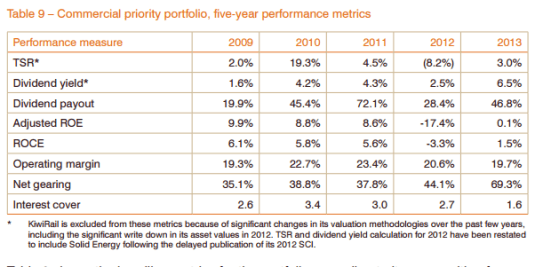
Source: Treasury, Crown Portfolio Report 2013.
A reply to the loss of dividends argument is the dividends from the portfolio as a whole do not repay the government debt incurred to fund capital infusions into state-owned enterprises both when initially established and through time. In that case, it is better to leave your money in the bank than in the state of enterprise.
John Quiggin often criticises privatisation on the grounds that state owned enterprises can invest at a cheaper rate because they are financed at the long-term bond rate:
In general, even after allowing for default risk, governments can borrow more cheaply than private firms. This cost saving may or may not outweigh the operational efficiency gains usually associated with private ownership.
It is not possible to scrutinise that argument without an annual rate of return on the portfolio of state owned enterprises as a whole to see if it is true at first pass at least. As the Treasury no longer calculates a rate of return on the portfolio and taxpayers’ equity, that debate comes to something of a crashing halt in New Zealand.
If these state owned enterprises were privately owned and listed on the share market, investors would just look at trends in share prices for daily measure of expected future profitability.
John Quiggin made the best simple summary of the case for privatisation which was the selling the dogs in the portfolio:
The fiscal case for privatisation must be assessed on a case by case basis. It will always be true for example that if a public enterprise is operating at a loss, and can be sold off for a positive price with no strings attached, the government’s fiscal position will benefit from privatisation.
Various early ventures in public ownership, such as the state butcher shops operated in Queensland in the 1920s (apparently a response to concerns about thumbs on scales) met this criterion, and there doesn’t seem to be much interest in repeating this experiment.
Quiggin also made a measured statement of why state ownership should be limited at most to monopolies:
In most sectors of the economy, the higher cost of equity capital is more than offset by the fact that private firms are run more efficiently, and therefore more profitably, than government enterprises.
But enterprises owned by governments are usually capital intensive and often have monopoly power that entails close external regulation, regardless of ownership. In these situations, the scope to increase profitability is limited, and the lower value of the asset to a private owner is reflected in the higher rate of return demanded by equity investors.
Quiggin is wrong about government enterprises have been a lower cost of capital because it contradicts the most fundamental principles of business finance as explained by Sinclair Davidson:
…it is clear that the Grant-Quiggin view violates the Modigliani-Miller theories of corporate finance. The cost of capital is a function of the riskiness of the investment projects and not a function of a firm’s ownership structure.
How the cash flows of a business are divided between owners and creditors does not matter unless that division changes the incentives they have to monitor the performance of the firm and keep it on its toes. Those lower down the pecking order if things go wrong such as owners have much more of an incentive to monitor the success of the business and lift its performance.
Capital structures of firms, the property rights structures of firms, matter precisely because they influence incentives of those with different claims on the cash flows of the firm.
Having to pay debt disciplines managerial slack and ensures that free-cash flows are used to repay debt (or pay dividends) rather than be invested in low quality new ventures. Having to borrow from strangers such as banks ensures regular scrutiny of the soundness and prospects of the company from a fresh set of eyes. Capital structures made up of both debt and equity keeps the firm on its toes.
Unfortunately, in New Zealand it is much more difficult to review the arguments for and against the current size and shape of the state owned enterprise portfolio as for example summarised by John Quiggin:
Technologies and social priorities change over time, with the result that activities suitable for public ownership at one time may be candidates for privatization in another. However, the reverse is equally true. Problems in financial markets or the emergence of new technologies may call for government intervention in activities previously undertaken by private enterprise.
In summary, privatization is valid and important as a policy tool for managing public sector assets effectively, but must be matched by a willingness to undertake new public investment where it is necessary.
As a policy program, the idea of large-scale privatization has had some important successes, but has reached its limits in many cases. Selling income-generating assets is rarely helpful as a way of reducing net debt. The central focus should always be on achieving the right balance between the public and private sectors.
This balancing of public and private ownership is more difficult in New Zealand because portfolio wide rates of return are unavailable unless you calculate them yourself. That must be labour-intensive given the Treasury thought it was too labour-intensive for it to do for itself.
An obvious motive to start a review the extent of state ownership is the portfolio is performing poorly. That warning sign is no longer available because the crown portfolio report is no longer published.
One way to fix an underperforming portfolio is to sell the dogs in the portfolio. One of the first ways owners notice dogs in their portfolio is the portfolio not returning as well as it used too because of the emergence of these dogs so further enquiries are made and explanations sought.
Taxpayers, ministers and parliamentarians are all busy people with little personal stake in the rate of return on the state owned enterprises portfolio.
Taxpayers, ministers and parliamentarians will all first look at the portfolio wide rate of return to see whether more detailed scrutiny of individual investments is required. That quick check against poor value for money and trouble ahead is no longer available on the state owned enterprises portfolio in New Zealand.
27 Jan 2016 Leave a comment
in politics - New Zealand, public economics Tags: Denmark, family tax credits, family taxation, in-work tax credits, Sweden, taxation and labour supply
Celebrating humanity's flourishing through the spread of capitalism and the rule of law
Celebrating humanity's flourishing through the spread of capitalism and the rule of law
Celebrating humanity's flourishing through the spread of capitalism and the rule of law
Celebrating humanity's flourishing through the spread of capitalism and the rule of law
Celebrating humanity's flourishing through the spread of capitalism and the rule of law
Celebrating humanity's flourishing through the spread of capitalism and the rule of law
A History of the Alt-Right
Econ Prof at George Mason University, Economic Historian, Québécois
Celebrating humanity's flourishing through the spread of capitalism and the rule of law
Scholarly commentary on law, economics, and more
Beatrice Cherrier's blog
Celebrating humanity's flourishing through the spread of capitalism and the rule of law
Celebrating humanity's flourishing through the spread of capitalism and the rule of law
Celebrating humanity's flourishing through the spread of capitalism and the rule of law
Why Evolution is True is a blog written by Jerry Coyne, centered on evolution and biology but also dealing with diverse topics like politics, culture, and cats.
Celebrating humanity's flourishing through the spread of capitalism and the rule of law
A rural perspective with a blue tint by Ele Ludemann
DPF's Kiwiblog - Fomenting Happy Mischief since 2003
Celebrating humanity's flourishing through the spread of capitalism and the rule of law
The world's most viewed site on global warming and climate change
Tim Harding's writings on rationality, informal logic and skepticism
A window into Doc Freiberger's library
Let's examine hard decisions!
Commentary on monetary policy in the spirit of R. G. Hawtrey
Thoughts on public policy and the media
Celebrating humanity's flourishing through the spread of capitalism and the rule of law
Politics and the economy
A blog (primarily) on Canadian and Commonwealth political history and institutions
Reading between the lines, and underneath the hype.
Economics, and such stuff as dreams are made on
"The British constitution has always been puzzling, and always will be." --Queen Elizabeth II
Celebrating humanity's flourishing through the spread of capitalism and the rule of law
Celebrating humanity's flourishing through the spread of capitalism and the rule of law
WORLD WAR II, MUSIC, HISTORY, HOLOCAUST
Undisciplined scholar, recovering academic
Celebrating humanity's flourishing through the spread of capitalism and the rule of law
Res ipsa loquitur - The thing itself speaks
In Hume’s spirit, I will attempt to serve as an ambassador from my world of economics, and help in “finding topics of conversation fit for the entertainment of rational creatures.”
Researching the House of Commons, 1832-1868
Articles and research from the History of Parliament Trust
Reflections on books and art
Posts on the History of Law, Crime, and Justice
Celebrating humanity's flourishing through the spread of capitalism and the rule of law
Exploring the Monarchs of Europe
Cutting edge science you can dice with
Small Steps Toward A Much Better World


Recent Comments