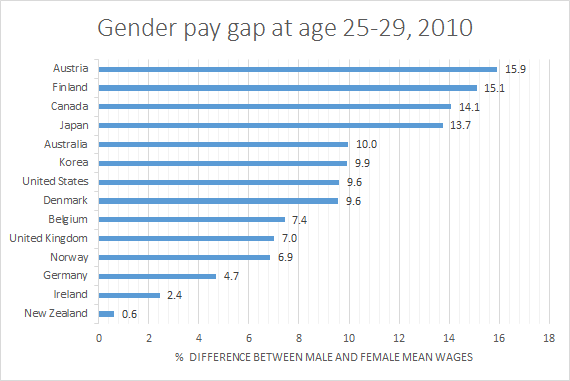
The gender pay gap in New Zealand rounds down to zero for women in their mid-20s!
Celebrating humanity's flourishing through the spread of capitalism and the rule of law
03 Dec 2015 Leave a comment
in discrimination, gender, human capital, labour economics, labour supply, politics - Australia, politics - New Zealand, politics - USA Tags: compensating differentials, gender wage gap, labour demographics
The gender pay gap in New Zealand rounds down to zero for women in their mid-20s!
03 Dec 2015 Leave a comment
in energy economics, environmental economics, global warming, politics - USA Tags: climate alarmism, expressive voting, rational ignorance, rational rationality, voter demographics
02 Dec 2015 Leave a comment
in economic history, politics - USA, Public Choice
01 Dec 2015 Leave a comment
in economics of regulation, politics - New Zealand, urban economics

Source: Inequality and the City – The New York Times via Krugman: Deregulate Housing, David Henderson | EconLog | Library of Economics and Liberty.
01 Dec 2015 Leave a comment
in economic growth, economic history, macroeconomics, politics - Australia, politics - New Zealand
I have updated my estimates of Australian and New Zealand detrended real GDP growth for the 2014 working age population statistics from the OECD. The charts show:
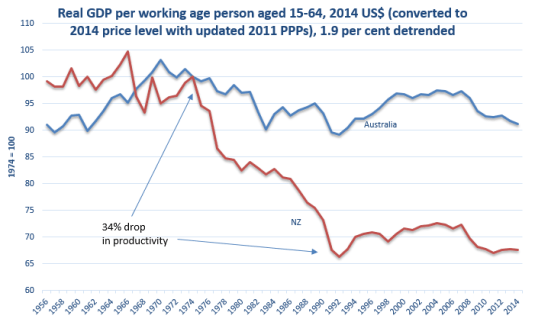
Source: Computed from OECD Stat Extract and The Conference Board. 2015. The Conference Board Total Economy Database™, May 2015, http://www.conference-board.org/data/economydatabase/
The real GDP data in the above chart is detrended by 1.9% per annum. 1.9% growth per year is the trend real GDP growth rate of the USA in the 20th century. The growth rate of the USA is taken as the growth rate of the global technological frontier. A flat line in the above chart is real GDP growth at 1.9% per year. A falling line is real GDP growth in that year of less than 1.9%; a rising line is growth that is greater than 1.9% in that year.
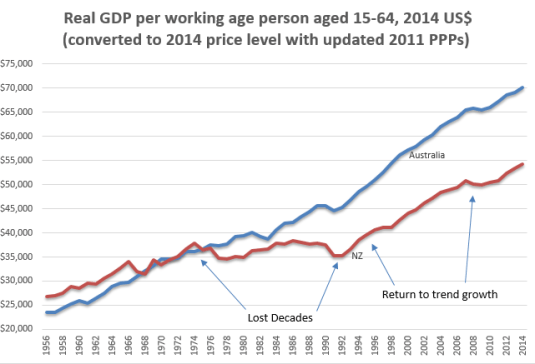
Source: Computed from OECD Stat Extract and The Conference Board. 2015. The Conference Board Total Economy Database™, May 2015, http://www.conference-board.org/data/economydatabase/
01 Dec 2015 1 Comment
in applied price theory, economics of bureaucracy, industrial organisation, politics - New Zealand
For some months now I’ve been trying to ascertain the latest performance of the state owned enterprises (SOE) portfolio. The last Crown Portfolio Report was issued in December 2013. That was two long years ago. I therefore asked for access to the quarterly report on the Crown commercial portfolio to the Minister of Finance by the Treasury.

My Official Information Act request to the Treasury was declined on commercial in confidence grounds. Not only was my request to the Minister of Finance similarly refused, he told me to do the analysis myself by working my way through the 49 annual reports of the state owned enterprises in New Zealand.

Source: Bill English, Minister of Finance, Response to Official Information Act request, 30 November 2015.
Look it up yourself is not a good approach to public accountability to busy taxpayers who have lives to lead. There is a very well-paid Treasury that can do that analysis and has been doing that analysis every year until two years ago.
There is been no explanation for the non-publication of the Crown Portfolio report for two years. That is unacceptable in terms of tax payer accountability.
What is weird about this blow to taxpayer accountability is I have been refused access to Treasury analysis of public information. I’m not actually asking for the analysis. I am asking for a tabulation of 49 annual reports of state owned enterprises. Somehow a tabulation of public information is commercial in confidence despite the fact I can do it myself. This makes no sense.
It appears that for two years now the Minister of Finance has not been advised on the annual rates of return of the state owned enterprise portfolio as a whole. If he had, the Treasury and the Minister of Finance would have supplied that data to me in the course of my Official Information Act requests because it was obvious that I was after that information and they have a duty to be helpful when processing Official Information Act requests.
The Minister of Finance should be more curious about tens of billions of dollars in taxpayer’s assets that currently struggle to offer a positive return.

Source: The New Zealand Treasury, Crown Portfolio Report 2013, p. 41.
No publicly listed company could fail to publish its annual report. The fact that this has not been picked up as an example of why public ownership is inferior. No one profits from highlighting these governance shortcomings.
If the state owned enterprises were listed on the stock exchange, investors would sell off a company that missed its reporting date. Missing a reporting date is a sure sign of both poor governance and poor performance. Entrepreneurs would see a poorly governed company as a takeover opportunity. There are no similar disciplines for state owned enterprises whose governance and transparency falls short.
By the way, the original objective of my research was to compare state-owned enterprise performance under the current and previous governments. The Treasury was unable to supply data further back than 2007. Everything before then is on paper. The individual company reports have to be looked up by hand.
Nothing is at the fingertips of the Treasury if the Minister of Finance was interested in knowing whether his stewardship of state owned enterprises was superior to that of his predecessors.
01 Dec 2015 3 Comments
in applied welfare economics, economics of regulation, environmental economics, global warming, politics - USA, Public Choice
When the Twitter Left brands an opponent as a libertarian, I assume it’s a secret handshake among true believers trying to identify each other. You need time management counselling in your calling as a political junkie if you knew what a libertarian was until a few years ago. The only reason to change was the election of Senator Ron Paul.
The Twitter Left likes to smear opponents as libertarians despite the fact that certainly outside the USA and even within the USA few know what the libertarian means even with the help of scare quotes.
Only political junkies have an inkling of what a neoliberal is so why smear someone such an even more obscure label such as libertarian? Libertarian must be lower than a neo-liberal and should be hated even more by the Twitter Left must be the implication despite its poor marketing outreach value. I’m still puzzled as to why use such an obscure political label.
Today in the New York Times, a guide was published giving its readers the short answers to the key questions global warming. The author argued that most attacks on the science of global warming come from libertarians and other political conservatives who don’t like the implications of fighting global warming for growth in the size of government.

Source: Short Answers to Hard Questions About Climate Change – The New York Times via Environmental Economics: Short Answers to Hard Questions About Climate Change – The New York Times.
It is true that people attempt to discredit the arguments behind positions. Let he who is without sin cast the first stone.
“How to discredit an unwelcome report:
… Stage Four: Discredit the person who produced the report. Explain (off the record) that
1. He is harbouring a grudge against the Department.
2. He is a publicity seeker.
3. He is trying to get a Knighthood/Chair/Vice Chancellorship.
4. He used to be a consultant to a multinational.
5. He wants to be a consultant to a multinational.”
Sir Humphrey, The Greasy Pole.
As a professional economist, I am used to special interests as well as the Twitter Left arguing that economics is “just a theory” and its methodology is unrealistic along with various other attempts to avoid engaging with the actual advice put forward.
It is also true that scepticism about climate science has a partisan divide. In the USA, for example, Democrats are far more worried about global warming then independents or Republicans. (Independents is their name for swinging voters. They are called independents because if they register as one, they can vote in the Republican or Democratic primaries in many states).

I have argued in the blogosphere since 2011 that let the science be settled, only the economics matters because the economic cost of global warming is small.
Global warming, although real, is not apt to be severe. It will lower the level of GDP by maybe 2%. The loss of one year’s income growth! Courtesy of David Friedman’s reading of the report, this is what the most recent report of the IPCC said:
With these recognized limitations, the incomplete estimates of global annual economic losses for additional temperature increases of ~2°C are between 0.2 and 2.0% of income (±1 standard deviation around the mean)
I have also argued that the climate alarmists scored a great tactical victory in keeping the debate about the reliability of the science. By successfully baiting that trap for opponents, the climate alarmists have avoided having to discuss the costs and benefits of global warming.
Richard Tol on the scientific consensus about human-caused global warming skepticalscience.com/graphics.php?g… http://t.co/OpdRtsY1tx—
John Cook (@skepticscience) March 24, 2015
So it is rather curious that climate sceptics are playing to the strength of the climate alarmists rather than their weaknesses. Those weaknesses are the economics of global warming and the public choice economics of international climate agreements.
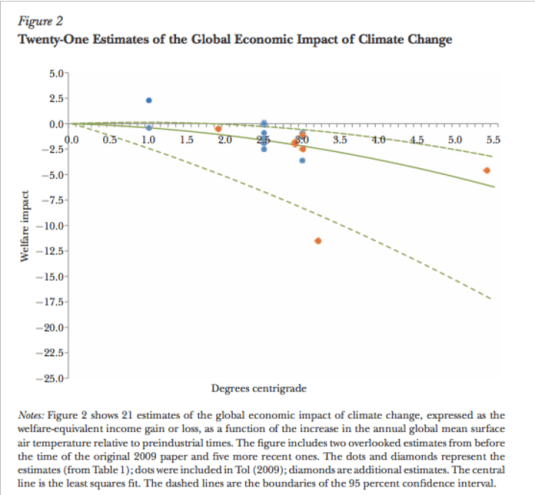
Source: Richard Tol.
Not only is the economic cost of global warming small, the chances of supplying an international public good such as a treaty to reduce carbon emissions is minimal.
The New York Times today in its Q&A guide did not quantify the costs and benefits of global warming. That makes their guide deeply misleading. This is because such estimates of the cost of global warming as a percentage of GDP are available from the IPCC. Which is worse? Being a libertarian or a misleading, low rent journalist?

Source: Short Answers to Hard Questions About Climate Change – The New York Times via Environmental Economics: Short Answers to Hard Questions About Climate Change – The New York Times.
What is even more bizarre in the guide today in the New York Times is the claim that politicians are finally taking climate change seriously. Anyone who claims that a climate change treaty will come out of Paris that is in any way binding is simply not paying attention to the last 5 years of politics and who controls the U.S. Congress. They cannot be taken seriously as a political commentator.
Obama gave up on a climate bill passed by the House of Representatives in 2010 despite the fact that he had the numbers in the Senate to break a filibuster. There were 5 Republican senators who would have voted for cap and trade in April 2010: Lindsey Graham, Susan Collins, Olympia Snowe, Scott Brown, and George LeMieux. There were 57 Democrat Senators. It takes 60 votes to break a filibuster.
Obama gave up because he didn’t want the additional political flak of passing a climate change bill in the aftermath of the political costs of passing Obamacare. President Obama could have fought harder to get the Bill the House passed through the Senate but he did not.
Concern about global warming fads away when it becomes a hip pocket issue. Rather than blaming vast right-wing conspiracies, using Google searches for “unemployment” and “global warming”, Kahn and Kotchen found that:
As Geoff Brennan has argued, CO2 reduction actions will be limited to modest unilateral reductions of a largely token character. There are many expressive voting concerns that politicians must balance to stay in office and the environment is but one of these. Once climate change policies start to actually become costly, expressive voting support for these policies will fall away, and it has.
30 Nov 2015 1 Comment
in discrimination, gender, minimum wage, politics - New Zealand
The minimum wage was pretty stable as a percentage of the median wage in New Zealand until recently. Nonetheless, the gender wage gap narrowed at the bottom of the labour market rapidly in the 1980s and 1990s.

Source: OECD Employment Database and Data extracted on 30 Nov 2015 04:03 UTC (GMT) from OECD.Stat.
In common with the USA, that narrowing of the gender wage gap stopped in the early 2000s after the minimum wage started increasing as a percentage of the median wage.
Again, that is contrary to the idea that the minimum wage is a failsafe that narrows the gender wage gap at the bottom. This failsafe is said to be the leading reason why the gender wage gap is much smaller at the bottom of the labour market than higher-up such as the median and in particular at the top.
30 Nov 2015 1 Comment
in discrimination, gender, labour economics, minimum wage, politics - USA
When feuding with strangers on Twitter about the gender wage gap, a common explanation for the much smaller gender wage gap at the bottom of the labour market is the power is the minimum wage to uplift women’s wages and with it narrow the gender wage gap at the bottom of the labour market.
Below I have plotted the minimum wage as a percentage of the median wage for the USA along with the gender wage gap for the bottom 10% of the U.S. labour market. Both are expressed as percentages of the median wage.
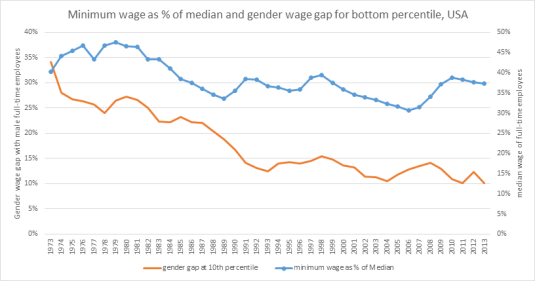
Source: OECD Employment Database and Data extracted on 30 Nov 2015 04:03 UTC (GMT) from OECD.Stat.
From what I can make of the above chart, the gender wage gap at the bottom of the labour market was closing rapidly when the minimum wage was falling as a percentage of the median wage. That gender wage gap then stabilised when the minimum wage stabilised as a percentage of the median. The gender wage gap increased when the minimum wage increased as a percentage of the median wage for full-time employees.
Should not this relationship between the minimum wage and the gender wage gap be the other way around if the minimum wage is a force for closing the gender wage gap at the bottom of the labour market?
29 Nov 2015 Leave a comment
in politics - USA Tags: voter demographics
28 Nov 2015 9 Comments
in discrimination, entrepreneurship, gender, labour economics, occupational choice, politics - New Zealand, survivor principle Tags: compensating differentials, employer discrimination, entrepreneurial alertness, gender wage gap, market selection, The meaning of competition
Geoff Simmons’ Friday Whiteboard podcast last night on the 12% gender wage gap was a good summary of the proximate drivers such as occupational segregation and part-time work. I have a few quibbles with his stress on unconscious bias as the driver of the gender wage gap.
The first of these quibbles is the gender wage gap is tiny at the bottom and even the middle of the labour market but is so high and so stable for so long at the top-end. Why does unconscious bias increase with the wages on offer? Better paid professional women have far more options to look around for the best paid job and turned down inferior officers.
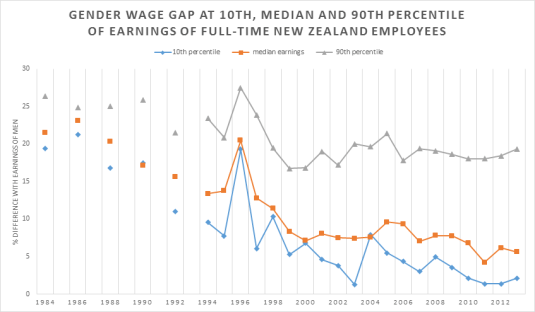
Source: OECD Employment Database.
My second quibble is the New Zealand gender wage gap is trivial for women under the age of 45 but suddenly there is a burst of unconscious bias until they retire. This is odd because mature age workers have had plenty of time to accumulate human capital, search around for the best job offer and will have a job and therefore can turn down inferior offers. These women are not new starters on the unemployment benefit desperate for employment.
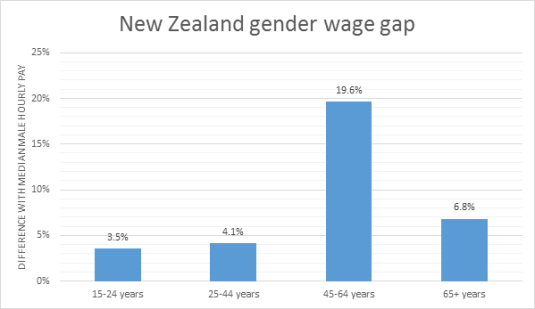
Source: New Zealand Income Survey 2014 via Human Rights Commission: Tracking Equality at Work.
My final quibble is the gender wage gap for part-time workers is reversed. No one takes this higher pay per hour as evidence that there is no unconscious bias against women who work part-time. If the gender pay gap was in the opposite direction, of course, that pay gap would be conclusive evidence of unconscious bias against women in part-time jobs. But as the gap is as it is in favour of women not against them, the usual adjustments for skills, age and experience become convenient truths.
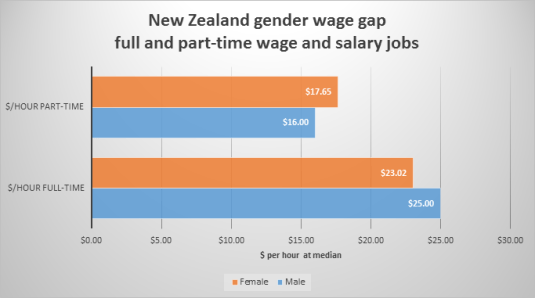
Source: Statistics New Zealand, New Zealand Income Survey, June quarter 2015.
Is what’s left of the unconscious bias hypothesis that we chauvinistic men, bastards all, have an unconscious bias against women who work full-time, who are over the age of 45 or earn a lot of money making us jealous?
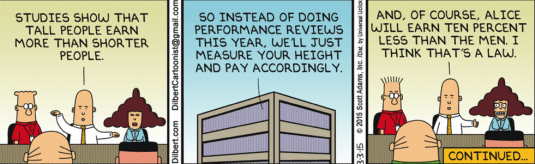
The unconscious bias hypothesis for the residual in the gender wage gap has come to the fore because earlier hypotheses of deliberate discrimination against women fell by the wayside as explanations for the gender wage gap.
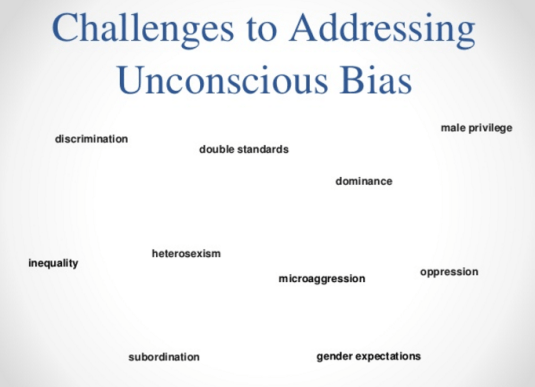
Complicating things is the unconscious bias hypothesis must explain why the unconscious bias is so much stronger at the top end of the labour market against women who have plenty of options to fight back including found in their own companies to hire women underpaid elsewhere.
As is well known, sex and race discrimination by employers as a profit opportunity for other less prejudiced employers including unconsciously prejudiced employers to hire the undervalued workers.
The process whereby the market bids up the wages of women undervalued by unconsciously biased employers can be itself be thoroughly unconscious as Armen Alchian explained in 1950. Alchian pointed out the evolutionary struggle for survival in the face of market competition ensured that only the profit maximising firms survived:
These surviving firms may not know why they are successful, but they have survived and will keep surviving until overtaken by a better rival. All business needs to know is a practice is successful. The reason for its success is less important.
In the case of unconscious bias against women, those employers who are less unconsciously biased than the rest will grow at the expense of less enlightened albeit unconsciously less enlightened rivals. Undervaluing workers for any reason is a business opportunity. The market processes will reduce this undervaluation. All that is required is that some employers be less unconsciously biased than others.
One method of organising production will supplant another when it can supply at a lower price (Marshall 1920, Stigler 1958). Gary Becker (1962) argued that firms cannot survive for long in the market with inferior product and production methods regardless of what their motives are. They will not cover their costs.
The more efficient sized firms are the firm sizes that are currently expanding their market shares in the face of competition; the less efficient sized firms are those that are currently losing market share (Stigler 1958; Alchian 1950; Demsetz 1973, 1976). Business vitality and capacity for growth and innovation are only weakly related to cost conditions and often depends on many factors that are subtle and difficult to observe (Stigler 1958, 1987). In the case of unconsciously biased employers, they are less likely to survive.

What is even more peculiar is this unconscious bias exists at the end of the market where there is the greatest incentive to invest in ascertaining the quality of recruits if Edward Lazear’s pioneering work on the personnel economics of hiring standards is to believed:
Screening is more profitable when the stakes are higher: The purpose of screening is to avoid the unprofitable candidates. Therefore, the greater the downside risk from hiring the wrong person, the more value there is to screening. Similarly, the longer that a new candidate can be expected to stay with the employer, the more valuable will be the screen. Firms that intend to hire employees for the long term thus tend to invest more in careful screening before committing to a new hire.
The higher the wage of recruit, the more important they are to the success of the firm. That gives the entrepreneur more reasons to sort and screen from better quality recruits. The higher paid is the recruit, the greater the returns to the applicant from signalling their quality:
Signalling is helpful when employers do not have enough information about job applicants to assess their potential accurately enough. It is useful when differences in talent among potential employees matter a lot to productivity. When differences in talent do not make much difference to productivity, signalling will not be very useful.
These ideas suggest when we should expect to see employment practices consistent with signalling. First, signalling should be more important in jobs where skills are most important. Such jobs tend to be those that are at high levels of the hierarchy, in research and development, and in knowledge work. They also correspond well to professional service firms, such as consulting, accounting, law firms, and investment banks. In such professions, even small differences in talent can lead to large differences in effectiveness on the job, so sorting for talent is very important. For this reason, such firms tend to screen very carefully at recruiting, and usually have promotion systems that correspond well to our probation story above, at least in the first few years on the job.
The presence of more unconscious bias at the top of the labour market than at the middle and the bottom doesn’t have as many legs as suggested by Geoff Simmons in his Friday podcast. The higher is the wage, the greater is investment by both sides to the recruitment equation in an unbiased consideration of the job application. This runs against the notion that the gender gap at the top end of the labour market is due to unconscious bias.

A far better explanation is compensating differentials. Women at the top are trading off wages from work-life balance and more time with their children. They can do so because they are well-paid.
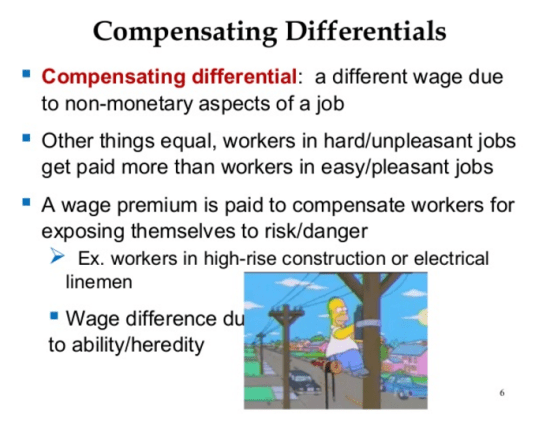
Whatever the hypothesis about compensating differentials is, that hypothesis has nothing to do with unconscious bias by employers. Alison Booth and Jan van Ours were almost annoyed to find that British women are actually quite satisfied with part-time work:
Women present a puzzle. Hours satisfaction and job satisfaction indicate that women prefer part-time jobs irrespective of whether these are small or large but their life satisfaction is virtually unaffected by hours of work.
I will close with a quote from Amy Wax on the impractical nature of doing anything about unconscious bias:
Demonstrating racial bias is no easy matter because there is often no straightforward way to detect discrimination of any kind, let alone discrimination that is hidden from those doing the deciding. As anyone who has ever tried a job-discrimination case knows, showing that an organization is systematically skewed against members of one group requires a benchmark for how each worker would be treated if race or sex never entered the equation. This in turn depends on defining the standards actually used to judge performance, a task that often requires meticulous data collection and abstruse statistical analysis.
Assuming everyone is biased makes the job easy: The problem of demonstrating actual discrimination goes away and claims of discrimination become irrefutable. Anything short of straight group representation — equal outcomes rather than equal opportunity — is “proof” that the process is unfair.
Advocates want to have it both ways. On the one hand, any steps taken against discrimination are by definition insufficient, because good intentions and traditional checks on workplace prejudice can never eliminate unconscious bias. On the other, researchers and “diversity experts” purport to know what’s needed and do not hesitate to recommend more expensive and strenuous measures to purge pervasive racism. There is no more evidence that such efforts dispel supposed unconscious racism than that such racism affects decisions in the first place.
27 Nov 2015 Leave a comment
in applied price theory, applied welfare economics, economic growth, labour economics, politics - USA, poverty and inequality, welfare reform Tags: 2016 presidential election, Leftover Left, Twitter left
25 Nov 2015 1 Comment
in politics - USA, Public Choice Tags: gerrymanders
Celebrating humanity's flourishing through the spread of capitalism and the rule of law
Celebrating humanity's flourishing through the spread of capitalism and the rule of law
Celebrating humanity's flourishing through the spread of capitalism and the rule of law
Celebrating humanity's flourishing through the spread of capitalism and the rule of law
Celebrating humanity's flourishing through the spread of capitalism and the rule of law
Celebrating humanity's flourishing through the spread of capitalism and the rule of law
A History of the Alt-Right
Econ Prof at George Mason University, Economic Historian, Québécois
Celebrating humanity's flourishing through the spread of capitalism and the rule of law
Scholarly commentary on law, economics, and more
Beatrice Cherrier's blog
Celebrating humanity's flourishing through the spread of capitalism and the rule of law
Celebrating humanity's flourishing through the spread of capitalism and the rule of law
Celebrating humanity's flourishing through the spread of capitalism and the rule of law
Why Evolution is True is a blog written by Jerry Coyne, centered on evolution and biology but also dealing with diverse topics like politics, culture, and cats.
Celebrating humanity's flourishing through the spread of capitalism and the rule of law
A rural perspective with a blue tint by Ele Ludemann
DPF's Kiwiblog - Fomenting Happy Mischief since 2003
Celebrating humanity's flourishing through the spread of capitalism and the rule of law
The world's most viewed site on global warming and climate change
Tim Harding's writings on rationality, informal logic and skepticism
A window into Doc Freiberger's library
Let's examine hard decisions!
Commentary on monetary policy in the spirit of R. G. Hawtrey
Thoughts on public policy and the media
Celebrating humanity's flourishing through the spread of capitalism and the rule of law
Politics and the economy
A blog (primarily) on Canadian and Commonwealth political history and institutions
Reading between the lines, and underneath the hype.
Economics, and such stuff as dreams are made on
"The British constitution has always been puzzling, and always will be." --Queen Elizabeth II
Celebrating humanity's flourishing through the spread of capitalism and the rule of law
Celebrating humanity's flourishing through the spread of capitalism and the rule of law
WORLD WAR II, MUSIC, HISTORY, HOLOCAUST
Undisciplined scholar, recovering academic
Celebrating humanity's flourishing through the spread of capitalism and the rule of law
Res ipsa loquitur - The thing itself speaks
In Hume’s spirit, I will attempt to serve as an ambassador from my world of economics, and help in “finding topics of conversation fit for the entertainment of rational creatures.”
Researching the House of Commons, 1832-1868
Articles and research from the History of Parliament Trust
Reflections on books and art
Posts on the History of Law, Crime, and Justice
Celebrating humanity's flourishing through the spread of capitalism and the rule of law
Exploring the Monarchs of Europe
Cutting edge science you can dice with
Small Steps Toward A Much Better World


Recent Comments