The political ideology of libertarians
19 Apr 2015 Leave a comment
in liberalism, libertarianism, politics - USA Tags: voter demographics
What are the revenue effects of capital gains tax cuts?
19 Apr 2015 Leave a comment
in politics - Australia, politics - New Zealand, politics - USA, public economics Tags: dynamic scoring, laffer curve, optimal taxation, taxation of capital income
Down and out in Australia ain’t what it used to be
18 Apr 2015 Leave a comment
in labour economics, politics - Australia, poverty and inequality Tags: Australia, living standards, The Great Enrichment
Average tax rates on consumption, investment, labour and capital in USA, UK and Canada, 1950-2013
17 Apr 2015 5 Comments
in business cycles, economic growth, economic history, fiscal policy, global financial crisis (GFC), great recession, macroeconomics, politics - USA, public economics Tags: British economy, Canada, sick man of Europe, tax incidence, tax reform
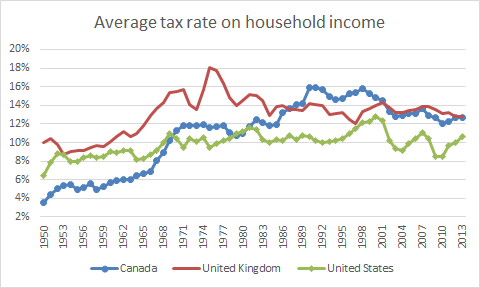
Income taxes in the USA and UK didn’t change all that much after the mid-70s. Prior to that, income tax rose quite steadily in the UK in the 1950s and 1960s and not surprisingly, Britain was the sick man of Europe in the 1970s. Income taxes rose quite steadily in Canada for most of the post-war period up until 1990 and then levelled out for most of that decade before a small tapered downwards.
Source: Cara McDaniel.
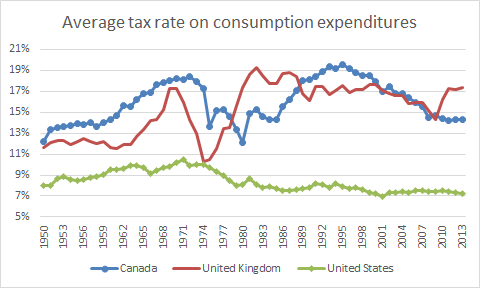
Taxes on consumption expenditure were very different stories across the Atlantic. There has been a tapering down in the average tax rate on American consumption expenditure since 1970 after modest increases before that. Canadian taxes on consumption expenditure rose steadily until the 1970s, then drop steadily in the 1970s and than rose in the 1980s and dropped again after 1992. British taxes on consumption expenditure rose sharply in the late 1960s, dropped sharply and then rose again in the 1970s and was pretty steady after that.
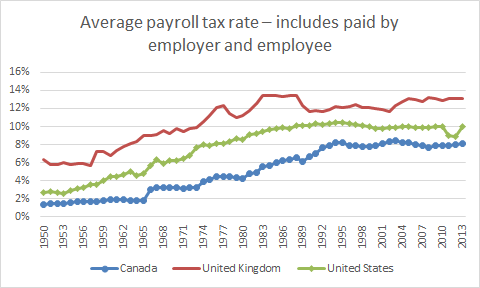
The sleeper tax in all three countries was payroll taxes to fund social security and the welfare state. These rose steadily in the USA, UK and Canada up until the 1990s.
Source: Cara McDaniel.
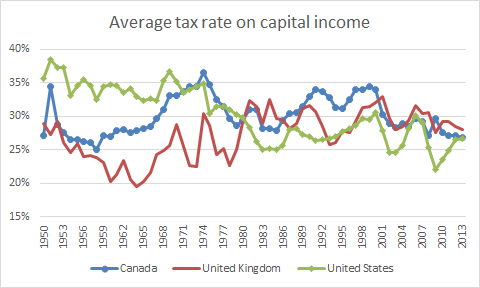
Despite all that nonsense about neoliberalism from the Left over Left, the average rate of tax on capital income did not appear to change much at all over the last 50 years. There was a modest taper in US capital income taxation from the mid-30s to the mid-20s over the entire post-war period. The average Canadian tax rate on income from capital rose steadily in the 60s, fell steadily in the 70s before rising again in the mid-1980s and fell again after 2000. The average British tax rate on capital income rose steadily in the 60s and 70s, coinciding with the emergence of Britain as a sick man of Europe, and then stabilised in the the 1980s onwards but with a dip in the late 80s before a rise in the early 1990s.. Despite the large cuts in the statutory corporate tax rate in the UK, there was only a mild taper in the average tax rate on capital income in the UK.
Source: Cara McDaniel.
The average tax rate on investment expenditures is pretty stable in the USA for the entire post-war period. The only significant increase in the average tax rate on investment expenditures in the UK coincided with the emergence of the sick man in Europe after a drop in the early 70s. The average tax rate on investment expenditures do not change at all in the UK after the 1970s. The Canadian average tax rate on investment expenditures is higher than elsewhere. It rose steadily in the 50s and 60s, dropped in the 70s and rose again in the 80s before tapering from 1992 onwards.
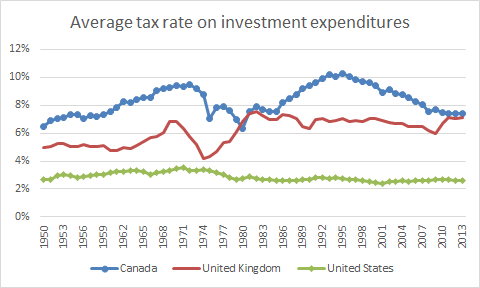
Source: Cara McDaniel.
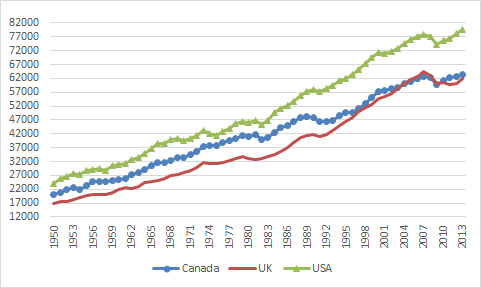
These higher on rising taxes and the UK and Canada did nothing for either country in catching up with the USA. The figure 1 below shows real GDP per working age per American, Canadian and British.
Figure 1: Real GDP per Canadian, British and American aged 15-64, converted to 2013 price level, updated 2005 EKS purchasing power parities, 1950-2013
Source: Computed from OECD StatExtract and The Conference Board, Total Database, January 2014, http://www.conference-board.org/economics
The USA is pulling away from Canada and the UK in GDP per working age person. The exception is British economy from about 1990 onwards which caught up with Canada.
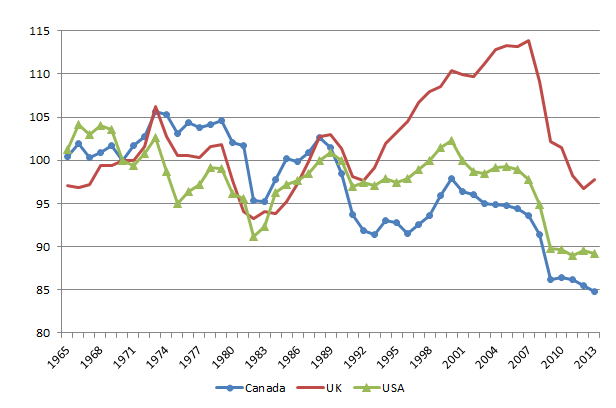
Figure 2, which is detrended GDP data, illustrates the British economic boom in the 1990s. Each country’s annual economic growth rate is detrended by 1.9%, the detrending value currently used by Ed Prescott. A flat line is growth at 1.9%, a rising line is above trend growth, a falling line is below trend growth.
Figure 2: Real GDP per Canadian, British and American aged 15-64, converted to 2013 price level, updated 2005 EKS purchasing power parities, detrended 1.9%, 1950-2013
Source: Computed from OECD Stat Extract and The Conference Board, Total Database, January 2014, http://www.conference-board.org/economics
Figure 2 shows that Canada has been in a long-term decline since the mid-1980s with much of this decline coinciding with periods of rising taxes on income from labour.
The British economy boomed in the 1990s, after the tax hikes of the 1970s and early 80s were reversed. This growth dividend was squandered by the Blair government in the 2000.
Figure 2 also shows that US growth was rather stable with some ups and downs up until 2007, expect during the productivity slowdown in the 1970s. The first major departure from trend growth of 1.9% was with the onset of the great recession.
The rapid emergence of Generation Rent in the UK and New Zealand
17 Apr 2015 1 Comment
in politics - New Zealand, urban economics Tags: Generation Rent, housing affordability, land supply restrictions, UK politics, zoning

I thought I should reproduce this chart for New Zealand to show the extent to which a Generation Rent has emerged in New Zealand in the last 10 years.


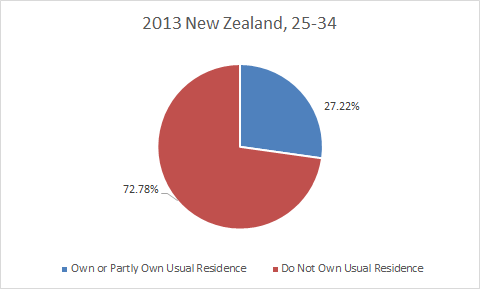
Source: 2013 Census QuickStats about housing.
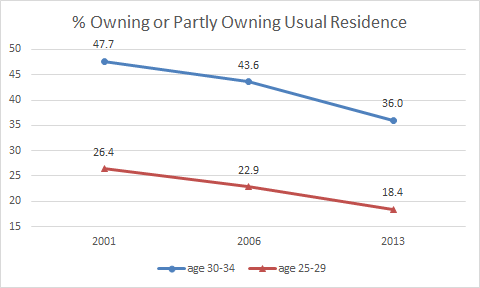
Might be more interesting to breakdown the pie charts as a single time series for 25 to 29 and 30 to 34 year-olds as the latter are more likely to be settling down and buying a house.
Source: 2013 Census QuickStats about housing.
The number of New Zealanders who own or partly owned their residence in the really 30s has dropped from almost one in two falling towards one in three since 2001. Generation Rent is very much the majority of New Zealanders aged 30 to 34.
For those New Zealanders aged 25 to 29, instead of one in four at least partly owning their residences, as was the case in 2001, the number of those aged 25 to 29 buying or owning their own house has dropped to less than one in five.
Generation Rent for those aged 25 to 29 has gone from a majority tendency to the dominant state for those in their late 20s. In both cases, the emergence of Generation Rent has sped up since 2006.
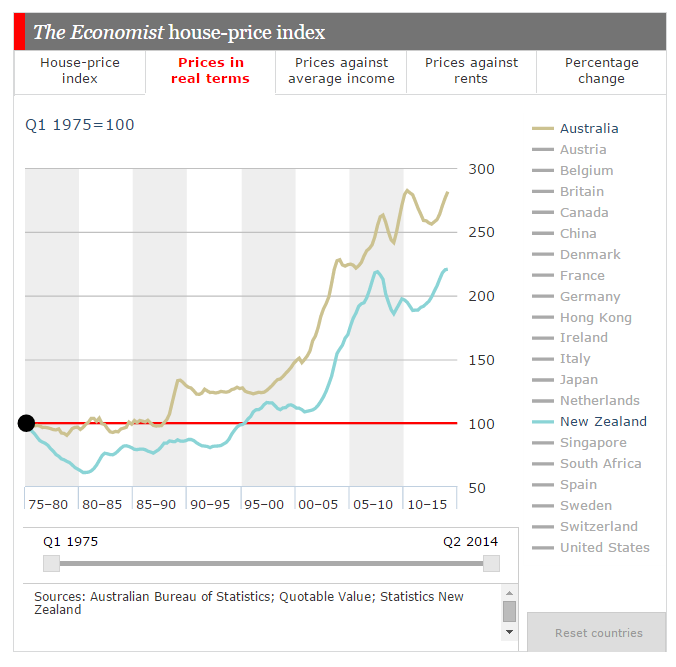
The emergence of generation rent coincided with a sharp increase in prices in real terms in New Zealand while housing prices against rents became far less competitive.
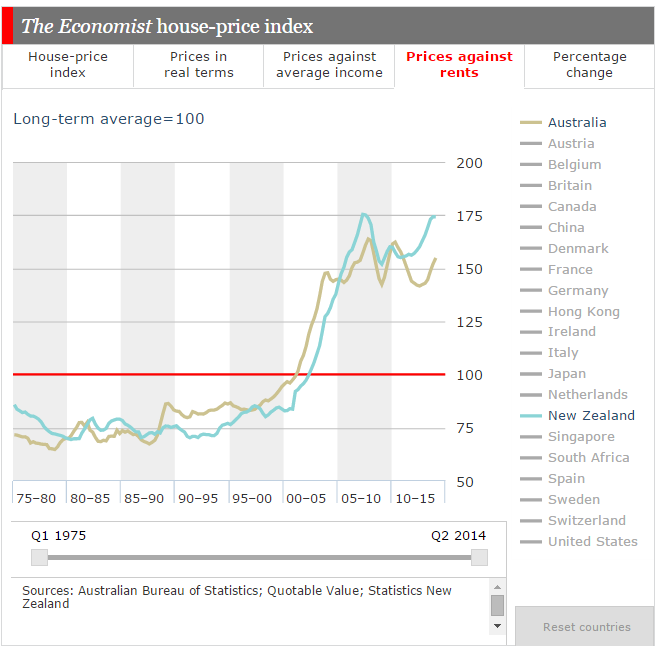
HT: Global house prices: Location, location, location | The Economist.
.
Support over time from marijuana decriminalisation was twin peaked in the USA
17 Apr 2015 Leave a comment
in economics of crime, law and economics, politics - USA Tags: marijuana decriminalisation, medical marijuana decriminalisation, voter demographics

The Obamas’ tax return
17 Apr 2015 Leave a comment
in politics - USA, public economics Tags: obama
You know you're curious– take a look at Obama's 1040: urbn.is/1JHnxvd #taxday http://t.co/M958cQoLVv—
Urban Institute (@urbaninstitute) April 15, 2015
DNA and death row exonerations
17 Apr 2015 Leave a comment
in law and economics, politics - USA Tags: capital punishment, crime and punishment, definitely
Renewable energy to supply same market share in 2040 as in 1949
17 Apr 2015 Leave a comment
CHART: New EIA forecast — Fossil fuels will supply >81% of our energy for at least the next quarter century http://t.co/Oju3njQrfD—
Mark J. Perry (@Mark_J_Perry) April 15, 2015
Think renewables will be important source of future energy? Not so, fossil fuels will provide 81% of energy in 2040 http://t.co/9LOoqC3VRK—
Mark J. Perry (@Mark_J_Perry) March 15, 2015
Who said the New Zealand share index lacked diversification
17 Apr 2015 Leave a comment
in financial economics, politics - New Zealand Tags: active investing, investment diversification, passive investing
One trait that makes the US stock market better than its peers read.bi/1EJ4ZrC http://t.co/6kz7zlghQa—
BI Chart of the Day (@chartoftheday) February 23, 2015
Becoming president is part of the college premium
16 Apr 2015 Leave a comment
in economics of education, politics - USA Tags: 2016 presidential election, College premium, graduate premium
These men lacked college degrees but they ran for president & guess what happened next …
pewresearch.org/fact-tank/2015… http://t.co/L05DXnSvtz—
Conrad Hackett (@conradhackett) March 29, 2015
Sharia law, arbitration law and family law
16 Apr 2015 Leave a comment
in economics of religion, law and economics, politics - Australia, property rights Tags: economics of contracts, family law, rule of law, Sharia law
Sharia law is part of a general issue of private arbitration in religious courts. There are rabbinical courts doing private arbitration among Orthodox Jews in the UK. There is a famous paper about extra-legal enforcement of contracts among Orthodox Jews in the diamond trade.
Success in the industry requires enforcing executory agreements that are beyond the reach of public courts, and Jewish diamond merchants enforce such contracts with a reputation mechanism supported by a distinctive set of industry, family, and community institutions. An industry arbitration system publicizes promises that are not kept. Intergenerational legacies induce merchants to deal honestly through their very last transaction, so that their children may inherit valuable livelihoods. And ultraorthodox Jews, for whom participation in their communities is paramount, provide important value-added services to the industry without posing the threat of theft and flight.
The British law society copped a lot of flak for issuing practice notes explaining how to write wills that were compliant with Islamic family law.
In any case, any will is always subject to laws about providing for the family and for dependent children and can be overridden on those grounds, no matter how they are written.
Peter Sellers left each of his adult children £750 because he wanted to disinherit them. Under the case law at that time, if you left your children nothing, the courts somehow persuaded themselves that you had forgotten to provide for them so they amended the will. By Sellers leaving them this small sum of money, he made it clear that he wanted the limit how much he gave his children.
In the UK, rulings handed down by the Muslim Arbitration Tribunal can be legally binding. This is because the Arbitration Act 1996 allows almost any body to act as a dispute resolution service if both parties agreed to be bound by its decision.
There is a bill before the House of Lords amending the Arbitration Act to ensure that the evidence of men and women are weighed equally and penalties to apply to any body purporting to have the powers of a court of law.
The UK parliament also passed a Forced Marriages Act a few years ago. This law included penalties for people who threaten self-harm if someone didn’t go through with an arranged marriage.
Feminism row erupts over Paul Henry comments – They have the Internet on computers now version
16 Apr 2015 Leave a comment
in discrimination, gender, politics - New Zealand

Jackie Blue, despite the resources of the Human Rights Commission, did not Google her own web site for the biography of the Chief Commissioner of the Human Rights Commission.

KiwiBlog has noted that the headline of “Ex All Black becomes Chief Executive” is common with David Kirk referred to as an ex All Black despite a successful business career.

Average tax rates on consumption, investment, labour and capital in Australia and New Zealand, 1959-2011–updated
16 Apr 2015 1 Comment
in economic growth, fiscal policy, macroeconomics, politics - Australia, politics - New Zealand, public economics Tags: GST, lost decades, taxation and the labour supply, taxation of capital
Cara McDaniel went to the mammoth task of constructing average tax rates for 15 OECD countries over the period 1950-2003 for consumption, investment, labour and capital:
Total tax revenue is divided into revenue generated from four different sources: consumption expenditures, investment expenditures, labour income and capital income.
To find the average tax rate, tax revenue from each source is then divided by the appropriate income or expenditure base.
She used that data to examine the role of taxes and productivity growth as forces influencing market hours. She used a calibrated growth model extended to include home production and subsistence consumption, both of which were key features influencing market hours. Her model was simulated for 15 OECD countries. She found the primary force driving changes in market hours is found to be changing labour income tax rates and productivity catch-up relative to the United States is found to be an important secondary force.
I thought I would summarise the tax rate data computed by Cara McDaniel for Australia and New Zealand.
Source: Cara McDaniel.
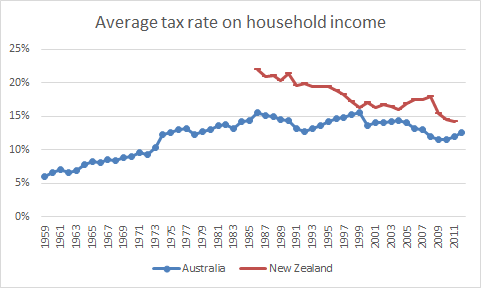
McDaniel’s data on average tax rates on household incomes in Australia and New Zealand suggests that the average tax rate New Zealand household incomes fell by a third since 1986. No estimates were calculated for earlier years for New Zealand.
As for Australia, taxes steadily increased between 1959 and 1987 stabilised until 2005 and then fell a bit.
Source: Cara McDaniel.
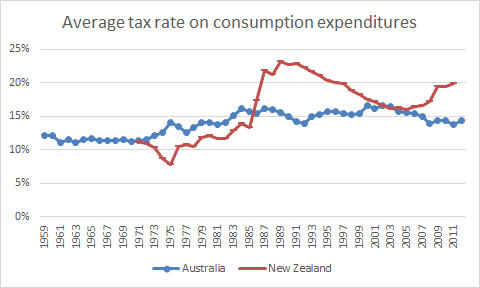
There is a big spike in the average tax rate on consumption expenditure in New Zealand in 1986 when a GST replaced the pre-existing sales taxes. The average tax rate on New Zealand consumption expenditures and tapered away until the end of2009 and started to increase again.
Not much happened in Australia regarding the average tax rate in consumption expenditures since about 1983 despite the introduction of a GST in 1998.
Source: Cara McDaniel.
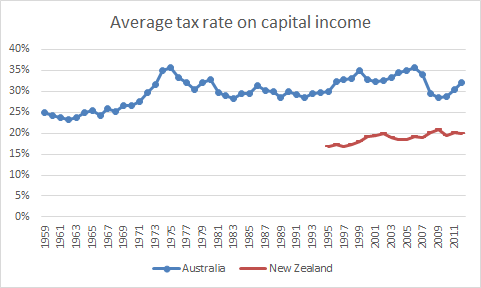
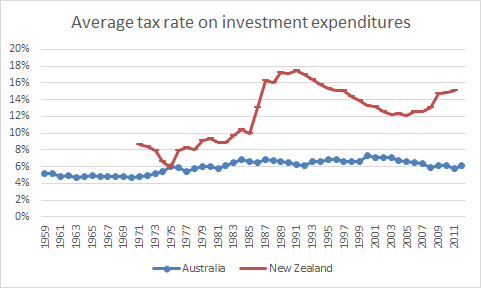
The average tax rate in capital income in Australia is much higher than in New Zealand. On the other hand, the average tax rate on investment expenditure is much higher New Zealand as compared to Australia.
Source : Cara McDaniel.
Taxes on investment expenditures increased quite significantly at the same time that a GST was introduced in New Zealand.
All in all, New Zealand cut taxes on personal income but that tax cut seemed to be pretty much offset by higher taxes on personal consumption through the introduction of a 10% and then 12.5% GST.
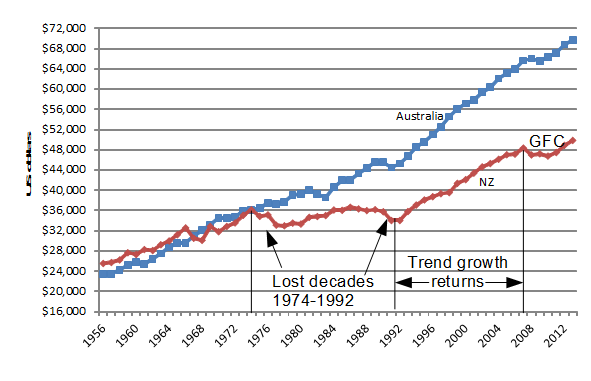
The most interesting finding in this database is the sharp increase in the average tax on investment expenditures in the mid-1980s. This prolonged New Zealand’s lost decades – the two decades of next to no GDP growth per working age New Zealander.
Real GDP per New Zealander and Australian aged 15-64, converted to 2013 price level with updated 2005 EKS purchasing power parities, 1956-2013
Source: Computed from OECD Stat Extract and The Conference Board, Total Database, January 2014.
New Zealand’s lost decades ended when the average tax rate on investment expenditures started to fall.


Recent Comments