Minorities represent nearly 40 percent of Americans, yet account for fewer than 16 percent of workers at the government agencies, nongovernmental organizations called NGOs and foundations that were studied.
…Taylor wrote that an “unconscious bias” exists within the liberal and progressive culture of the groups, preserving a racially homogenous workplace. “Recruitment for new staff frequently occurs through word-of-mouth and informal networks,” the study said. “This makes it difficult for ethnic minorities, the working class, or anyone outside of traditional environmental networks to find out about job openings and apply for those jobs.”
The Hayek and FriedmanMonday conferences on the ABC in 1976 and 1975 are still ruling the Australian policy roost, if some of the Left over Left in Australia are to be believed. Milton Friedman is said to have mesmerised several countries with a flying visit with his Svengali powers of persuasion.
When working at the next desk to a monetary policy section in the Australian Prime Minister’s Department in the late 1980s, I heard not a word of Friedman’s Svengali influence:
• The market determined interest rates, not the Reserve Bank was the mantra for several years. Joan Robinson would have been proud that her 1975 Monday conference was still holding the reins.
• Monetary policy was targeting the current account. Read Edwards’ biography of Keating and his extracts from very Keynesian Treasury briefings to Keating signed by David Morgan that reminded me of Keynesian macro101.
When as a commentator on a Treasury seminar paper in 1986, Peter Boxhall – fresh from the US and 1970s Chicago educated – suggested using monetary policy to reduce the inflation rate quickly to zero, David Morgan and Chris Higgins almost fell off their chairs. They had never heard of such radical ideas.
In their breathless protestations, neither were sufficiently in-tune with their Keynesian educations to remember the role of sticky wages or even the need for the monetary growth reductions to be gradual and, more importantly, credible as per Milton Freidman and as per Tom Sargent’s end of 4 big and two moderate inflations papers in the early 1980s.
I was far too junior to point to this gap in their analytical memories about the role of sticky wages, and I was having far too much fun watching the intellectual cream of Treasury senior management in full flight. (I read Friedman & Sargent much later).
Man Booker Prize author Eleanor Catton from New Zealand managed in the same interview in India to denounce the neoliberalism of New Zealand’s current government and then denounce the tall poppy syndrome that cuts down artistic elites such as herself down to size when they become successful.
At the moment, New Zealand, like Australia and Canada, (is dominated by) these neo-liberal, profit-obsessed, very shallow, very money-hungry politicians who do not care about culture
This is tremendous a hypocrisy: to denounce a neoliberal philosophy that supposedly favours the elite over the working class and then complain about members of the elite such as herself are not supported sufficiently from the taxpayers’ tough:
We have this strange cultural phenomenon called “tall poppy syndrome”; if you stand out, you will be cut down…
If you get success overseas then very often the local population can suddenly be very hard on you. Or the other problem is that the local population can take ownership of that success in a way that is strangely proprietal.
Catton manages to denounce neoliberalism and the capitalist competition that entails but then gets quite annoyed over the fact the successful people aren’t rewarded and recognised by the country.
What hypocrisy. She denounces neoliberalism and then complains about been cut down because of her success. If you’re an opponent of neoliberalism, there is some obligation on you to argue for a levelling of income and wealth, including your own.
It betrays an attitude towards individual achievement which is very, uncomfortable. It has to belong to everybody or the country really doesn’t want to know about it…
I’ve really struggled with my identity as a New Zealand writer. I feel uncomfortable being an ambassador for my country when my country is not doing as much as it could, especially for the intellectual world.
Catton is particularly upset over the fact that New Zealand is expected to share her fame with them some way. Obviously, Catton believes in private profits, private fame at social losses and public subsidies for the arts. Having to share what she earns is not part of her opposition to neoliberalism.
From each in accordance with their ability, to each in according to their need is the heart of the anti-neoliberal philosophy, or is it Robert Nozick’s capitalistic acts between consenting adults where it is from each as they choose, to each as they are chosen, especially if you’re a successful artist.
Such is the price neoliberalism is Eleanor Catton, like every other able-bodied adult, is expected to earn a living for themselves by producing something that someone wants a profitable global for them rather than expect a hand-out from the government simply because of the desire of the recipients to receive the money. In her case, her claim for government hand-outs is because she happens to be artistic.
Jim Hacker: “So they insult me and then expect me to give them more money?”
Sir Humphrey: “Yes, I must say it’s a rather undignified posture. But it is what artists always do: crawling towards the government on their knees, shaking their fists.”
Jim Hacker: “Beating me over the head with their begging bowls.”
Bernard Woolley: “Oh, I am sorry to be pedantic, Prime Minister, but they can’t beat you over the head if they’re on their knees. Unless of course they’ve got very long arms.”
This picture is quite an interesting one. It shows India’s richest businessmen queuing to wait to meet US President Barack Obama patiently. It is ironical in many ways to see the rich and mighty queue like school children waiting for their score card or something. In many ways it is a score card of future where the chosen guys would either get to invest in US or be a partner of US money into India.
It clearly shows the power of politics. Those who keep talking of free markets and so on should see how politics dominates the game. At the end of the day, you have to get closer to the politique to see your empire grow.
But this is also an example of cronyism where business and politics get real close. Deals are signed amidst favorites and it is dubbed as competition. Most of cronyism happens behind the scenes and this is all…
Five years ago, we were told that the 2009 Copenhagen climate summit was the last chance to save civilization. As the 2015 Paris summit approaches, the same sort of fear mongering is ramping up.
Earlier this week, a climate declaration published as a full-page ad in the international edition of New York Times tried to frighten us. It told us that:
the UN Climate Summit in Paris in December 2015 may be the last chance to agree a treaty capable of saving civilization; [bold added]
The declaration insisted that global warming may “cause the very fabric of civilization to crash.” It said charitable foundations should therefore divert resources away from other projects – presumably building hospitals and schools, preventing blindness and malaria, ensuring basic sanitation – in order to “save civilization” from the climate scourge.
Problem is, we’ve heard this before. Not so very long ago, the British Prime…
Every generation has its moral panic about technological change in creative destruction.
For young people, it’s that overweening conceit about the problems they are attempting to solve are new.
For the middle-aged and older, rather than suggest that they are policy hustlers, it’s more like you they simply forgot that these debates were had 20 years ago and the scaremongers lost the same reason they lost 20 years before that, and so on.
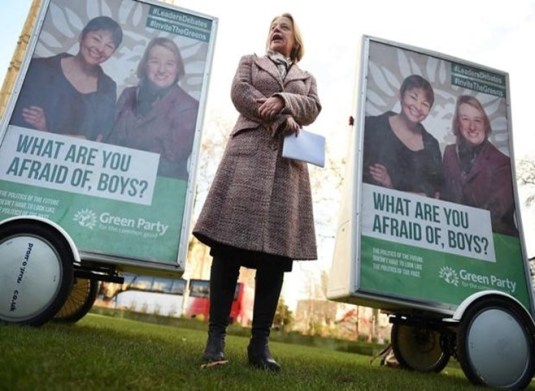
Obviously, the UK Greens are not as fluffy as their down-under compatriots if you have a look at this somewhat confrontational sign of theirs.
The New Zealand Greens have election campaign signs from which I can neither discern their message, nor easily work out that it is a Green sign because their logo is so small in the bottom right hand corner when driving by a car.
Maybe the Greens are not after car-owner votes, only bicyclists and public transport users – the middle-class on the way to their jobs in the city.
The sign of the UK Greens borders on hate speech. The UK Greens also do not have female and male co-leaders, as is the case for the New Zealand Greens, from what I can see – where is their gender balance?
Why Evolution is True is a blog written by Jerry Coyne, centered on evolution and biology but also dealing with diverse topics like politics, culture, and cats.
In Hume’s spirit, I will attempt to serve as an ambassador from my world of economics, and help in “finding topics of conversation fit for the entertainment of rational creatures.”










Recent Comments