Full-time work on the minimum wage is enough to keep a NZ family out of poverty!

An OECD chart that shows New Zealand parents only need to work a little over 40 hours a week on the minimum wage to lift a family out of poverty in New Zealand.

image

The figure above shows that a lone parent with two children needs to work about 25 hours a week stay out of poverty in 2013 in New Zealand Once taxes are taken into account as well as additional family benefits such as in-work tax credits. New Zealand is one of the easiest places in the world to get out of poverty by working part-time for a sole mother.

The figure above from the OECD shows that New Zealand couple with two children needs to work about 40 hours a week to stay out of poverty. Of course, what is poverty depends on the definition of the poverty line and in this case by the OECD, it is defined as 50% of the median wage after taxes and family benefits. Another common definition of poverty is earning less than 60% of the median wage

The minimum wage is $14.75 per hour in New Zealand while proposals for a living wage in New Zealand are now $19.25 an hour. The Labour Party wants to increase the minimum wage to $15 per hour.The Greens want to increase the minimum wage to the living wage.

Simon Chapple and Jonathan Boston pointed out in their excellent book last year on child poverty in New Zealand that full-time work by one parent and part-time work by the other in the same household is enough to lift families out of most  definitions of poverty:

Sustained full-time employment of sole parents and the fulltime and part-time employment of two parents, even at low wages, are sufficient to pull the majority of children above most poverty lines, given the various existing tax credits and family supports.

The best available analysis, the most credible analysis, the most independent analysis in New Zealand or anywhere else in the world that having a job and marrying the father of your child is the secret to the leaving poverty is recently by the Living Wage movement in New Zealand.

According to the calculations of the Living Wage movement, earning only $19.25 per hour with a second earner working only 20 hours affords their two children, including a teenager, Sky TV, pets, international travel, video games and 10 hours childcare. This analysis of the Living Wage movement shows that finishing school so your job pays something reasonable and marrying the father of your child affords a comfortable family life.

The OECD’s analysis also showed that incentives for New Zealanders to work more and earn more is better than in most countries in terms of what happens if they earn a wage increase.

image

In New Zealand, when there is a 5% minimum wage increase, four percentage points  of that wage increase actually stays in the hands of the worker.

In some countries such as Australia, the USA  and UK, 60 to 80%of the minimum wage increase is gobbled up in reductions in benefits and taxes. At the same time, the minimum wage increase makes it less profitable for your employer to retain you so your job is more at risk.

The only explanation I have for why the Labour Party, NZ Greens and the living wage movement don’t highlight the success of the existing minimum wage in reducing family poverty in New Zealand is mass kidnappings.

image

But for these abductions most fowl, I’m sure the Labour Party,  NZ  Greens and the living wage movement would be dancing in the street celebrating successes of capitalism and freedom in New Zealand in keeping families out of poverty through the minimum wage.

The war situation in Iraq and Syria

HT: Lorenzo M Warby

Image

Senator Warren made a good case against Investor-State Dispute Settlement in the TPP

In the Washington Post a few months ago, Senator Elizabeth Warren made a balanced case against investor state dispute settlement, not only in the Trans-Pacific Partnership. But in any trade agreement.

Apart from a few rushes of blood in rhetoric to appeal to her base, she made reasoned arguments, good use of history, and put up constructive alternatives to what she was criticising. Furthermore, she put forward arguments that appealed to every point in the political spectrum. The Left over Left critics of investor state disputes settlement clauses in trade agreements in New Zealand never do that.

She echoed arguments I have made the at investor state disputes settlement clauses have no place in trade agreements between liberal democracies.

clip_image002

Liberal democracies have independent courts and honest politics where everyone gets a fair go. That means sometimes you’re on the losing side of politics, but you as free to persuade the majority that they are mistaken. That is democracy in action: sometimes you win, sometimes you lose and there is an election in a few years where you can get another go.

New Zealand has a Closer Economic Relations Agreement with Australia. One provision is a requirement that in most cases New Zealanders are treated the same as Australians under Australian law.

To explain this, some years ago, a New Zealand television production company successfully sued the Australian television regulator to have New Zealand made television shows recognised as Australian content under the 50% Australian content regulations for free-to-air television in Australia.

Note the New Zealand business sued in the Federal Court of Australia and won. They had their day in court.

Senator Warren makes the point that if a business in the USA is unhappy with a regulation, they can challenge by normal democratic and legal means, which investor state disputes settlement undermines:

If a foreign company that makes the toxic chemical opposes the law, it would normally have to challenge it in a U.S. court. But with ISDS, the company could skip the U.S. courts and go before an international panel of arbitrators. If the company won, the ruling couldn’t be challenged in U.S. courts, and the arbitration panel could require American taxpayers to cough up millions — and even billions — of dollars in damages.

Senator Warren also provides a good history of the emergence of investor state disputes settlement and the relevance of that history to contemporary developments:

But after World War II, some investors worried about plunking down their money in developing countries, where the legal systems were not as dependable. They were concerned that a corporation might build a plant one day only to watch a dictator confiscate it the next. To encourage foreign investment in countries with weak legal systems, the United States and other nations began to include ISDS in trade agreements.

Investor state disputes settlement were indeed created to protect businesses that did not have robust democracies and legal systems. Would be international investors in one of these countries were promised international redress if there was a coup, a takeover of their investments or some other unforeseen negative impact because sovereign risk.

She then asked why are these provisions in trade agreements with liberal democracies where they have no relevance:

Those justifications don’t make sense anymore, if they ever did. Countries in the TPP are hardly emerging economies with weak legal systems. Australia and Japan have well-developed, well-respected legal systems, and multinational corporations navigate those systems every day, but ISDS would pre-empt their courts too.

Senator Warren also makes a good point that investor state disputes settlement undermines competition between legal jurisdictions and the rewards for having a sound legal system:

…to the extent there are countries that are riskier politically, market competition can solve the problem. Countries that respect property rights and the rule of law — such as the United States — should be more competitive, and if a company wants to invest in a country with a weak legal system, then it should buy political-risk insurance.

Political risk is is an entrepreneurial opportunity for the insurance market. The World Bank’s Multilateral Investment Guarantee Agency provides insurance to those investing in developing countries against expropriation (including indirect expropriation), as well as acts of war and terrorism. Export Finance schemes of many governments offer political risk Insurance. Anyone who travels in the less safe countries of the world routinely buys travel insurance.

The World Bank puts out an annual index on ease of doing business in every country of the world so foreign investors can’t say they won’t warned of the risks they were taking for the profits they sought.

image

Investor state disputes that were indeed referred to international arbitration used to be rare. Now they are more common as Senator Warren explains:

From 1959 to 2002, there were fewer than 100 ISDS claims worldwide. But in 2012 alone, there were 58 cases.

Recent cases include a French company that sued Egypt because Egypt raised its minimum wage, a Swedish company that sued Germany because Germany decided to phase out nuclear power after Japan’s Fukushima disaster, and a Dutch company that sued the Czech Republic because the Czechs didn’t bail out a bank that the company partially owned. U.S. corporations have also gotten in on the action: Philip Morris is trying to use ISDS to stop Uruguay from implementing new tobacco regulations intended to cut smoking rates.

In a response to Senator Warren’s op-ed, Gary Clyde Hufbauer said:

…only 13 ISDS cases have been brought to judgment against the United States.  The United States has not lost a single case.

Why? Because the United States does not expropriate private property without compensation, and the United States does not enact arbitrary or discriminatory laws against foreign firms. Contrary to what the Senator implies, American taxpayers have not had to cough up millions and even billions of dollars in damages. They have not had to cough up anything.

The best part of Senator Warren’s op-ed is when she appeals to all points of the political spectrum based on arguments that do indeed appealed to them:

Conservatives who believe in U.S. sovereignty should be outraged that ISDS would shift power from American courts, whose authority is derived from our Constitution, to unaccountable international tribunals. Libertarians should be offended that ISDS effectively would offer a free taxpayer subsidy to countries with weak legal systems. And progressives should oppose ISDS because it would allow big multinationals to weaken labour and environmental rules.

Senator Warren did make a good case against investor state disputes settlement, particularly between liberal democracies. Foreign investors should take their chances in domestic politics and the courts like the rest of us. They’ve invested in a liberal democracy with independent courts, honest politicians and a commitment to a market economy.

Investor state disputes settlement clauses in trade agreements allow foreign investors to sue the host country for laws, policies, or court decisions they find objectionable. This gives foreign investors more rights than local investors; more influence than local citizens. That is contrary to equality before the law, which is the essence of liberalism.

The point that the Twitter Left rarely makes against investor state disputes settlement, and Senator Warren goes a way towards making is the shield offered by investor state disputes settlement clauses against predatory, corrupt governments in underdeveloped countries, many of which were socialist kleptocracies, has become a sword against regulations that arise in any liberal democracy that were sought and obtained through normal democratic means.

The Australian Productivity Commission held a public inquiry into regional and bilateral trade agreements in 2010. The commission specifically addressed investor state disputes settlement in its subsequent report:

1. There does not appear to be an underlying economic problem that necessitates the inclusion of ISDS provisions within agreements. Available evidence does not suggest that ISDS provisions have a significant impact on investment flows.

2. Experience in other countries demonstrates that there are considerable policy and financial risks arising from ISDS provisions.

The Productivity Commission concluded that investor state dispute settlement provisions are just not worth bargaining coin:

Nor, in the Commission’s assessment, is it advisable in trade negotiations for Australia to expend bargaining coin to seek such rights over foreign governments, as a means of managing investment risks inherent in investing in foreign countries. Other options are available to investors.

The Australian Productivity Commission was quite right to question the advantages of setting up a preferential legal system for anyone:

…a bilateral arrangement with Australia to provide a ‘preferential legal system’ for Australian investors is unlikely to generate the same benefits for that country than if its legal system was developed on a domestic non-preferential basis.

To the extent that secure legal systems facilitate investment in a similar way that customs and port procedures facilitate goods trade, there may be a role for developed nations to assist through legal capacity building to develop stable and transparent legal and judicial frameworks.

When the Left over Left usually argues against investor state disputes settlement provisions they get so carried away with the conspiratorial rhetoric that they overlook a much better argument.

Investor state disputes settlement provisions are bad deal from liberal democracies. Liberal democracies with the rule of law, a market economy and private property rights offer ample protections to any foreign investor.

In trade agreements with less democratic countries, the need for reciprocal promises may not be worth the price when there are other options for investment protection, such as political risk insurance.

The question must be asked as to who lobbies for these agreements considering how much is opposition they provoke, and how useful they are as a mobilisation tool for the Twitter Left in their relentless campaign against lower prices and higher living standards.

The shy Tory voter versus the shy Labour voter (waiting for those hard left policies) – updated

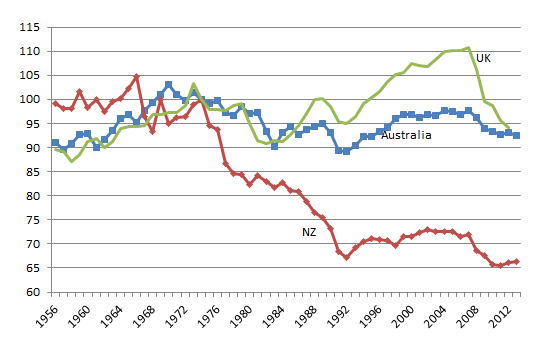
The go left young man, go left strategy is a view of many in the Labour Party in New Zealand, Australia and the UK is if they present hard left policies to the electorate, they will mobilise many more votes from people who are currently don’t vote or who are mysteriously parking their vote with the Tory party or other centre parties.

Michael Foot’s attempt at to get out shy Labour voters with a hard left campaign in the 1983 British general election, which lead to his manifesto earning the title the longest suicide note in history.

The eight foot high stone monolith Ed Miliband planned to erect in the garden of number 10 Downing Street, if he could get planning permission, was dubbed the heaviest suicide note in history.

The New Zealand Labour Party went left at the 2014 general election and for its troubles earned its lowest party vote since the party was founded in 1919.

Central to the strategy of the New Zealand Labour Party in the 2014 general election was mobilising non-voters in their working-class electorates.

The median voter theorem be dammed! The New Zealand Labour Party in the 2014 general election honestly believed that hard left policies would induce these non-voters to vote.

These non-voters are called the missing million by the New Zealand left . Almost one million people did not vote in 2014; 250,683 were not enrolled, while 694,120 were enrolled but did not turn out to vote. Many of these voters were thought to be just parking their vote pending the arrival of true believers to lead the Labour Party if the Left over Left is to be believed! Many of these non-voters are younger voters who generally are more likely to vote left.

The Internet – Mana party also spent an immense amount of the $4 million donated by Kim.com in trying to turn out to the youth voter as well.

Chris Trotter was wise and prophetic on go left young man, go left and the shy Labour voters will come:

[T]he Left has been given an extraordinary opportunity to prove that it still has something to offer New Zealand …..

If Cunliffe and McCarten are allowed to fail, the Right of the Labour Party and their fellow travellers in the broader labour movement (all the people who worked so hard to prevent Cunliffe rising to the leadership) will say:

“Well, you got your wish. You elected a leader pledged to take Labour to the Left. And just look what happened. Middle New Zealand ran screaming into the arms of John Key and Labour ended up with a [pitiful] Party Vote …

So don’t you dare try peddling that ‘If we build a left-wing Labour Party they will come’ line ever again! You did – and they didn’t.”

Be in no doubt that this will happen – just as it did in the years after the British Labour Party’s crushing defeat in the general election of 1983. The Labour Right called Labour’s socialist manifesto “the longest suicide note in history” and the long-march towards Blairism … began.

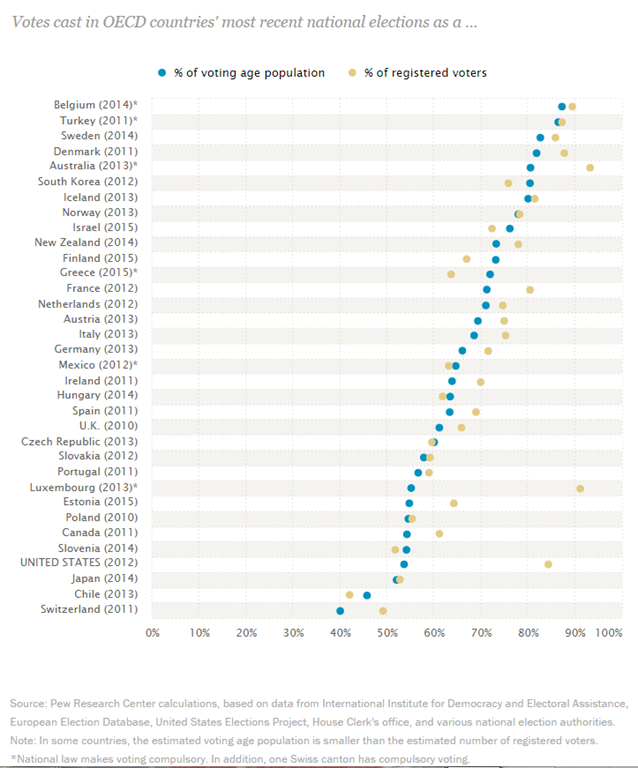
The most obvious flaw in the missing million and non-voter argument where they are waiting for true believers to offer hard left policies is a countries with much higher rates of voter turnouts and compulsory voting are not more likely to have left-wing governments.

image

There is much more evidence of shy Tory voters rather than shy Labour voters.

Shy Tory voters is a name invented by British opinion polling companies in the 1990s. The share of the vote won by the Tories in elections was substantially higher than the proportion of people in opinion polls who said they would vote for the party.

The final opinion polls gave the Tories between 38% and 39% of the vote – 1% behind the Labour Party. In the final results, the Conservatives had a lead of 7.6% over Labour and won their fourth successive general election.

Because of this turnout of shy Tory voters, the Tories won 3 million more votes than the Labour Party. This 14 million votes was more votes than they or any other British political party is ever won in a British general election, breaking the record set by Labour in 1951.

In a subsequent marketing research port, it was found a significant number of Tory party supporters refusing to disclose their voting intentions both the opinion poll companies, and exit polls.

This shy Tory factor is so large that opinion poll companies attempt to account for it in the weights they assign in their opinion polls surveys.

One of the explanations behind the turnout of the shy Tory vote in the 2015 British general election was a fear that a Labour Party minority government would be be holding to the hard left Scottish nationalists.

A number of British media commentators talked about running into many ordinary people expressing that very fear and they were undecided voters. About 20% of British voters were undecided on the eve the election, which is an unusually high amount.

Ironically, Neil Kinnock, the British Labour Party leader in the 1992 election, warned of a shy Tory factor a few days before the current British general election.

Tony Blair was much blunter a few months before the British general election about the relevance of the median voter theorem  to British politics and the future of the British Labour Party. The most electorally successful politician in Labour history said that May’s general election risks becomes one in which a

traditional left-wing party competes with a traditional right-wing party, with the traditional result.

Asked by the Economist magazine if he meant that the Conservatives would win the general election in those circumstances, Mr Blair replied: “Yes, that is what happens.”

The post-mortem by the New Statesman called “10 delusions about the Labour defeat to watch out for” equally blunt about the role of Tony Blair in rescuing British labour from permanent oblivion:

Many of your drinks will be prompted by variations on this perennial theme. Labour accepted the austerity narrative. Labour weren’t green enough. Labour weren’t radical (which has somehow come to be used as a synonym for left-wing).

Given that the last time Labour won an election without Tony Blair was 1974 it’s hard to believe people still think the answer is to move left. But people still do. I sort of love these people for their stubbornness. But I don’t want them picking the next leader.

The shy Tory vote stirred by the fears of a hard left government happened in the 2014 New Zealand general election. On the Monday night for the election that Saturday, the Internet – Mana party board had an hour of television for their Moment of Truth. This included Edward Snowden beamed in  from Moscow put forward a whole range of bizarre conspiratorial theories about NASA surveillance of New Zealand and analysis by base in Auckland.

David Farrar reported that in Tuesday night opinion polling, the National party’s party vote rose from 44% to 47%. In the subsequent general election that Saturday, the national party led all night for the first time. It won as many votes as it did in the previous election when it was expected to lose votes because the national party government was going into its third term.

One reason  for shy Tory voters is expressive voting. People obtain more sense of identity by proclaiming themselves to be a left-wing voter than they do from saying that they are a right-wing voter.

The expressive aspect of voting is “action that is undertaken for its own sake rather than to bring about particular consequences” (Brennan and Lomasky 1993, 25). There is almost never a causal connection between an individual’s vote and the associated electoral outcome. Hence, a vote is not disciplined by opportunity cost.

With no opportunity cost of how you vote in terms of deciding the outcome, people vote expressively to affirm their identity. Voting is about who and what you boo and cheer for and how you present yourself to the world.

Through the fatal conceit and the pretence to knowledge, a left-wing vote allows people to identify with doing good and changing the world for the better. No point in voting that way if you don’t go around thumping your chest proclaiming yourself as doing good for others by voting Left including telling the truth to polling companies.

Noam Chomsky’s fact free world about the poor dying fighting the wars started by the rich

Noam Chomsky hit a new low with his claim that the poor die fighting the wars started by the rich. Wartime casualty rates are available on the Internet in great detail to rebut this nonsense claim.

In the Second World War, First World War and Boar War, the British, Australian and New Zealand Army had minimum fitness standards. Many from poor backgrounds were rejected because of poor health or they were too short.

12% per cent of all men mobilised in Britain between 1914 and 1918 were killed; but nearly a fifth of Oxford graduates who served did not return from the war; the figure for Cambridge was 18 per cent.

clip_image002

UK wartime Prime Minister Herbert Asquith lost a son; future Prime Minister Andrew Bonar Law lost two. Anthony Eden lost two brothers, another brother of his was terribly wounded, and an uncle was captured. At the end of World War II, Anthony Eden had to take a week off to grieve because he lost his son in the final days of fighting.

So much for the poor fighting the wars of the rich. Furthermore, taxes on both incomes and inheritances were very high both during and after both world wars.

Australia and New Zealand had volunteer armies in the First World War. The population of New Zealand in 1914 was approximately 1.1 million. Almost 100,000 New Zealanders served overseas in the New Zealand Expeditionary Force. From a population of fewer than five million, 416,809 Australian men signed up.

By war’s end, over 60,000 Australians were killed and 156,000 wounded, gassed, or taken prisoner. This compares with around 700,000 British, 60,000 Canadians and 16,000 New Zealanders killed.

In 1939, the New Zealand labour government went to great lengths to ensure it would declare war on Germany simultaneously with the Mother Country. As in 1914, Australia made no separate declaration of war because it regarded as automatic that it would be at war with the enemies of the Mother Country

Military service was all but indispensable to been elected to public office from much of the 20th century.

Bill Clinton’s and Michael Dukakis’s failure to serve were issues on their presidential campaigns that hurt them among their own voting base. They knew that and had to have very elaborate explanations as to why they didn’t serve.

clip_image004

The lack of a service in the First World War of Australia’s wartime Prime Minister in the Second World War, Sir Robert Menzies, was a constant source of taunting and heckling both in Parliament and at public meetings during that war and for the rest of his life.

The First World War broke out during the  1914 Australian federal election. There was ample opportunity for a popular vote on the wisdom of going to war. The opposition Labour party won that election on the pledge of fighting to the last man and the last shilling.

image

Being an intellectual, Chomsky forgets the patriotism of the working class and the plain desire to ward off foreign domination and conquest. What is a just war? Murray Rothbard explains:

a just war exists when a people tries to ward off the threat of coercive domination by another people, or to overthrow an already-existing domination.

A war is unjust, on the other hand, when a people try to impose domination on another people, or try to retain an already existing coercive rule over them

Democracy in Australia

Vindicating my long-standing view that anybody can get into Parliament as long as they’re not a Trot, the Animal Justice Party has been elected to the New South Wales Legislative Council last month.

The federal and state upper houses in Australia a democracy at its finest with the voters getting what they voted for, good and hard. These upper houses are powerful, with the ability to reject any bill with varying limitations on their ability to reject or amend money bills in a few of the upper houses.

Many Australian voters – at least 20% now – don’t like the major parties , including the Greens so they vote for a wide range of minor parties and independents in upper house elections if only as a protest vote that will go back to the major parties if they lift their game. Voters don’t have this option of vote splitting and protest voting in Queensland because a Labour government abolish their upper house in the 1930s in the name of democracy.

All but one of the Australian federal and state upper houses is elected by proportional representation, often with the option of a group ticket. That is, instead of filling out every box to cast a valid vote, you vote above the line put in a 1 against party you prefer.

Under group ticket voting, the party whose group you voted for decides how your preferences are distributed, which plays a vital role in deciding who gets elected. More importantly, the small parties engage in preference swapping so that they accumulated enough second and subsequent preference votes to win the last seat.

The Tasmanian Legislative Council is the exception to proportional representation in Australian upper houses with 15 single member constituencies. Naturally, 12 of these 15 legislative councillors are independents. That’s a little bit low by historic standards in my home state were normally the political parties have no success in getting members elected to the Tasmanian upper house.

Minor parties and independents control the balance of power in most Australian upper houses, including the Federal Senate.

The 40 member Victorian Legislative Council is a mixed bag with the balance of power depending on which particular combination of Green plus minor party legislative councillors get together to support the governing Labour Party government. I must admire the Vote 1 Local Jobs party as a brand name.

In the 42 member New South Wales Legislative Council, the Liberal National Party government relies on the god squad and anti-pornography campaigners in the Christian Democratic Party for the balance of power. If they fall short, they can always turn to the Shooters and Fishers party.

In the 22 member South Australian Legislative Council, neither of the major parties are particularly popular, nor are the South Australian Greens. To pass a bill with 12 votes, the Labour Party government must string together its seven members with a combination of the South Australian Greens, the Family First Party, Dignity for Disability, an independent and the Nick Xenophon team. Good luck.

In the Western Australian Legislative Council, the Liberal National party government has a majority, so what the Western Australian Greens and the Shooters and Fishers Party legislative councillors think don’t matter that much.

The Western Australian Legislative Council is the only upper house in Australia elected all at one time for four-year terms. For the other upper houses, half of each is elected at each lower house election for six or eight years terms. Tasmania is again the exception to this with two or three of their legislative councillors elected every year for six-year terms.

In the 76 strong Federal Senate, what could not be a more mixed bags of independents, minor parties and minor party defectors and renegades control the balance of power.

The strength of democracy lies in the ability of small groups of concerned and thoughtful citizens to band together and change things by running for office and winning elections.

That is how new Australian parties in the 20th century such as the Australian Labour Party, the Country Party, Democratic Labour Party, Australian Democrats and Greens changed Australia. Most of these parties started in someone’s living room, full of concerned citizens aggrieved with the status quo.

In the 21st century, Australian democracy could not be more democratic, with a wide range of totally obscure new political parties winning seats in the state upper houses and Federal Senate at every election.

In a democracy, we resolve our differences by trying to persuade each other and voting at elections.

The Australian Federal democracy with upper houses elected through proportional representation show that democracy could not be stronger or work any better.

In Australia, it is possible for just about anyone except a Trot to win a seat at the next election on issues that are important to them because they don’t need that many others to share their concerns and aspirations to win that last upper house seat on preferences.

New Zealand spends more than most on disability benefits

Image

Penn and Teller on recycling – the practice of ‘feeling good for no reason’ | Carpe Diem Blog

via For Earth Day: Penn and Teller on recycling – the practice of ‘feeling good for no reason’ – AEI | Carpe Diem Blog » AEIdeas.

Video

Another example of the speed of preference reversal

Who pays the highest income tax rate?

The Left over Left is withering away

Taxpayers in every country should get one of these charts

New Zealand does an excellent job in attracting skilled migrants

Would a living wage reduce poverty in America?

% spent on housing as a share of disposable income, OECD members, 2014

New Zealand is pretty much on top of the world as to the amount of income that households must spend keep a roof. That success is a product of local council restrictions on the supply of land and national and local regulations such as under the Resource Management Act (RMA) that increase the costs of bringing lands in the market.

image

Source: OECD Better Life Index.

Note: Household net adjusted disposable income is  the maximum amount that a household can afford to consume without having to reduce its assets or to increase its liabilities. It’s obtained, as defined by the System of National Accounts – SNA, adding to people’s gross income (earnings, self-employment and capital income, as well as current monetary transfers received from other sectors) the social transfers in-kind that households receive from governments (such as education and health care services), and then subtracting the taxes on income and wealth, the social security contributions paid by households as well as the depreciation of capital goods consumed by households.

Previous Older Entries Next Newer Entries

Bassett, Brash & Hide

Celebrating humanity's flourishing through the spread of capitalism and the rule of law

Truth on the Market

Scholarly commentary on law, economics, and more

The Undercover Historian

Beatrice Cherrier's blog

Matua Kahurangi

Celebrating humanity's flourishing through the spread of capitalism and the rule of law

Temple of Sociology

Celebrating humanity's flourishing through the spread of capitalism and the rule of law

Velvet Glove, Iron Fist

Celebrating humanity's flourishing through the spread of capitalism and the rule of law

Why Evolution Is True

Why Evolution is True is a blog written by Jerry Coyne, centered on evolution and biology but also dealing with diverse topics like politics, culture, and cats.

Down to Earth Kiwi

Celebrating humanity's flourishing through the spread of capitalism and the rule of law

NoTricksZone

Celebrating humanity's flourishing through the spread of capitalism and the rule of law

Homepaddock

A rural perspective with a blue tint by Ele Ludemann

Kiwiblog

DPF's Kiwiblog - Fomenting Happy Mischief since 2003

The Dangerous Economist

Celebrating humanity's flourishing through the spread of capitalism and the rule of law

Watts Up With That?

The world's most viewed site on global warming and climate change

The Logical Place

Tim Harding's writings on rationality, informal logic and skepticism

Doc's Books

A window into Doc Freiberger's library

The Risk-Monger

Let's examine hard decisions!

Uneasy Money

Commentary on monetary policy in the spirit of R. G. Hawtrey

Barrie Saunders

Thoughts on public policy and the media

Liberty Scott

Celebrating humanity's flourishing through the spread of capitalism and the rule of law

Point of Order

Politics and the economy

James Bowden's Blog

A blog (primarily) on Canadian and Commonwealth political history and institutions

Science Matters

Reading between the lines, and underneath the hype.

Peter Winsley

Economics, and such stuff as dreams are made on

A Venerable Puzzle

"The British constitution has always been puzzling, and always will be." --Queen Elizabeth II

The Antiplanner

Celebrating humanity's flourishing through the spread of capitalism and the rule of law

Bet On It

Celebrating humanity's flourishing through the spread of capitalism and the rule of law

History of Sorts

WORLD WAR II, MUSIC, HISTORY, HOLOCAUST

Roger Pielke Jr.

Undisciplined scholar, recovering academic

Offsetting Behaviour

Celebrating humanity's flourishing through the spread of capitalism and the rule of law

JONATHAN TURLEY

Res ipsa loquitur - The thing itself speaks

Conversable Economist

In Hume’s spirit, I will attempt to serve as an ambassador from my world of economics, and help in “finding topics of conversation fit for the entertainment of rational creatures.”

The Victorian Commons

Researching the House of Commons, 1832-1868

The History of Parliament

Articles and research from the History of Parliament Trust

Books & Boots

Reflections on books and art

Legal History Miscellany

Posts on the History of Law, Crime, and Justice

Sex, Drugs and Economics

Celebrating humanity's flourishing through the spread of capitalism and the rule of law

European Royal History

Exploring the Monarchs of Europe

Tallbloke's Talkshop

Cutting edge science you can dice with

Marginal REVOLUTION

Small Steps Toward A Much Better World

NOT A LOT OF PEOPLE KNOW THAT

“We do not believe any group of men adequate enough or wise enough to operate without scrutiny or without criticism. We know that the only way to avoid error is to detect it, that the only way to detect it is to be free to inquire. We know that in secrecy error undetected will flourish and subvert”. - J Robert Oppenheimer.

STOP THESE THINGS

The truth about the great wind power fraud - we're not here to debate the wind industry, we're here to destroy it.

Lindsay Mitchell

Celebrating humanity's flourishing through the spread of capitalism and the rule of law

Alt-M

Celebrating humanity's flourishing through the spread of capitalism and the rule of law

croaking cassandra

Economics, public policy, monetary policy, financial regulation, with a New Zealand perspective

The Grumpy Economist

Celebrating humanity's flourishing through the spread of capitalism and the rule of law

International Liberty

Restraining Government in America and Around the World