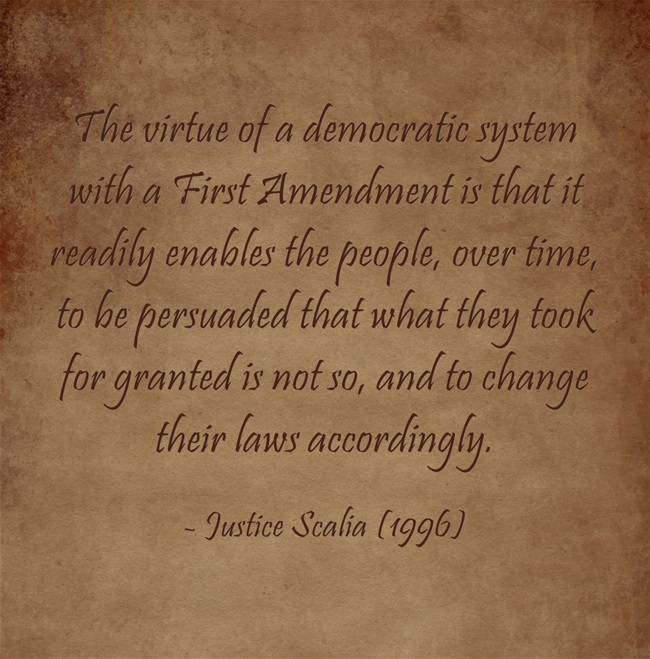
In a democracy we resolve our differences by trying to persuade each other and elections
17 Jul 2014 Leave a comment
Freedom of religion and equality before the law in a democracy
04 Jul 2014 4 Comments
in liberalism, politics - Australia, war and peace Tags: democracy, democratic equality, Freedom of religion, freedom of speech, rule of law

An individual’s religious beliefs does not excuse him from compliance with an otherwise valid law of general application prohibiting conduct that governments are free to regulate.
Allowing exceptions to every law or regulation that directly or indirectly affects religion would open the prospect of constitutionally required exemptions from legal obligations of almost every conceivable kind. Examples are compulsory military service, payment of taxes, polygamy, vaccination requirements, and child-neglect laws. some parliaments do provide exemptions and accommodations but that does not say they must.
Justice Frankfurter wrote in 1940:
conscientious scruples have not in the course of the long struggle for religious toleration relieved the individual from obedience to a general law not aimed at the promotion or restriction of religious beliefs.
The mere possession of religious convictions which contradict the relevant concerns of political society does not relieve the citizen from the discharge of political responsibilities
Religious freedom bars laws that prohibit:
- the holding of a religious belief,
- the right to communicate those beliefs to others, and
- the right of parents to direct the education of their children.
This approach also has the advantage of not placing courts into the position of having to determine the importance of a particular belief in a religion or the plausibility of a religious claim when weighing it against other government interests and the objectives of the disputed law.
It might be said that there should be a compelling government interest before a religious objection can be overridden. Deciding what is a compelling government interest raises questions of public policy.
Men and women decide what is more or less important in the course of making legislation goes to the very heart of democratic decision-making. This clash of opinions and visions of the good society and what laws should be passed or not are all resolved peacefully through the ballot box and free speech even in the most desperate times.

This is not to say that a parliament may if it wishes exempt people from certain obligations on the basis of religious objections or making other accommodations. What it does require is that religions take their chances in democratic politics like the rest of us when seeking exemptions from a law.


Minorities with strong feelings about an issue regularly prevail in legislative battles because they are willing to vote as a block on one issue and trade their block support with other groups in the society to assemble the necessary majority for what they want.

Indeed, a major discontent with contemporary democratic politics is minorities and special interests have too much say, not too little.

It is up to the political process to decide whether to disadvantage those religious practices that are not widely engaged in, but that unavoidable consequence of democratic government must be preferred to a system in which each conscience is a law unto itself. To quote Frankfurter again:
Its essence is freedom from conformity to religious dogma, not freedom from conformity to law because of religious dogma.
Religious loyalties may be exercised without hindrance from the state, not the state may not exercise that which except by leave of religious loyalties is within the domain of temporal power. Otherwise each individual could set up his own censor against obedience to laws conscientiously deemed for the public good by those whose business it is to make laws…
The validity of secular laws cannot be measured by their conformity to religious doctrines. It is only in a theocratic state that ecclesiastical doctrines measure legal right or wrong
The decline of class as a factor in voting
03 Jul 2014 Leave a comment
in politics - Australia, Public Choice Tags: voter demographics

At the UK General Election of 1964, a 2% of voters with no ‘working class characteristics’ voted Labour.
People’s socio-economic characteristics are now much less significant than they used to be as indicators of how they are likely to vote, for not only do many working class people vote for parties of the right, but large swathes of the middle class now vote Labour.
Support for Labor among manual working class voters as a whole was no higher than support for the right-wing parties in the 2004 Australian election.
If lower grade white collar occupations are included as working class, the right-wing parties in Australia actually achieved a small lead over the Australian Labor Party among working class voters.
POSSUM COMITATUS asks why are the Greens strongest in the inner cities? What is the cause of Greens voters living in the inner cities?

He found that people working in the arts, education, media and technology industries are more likely to vote Green, and as a result of the distribution of workplaces for these industries having a higher density in the inner suburbs, the people living within close proximity to their workplaces naturally leads to the inner cities having higher levels of Greens voters. He concludes:
it’s just a modern evolution of class based electoral analysis – whereas the Labor vote used to correlate strongly with manufacturing and low skill, labour intensive industries – today, the Green vote correlates with new skilled services industries like arts, education, media and technology.
Hero worship in left-wing politics
18 Jun 2014 Leave a comment
in liberalism, politics - Australia Tags: hero worship, Ludwig von Mises, The fatal conceit
It is the Left who hero worships its leaders and even have photos of them on the walls inside their houses. Right-wing party leaders are mostly forgotten 5 minutes after they left office.
Do you recall the wide smiles on the faces of Bob Brown and Adam Bandt when the parliament was addressed by the Drone Commander-in-Chief Obama.

Did Bob Brown interrupt Obama’s speech to ask about the war in Afghanistan and drone strikes? He interrupted Bush when he addressed parliament.
The Left is inherently prone to hero worship because the Left wants to reshape the world and the leaders of that movement have heroic missions. As Mises explained:
The incomparable success of Marxism is due to the prospect it offers of fulfilling those dream-aspirations and dreams of vengeance which have been so deeply embedded in the human soul from time immemorial. It promises a Paradise on earth, a Land of Heart’s Desire full of happiness and enjoyment, and—sweeter still to the losers in life’s game—humiliation of all who are stronger and better than the multitude.

I forgot to vote once because I forgot there was an election on
11 May 2014 Leave a comment
in politics - Australia, Public Choice Tags: Attack Ads, electioneering, Tasmanian elections
Tasmania’s House of Assembly election in 1982 had no party campaigns, no TV or newspaper ads, no how to vote cards and all candidates could only solicit votes for themselves, not for others in their party or anyone else.
 A late legal opinion was that any form of expenditure on co-ordinated campaigning and joint solicitation of votes would be added to each individual candidate spending limits of $1000 separately.
With no party campaigns, no TV or newspaper ads, no how to vote cards and all candidates could only solicited votes for themselves, the date of the election slipped my mind and I forgot to get a postal vote before going inter-state for a holiday.
The Liberal Party won in a landslide defeating the incumbent Labor Government.
The campaigning ban seemed to give an advantage to the party already leading because the party on the nose could not dig itself out of a hole in the campaign by pointing out that they may be bad, but, on closer inspection, the other side is worse.
I do not know of any studies of this unusual election.
Greens as heirs of the 19th century Tory radicals
08 May 2014 1 Comment
in libertarianism, political change, politics - Australia, politics - New Zealand, Public Choice Tags: 19th century British Tory Radicals, green voters
The Greens are no more than a reincarnation of the 19th century British Tory Radicals with their aristocratic sensibilities that combined strong support for centralised power with a paternalistic concern for the plight of the poor:
- 19th century Tory radicals opposed the middle classes and the aesthetic ugliness they associated with an industrial economy; and
- Like the 19th century Tory Radicals, today’s green gentry see the untamed middle classes as the true enemy.
Environmentalists have an aristocratic vision of a stratified, terraced society in which the knowing ones would order society for the rest of us.
Environmentalism offered the extraordinary opportunity to combine the qualities of virtue and selfishness
Many left-wingers thought they were expressing an entirely new and progressive philosophy as they mouthed the same prejudices as Trollope’s 19th century Tory squires: attacking any further expansion of industry and commerce as impossibly vulgar, because it was:
ecologically unfair to their pheasants and wild ducks.
Neither the failure of the environmental apocalypse to arrive nor the steady improvement in environmental conditions because of capitalism has dampened the ardour of those well-off enough to be eager to make hair-shirts for others to wear.

The 19th century Tory radical’s disdain for the habits of their inferiors remains undiminished in their 21st century heirs and successors.
True to its late 1960s origins, political environmentalism gravitates toward bureaucrats and hippies: toward a global, little-brother government that will keep the middle classes in line and toward a back-to-the-earth, peasant-like localism, imposed on others but presenting no threat to the inner city elites’ comfortable middle class lives.
Unlike most, green voters tend to be financially secure and comfortable enough to be able to put aside immediate self-interest when imposing their political opinions.
The rising Green vote is a product of increasing tertiary education. Green voters are typically tertiary educated or undergoing tertiary education.
Green votes are defined by what they studied at university: arts, society and culture, architecture and education. Professionally they tended to be consultants, or worked in the media, health or education. Theses jobs are heavily concentrated in tertiary disciplines that are focused on much more than just making money.
Greens are very well-paid inner-urban dwellers who make more use of public transport and have few religious convictions. They tend not to have children until their 30s, if at all, which makes them even richer and gives them lots more spare time to organise political activities and annoy the rest of us. Some of them still haunt campuses, churning out more arts graduates, but increasingly, green voters comprise a well-heeled professional group.
Greens are distinct from the typical Labor or National voter demographic but they support the the Green Party for social rather than economic reasons. Not unlike middle-class Catholics in the 1950s and 1960s who voted Labour.
How ironic that the green gentry—progressives against progress—turn out to be nothing more than nineteenth-century urbane conservatives. There is nothing new under the sun.
Big HT: http://www.city-journal.org/2010/20_3_american-liberalism.html
The Internet Arguing Checklist for Right-Wingers
06 May 2014 Leave a comment
in politics - Australia, politics - New Zealand, politics - USA Tags: infotopia, open society
- Say something offensive.
- Pretend statistics support your offensive statement.
- Claim liberal bias in the media.
- Claim there’s a liberal agenda.
- Offer up a conspiracy theory.
- Call your opponent stupid.
- Gloat about your accomplishments.
- Offer easily disqualified opinions.
- Create derogatory nicknames for opponents.
- Say science proves your point.
- Say science is limited when it conflicts with your point.
- When all else fails, Communism!
via Pox Vopoli: The Internet Arguing Checklist for Right-Wingers.
The Internet Arguing Checklist for Left-Wingers
06 May 2014 Leave a comment
in politics - Australia, politics - New Zealand, politics - USA Tags: infotopia, open society
- Skim until Offended
- Disqualify that Opinion
- Attack, Attack, Attack
- Disregard Inconvenient facts
- Make Shit Up
- Resort to Moral Equivalency
- Concern Trolling
- When all else fails, Racism!

The end of the great inflation in Australia in 1990 was a policy accident
02 May 2014 Leave a comment
in macroeconomics, Milton Friedman, politics - Australia Tags: current account deficits, inflation, monetary policy
No one under 40 has an adult memory of inflation in Australia. They have forgotten what high inflation was like.

Those older than 40 have forgotten how inflation was tamed.
Edward Nelson’s paper ‘Monetary policy neglect and the Great Inflation in Canada, Australia, and New Zealand‘ is good on this. His paper trawls through the press reports of the 1970s onwards to document exactly what the views of the day were of the causes of inflation:
- Policy-makers at least from 1971 viewed inflation as resulting from factors beyond their control, not as a consequence of their monetary policy decisions;
- Policy-makers embraced non-monetary approaches against inflation in a manner that defied political classification; and
- Highly interventionist strategies of compulsory wage and price controls was adopted by the traditionally more anti-interventionist of the major political parties;
The Governments and Reserve Bank of the 1970s and 1980s attributed the double-digit inflation of that time to a range of causes other than loose monetary policy.
1988 witnessed a major monetary policy tightening in Australia.
The tightening itself was motivated by balance-of-payments rather than inflation considerations. It was that old bogey, the current account deficit. The current account is the most pernicious statistic published.
The fall in inflation to 3% in 1991 transformed the views of policymakers and observers about the role of monetary policy in inflation control.
As late as 1990, the Governor of the Reserve Bank rejected central-bank inflation targeting as infeasible in Australia, and cited the need to use other tools such as wages policy.
When inflation fell below 3% in early 1991—clearly a response to the period of monetary restraint – I can assure you that none of the briefings to ministers at that time forecasted inflation to fall so rapidly.
Policy attitudes changed all through brute experience; no neo-liberal conspiracies here. Milton Friedman was still a swear word back then and the idea that inflation was a monetary phenomenon was still career limiting.
Gruen and Stevens (2000) record that in the 1990s, “the main insight of two centuries of monetary economics… that monetary policy ultimately determined inflation” convinced the authorities that non-monetary approaches to inflation control should be abandoned in favour of central-bank inflation targeting.
The current account did not change much as a result of the deep recession designed to bring it under control. The current account deficit as a major policy problem was quietly forgotten.
Rod Croome’s unanticipated revolution
23 Apr 2014 1 Comment
in politics - Australia, politics - New Zealand, Public Choice Tags: Alex Tabarrok, Rod Croome, Timur Kuran, unanticipated revolutions
Back in 1986, an old University mate of mine, Rod Croome was very physically brave in his protesting for reforms to the Tasmanian state criminal law.
- Rod even walked into a Tasmanian police station and confessed to abominations against the order of nature, as the Tasmanian criminal code called it.
- The Police said they could not prosecute without the other party coming forward as the witness. The abominee did.
- The Tasmanian Director of Public Prosecutions then declined to prosecute on public interest grounds. His discretion to not prosecute is absolute.
These days, Rod is campaigning for the equal right to marry. All inside one generation!
When Rod walked out of that police station rather disappointed at being a free man, I wonder if he anticipated how much change would happen regarding gay rights in his lifetime, much less in the next 5, 10, and 20-years.
A good explanation of this rapid social change is in Timur Kuran’s “Sparks and Prairie Fires: A Theory of Unanticipated Political Revolutions” and “Now Out of Never: The Element of Surprise in the East European Revolution of 1989“.
Kuran suggests that political revolutions and large shifts in political opinion will catch us by surprise again and again because of people’s readiness to conceal their true political preferences under perceived social pressure:
People who come to dislike their government are apt to hide their desire for change as long as the opposition seems weak.
Because of the preference falsification, a government that appears unshakeable might see its support crumble following a slight surge in the opposition’s apparent size, caused by events insignificant in and of themselves.
Kuran illustrated his bandwagon effect first with the fall of the Russian Czar in 1918. On the morning of the day that the Czar abdicated, he thought it was just another day at the office. But the regiment stationed in St. Petersburg to put down riots had been recently sent to the front. The raw recruits that replaced them melted away in the front of the rioters. The rest is history.
Then there is the Ayatollah Khomeini: two months before the Iranian Revolution, the main concern of his aides was his French visa was expiring; He needed a new country to seek refuge. Just before the Iranian Revolution of 1979, a CIA report characterised the Shah of Iran as an “island of stability.”
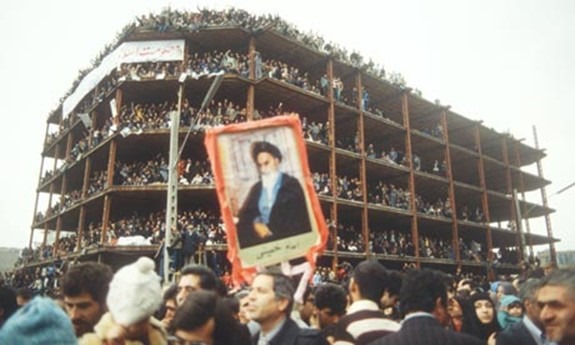
Yeltsin came to power after the coup attempt by hard-liners against Gorbachev because a KBG regiment sent to arrest Yeltsin mutinied against the orders of the hard-line coup leaders. Then everyone at the top of the military and security forces saw their main chance and switched sides. All popular revolutions against autocrats are ultimately palace revolutions, as I have argued before.
The loyalties of security forces are crucial in any political revolution. Within the security forces, a key concern is ending-up on the winning side in any show-down. Moving too early, too late or not at all have risks of their own when the time comes after a military coup to reward supporters and punish those that chose the wrong side, or even worse, sat on the side-lines waiting to see who would win.
Kuran argues that everyone has a different revolutionary threshold where they reveal their true beliefs, but even one individual shift to opposition leads to many others to come forward and defy the existing order. Small concessions only emboldens the ground-swell of revolution.
Those ready to oppose social intolerance or who are lukewarm in their intolerance keep their views private until a coincidence of factors gives them the courage to bring their views into the open. They find others share their views and there is a revolutionary bandwagon effect.
Plenty of people have had personal experiences of this in the 1980s and the 1990s when there were rapid changes in social and political attitudes about racism, sexism and gay rights.
A few political entrepreneurs such as Rod Croome had to stand up for what was right, and a surprisingly large number of others will quickly join the side pushing for social change.

In switching sides, these early movers and initial protestors encourage other hidden opponents of the established social and political order to switch. As knowledge of the opposition spreads and grows, the external cost of joining becomes lower.

In Crime Waves, Riots, and Revolutions, Alex Tabarrok makes the important related point that when the courts and police are over-crowded and over-whelmed, proportionately fewer criminals or protestors will be apprehended, convicted, and imprisoned or otherwise socially pressured to conform. This feedback effect from one decision to participate in crime or protest to the decisions of others to break the law or rebel can be highly significant.
Kuran argued that fear changes sides once the revolutionary bandwagon takes hold: genuine supporters of the old political or social older or the traditional social values falsify their publicly professed preferences, pretending that they support the new order.
These are late-switchers. Do not trust them.
These late switchers are opportunists who will as easily switch back or move on to support another coup or a counter-coup or a return to traditional values.
Kuran argued that the reason for the bloody purges among revolution movements after many takeovers is to find and route-out these late-switchers. Many are purged, rightly or wrongly, before they have a chance to betray the current leaders of the revolution or military coup.
There are plenty of Christian and family parties winning upper house seats in Australia and soon in the New Zealand House of Representatives. There are plenty of morally manoeuvrable politicians willing to switch to their side if they have enough votes.
Ministers of course have a whole range of dazzling qualities, including … um … well, including an enviable intellectual suppleness and moral manoeuvrability.
Sir Humphrey, The Death List
Addendum: don’t pretend it was just the old fogeys who were the social reactionaries back then in the 80s.
When a gay men’s club sought affiliation with the Tasmanian University Union’s Societies Council in 1983, a number of clubs spoke against it because they simply didn’t like gays. I was there representing a catholic college students club so I seconded the motion.
When the motion was put to the vote, it was carried on the voices with a lot of people not saying anything or mumbling against it.
The chairman of the meeting, who was a member of the Liberal club, wisely didn’t put the motion to a vote. He declared it carried and moved as quickly as possible to the next item of business in case there was a call for show of hands.
Anti-gay rhetoric was common among young people in the 1980s.
Stephen Franks: Time to call out the earthquake sooks-updated
20 Apr 2014 Leave a comment
in economics of natural disasters, economics of regulation, politics - Australia, politics - New Zealand Tags: earthquake building standards, Stephen Franks
An over-the-top blog post title spoiled a great round-up by Stephen Franks of the costs and benefits of higher building standards regarding earthquakes:
- Employees are pressing employers to avoid premises seen as risky even if the earthquake risk is a fraction of the risks faced by employees in their homes, or getting to and from work;
- Retroactive earthquake strengthening may cost more than the cost of a completely new building (the Canterbury Earthquake Royal Commission mentions up to 120%);
- Retroactively strengthening buildings outside our highest seismic risk regions is rarely likely to pass any rational cost/benefit test because few if any of them will ever cause an injury.
- The Martin Jenkins & Associates cost benefit study mentioned by the Canterbury Earthquake Royal Commission showed no retrospective upgrading policy that could deliver net economic benefit.
- Rationally, almost all existing weaker buildings should be allowed to end their useful life naturally and be replaced.
- In high risk Wellington the $60m the Council is looking at spending on the Town Hall would save more lives if spent on dedicated cycle-ways.
via StephenFranks.co.nz » Blog Archive » Time to call out the earthquake sooks.
I remember reading a justifiably bitter op-ed by a woman who survived the bus on which a wall fell on and flattened in the second Canterbury Earthquake in February 2011. Eleven died.
That historic wall was known to be in risk is collapse both before and after the first Canterbury Earthquake in 2010.
The wall could not be demolished because of restrictions under the Historic Places Act.
A relative sat on a council committee in a small country town that was among other things trying to demolish a derelict building. The building was protected by heritage legislation.
Permission was refused to demolish the derelict building even after it caught fire and nearly burnt down the pub next door.
So privatisation, deregulation and tax cuts in Australia were mistakes?
13 Apr 2014 Leave a comment
in applied welfare economics, politics - Australia Tags: deregulation, privatisation
The test of a mistake is if you can, you undo it.

The classic in Australia is Kim Beazley in the 1998 federal election:
- He was asked by a journalist that if the GST is a mistake, as he claimed, would he repeal the GST if he won office at some later time.
- Beazley waffled about you can’t unscramble an egg and so on. He could not admit the truth.
If deregulation was a mistake, campaign for a reintroducing of the two-airline policy, the bank regulation that suppressed competition, high tariffs on cars, electrical goods and clothes, and media regulation that outlawed cable TV. Campaign for a repeal of the GST and for 66% tax rates again on the middle class!
The Left must campaign for a buy back of the Commonwealth Bank, Qantas and Telecom. They will be a good buy. Public ownership is said by them to be as least as efficient as private ownership, and the cost of capital cost for state owned enterprises is allegedly less.
Go for it. It will ensure another 60 years is the wilderness for the Left. The only Left-wing government that held office in Australia since 1949 was the Whitlam Government from 1972 to 1975.
How biased is the Australian media?
03 Apr 2014 Leave a comment
in industrial organisation, market efficiency, politics - Australia, survivor principle Tags: media bias
Camped firmly over the middle-ground. Sorry to disappoint.
Leigh and Gans in "How Partisan is the Press? Multiple Measures of Media Slant" in The Economic Record 2012 employed several different approaches to find that the Australian media are quite centrist, with very few outlets being statistically distinguishable from the middle of Australian politics.
The minor exceptions were ABC Channel 2 and perhaps the Melbourne Age in its news slant in the 2004 election. Their media slants were small.
Australian newspapers tended to endorse the Liberal-National coalition in the federal elections from 1996 to 2007 although The Australian, right-wing rag that it is, backed the Labor Party in 2007! I agree that this was a serious lapse of judgement.
Another lapse is the editorial of April 6, 1995, where the Australian said: "The scientific consensus that global warming is occurring unnaturally, primarily as a result of industrial development and deforestation, is no longer seriously disputed in the world." Murdoch’s paper supports global action on climate change based on science.
The editorial endorsements series should have been longer in the analysis of Leigh and Gans because some newspapers back winners just before they become winners and oppose the re-election of tired and smelly governments that have being there too long no matter what their party.
The results of Leigh and Gans should come as no surprise. Newspapers that are out of tune with their readers lose sales and risk going broke. Plenty of newspapers are losing money these days because of the digital revolution in media. There is no scope left to indulge the political preferences of the owners at the expense of circulation. Margaret Simons got it right when she said:
The market is too small to support newspapers that don’t play to the centre ground … In a marketplace full of bland centrist publications and carefully mixed stables of commentators, small deviations can look extreme.
For links discussing the quality of the analysis of Leigh and Gans, see http://offsettingbehaviour.blogspot.co.nz/2009/09/measuring-media-bias-in-oz.html and http://economics.com.au/?p=4226 for Gans’ rely to http://andrewnorton.info/2009/09/02/can-public-intellectuals-be-used-to-assess-partisan-media-slant/
Lessons from how Australia came out of the Great Depression-updated
31 Mar 2014 Leave a comment
in great depression, macroeconomics, politics - Australia, politics - New Zealand Tags: fiscal austerity, great recession, New Deal, Premiers' Plan
How Australia got out of the Great Depression in the 1930s could have lessons for today, for the global financial crisis and the Great Recession. In Australia, the massive fiscal contraction from late 1930 onwards was called the Premiers’ Plan. In 1931, unemployment rates was 25% or more.
The Premiers’ Plan required the federal and state governments to cut spending by 20%, including cuts to wages and pensions and was to be accompanied by tax increases, reductions in interest on bank deposits and a 22.5% reduction in the interest the government paid on internal loans.
The Premiers’ Plan was complementary to the Arbitration Court’s 10 per cent nominal wage cut in January 1931 and the devaluation of the Australian pound. Most countries had abandoned the gold standard by 1931 and 1932 and devalued by about 10% including the UK. These competitive devaluations were called currency wars. Most countries below started to recovery before they left the gold standard, a year or two before they left the cross of gold.
Real GDP and dates of exit from gold standard

Sources: GGDC‑Maddison International Historical Database (http://www.ggdc.net/Maddison/), Bernanke et al. 1990; Gruen and Clark 2009.
The New Zealand Government also cut everything that could be cut by 20% in 1931.
Maclaren (1936) dated the Australian economic recovery from the last months of 1932. It was to take another three years before unemployment rates fell below 10 per cent — the rate it had been during most of the 1920s.
The June 1931 Premiers’ Plan of fiscal consolidation had time by late 1932 to become credible and take hold given the usual leads and lag on fiscal policy.
Unemployment data in the 2001 Australian yearbook of the Australian Bureau of Statistics graphed below shows a rapid fall in the high twenties unemployment rate in 1932 to be below 10 per cent by 1937. This fall started just after the 1931 Premiers’ Plan of fiscal consolidation.
Australian unemployment was 7.5 per cent in 1938, which is the long-term average for the period 1906 to 1929. The USA had an unemployment rate twice that in 1938 and was coming out of a double dip great depression.
Australia and New Zealand came out of the Depression earlier than most other countries because of the fiscal austerity under the Premiers’ Plan. The New Deal prolonged the great depression in the USA.
For those that doubt, how much lower would have been the Australian unemployment rate between 1932 and 1937 but for the fiscal contraction? What is your counter-factual? The role of fiscal policy in Australia in the 1930s is rather under-studied in Keynesian macroeconomics. Why?
The fiscal consolidation in the Premiers’ Plan removed fears of even harsher future taxes, stabilised expectations, increased consumers’ expected disposable incomes, and increased investor confidence and therefore stimulated private investment. See Keynes’ 1932 letter where he says
I am sure the Premiers’ Plan last year saved the economic structure of Australia.
What is neoliberalism? Please tell me – show me one.
27 Mar 2014 4 Comments
in F.A. Hayek, macroeconomics, Milton Friedman, politics - Australia, politics - USA Tags: economic reform, Milton Friedman, neoliberalism, political change
I want to meet someone who believes neoliberalism was the leading light of the economic reforms since 1980. They can then tell me what neoliberalism is. Please, tell me.
The prefix “neo-” makes “neoliberalism” sound like something that morphed into something bad. Is neoliberalism something more than a sustained sneer – a personal attack as a way of avoiding debate?
Not only is there no single definition of neoliberalism, there is no one who identifies himself or herself as a neoliberal. At least communists and socialists were proud to be called so.
In Neoliberalism: From New Liberal Philosophy to Anti-Liberal Slogan, Taylor Boas & Jordan Gans-Morse went in search of anyone who identifies one’s self as a neoliberal:
- They did not uncover a single contemporary instance in which an author used the term self-descriptively, and only one – an article by New York Times columnist Thomas Friedman (1999) – in which neoliberal was applied to the author’s own policy recommendations.
- Digging into the archives, they did find that while Milton Friedman (1951) embraced the neoliberal label and philosophy in one of his earliest political writings, he soon distanced himself from the term, trumpeting “old-style liberalism” in later manifestoes (Friedman 1955). See “Neo-liberalism and its Prospects”, Milton Friedman Papers, Box 42, Folder 8, Hoover Institution Archives. 1951. Hardly a smoking gun?
What Boas and Gans-Morse found, based on a content analysis of 148 journal articles published from 1990 to 2004, was that the term is often undefined. It is employed unevenly across ideological divides; it is used to characterise an excessively broad variety of phenomena.
That is academic speak for neoliberalism is an empty slogan.
Neoliberalism was supposed to rule the roost under Reagan, Thatcher, Hawke and Lange-Douglas. The local branches of neoliberalism were Thatchernomics, Rogernomics, and Reaganomics.
Milton Friedman is said to have mesmerised several countries with a flying visit. The Friedman Monday Conference on ABC in 1975 and by Hayek in 1976 are still ruling the Australian policy roost, if some serious public commentators are to be believed.

In the 1980s and up to the mid-1990s, despite all the neo-liberal deregulation and Milton Friedman taking over monetary policy, mentioning Friedman’s name at job interviews would have been extremely career limiting, and that was at the Australian Treasury.
Back then, the much less radical Friedman was just graduating from being a wild man in the wings to just a suspicious character.
If you name dropped Hayek in the early 1990s, any sign of name recognition would have indicated that you were being interviewed by educated people.
When the Left gets on its high horse and goes on about Hayek and Friedman running neoliberalism, with Hayek as Friedman’s mentor, it is refreshing to remind all how little they had in common on macroeconomics. The University of Chicago Department of Economics did not offer Hayek a job in the late 1940s despite his outstanding record at LSE as Keynes’ principal critic in the 1930s.
While working at the next desk to a monetary policy section in the late 1980s, when mortgage rates were 18%, I heard not a word of Friedman’s Svengali influence:
- The mantra for several years was that the market determined interest rates, not the Reserve Bank. Joan Robinson would have been proud that her 1975 Monday conference was still holding the reins.
- Monetary policy was targeting the current account. Read Edwards’ biography of Paul Keating’s time as Treasurer and Prime Minister and his extracts from very Keynesian treasury briefings to Keating signed by David Morgan that reminded me of Keynesian Macro 101.
As a commentator on an Australian Treasury seminar paper in 1986, Peter Boxhall – freshly educated from the 1970s Chicago School – suggested using monetary policy to reduce the inflation rate quickly to zero. David Morgan and Chris Higgins almost fell off their chairs. These Treasury Deputy CEOs had never heard of such radical ideas.
In their breathless protestations, neither Morgan nor Higgins were sufficiently in tune with their Keynesian education to remember the role of sticky wages or even the need for monetary growth reductions to be gradual and, more importantly, credible, as per Milton Friedman.
By the way, Friedman’s presidential address to the AEA in 1967 is now recognised as perhaps the single most influential journal article of the 20th century. That article is the essence of good communication and empirical testing of competing hypotheses as was his 1976 Noble Prize lecture. No wonder both were hidden from impressionable undergraduates such as me a few years after.


Recent Comments