
Celebrating humanity's flourishing through the spread of capitalism and the rule of law
15 Mar 2018 Leave a comment
in economics of crime, gender, law and economics, politics - New Zealand


14 Mar 2018 1 Comment
in applied price theory, applied welfare economics, economics of regulation, international economics, politics - New Zealand, Public Choice
This submission is in my personal capacity. I am an economic consultant in Wellington who has worked in the past for the Ministry of Business, Innovation and Employment, the Department of Labour, the Ministry of Social Development, Child, Youth and Families Department and the New Zealand Treasury, and in Canberra for the Productivity Commission, the Department of Prime Minister and Cabinet, and the Department of Finance. I have Masters degrees in economics and in public policy from the Australian National University and from the now National Graduate Institute for Policy Studies in Tokyo respectively. I have written op-eds on the Trans-Pacific Partnership Agreement and other topics for the New Zealand Herald, Dominion Post and National Business Review. I blog at www.utopiayouarestandinginit.com
Free trade agreements are at best suspect. That is not me saying this. That is Paul Krugman, his generation’s leading trade theorist.
Krugman argues that you should start as a mild opponent of any free trade agreement. Closely inspect the baggage they carry; environment and labour chapters, intellectual property, investor state dispute settlement (ISDS) and government procurement such as Pharmac. Start with a sceptical eye.
These add-on chapters are the costs of free trade agreements that are relatively obvious to the untrained eye. No technical economics is yet required to suspect that any trade agreement will be an opportunity for special interests on the right and the left, both unions and big corporations, to feather their own nest. Longer patent lives, more stringent enforcement of overseas copyrights, Pharmac buying more expensive drugs, and so on in return for tariff cuts in export markets.
But let us start with what is claimed as the benefits by the government. In a TPPA without the USA, in about 30-years’ time, as little as 0.3% extra GDP and at most 1% more GDP in sum will be generated. Less than one quarter of these modest gains over 30 years come from tariff cuts.
The rest of the gains are from behind the border changes from streamlining customs to investor state dispute settlement. Never easy to quantify because even the most impartial spectators can disagree amongst themselves on whether these regulations are a plus or minus to begin with, so they cannot agree on whether reducing or increasing them are a plus or not. The 20 odd carve-outs and side letters negotiated by the new government was all about prying back this baggage. This suggests that most of this baggage should not have been loaded up to begin with.
The only time tariff cuts are suspect is when they are part of a free trade agreement. The reason is trade diversion. A technical concept which MFAT does not know about because I received a nil response to an Official Information Act request about their TPPA advice to ministers about the costs and benefits including any reference to trade diversion.
We have been of the rough end of trade diversion in the two biggest trade agreements to affect us. When Britain entered the Common Market in 1973, they stop buying cheap New Zealand lamb in favour of expensive French lamb. The tariff revenue collected by the British on our lamb exports was converted into payments to prop up hopelessly inefficient French farmers. British consumers paid the same or more for lamb and there was no tariff revenue to collect.
New Zealand car buyers then got screwed by Closer Economic Relations. Instead of buying cheap Japanese imports and collecting a tariff, Holdens and Fords became cheap because they did not pay this tariff. Cars were not cheaper for New Zealand buyers; the tariff revenue went off to Australian car manufacturers as higher import prices to keep their hopelessly inefficient car plants open.
With the USA out of the TPPA, the tariff cuts are less even if there was no trade diversion and we still have all the baggage in the agreement from environment and labour chapters, intellectual property, threats to Pharmac, and ISDS. The costs have not gone down but the benefits have because of the loss of the single biggest market planning to join the agreement.
Investor state dispute settlement has no place in trade agreements between democracies. They have the rule of law where investors can take their chances in domestic politics just like the rest of us. Yes, there will be breathless populism from the left or right from time to time, such as recently over foreign land sales, but by and large foreign investment is welcome and gets a fair deal.
Developing countries offered to sign on to investor state dispute settlement because their own courts are corrupt. Maybe investor state dispute settlement worked 50 years ago when investment in developing countries was tiny and handled by a few big players who might get picked on by politicians looking for a few cheap votes or more likely, a backhander to the Swiss bank account.
Now there is broad-based trade and investment in developing countries despite their corrupt courts and dodgy politicians. Many exporters and investors are willing to take their chances. When the local politicians and bureaucrats get rough, investors have already factored that in by backing investments with high enough returns to compensate for these risks. Tourists buy travel insurance and keep their eyes open; investors know the rules abroad are different and must be just as watchful.
Japan, Singapore, South Korea, Hong Kong, Taiwan and the other Asian Tigers and now India too managed to have development miracles without investor state dispute settlement. Extreme poverty dropped by about 1/3rd around the globe over the decade or so course of the TPPA negotiations and far more than that in China so I think they are getting on pretty well without it.
Most of these points are lost in the debate on the TPPA because too many of its opponents are motivated by anti-capitalist or anti-foreign sentiments rather than cost benefit analysis. They would oppose a trade agreement solely about tariffs that lowered prices to New Zealand consumers.
Not every trade negotiation is successful. For some, you reach the point where you must walk away. More so because of all the baggage loaded up into trade agreements in the last few decades.
There should be a hard-nosed benefit cost analysis and when the USA was in, the TPPA might have been worth the risk, just. More access to the US market may have made up for all the other baggage. The price has gone up on signing the TPPA, so much so we probably should give it a miss.
11 Mar 2018 1 Comment
in applied price theory, economics of regulation, politics - New Zealand, Public Choice, rentseeking, urban economics Tags: housing affordability, land supply, zoning
10 Mar 2018 Leave a comment
in politics - Australia, politics - New Zealand, politics - USA, Public Choice Tags: political psychology
03 Mar 2018 Leave a comment
in economics of media and culture, politics - New Zealand

03 Mar 2018 Leave a comment
in environmental economics, global warming, politics - New Zealand
What rubbish. Dozens have estimated the cost of global warming including regional and national estimates of the cost of global warming.

From official information act Official Information Act request to the Ministry of Environment.
24 Feb 2018 Leave a comment
in economics of crime, law and economics, politics - New Zealand

19 Feb 2018 Leave a comment
in development economics, economics of bureaucracy, economics of crime, growth disasters, politics - New Zealand
Japanese ODA agencies budget 10% for donations. Their main interest is making sure that these donations go to the politicians who can actually deliver on removing roadblocks to their aid delivery rather than chancers who try it on and never deliver. Benazir Bhutto’s husband was Mr. 10% when she was first prime minister. He was a net plus to the country according to The Economist Magazine article of say 20 years ago because investors only had to pay him rather than dozens of petty bureaucrats, each wanting a taste. These payments are lawful under the laws of Western countries because they are facilitation payments. They are not bribes because the foreign company is only paying the politician or bureaucrat to do what is his duty to do in the first place rather than stall the process in the hope of a bribe.

From The Dictator’s Handbook.
18 Feb 2018 Leave a comment
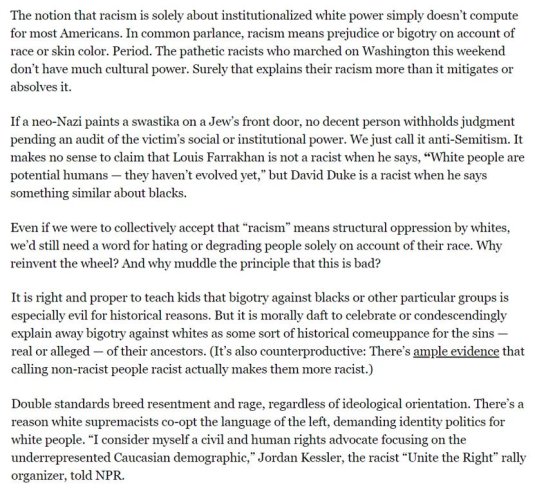
in politics - Australia, politics - New Zealand, politics - USA Tags: political correctness
17 Feb 2018 Leave a comment
in economics of education, politics - New Zealand, unions
Unions fight for better playing conditions for their members. Is not that what the class war is all about? Unions are not there to act as management consultants to the employer, working out ways to make their wage slaves profitable – extract more labour surplus.
Please do not mention that the employer of teachers is the state sector. That is an argument against unions in the state sector, a very slippery slope.
When the interests of the union and it is teacher members and the interests of children conflict, the union will do what its mission is which is to protect its members.
The first jobs to be unionised were craft jobs. The craft unions certainly foster the marketability of their members but were keen to suppress competition nonetheless. To quote Charles Baird
Most unions in the private sector are in crafts and industries that have few companies or that are concentrated in one region of the country. This makes sense. Both factors—few employers and regionally concentrated employers—make organizing easier. Conversely, the large number of employers and the regional dispersion of employers sharply limit unionization in trade, services, and agriculture. A 2002 unionization rate of 37.5 percent in the government sector, more than four times the 8.5 percent rate in the private sector, further demonstrates that unions do best in heavily regulated, monopolistic environments. Even within the private sector, the highest unionization rates (23.8 percent) are in transportation (airlines, railroads, trucking, urban transit, etc.) and public utilities (21.8 percent), two heavily regulated industries.
Craft unions opposed unionisation of less skilled workers because it threatens their own ability to extract higher wages as explained in the Wikipedia entry:
The concept of organizing a strong federation on the basis of craft evolved out of conflict between the Knights of Labor (KOL), which organized mass organizations of unskilled, semiskilled and skilled workers by territory, and the American Federation of Labor (AFL), which organized only skilled workers.[1] The craft workers were capable of demanding more from their employers due to their skills, and therefore organized into stronger organizations pursuing narrower interests.[2] The AFL was formed as a direct result of the perceived need by skilled workers to defend their individual craft organizations from poaching by the Knights of Labor.[3] The Knights of Labor believed that skilled workers should dedicate their greater leverage to benefit all workers.[4] Selig Perlman wrote in 1923 that this resulted in “a clash between the principle of solidarity of labor and that of trade separatism.”[2] The trade unions “declared that their purpose was ‘to protect the skilled trades of America from being reduced to beggary’.”[5]… As long as the craft unions were the dominant power in the AFL, they took every step possible to block the organizing of mass production industries. This led to challenges from both inside and outside the Federation.
The craft unions such as teachers unions have more bargaining power because they are difficult to replace on short notice unlike less skilled workers. In addition, teachers are much more difficult to automate away. I am not too sure what the teachers union might think of giving more responsibility to teachers aides?
15 Feb 2018 Leave a comment
in economics of crime, health economics, liberalism, politics - New Zealand
Assisted suicide has had popular support for many decades. The two previous attempts at passing a Death with Dignity Bill failed despite widespread public support:
The reason political parties do not act is those who are against assisted suicide are passionately against it and will change their vote because of such a bill. Those who are for assisted suicide are unlikely to change their vote if a bill is not passed by Parliament.
Any bill that does go for on assisted dying will divide Parliament in much the way it divides the community which is into three equally sized groups.
Those doubts are legitimate and entitled to be satisfied before an MP votes for the bill.
Many who support euthanasia in principle have serious reservations about the ability to craft a Bill that prevents abuses. Parliaments have an interest in protecting vulnerable groups–including the poor, the elderly, and disabled persons–from abuse, neglect, and mistakes.
Many people have strong views on exactly when and when not euthanasia is permissible because of their views about the sanctity of life and the risk of abuse. The recent High Court judgement on an unsuccessful application for an exception to the criminal law on assisted suicide said that:
The sanctity of human life principle underpins the criminal law relating to culpable homicide. It was said by Blackstone to be the first rule of English law.
When making an exception to the first rule of law, people want to know exactly what they are voting for and exactly what safeguards apply the proposed exceptions. A badly drafted bill may offer insufficient assurances to some MPs about preventing abuse and ensuring people who are depressed are not offered options that are not in their best interests.
Others have moral or religious objections. The religious objections were summarised by Blackstone, in his Commentaries on the Laws of England, where suicide was also a spiritual offence:
…in evading the prerogative of the Almighty, and rushing into his immediate presence uncalled for
Many Bills have failed such as recently in the Scottish Parliament and in 2003 in the New Zealand Parliament because they were badly drafted and were considered to offer insufficient protection of the vulnerable against abuse and melancholy.
Even when courts rule favourably on the matter, such as in Canada with its recent Supreme Court decision under its Bill of Rights, that court suspended its judgement upholding the right to euthanasia for 12 month so that the Canadian Parliament could work out the ever so vital details by passing a Bill. As the Supreme Court of United Kingdom recently ruled:
… unless the court can be satisfied that any exception to the subsection can be operated in such a way as to generate an acceptably small risk that assistance will be afforded to those vulnerable to pressure to seek to commit suicide, it cannot conclude that the absolute prohibition in the subsection is disproportionate to its legitimate aim.
That is the essence of reservations about end of life choice. Blackstone’s ratio applies to standards of proof in criminal proceedings: it is better that 10 guilty go free than one innocent suffer.

Those with reservations about end of life choice have the same concerns that motivated Blackstone’s ratio. Their reservations are focused on few cases of abuse not justifying the benefits of going gently into that good night by making exceptions from an absolute prohibition under the criminal law against assisted suicide for the terminally ill despite they being of sound mind and independent judgement.
The law has long acted to prevent, by force if necessary, suicide – including suicide by refusing to take appropriate measures necessary to preserve one’s life after the point at which life become unbearable. Whether the patient’s wishes to be honoured in this area is left to elected representatives to legislate. Justice Scalia asks
Are there, then, no reasonable and humane limits that ought not to be exceeded in requiring an individual to preserve his own life? There obviously are, but they are not set forth in the Due Process Clause.
What assures us that those limits will not be exceeded is the same constitutional guarantee that is the source of most of our protection – what protects us, for example, from being assessed a tax of 100% of our income above the subsistence level, from being forbidden to drive cars, or from being required to send our children to school for 10 hours a day, none of which horribles is categorically prohibited by the Constitution.
Our salvation is the Equal Protection Clause, which requires the democratic majority to accept for themselves and their loved ones what they impose on you and me.
The biggest threat to an End of Life Choice bill passing the New Zealand Parliament was judicial intervention in this charged social issue that will only mobilises the opponents of the right the applicants to the court seek. Scalia again this time on the risks of the courts moving in advance of the popular will, and thereby poisoning the democratic process:
Leaving this matter to the political process is not only legally correct, it is pragmatically so. That alone… can produce compromises satisfying a sufficient mass of the electorate that this deeply felt issue will cease distorting the remainder of our democratic process.
As an example of the importance of democratic compromises in securing the votes in Parliament, there is a voluntary euthanasia bill currently before the Scottish Parliament. It has been stuck in committee for two years because it not only promises end of life choice, it also grants a right of euthanasia to those with progressive degenerative diseases.
By overreaching to progressive degenerative diseases, the Bill in the Scottish Parliament was bogged down because euthanasia as distinct from a death with dignity is a step too far from many members of Parliament willing to support end of life choice for the terminally ill such as provided for in the House of Lords Private Member’s Bill on end of life choice which later failed in the Commons.
Any private member’s bill that does pass the New Zealand Parliament on end of life choice will be riddled with compromises and will have a genuine concern to prevent abuse and guard against questionable decisions made when judgements of the terminally ill is clouded in some way. No court in a single judgement can provide all those details and compromises.
The great strength of democracy is a small group of concerned and thoughtful citizens can band together and change things by mounting single issue campaigns or joining a political party and running for office and winning elections or influencing who wins.
Indeed, it is that very strength of democracy – small groups of concerned citizens banding together – is what is holding up legislating on an end of life choice. It is not that minorities are powerless and individuals are voiceless. Exactly the opposite.
Many people have passionate opinions for and against an End of Life Choice Bill. These opinions are taken into account by members of Parliament in fine detail depending on how voters will vote at the next election. What can be undemocratic about members of Parliament paying attention to how a wide range of ordinary members of the community might vote if they disappoint them.
The key safeguard of minorities against the majority is their ability to block vote. Yes, those in the majority will be annoyed at the power of the minority to slow down the passage of a End of Life Choices Bill. Yet on some other matter passionate to them those currently in the majority will one day or another end up in a minority. The rotation of power is common in democracies, and the worst rise to the top.
It is wise to design constitutional safeguards to minimise the damage done when those crazies to the right or left of you get their chance in office, as they will sooner or later rather than focus on the powers you and those that currently agree with you should have in your few days in which you fleetingly have a majority. Too many policies and ideas of the one political party or another assume that they are the face of the future, rather than just another political party that will hold power as often as not and always for an uncertain time.
New Zealand Parliamentary elections are always close because of proportional representation. This makes reality of ending up in the minority again very quickly in a few years very real.
Yesterday’s majority of the vote sooner or later and often sooner than they expect will break off into different minorities on the next big issue of the day.
These newly formed minorities will use that same ability to band together as a minority to block vote to protect what they think is important and advance agendas they think are to be wider benefit despite the opinion of the current majority to the contrary. All reforms start as a minority viewpoint.
You can’t complain about democracy not working because it’s working precisely as it should: parliamentarians paying close attention to how a great number of people from all walks of life vote in light of how they as members of Parliament voted on specific issues important to them.
The democratic process must strike a proper balance between the interests of terminally ill, mentally competent individuals who would seek to end their suffering and the State’s interests in protecting those who might seek to end life mistakenly or under pressure. The pros and cons of euthanasia as a practical matter is ably summarised by Richard Posner:
Countries and states that authorize physician-assisted suicide impose strict requirements that minimize the danger of involuntary euthanasia—too strict, some believe (such as the requirement in Dutch law that the patient’s suffering be “unbearable” before he can invoke physician assistance to end his life).
These requirements (which further reduce the stigma of physician-assisted suicide by confining the practice to cases of genuine desperation) are not airtight, or uniformly observed.
Any system will be abused. The question is whether the incidence of abuses, combined with the other costs of the system, outweigh the benefits.
Gary Becker has written frequently on the issue of euthanasia and suicide. Indeed, he wrote the Economic Theory of Suicide, not long after his wife took her own life in the early 1970s. He argues well about people’s ability to weigh the considerations:
Rational forward–looking persons with good information about their future circumstances would commit suicide only when convinced that they would be worse off by continuing to live.
David Hume said (in his Essays on Suicide and the Immortality of the Soul) “That suicide may often be consistent with interest and with our duty to ourselves no one can question, who allows that age, sickness, or misfortune may render life a burden, and make it worse than annihilation.”
Schopenhauer was also confident about the rationality of suicide, “It will generally be found that, as soon as the terrors of life outweigh the terrors of death, a man will put an end to his life” (Parerga and Paralipomena).
Becker also wrote insightfully of the terrors of death:
Hume adds “I believe no man ever threw away life, while it was worth keeping. For such is our natural horror of death”, and Schopenhauer makes the same observation “But the terrors of death offer considerable resistance…”
The reason why Death with Dignity Bills fail in Parliament is those in the community who are against it are passionately against that it and will change their vote if it passed. Those that are for it are not swinging or single issue voters.
The way in which a bill on assisted dying is to be passed is by normal democratic means: by trying to persuade each other and elections. As United States Supreme Court Justice Antonin Scalia said
The virtue of a democratic system [with a constitutionally guaranteed right to free speech] is that it readily enables the people, over time, to be persuaded that what they took for granted is not so and to change their laws accordingly.
Yes, assisted dying years a passionate issue and some people are impatient and wanted to use the courts, but again I believe Justice Scalia is right when he said:
We might have let the People decide. But that the majority will not do. Some will rejoice in today’s decision, and some will despair at it; that is the nature of a controversy that matters so much to so many. But the Court has cheated both sides, robbing the winners of an honest victory, and the losers of the peace that comes from a fair defeat. We owed both of them better. I dissent.
That importance of a fair defeat at the ballot box and in Parliament is important both to when and if a bill on end of life choice is passed, and to how quickly support opposition to that bill will be mobilised before such a bill even is put into the Parliamentary ballot of private member’s bills.
Nothing stirs up the impassioned (and most other people as well) more than depriving them of their right to support or oppose what is important to them through political campaigns and at an election. The losing side, we all end up on the losing side at one time or another, are much more likely to accept an outcome if they had their say and simply lost the vote at the election or in Parliament.
The advocates of a referendum want to remake democracy with the faculty workshop as their model. Such deliberation has demanding requirements for popular participation in the democratic process, including a high level of knowledge and analytical sophistication and an absence, or at least severe curtailment, of self-interested motive.
Representative democracy is a division of labour in the face of information overload. John Stuart Mill had sympathy for parliaments as best suited to be places of public debate on the various opinions held by the population and as a watchdog of the professionals who create and administer laws and policy:
Their part is to indicate wants, to be an organ for popular demands, and a place of adverse discussion for all opinions relating to public matters, both great and small; and, along with this, to check by criticism, and eventually by withdrawing their support, those high public officers who really conduct the public business, or who appoint those by whom it is conducted.
Representative democracy has the advantage of allowing the community to rely in its decision-making on the contributions of individuals with special qualifications of intelligence or character. Representative democracy makes a more effective use of resources within the citizenry to advance the common good.
Members of parliament are trustees who follow their own understanding of the best action to pursue in another view. As Edmund Burke wrote:
Parliament is not a congress of ambassadors from different and hostile interests; which interests each must maintain, as an agent and advocate, against other agents and advocates; but parliament is a deliberative assembly of one nation, with one interest, that of the whole; where, not local purposes, not local prejudices ought to guide, but the general good, resulting from the general reason of the whole.
You choose a member indeed; but when you have chosen him, he is not a member of Bristol, but he is a member of parliament. … Our representative owes you, not his industry only, but his judgment; and he betrays instead of serving you if he sacrifices it to your opinion.
Modern democracy is government subject to electoral checks. Citizens do have sufficient knowledge and sophistication to vote out leaders who are performing poorly or contrary to their wishes. Modern democracy is the power to replace governments at periodic elections.
Richard Posner argued that a representative democracy enables the adult population, at very little cost in time, money or distraction from private pursuits commercial or otherwise:
The power of the electorate to turn elected officials out of office at the next election gives elected officials an incentive to adopt policies that do not outrage public opinion and administer the policies with some minimum honesty and competence.
A referendum is an all or nothing choice that does not allow an iterative process where people can converge on better and better drafts of the proposed law. Only Parliament can do that.
Bills have 3 readings on the floor of the house and a select committee process for a reason. There is plenty of time for the parliament to deliberate consider options and alternatives and change its mind in light of further revisions to a bill. None of those possibilities for reflection and reconsideration are available in a referendum. That is why we live in a representative democracy.
We choose people and parties who we see to be of sound judgement and leave the details to them. If they keep getting it wrong, those members of parliament will pay at the ballot box.
12 Feb 2018 1 Comment
in applied price theory, economics of regulation, politics - New Zealand, poverty and inequality, urban economics
12 Feb 2018 Leave a comment
in politics - New Zealand, poverty and inequality, urban economics
09 Feb 2018 Leave a comment
in politics - New Zealand, urban economics Tags: affordable housing, land supply

04 Feb 2018 1 Comment
in economics of bureaucracy, economics of crime, politics - New Zealand
One of the first things I noticed after coming to New Zealand from Australia in 1998 was the petty veniality in government departments.

In my first week, I discovered employers pay for farewells. No chance in Canberra. We take our colleague out for lunch and have a whip-round to pay for their lunch. If it was a retirement function, such as for a long serving employee, the senior staff would pay for it out of their own pocket. The taxpayer never ever paid.
Then I noticed that public servants would charge lunches with each other to their government credit card. They would buy wine! By chance, I discovered when working at the Productivity Commission that the chairman was authorised to send out for sandwiches if a meeting ran over lunch time. He never did. The last time I remember a meeting running over lunch, the deputy chairman, who later went on to be the chairman, bought the sandwiches out of his own pocket.
It got worse when I noticed who went on overseas trips. When it was a more exotic location, a much more senior manager felt the need to represent his country. Enthusiasm in a minister’s office for going to a rather boring international meeting picked up no end when they discovered it was in Istanbul.
I thought most overseas travel was a waste of time in 1999 even with that so primitive an Internet back then so I actively avoided it and never proposed a trip. This became crystal clear when we were receiving cables from the embassy in Washington and London telling me what I had already read in the Washington Post and the London Times while they were sleeping. The Ministry of Foreign Affairs a couple years later installed desktop Internet access.
Then to my astonishment, I found that government employees would take holidays at the end of their business travel. If you tried that in Australia, you would be fired and hopefully your manager too for not setting the right tone. It would never be considered.
If you were on an interstate secondment, as some friends once were from Adelaide to Canberra for the Tax Office, they were entitled to take leave equal to the amount of time accrued while on that secondment. If they were away for one month, they were entitled to take one and a half days leave and receive travelling allowances and so forth for those one and a half days.
Clearly, it would give an appearance of bias when you are writing the business case if you could get it business class air ticket to the other side of the world and then take a long holiday on the way back. Appearances count, especially when you are thinking about taxpayers’ money.
New Zealand government departments seem to employ a lot of contractors as policy analysts. I have never heard of such things in Canberra when working at the Department of Finance, the Prime Minister’s Department and the Productivity Commission.
If a manager could not recruit and retain enough analysts to work through peaks and troughs in the workload, you were not a very good manager. If it was a real crisis, you found someone who was not busy from within the organisation and had them seconded to your team.
In more than a few places, these contractors seemed to be good friends of the manager. These contractors can be hired so quickly and in such number that a new manager can find no time to talk to his existing staff about what they do now, what they might do in the coming months or what skill sets they might have. Is always a bit odd that new managers can hire a couple of contractors but not have time to sign a performance agreement with any of his staff in that year.
I was talking to a colleague, also a migrant to this country from another state sector about how he would always refuse attempts by people to buy him lunch or a beer. Like me, he would be up the back eating his own sandwiches while the senior executives tucked into 3 course lunches plus wine provided by various lobby groups.
Until I came to New Zealand, the taxpayer had never bought me lunch or a beer. I was careful to refusal offers of hospitality. If an offer was made, I thought they were up to something.
But worst of all, worse than any of this veniality, the worst culture shock of all was until I came to Wellington, I had never been to a team meeting. When I was asked to go to my first team meeting, the 2nd day on the job, I just had to wing it.
In Australia, managers are expected to keep staff in the loop and staff are expected to talk to each other about what they are working on in case they can help each other. Managers and staff are expected to be frugal with their time as well as the taxpayers’ money paying their salaries.
Celebrating humanity's flourishing through the spread of capitalism and the rule of law
Scholarly commentary on law, economics, and more
Beatrice Cherrier's blog
Celebrating humanity's flourishing through the spread of capitalism and the rule of law
Why Evolution is True is a blog written by Jerry Coyne, centered on evolution and biology but also dealing with diverse topics like politics, culture, and cats.
Celebrating humanity's flourishing through the spread of capitalism and the rule of law
A rural perspective with a blue tint by Ele Ludemann
DPF's Kiwiblog - Fomenting Happy Mischief since 2003
Celebrating humanity's flourishing through the spread of capitalism and the rule of law
The world's most viewed site on global warming and climate change
Tim Harding's writings on rationality, informal logic and skepticism
A window into Doc Freiberger's library
Let's examine hard decisions!
Commentary on monetary policy in the spirit of R. G. Hawtrey
Thoughts on public policy and the media
Celebrating humanity's flourishing through the spread of capitalism and the rule of law
Politics and the economy
A blog (primarily) on Canadian and Commonwealth political history and institutions
Reading between the lines, and underneath the hype.
Economics, and such stuff as dreams are made on
"The British constitution has always been puzzling, and always will be." --Queen Elizabeth II
Celebrating humanity's flourishing through the spread of capitalism and the rule of law
WORLD WAR II, MUSIC, HISTORY, HOLOCAUST
Undisciplined scholar, recovering academic
Celebrating humanity's flourishing through the spread of capitalism and the rule of law
Res ipsa loquitur - The thing itself speaks
In Hume’s spirit, I will attempt to serve as an ambassador from my world of economics, and help in “finding topics of conversation fit for the entertainment of rational creatures.”
Researching the House of Commons, 1832-1868
Articles and research from the History of Parliament Trust
Reflections on books and art
Posts on the History of Law, Crime, and Justice
Celebrating humanity's flourishing through the spread of capitalism and the rule of law
Exploring the Monarchs of Europe
Cutting edge science you can dice with
Small Steps Toward A Much Better World
“We do not believe any group of men adequate enough or wise enough to operate without scrutiny or without criticism. We know that the only way to avoid error is to detect it, that the only way to detect it is to be free to inquire. We know that in secrecy error undetected will flourish and subvert”. - J Robert Oppenheimer.
The truth about the great wind power fraud - we're not here to debate the wind industry, we're here to destroy it.
Celebrating humanity's flourishing through the spread of capitalism and the rule of law
Economics, public policy, monetary policy, financial regulation, with a New Zealand perspective
Celebrating humanity's flourishing through the spread of capitalism and the rule of law
Restraining Government in America and Around the World
Recent Comments