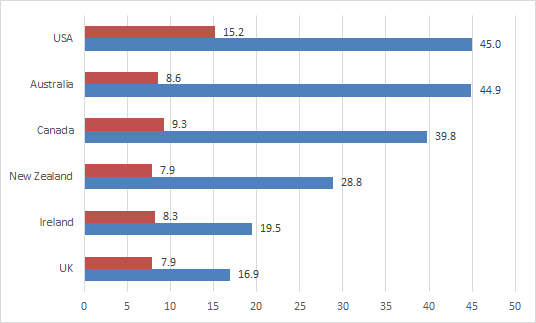
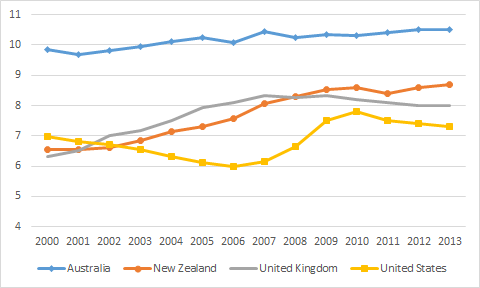
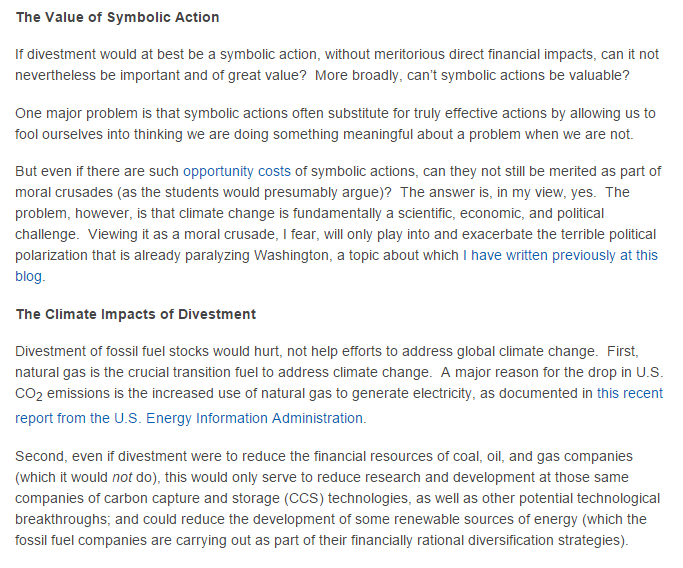
How Taxes Affect Investment Decisions For Multinational Firms onforb.es/1Oe5lKu by @ErikCederwall http://t.co/BduZZbHs2n—
Tax Foundation (@taxfoundation) April 15, 2015
How Taxes Affect Investment Decisions For Multinational Firms
11 May 2015 Leave a comment
in applied price theory, politics - Australia, politics - New Zealand, politics - USA, public economics Tags: company tax rates, foreign investment, multinational corporations, tax competition
Housing affordability and land regulation around the globe
11 May 2015 Leave a comment
in politics - Australia, politics - New Zealand, politics - USA, urban economics Tags: land supply, land use regulation, NIMBYs, RMA, zoning
Auckland is up with London and New York in terms of housing unaffordability relative to median incomes. US cities with responsive land regulation don’t experience housing bubbles.
Glaeser and Gyourko summarised the findings of a number of studies on land supply and housing prices:
Recent research also indicates that house prices are more volatile, not just higher, in tightly regulated markets …. price bubbles are more likely to form in tightly regulated places, because the inelastic supply conditions that are created in part from strict local land-use regulation are an important factor in supporting ever larger price increases whenever demand is increasing.
…. It is more difficult for house prices to become too disconnected from their fundamental production costs in lightly regulated markets because significant new supply quickly dampens prices, thereby busting any illusions market participants might have about the potential for ever larger price increases.
Via The Truth About the U.S. Housing Market | Seeking Alpha.
Full-time work on the minimum wage is enough to keep a NZ family out of poverty!
10 May 2015 Leave a comment
in labour economics, minimum wage, politics - Australia, politics - New Zealand, politics - USA, poverty and inequality Tags: capitalism and freedom, child poverty, family poverty, Left-wing hypocrisy, living wage, New Zealand Greens, New Zealand Labour Party, Simon Chapple
Where a 40-hour workweek doesn't lift families from poverty: bloom.bg/1AFOD0q http://t.co/eBoJSz1TkX—
Bloomberg VisualData (@BBGVisualData) May 23, 2015
An OECD chart that shows New Zealand parents only need to work a little over 40 hours a week on the minimum wage to lift a family out of poverty in New Zealand.
The figure above shows that a lone parent with two children needs to work about 25 hours a week stay out of poverty in 2013 in New Zealand Once taxes are taken into account as well as additional family benefits such as in-work tax credits. New Zealand is one of the easiest places in the world to get out of poverty by working part-time for a sole mother.
The figure above from the OECD shows that New Zealand couple with two children needs to work about 40 hours a week to stay out of poverty. Of course, what is poverty depends on the definition of the poverty line and in this case by the OECD, it is defined as 50% of the median wage after taxes and family benefits. Another common definition of poverty is earning less than 60% of the median wage
The minimum wage is $14.75 per hour in New Zealand while proposals for a living wage in New Zealand are now $19.25 an hour. The Labour Party wants to increase the minimum wage to $15 per hour.The Greens want to increase the minimum wage to the living wage.
Simon Chapple and Jonathan Boston pointed out in their excellent book last year on child poverty in New Zealand that full-time work by one parent and part-time work by the other in the same household is enough to lift families out of most definitions of poverty:
Sustained full-time employment of sole parents and the fulltime and part-time employment of two parents, even at low wages, are sufficient to pull the majority of children above most poverty lines, given the various existing tax credits and family supports.
The best available analysis, the most credible analysis, the most independent analysis in New Zealand or anywhere else in the world that having a job and marrying the father of your child is the secret to the leaving poverty is recently by the Living Wage movement in New Zealand.
According to the calculations of the Living Wage movement, earning only $19.25 per hour with a second earner working only 20 hours affords their two children, including a teenager, Sky TV, pets, international travel, video games and 10 hours childcare. This analysis of the Living Wage movement shows that finishing school so your job pays something reasonable and marrying the father of your child affords a comfortable family life.
The OECD’s analysis also showed that incentives for New Zealanders to work more and earn more is better than in most countries in terms of what happens if they earn a wage increase.
In New Zealand, when there is a 5% minimum wage increase, four percentage points of that wage increase actually stays in the hands of the worker.
In some countries such as Australia, the USA and UK, 60 to 80%of the minimum wage increase is gobbled up in reductions in benefits and taxes. At the same time, the minimum wage increase makes it less profitable for your employer to retain you so your job is more at risk.
The only explanation I have for why the Labour Party, NZ Greens and the living wage movement don’t highlight the success of the existing minimum wage in reducing family poverty in New Zealand is mass kidnappings.
But for these abductions most fowl, I’m sure the Labour Party, NZ Greens and the living wage movement would be dancing in the street celebrating successes of capitalism and freedom in New Zealand in keeping families out of poverty through the minimum wage.
Land use regulation knocks 10 points of US GDP!
10 May 2015 Leave a comment
in economic growth, economics of regulation, income redistribution, macroeconomics, politics - New Zealand, politics - USA, rentseeking, urban economics Tags: Enrico Moretti, Green Left, housing affordability, Inner-city Left, labour mobility, land supply, land use planning, land use regulation, NIMBYs, regional mobility, RMA, zoning
Bloomberg Business highlighted a great new study by Enrico Moretti on power of the regulatory restrictions on land supply to destroy wealth.

Moretti focused on the impact that restrictions on land supply have on the ability of workers to move to higher productivity cities. Moretti is the second best urban economist working at the moment. The best is Ed Glaeser. Moretti concluded that
A limited number of American workers can have access to these very high-productivity cities
He concluded that a more efficient distribution would be “a general benefit for the entire economy.”
The secret of his analysis was to look at how different US cities, the high productivity cities, contributed to national economic growth. He then explore the implications of fewer and fewer workers been able to move to these cities to take advantage of the great productive potential. The barrier to them moving was high housing prices and high rents.
For example, labour productivity grew quickly in San Francisco, New York and San Jose overt 45-years. All of these cities are famous for their human capital-intensive industries including technology and finance. These cities weren’t America’s growth engine:
The reason is that the main effect of the fast productivity growth in New York, San Francisco, and San Jose was an increase in local housing prices and local wages, not in employment.
Despite the large difference in local GDP growth between New York, San Jose, and San Francisco and the Rust Belt cities, both groups of cities had roughly the same contribution to aggregate output growth.
The drivers of US growth between 1964 and 2009 were southern U.S. cities and 19 other large cities. These cities attracted many residents because of good weather and abundant supply of cheap housing.
The lesson both the US and for New Zealand, and Auckland in particular, is this reallocation of population away from the expensive cities with restricted land supply reduced national output because these population movements bring workers to cities "where the marginal product of labour is low."
In a technology boom town such as San Francisco, it is now what like New Zealand will be as Generation Rent runs its course – 65% of residents are renters:
Over the past year, the City and County of San Francisco boasted the second strongest labour market in the nation, adding 25,000 new jobs. Yet only 2,548 new housing units were permitted and even fewer were built.
Just think: 25,000 new workers and their families have been knocking on San Francisco doors, but there are new units for less than 10 percent of them. It is not surprising that apartment prices get bid up.
The war situation in Iraq and Syria
10 May 2015 Leave a comment
ISW Iraq SITREP. Baiji-Repeat of Tikrit w/ roles of Iranian militias vs. Coalition airstrikes?
iswiraq.blogspot.com/2015/05/iraq-s… http://t.co/QLwhV0lkhS—
ISW (@TheStudyofWar) May 09, 2015
ISW Syria SITREP is out. Did Hezbollah decide to not engage JN or is "Qalamoun battle coming"? bit.ly/1JOMZ4R http://t.co/eb3zIQuhwU—
ISW (@TheStudyofWar) May 05, 2015
HT: Lorenzo M Warby
Hypocritical Greens betray NZ sovereignty to US court decision but oppose investor state dispute settlement on sovereignty grounds
10 May 2015 Leave a comment
in defence economics, economics of crime, international economic law, international economics, International law, law and economics, politics - New Zealand, politics - USA Tags: foreign policy, free trade agreements, green hypocrisy, green party, investor state disputes settlement, national security, preferential trading agreements, war against terror
The Greens are happy to betray New Zealand’s sovereignty to a US court where New Zealand’s side of the story was not heard, New Zealand was not a litigant, New Zealand was not named in the proceedings and New Zealand had not agreed to waive its sovereign immunity under US law.
The Greens on the other hand are hysterical about the prospect of New Zealand voluntarily submitting to investor state disputes settlement through an international treaty. International treaties normally are about trading in sovereignty: you give up some form of sovereignty return for something you value more.
It is thoroughly hypocritical of the Greens to argue the New Zealand should bow down to a foreign court when that court rules in a way that it favours its ideological agenda but refuse to support the principle of international arbitration in circumstances where that may advance New Zealand’s national interests.
At a minimum, New Zealand itself chose to give up its sovereignty if it agrees to investor state dispute settlement in a trade agreement. The decision was not imposed by a foreign court where it was not heard nor was a party.


Of particular concern to the Greens is international arbitration could "trump the public’s vote vote". New Zealand has repeatedly elected parties that support the alliance with America, and support a robust security and intelligence policy, including electronic surveillance as part of the war on terror.
The last week of the 2014 general election campaign was dominated by the Government Security Communications Bureau and its cooperation with the National Security Agency and the extent to which New Zealand security services engaged in electronic surveillance in New Zealand and abroad.
The Greens want to subvert that democratic decision that has been repeated over many New Zealand elections about national security and foreign relations to defer to an American court when New Zealand didn’t even appear as a party.
The US Court of appeal was deciding an issue of statutory interpretation of the Patriot Act. There was no constitutional issues at hand.
The Patriot Act expires in a month unless it is extended. Congress has ample opportunity to amend the renewed law to overturn the appeal court’s decision for the future operation of its security and intelligence laws.
The Greens want a Court of Appeal interpretation of the American Patriot Act to extend to New Zealand without a vote of the New Zealand people or the parliament having any say on whether to give up New Zealand’s sovereignty or waive sovereign immunity in American courts.
.
Senator Warren made a good case against Investor-State Dispute Settlement in the TPP
09 May 2015 Leave a comment
in economic history, economics of regulation, entrepreneurship, industrial organisation, international economic law, international economics, law and economics, politics - Australia, politics - New Zealand, politics - USA, property rights Tags: Australian productivity commission, free trade agreements, investor state disputes settlement, Leftover Left, preferential trade agreements, Senator Elizabeth Warren, Twitter left
In the Washington Post a few months ago, Senator Elizabeth Warren made a balanced case against investor state dispute settlement, not only in the Trans-Pacific Partnership. But in any trade agreement.
Apart from a few rushes of blood in rhetoric to appeal to her base, she made reasoned arguments, good use of history, and put up constructive alternatives to what she was criticising. Furthermore, she put forward arguments that appealed to every point in the political spectrum. The Left over Left critics of investor state disputes settlement clauses in trade agreements in New Zealand never do that.
She echoed arguments I have made the at investor state disputes settlement clauses have no place in trade agreements between liberal democracies.
Liberal democracies have independent courts and honest politics where everyone gets a fair go. That means sometimes you’re on the losing side of politics, but you as free to persuade the majority that they are mistaken. That is democracy in action: sometimes you win, sometimes you lose and there is an election in a few years where you can get another go.
New Zealand has a Closer Economic Relations Agreement with Australia. One provision is a requirement that in most cases New Zealanders are treated the same as Australians under Australian law.
To explain this, some years ago, a New Zealand television production company successfully sued the Australian television regulator to have New Zealand made television shows recognised as Australian content under the 50% Australian content regulations for free-to-air television in Australia.
Note the New Zealand business sued in the Federal Court of Australia and won. They had their day in court.
Senator Warren makes the point that if a business in the USA is unhappy with a regulation, they can challenge by normal democratic and legal means, which investor state disputes settlement undermines:
If a foreign company that makes the toxic chemical opposes the law, it would normally have to challenge it in a U.S. court. But with ISDS, the company could skip the U.S. courts and go before an international panel of arbitrators. If the company won, the ruling couldn’t be challenged in U.S. courts, and the arbitration panel could require American taxpayers to cough up millions — and even billions — of dollars in damages.
Senator Warren also provides a good history of the emergence of investor state disputes settlement and the relevance of that history to contemporary developments:
But after World War II, some investors worried about plunking down their money in developing countries, where the legal systems were not as dependable. They were concerned that a corporation might build a plant one day only to watch a dictator confiscate it the next. To encourage foreign investment in countries with weak legal systems, the United States and other nations began to include ISDS in trade agreements.
Investor state disputes settlement were indeed created to protect businesses that did not have robust democracies and legal systems. Would be international investors in one of these countries were promised international redress if there was a coup, a takeover of their investments or some other unforeseen negative impact because sovereign risk.
She then asked why are these provisions in trade agreements with liberal democracies where they have no relevance:
Those justifications don’t make sense anymore, if they ever did. Countries in the TPP are hardly emerging economies with weak legal systems. Australia and Japan have well-developed, well-respected legal systems, and multinational corporations navigate those systems every day, but ISDS would pre-empt their courts too.
Senator Warren also makes a good point that investor state disputes settlement undermines competition between legal jurisdictions and the rewards for having a sound legal system:
…to the extent there are countries that are riskier politically, market competition can solve the problem. Countries that respect property rights and the rule of law — such as the United States — should be more competitive, and if a company wants to invest in a country with a weak legal system, then it should buy political-risk insurance.
Political risk is is an entrepreneurial opportunity for the insurance market. The World Bank’s Multilateral Investment Guarantee Agency provides insurance to those investing in developing countries against expropriation (including indirect expropriation), as well as acts of war and terrorism. Export Finance schemes of many governments offer political risk Insurance. Anyone who travels in the less safe countries of the world routinely buys travel insurance.
The World Bank puts out an annual index on ease of doing business in every country of the world so foreign investors can’t say they won’t warned of the risks they were taking for the profits they sought.
Investor state disputes that were indeed referred to international arbitration used to be rare. Now they are more common as Senator Warren explains:
From 1959 to 2002, there were fewer than 100 ISDS claims worldwide. But in 2012 alone, there were 58 cases.
Recent cases include a French company that sued Egypt because Egypt raised its minimum wage, a Swedish company that sued Germany because Germany decided to phase out nuclear power after Japan’s Fukushima disaster, and a Dutch company that sued the Czech Republic because the Czechs didn’t bail out a bank that the company partially owned. U.S. corporations have also gotten in on the action: Philip Morris is trying to use ISDS to stop Uruguay from implementing new tobacco regulations intended to cut smoking rates.
In a response to Senator Warren’s op-ed, Gary Clyde Hufbauer said:
…only 13 ISDS cases have been brought to judgment against the United States. The United States has not lost a single case.
Why? Because the United States does not expropriate private property without compensation, and the United States does not enact arbitrary or discriminatory laws against foreign firms. Contrary to what the Senator implies, American taxpayers have not had to cough up millions and even billions of dollars in damages. They have not had to cough up anything.
The best part of Senator Warren’s op-ed is when she appeals to all points of the political spectrum based on arguments that do indeed appealed to them:
Conservatives who believe in U.S. sovereignty should be outraged that ISDS would shift power from American courts, whose authority is derived from our Constitution, to unaccountable international tribunals. Libertarians should be offended that ISDS effectively would offer a free taxpayer subsidy to countries with weak legal systems. And progressives should oppose ISDS because it would allow big multinationals to weaken labour and environmental rules.
Senator Warren did make a good case against investor state disputes settlement, particularly between liberal democracies. Foreign investors should take their chances in domestic politics and the courts like the rest of us. They’ve invested in a liberal democracy with independent courts, honest politicians and a commitment to a market economy.

Investor state disputes settlement clauses in trade agreements allow foreign investors to sue the host country for laws, policies, or court decisions they find objectionable. This gives foreign investors more rights than local investors; more influence than local citizens. That is contrary to equality before the law, which is the essence of liberalism.

The point that the Twitter Left rarely makes against investor state disputes settlement, and Senator Warren goes a way towards making is the shield offered by investor state disputes settlement clauses against predatory, corrupt governments in underdeveloped countries, many of which were socialist kleptocracies, has become a sword against regulations that arise in any liberal democracy that were sought and obtained through normal democratic means.
The Australian Productivity Commission held a public inquiry into regional and bilateral trade agreements in 2010. The commission specifically addressed investor state disputes settlement in its subsequent report:
1. There does not appear to be an underlying economic problem that necessitates the inclusion of ISDS provisions within agreements. Available evidence does not suggest that ISDS provisions have a significant impact on investment flows.
2. Experience in other countries demonstrates that there are considerable policy and financial risks arising from ISDS provisions.
The Productivity Commission concluded that investor state dispute settlement provisions are just not worth bargaining coin:
Nor, in the Commission’s assessment, is it advisable in trade negotiations for Australia to expend bargaining coin to seek such rights over foreign governments, as a means of managing investment risks inherent in investing in foreign countries. Other options are available to investors.
The Australian Productivity Commission was quite right to question the advantages of setting up a preferential legal system for anyone:
…a bilateral arrangement with Australia to provide a ‘preferential legal system’ for Australian investors is unlikely to generate the same benefits for that country than if its legal system was developed on a domestic non-preferential basis.
To the extent that secure legal systems facilitate investment in a similar way that customs and port procedures facilitate goods trade, there may be a role for developed nations to assist through legal capacity building to develop stable and transparent legal and judicial frameworks.
When the Left over Left usually argues against investor state disputes settlement provisions they get so carried away with the conspiratorial rhetoric that they overlook a much better argument.
Investor state disputes settlement provisions are bad deal from liberal democracies. Liberal democracies with the rule of law, a market economy and private property rights offer ample protections to any foreign investor.

In trade agreements with less democratic countries, the need for reciprocal promises may not be worth the price when there are other options for investment protection, such as political risk insurance.
The question must be asked as to who lobbies for these agreements considering how much is opposition they provoke, and how useful they are as a mobilisation tool for the Twitter Left in their relentless campaign against lower prices and higher living standards.
The shy Tory voter versus the shy Labour voter (waiting for those hard left policies) – updated
09 May 2015 1 Comment
in constitutional political economy, politics - Australia, politics - New Zealand, politics - USA, Public Choice Tags: British general election, British Labour Party, expressive voting, Leftover Left, New Zealand general election, New Zealand Labour Party, opinion polls, rational ignorance, rational irrationality, UK politics, voter demographics
The go left young man, go left strategy is a view of many in the Labour Party in New Zealand, Australia and the UK is if they present hard left policies to the electorate, they will mobilise many more votes from people who are currently don’t vote or who are mysteriously parking their vote with the Tory party or other centre parties.

Michael Foot’s attempt at to get out shy Labour voters with a hard left campaign in the 1983 British general election, which lead to his manifesto earning the title the longest suicide note in history.
The eight foot high stone monolith Ed Miliband planned to erect in the garden of number 10 Downing Street, if he could get planning permission, was dubbed the heaviest suicide note in history.
The heaviest suicide note in history http://t.co/1xDQlnnWU7—
Phil Rodgers (@PhilRodgers) May 03, 2015
The New Zealand Labour Party went left at the 2014 general election and for its troubles earned its lowest party vote since the party was founded in 1919.
Central to the strategy of the New Zealand Labour Party in the 2014 general election was mobilising non-voters in their working-class electorates.

The median voter theorem be dammed! The New Zealand Labour Party in the 2014 general election honestly believed that hard left policies would induce these non-voters to vote.
These non-voters are called the missing million by the New Zealand left . Almost one million people did not vote in 2014; 250,683 were not enrolled, while 694,120 were enrolled but did not turn out to vote. Many of these voters were thought to be just parking their vote pending the arrival of true believers to lead the Labour Party if the Left over Left is to be believed! Many of these non-voters are younger voters who generally are more likely to vote left.
The Internet – Mana party also spent an immense amount of the $4 million donated by Kim.com in trying to turn out to the youth voter as well.
Chris Trotter was wise and prophetic on go left young man, go left and the shy Labour voters will come:
[T]he Left has been given an extraordinary opportunity to prove that it still has something to offer New Zealand …..
If Cunliffe and McCarten are allowed to fail, the Right of the Labour Party and their fellow travellers in the broader labour movement (all the people who worked so hard to prevent Cunliffe rising to the leadership) will say:
“Well, you got your wish. You elected a leader pledged to take Labour to the Left. And just look what happened. Middle New Zealand ran screaming into the arms of John Key and Labour ended up with a [pitiful] Party Vote …
So don’t you dare try peddling that ‘If we build a left-wing Labour Party they will come’ line ever again! You did – and they didn’t.”
Be in no doubt that this will happen – just as it did in the years after the British Labour Party’s crushing defeat in the general election of 1983. The Labour Right called Labour’s socialist manifesto “the longest suicide note in history” and the long-march towards Blairism … began.
The most obvious flaw in the missing million and non-voter argument where they are waiting for true believers to offer hard left policies is a countries with much higher rates of voter turnouts and compulsory voting are not more likely to have left-wing governments.
There is much more evidence of shy Tory voters rather than shy Labour voters.
Shy Tory voters is a name invented by British opinion polling companies in the 1990s. The share of the vote won by the Tories in elections was substantially higher than the proportion of people in opinion polls who said they would vote for the party.
The final opinion polls gave the Tories between 38% and 39% of the vote – 1% behind the Labour Party. In the final results, the Conservatives had a lead of 7.6% over Labour and won their fourth successive general election.
Because of this turnout of shy Tory voters, the Tories won 3 million more votes than the Labour Party. This 14 million votes was more votes than they or any other British political party is ever won in a British general election, breaking the record set by Labour in 1951.
In a subsequent marketing research port, it was found a significant number of Tory party supporters refusing to disclose their voting intentions both the opinion poll companies, and exit polls.
This shy Tory factor is so large that opinion poll companies attempt to account for it in the weights they assign in their opinion polls surveys.
One of the explanations behind the turnout of the shy Tory vote in the 2015 British general election was a fear that a Labour Party minority government would be be holding to the hard left Scottish nationalists.
A number of British media commentators talked about running into many ordinary people expressing that very fear and they were undecided voters. About 20% of British voters were undecided on the eve the election, which is an unusually high amount.
Ironically, Neil Kinnock, the British Labour Party leader in the 1992 election, warned of a shy Tory factor a few days before the current British general election.
Tony Blair was much blunter a few months before the British general election about the relevance of the median voter theorem to British politics and the future of the British Labour Party. The most electorally successful politician in Labour history said that May’s general election risks becomes one in which a
traditional left-wing party competes with a traditional right-wing party, with the traditional result.
Asked by the Economist magazine if he meant that the Conservatives would win the general election in those circumstances, Mr Blair replied: “Yes, that is what happens.”
The post-mortem by the New Statesman called “10 delusions about the Labour defeat to watch out for” equally blunt about the role of Tony Blair in rescuing British labour from permanent oblivion:
Many of your drinks will be prompted by variations on this perennial theme. Labour accepted the austerity narrative. Labour weren’t green enough. Labour weren’t radical (which has somehow come to be used as a synonym for left-wing).
Given that the last time Labour won an election without Tony Blair was 1974 it’s hard to believe people still think the answer is to move left. But people still do. I sort of love these people for their stubbornness. But I don’t want them picking the next leader.
The shy Tory vote stirred by the fears of a hard left government happened in the 2014 New Zealand general election. On the Monday night for the election that Saturday, the Internet – Mana party board had an hour of television for their Moment of Truth. This included Edward Snowden beamed in from Moscow put forward a whole range of bizarre conspiratorial theories about NASA surveillance of New Zealand and analysis by base in Auckland.
David Farrar reported that in Tuesday night opinion polling, the National party’s party vote rose from 44% to 47%. In the subsequent general election that Saturday, the national party led all night for the first time. It won as many votes as it did in the previous election when it was expected to lose votes because the national party government was going into its third term.
One reason for shy Tory voters is expressive voting. People obtain more sense of identity by proclaiming themselves to be a left-wing voter than they do from saying that they are a right-wing voter.
The expressive aspect of voting is “action that is undertaken for its own sake rather than to bring about particular consequences” (Brennan and Lomasky 1993, 25). There is almost never a causal connection between an individual’s vote and the associated electoral outcome. Hence, a vote is not disciplined by opportunity cost.

With no opportunity cost of how you vote in terms of deciding the outcome, people vote expressively to affirm their identity. Voting is about who and what you boo and cheer for and how you present yourself to the world.

Through the fatal conceit and the pretence to knowledge, a left-wing vote allows people to identify with doing good and changing the world for the better. No point in voting that way if you don’t go around thumping your chest proclaiming yourself as doing good for others by voting Left including telling the truth to polling companies.
Labour Party betrays working class again: nanny state obligations to enrol to vote
09 May 2015 Leave a comment
in constitutional political economy, politics - New Zealand, politics - USA, Public Choice, Richard Posner Tags: compulsory voting, expressive voting, Internet, Joseph Schumpeter, Labour Party, nanny state, non-voting, rational ignorance, rational irrationality, Richard Posner, Robert McCormick, Robert Tollison, voter demographics, William F. Shughart
Extraordinary. Political junkies don’t realise that there are people out there that have better things to do with their lives than take an interest in politics.
It’s a free society. They are free not to listen, not engage and not vote for anyone. Free speech includes a right not to speak and not to participate. If you disappointed with that political apathy, put forward a party platform that excites them enough to vote. Get out the vote by being worth voting for.
What is more extraordinary is a party that claims to speak for the working class first opposed obligations on welfare benefit receipt regarding looking more intensively for work and paying court fines and so forth, but it is happy to use the same provisions for their own political advantage because they are on the ropes. The New Zealand Labour Party’s party vote at the last election was at record low levels. It is still at the same level in the opinion polls.
As for voter registration drives in working-class electorates, the New Zealand Labour Party has no large donors apart from unions. The reason for this is as their former president, Mike Williams says " if you don’t ask, you don’t get ".
Voter registration is voluntary in the USA and for all its flaws, and I think there are far fewer than people say, Richard Posner could still give an excellent defence of political participation in the USA:
American democracy enables the adult population, at very little cost in time, money or distraction from private pursuits commercial or otherwise, to punish at least the flagrant mistakes and misfeasances of officialdom, to assure an orderly succession of at least minimally competent officials, to generate feedback to the officials concerning the consequences of their policies, to prevent officials from (or punish them for) entirely ignoring the interests of the governed, and to prevent serious misalignments between government action and public opinion.
Too many as Richard Posner has argued well in his writing want to remake democracy with the faculty workshop as their model. Such deliberation has demanding requirements for popular participation in the democratic process, including a high level of knowledge and analytical sophistication and an absence, or at least severe curtailment, of self-interested motives.
Much empirical research demonstrates that citizens have astonishingly low levels of political knowledge. Most lack very basic knowledge of political parties, candidates and issues, much less the sophisticated knowledge necessary to meet the demands of a deliberative democracy.
One reason for these low levels of political knowledge is a large number of people are simply not interested in politics even if they have the time to take an interest.
Because of this political ignorance and apathy, Posner championed Schumpeter’s view of democracy. Schumpeter disputed the widely held view that democracy was a process by which the electorate identified the common good, and that politicians carried this out:
- The people’s ignorance and superficiality meant that they were manipulated by politicians who set the agenda.
- Although periodic votes legitimise governments and keep them accountable, their policy programmes are very much seen as their own and not that of the people, and the participatory role for individuals is limited.
Schumpeter’s theory of democratic participation is that voters have the ability to replace political leaders through periodic elections. Citizens do have sufficient knowledge and sophistication to vote out leaders who are performing poorly or contrary to their wishes.
The power of the electorate to turn elected officials out of office at the next election gives elected officials an incentive to adopt policies that do not outrage public opinion and administer the policies with some minimum honesty and competence.
The outcome of Schumpeterian democracy in the 20th century, where governments are voted out rather than voted in, is that most of modern public spending is income transfers that grew to the levels they are because of support from the average voter.
Political parties on the Left and Right that delivered efficient increments and stream-linings in the size and shape of government were elected, and then thrown out from time to time, in turn, because they became tired and flabby or just plain out of touch.
I wouldn’t revel too much on the higher voter turnout as as yet another saviour on the horizon to bring the Left over Left back from the political wilderness. The most votes ever won by a political party in the UK was 14 million by John Major’s Tory party in 1992 when the shy Tories came out in force to re-elected the incumbent government much the surprise of the opinion polls.
Higher voter turnout is not necessarily always a good thing in terms of good governance. William Shughart found that voter participation increases in gubernatorial elections in the USA when evidence of corruption mounts. Candidates, political parties, and interest groups have incentives to invest in mobilising support on Election Day.
Those who stand to gain from being office through their corruption invest considerable resources in mobilising voter turnout that is in their favour. Corruption increase the value of winning public office and strengthens the demand-side efforts to build winning coalitions.
In a prophetic article at the dawn of the Internet, Robert Tollison, William F. Shughart II, and Robert McCormick wrote in 1999 about how voting is not the only way in which people express their political preferences effectively.
Observers of American democracy complain that voter turnout and voter registration are low and had been low from 50 years. Tollison, Shughart, and McCormick reminded these critics that:
Voters now have more political information available to them than ever before, and they are no longer confined to expressing their political preferences at the polls once every two or four years.
Newly available technologies have lowered voters’ costs of becoming informed about political issues and of communicating with their political representatives.
Voter registration and voter turnout is lowest among young people who also happen to be the most Internet savvy. This is not surprising considered the prophetic observation of Tollison, Shughart, and McCormick in 1999 that:
What is more important, the opinions voters form on the basis of the information available to them can be communicated to policy makers rapidly and effectively.
E-mails, faxes, and phone calls are substitutes for ballots. By the time an election rolls around, politicians and policy makers already know what the voters think and, hence, their wishes have already been incorporated into laws and policies.
Tollison, Shughart, and McCormick asked why vote when you have already influenced political outcomes through alternative means between elections such as social media:
Having affected policy outcomes, voters are naturally less interested in voting on candidates. Low turnout rates on election day may paradoxically be evidence of greater voter participation in the political process.
In fact, we are fast approaching a return to the town meeting, where individuals register their preferences on specific policy proposals and politicians can assess the intensities of those preferences by reading their e-mail. Indeed, voters can vote as much and as often as they want in the information age.
It is not surprising therefore in this prophetic article that Tollison, Shughart, and McCormick predicted that politicians would pay close regard to social media, and if they did, democracy works:
As long as politicians are good agents who read their faxes and e-mails correctly, voters will correspondingly have less need to go to the polls.
Voters will vote only when their representatives ignore their electronic opinions. Indeed, that is the implicit threat.
And because voters don’t have to go to the barricades to voice those opinions, political discourse should become more civil and political protests less frequent and disruptive.
HT: Nick Kearney
New Zealand is on top of the world for education spending
08 May 2015 Leave a comment
in economics of education, politics - New Zealand Tags: College premium, education premium, schools
#Education expenditure in selected OECD countries –
1st NZ 21.6%
statista.com/chart/3398/whi… http://t.co/xgoHKsjNxu—
Statista (@StatistaCharts) April 20, 2015
Noam Chomsky’s fact free world about the poor dying fighting the wars started by the rich
08 May 2015 2 Comments
in politics - Australia, politics - New Zealand, politics - USA, war and peace Tags: Noam Chomsky, Vietnam war, World War I, World War II
Noam Chomsky hit a new low with his claim that the poor die fighting the wars started by the rich. Wartime casualty rates are available on the Internet in great detail to rebut this nonsense claim.
In the Second World War, First World War and Boar War, the British, Australian and New Zealand Army had minimum fitness standards. Many from poor backgrounds were rejected because of poor health or they were too short.

12% per cent of all men mobilised in Britain between 1914 and 1918 were killed; but nearly a fifth of Oxford graduates who served did not return from the war; the figure for Cambridge was 18 per cent.
UK wartime Prime Minister Herbert Asquith lost a son; future Prime Minister Andrew Bonar Law lost two. Anthony Eden lost two brothers, another brother of his was terribly wounded, and an uncle was captured. At the end of World War II, Anthony Eden had to take a week off to grieve because he lost his son in the final days of fighting.
So much for the poor fighting the wars of the rich. Furthermore, taxes on both incomes and inheritances were very high both during and after both world wars.
Australia and New Zealand had volunteer armies in the First World War. The population of New Zealand in 1914 was approximately 1.1 million. Almost 100,000 New Zealanders served overseas in the New Zealand Expeditionary Force. From a population of fewer than five million, 416,809 Australian men signed up.
By war’s end, over 60,000 Australians were killed and 156,000 wounded, gassed, or taken prisoner. This compares with around 700,000 British, 60,000 Canadians and 16,000 New Zealanders killed.
In 1939, the New Zealand labour government went to great lengths to ensure it would declare war on Germany simultaneously with the Mother Country. As in 1914, Australia made no separate declaration of war because it regarded as automatic that it would be at war with the enemies of the Mother Country

Military service was all but indispensable to been elected to public office from much of the 20th century.
![]()
Bill Clinton’s and Michael Dukakis’s failure to serve were issues on their presidential campaigns that hurt them among their own voting base. They knew that and had to have very elaborate explanations as to why they didn’t serve.
The lack of a service in the First World War of Australia’s wartime Prime Minister in the Second World War, Sir Robert Menzies, was a constant source of taunting and heckling both in Parliament and at public meetings during that war and for the rest of his life.
The First World War broke out during the 1914 Australian federal election. There was ample opportunity for a popular vote on the wisdom of going to war. The opposition Labour party won that election on the pledge of fighting to the last man and the last shilling.
Being an intellectual, Chomsky forgets the patriotism of the working class and the plain desire to ward off foreign domination and conquest. What is a just war? Murray Rothbard explains:
a just war exists when a people tries to ward off the threat of coercive domination by another people, or to overthrow an already-existing domination.
A war is unjust, on the other hand, when a people try to impose domination on another people, or try to retain an already existing coercive rule over them
The tired Marxism of @chrishipkins MP. Is government provision cheaper because they don’t have to make a profit?
05 May 2015 1 Comment
in Austrian economics, entrepreneurship, Marxist economics, politics - New Zealand Tags: schools, state owned enterprises

At least one Labour MP must have watched the other channel when the Berlin Wall fell. How else could Chris Hipkins, MP ever think that government provision is cheaper because they don’t have to make a profit? OK, he was a teenager when the Berlin Wall fell, but even teenagers watch the headline news or pick up the gist of the headlines from friends.
The tidiest of all Marxist arguments, the saddest of all Marxist arguments is government operation of businesses is cheaper because they don’t have to make a profit. At least we were spared the cliché “people not profits”.
Leaving to one side that government school buildings are built by private contractors to the Ministry of Education, let’s focus on whether government businesses will be cheaper because they don’t have to make a profit.
No cheap shots about how the portfolio of state owned enterprises are worth $30 billion returned a profit of $20 million to New Zealand taxpayers last year or of the inherent flaws of government ownership:
On the free market, in short, the consumer is king, and any business firm that wants to make profits and avoid losses tries its best to serve the consumer as efficiently and at as low a cost as possible.
In a government operation, in contrast, everything changes. Inherent in all government operation is a grave and fatal split between service and payment, between the providing of a service and the payment for receiving it.
The government bureau does not get its income as does the private firm, from serving the consumer well or from consumer purchases of its products exceeding its costs of operation.
No, the government bureau acquires its income from mulcting the long-suffering taxpayer. Its operations therefore become inefficient, and costs zoom, since government bureaus need not worry about losses or bankruptcy; they can make up their losses by additional extractions from the public till.
The accounting profit or loss of any firm combines two rather different concepts of profit:
- normal profit – the interest paid to those who lend capital to the form either as a loan or as equity; and
- economic profit – the earnings that result from risk taking and entrepreneurship.
Normal profit is simply at the cost of raising capital from investors. This capital can be borrowed in the form of a loan or can be equity.
Chris Hipkins, MP concedes a need to borrow capital when he talks about government typically having lower costs to access capital in the screenshot above. Both private and public builders of schools will have to pay to access capital.
Economic profit is a far more complicated concept frequently misunderstood, especially by Marxists, the Left over Left and, of course, professional media commentators. As Mises explains:
If all people were to anticipate correctly the future state of the market, the entrepreneurs would neither earn any profits nor suffer any losses. They would have to buy the complementary factors of production at prices which would, already at the instant of the purchase, fully reflect the future prices of the products. No room would be left either for profit or for loss.
What makes profit emerge is the fact that the entrepreneur who judges the future prices of the products more correctly than other people do buys some or all of the factors of production at prices which, seen from the point of view of the future state of the market, are too low. Thus the total costs of production — including interest on the capital invested — lag behind the prices which the entrepreneur receives for the product. This difference is entrepreneurial profit.
Profits arise from the dynamism of the market and the ability of superior entrepreneur’s to anticipate the future better than others for which there is always only a temporary profit:
Profits are never normal. They appear only where there is a maladjustment, a divergence between actual production and production as it should be in order to utilize the available material and mental resources for the best possible satisfaction of the wishes of the public. They are the prize of those who remove this maladjustment; they disappear as soon as the maladjustment is entirely removed.
Frank Knight in Risk, Uncertainty, and Profit (1921) distinguished between interest on capital that is lend as either a loan or equity – long-run normal profits – and the short-run profits and losses earned by superior, or suffered by inferior entrepreneurs , respectively. This entrepreneurial superiority or inferiority flows from the ability to forecast the uncertain future. Those entrepreneurs “with superior knowledge and superior foresight,” wrote Frank Fetter, “are merchants, buying when they can in a cheaper and selling in a dearer capitalisation market, acting as the equalizers of rates and prices.”
Knight argued that entrepreneurs earn profits as a return for putting up with uncertainty and anticipating uncertainty faster than the rest. Many businesses are unprofitable because of rising costs or falling sales that were not anticipated. The Knightian concept is of the profit-seeking entrepreneur investing resources under uncertainty about market demand and costs in the future.
Alchian (1950) illustrated the unreliability of cost estimation with the range of bids made in government tendering processes. When contractors bid for the same project, these entrepreneurs routinely disagree over its likely cost by margins of 20 percent. These tenderers are predicting their own costs, about which they are knowledgeable, and they have an incentive to be truthful to win the initial tender.
Profits and losses, by rewarding and penalising the entrepreneurs who are not the quickest, ensures that only what consumers want is bought to the market as Henry Hazlett explains:
In a free economy, in which wages, costs, and prices are left to the free play of the competitive market, the prospect of profits decides what articles will be made, and in what quantities—and what articles will not be made at all.
If there is no profit in making an article, it is a sign that the labour and capital devoted to its production are misdirected: the value of the resources that must be used up in making the article is greater than the value of the article itself.
Profits arise as the reward for superior foresight into the future and innovation. Both of these concepts are not associated with government run businesses as Alfred Marshall explained:
A government could print a good edition of Shakespeare’s works, but it could not get them written.
As for Hipkins’ argument that governments can borrow at a cheaper rate than private firms, Bailey and Jensen (1972) said:
…we argue that efficient allocation of risk bearing is usually more difficult for government projects than it is for private ones. Therefore, if anything, the allowance for risk should be greater for government projects than it is for otherwise comparable private ones…
We find no support for the arguments in favor of using the government bond rate or any other such universally low rate for discounting costs and benefits of public projects.
We concur in Hirshleifer’s conclusion that a public project with given attributes (in terms of dispersion of possible future outcomes and of the covariance of these outcomes with those for existing portfolios) should he discounted with at least as high a rate as a similar private project.
This “same rate” should include the appropriate allowances for taxes and other distortions in private markets (as outlined by Harberger) as well as the appropriate allowances for risk, which we have outlined above.
Moreover, if private markets in risk are as “imperfect” as many have claimed, that merely tends to increase the rate that should be used, because the government is even less able to distribute risks than are these markets.

Recent Comments