One trait that makes the US stock market better than its peers read.bi/1EJ4ZrC http://t.co/6kz7zlghQa—
BI Chart of the Day (@chartoftheday) February 23, 2015
Who said the New Zealand share index lacked diversification
17 Apr 2015 Leave a comment
in financial economics, politics - New Zealand Tags: active investing, investment diversification, passive investing
Feminism row erupts over Paul Henry comments – They have the Internet on computers now version
16 Apr 2015 Leave a comment
in discrimination, gender, politics - New Zealand
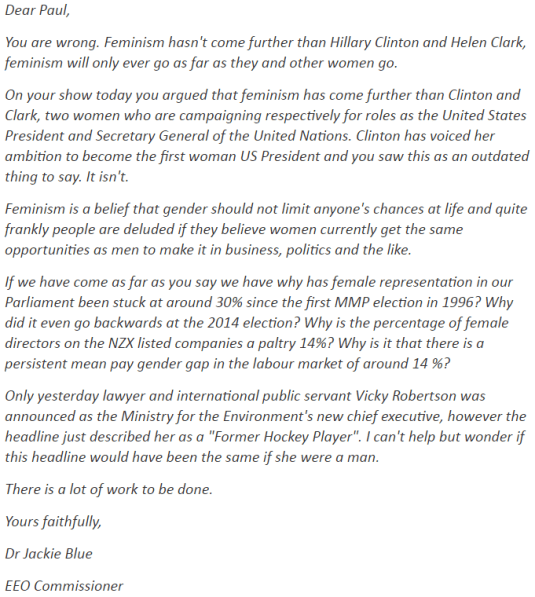
Jackie Blue, despite the resources of the Human Rights Commission, did not Google her own web site for the biography of the Chief Commissioner of the Human Rights Commission.

KiwiBlog has noted that the headline of “Ex All Black becomes Chief Executive” is common with David Kirk referred to as an ex All Black despite a successful business career.

Average tax rates on consumption, investment, labour and capital in Australia and New Zealand, 1959-2011–updated
16 Apr 2015 1 Comment
in economic growth, fiscal policy, macroeconomics, politics - Australia, politics - New Zealand, public economics Tags: GST, lost decades, taxation and the labour supply, taxation of capital
Cara McDaniel went to the mammoth task of constructing average tax rates for 15 OECD countries over the period 1950-2003 for consumption, investment, labour and capital:
Total tax revenue is divided into revenue generated from four different sources: consumption expenditures, investment expenditures, labour income and capital income.
To find the average tax rate, tax revenue from each source is then divided by the appropriate income or expenditure base.
She used that data to examine the role of taxes and productivity growth as forces influencing market hours. She used a calibrated growth model extended to include home production and subsistence consumption, both of which were key features influencing market hours. Her model was simulated for 15 OECD countries. She found the primary force driving changes in market hours is found to be changing labour income tax rates and productivity catch-up relative to the United States is found to be an important secondary force.
I thought I would summarise the tax rate data computed by Cara McDaniel for Australia and New Zealand.
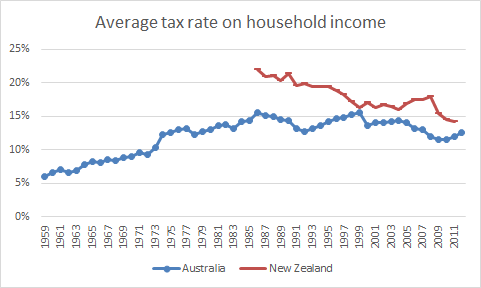
Source: Cara McDaniel.
McDaniel’s data on average tax rates on household incomes in Australia and New Zealand suggests that the average tax rate New Zealand household incomes fell by a third since 1986. No estimates were calculated for earlier years for New Zealand.
As for Australia, taxes steadily increased between 1959 and 1987 stabilised until 2005 and then fell a bit.
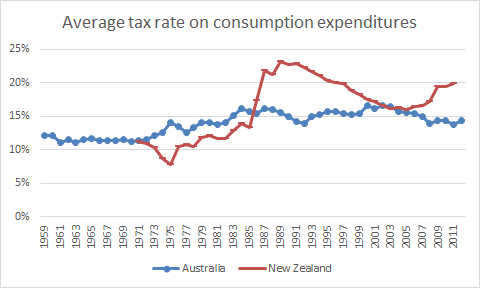
Source: Cara McDaniel.
There is a big spike in the average tax rate on consumption expenditure in New Zealand in 1986 when a GST replaced the pre-existing sales taxes. The average tax rate on New Zealand consumption expenditures and tapered away until the end of2009 and started to increase again.
Not much happened in Australia regarding the average tax rate in consumption expenditures since about 1983 despite the introduction of a GST in 1998.
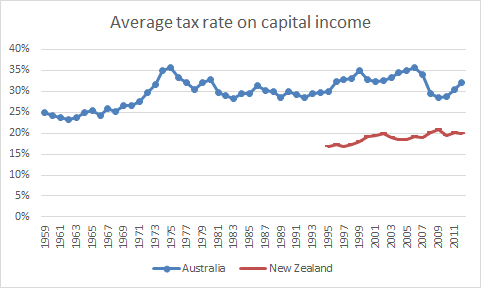
Source: Cara McDaniel.
The average tax rate in capital income in Australia is much higher than in New Zealand. On the other hand, the average tax rate on investment expenditure is much higher New Zealand as compared to Australia.
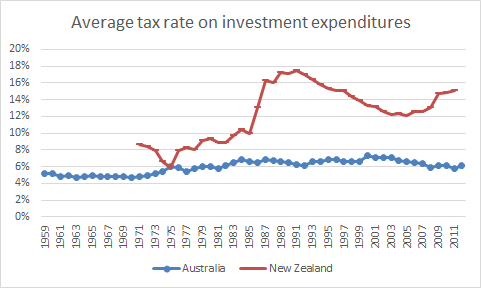
Source : Cara McDaniel.
Taxes on investment expenditures increased quite significantly at the same time that a GST was introduced in New Zealand.
All in all, New Zealand cut taxes on personal income but that tax cut seemed to be pretty much offset by higher taxes on personal consumption through the introduction of a 10% and then 12.5% GST.
The most interesting finding in this database is the sharp increase in the average tax on investment expenditures in the mid-1980s. This prolonged New Zealand’s lost decades – the two decades of next to no GDP growth per working age New Zealander.
Real GDP per New Zealander and Australian aged 15-64, converted to 2013 price level with updated 2005 EKS purchasing power parities, 1956-2013
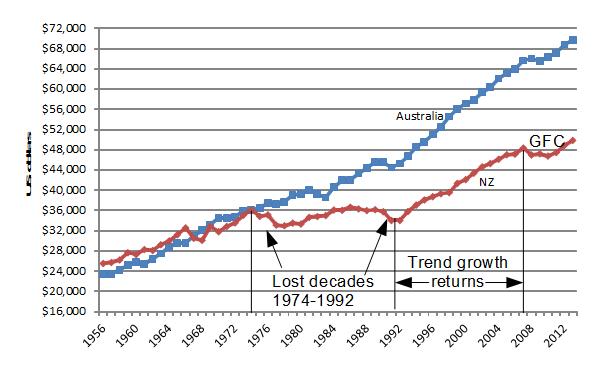
Source: Computed from OECD Stat Extract and The Conference Board, Total Database, January 2014.
New Zealand’s lost decades ended when the average tax rate on investment expenditures started to fall.
Lessons for New Zealand from Bob Hawke’s promise that no child need live in poverty by 1990
15 Apr 2015 Leave a comment
in income redistribution, politics - Australia, politics - New Zealand, poverty and inequality
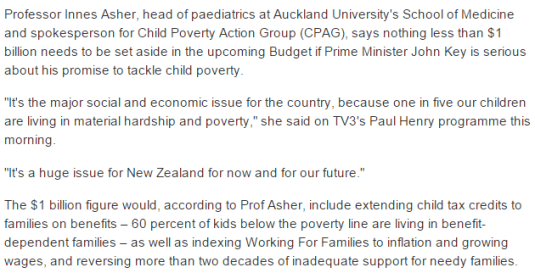
A local doctor thinks we can abolish child poverty in New Zealand with $1 billion in increases to welfare benefits and family allowances.
During the 1987 Australian Federal election campaign, Labour Party Prime Minister Bob Hawke announced a Family Allowance Supplement that would ensure no Australian child need live in poverty by 1990.
Child poverty was to be no more in Australia by 1990. These changes in social welfare benefits and family allowance supplements would ensure that every family would be paid one per week dollar more than the poverty threshold applicable to their family situation. I know child poverty was to be done in this way because I worked in the Prime Minister’s Department at this time.

Bob Hawke was not a man for admitting error, most certainly was not, but he admitted that this promise was his greatest error – his pledge that no child will need live in poverty by 1990:
It was a silly shorthand thing,” Mr Hawke has told News Limited newspapers. “I should have just said what was in the distributed speech.” “We set ourselves this first goal: by 1990 no Australian child will be living in poverty,” Mr Hawke said on June 23, 1987 at an election campaign launch. The comment entered Australian political folklore after it was supposed to improve the ALP’s major social welfare reform. The printed version had it as: “By 1990 no Australian child need live in poverty.” Mr Hawke’s words returned to haunt him as his pledge was impossible to keep.
About 580,000 Australian children lived in poverty in 1987. In 2007, at least 13 per cent of children, or 730,000 people, were poor. This was after social welfare benefits and family allowance supplements were increased to $1 above the child poverty threshold.
There is an infallible test of the practicality of Left over Left dreams such as the abolition of child poverty by writing bigger and bigger cheques to those currently poor.
If you could abolish child poverty simply by increasing welfare benefits and family allowances, the centre-right parties would be all over it like flies to the proverbial as a way of camping over the middle ground and winning the votes of socially conscious swinging voters for decades to come. Many people who would naturally vote for the centre-right parties on all other issues vote over to centre-left parties out of a concern for poverty and a belief that centre-left parties will give a better deal to the poor.
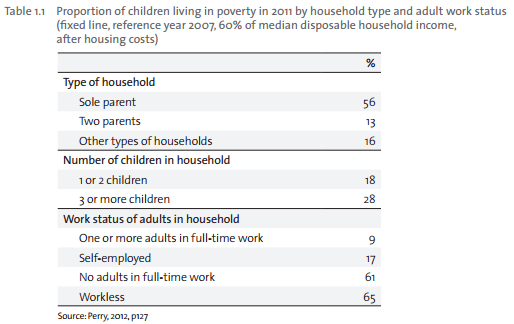
Countries all round the world have attempted to buy their way out of poverty by lifting welfare benefits and family allowance rates with no success. Simon Chapple is also quite clear that social welfare benefits reduce the incentive to work.
The payment of welfare benefits to families who do not work creates a number of potential issues. Firstly, as it guarantees an income to people not in paid employment, including those with children, it creates incentives not to work. While theoretically indisputable, much debate surrounds how large this effect is in practice, and how best to offset it.
There is child poverty in northern European and Scandinavia despite the most generous possible welfare states. Most of this child poverty is among single parent families in all industrialised countries.
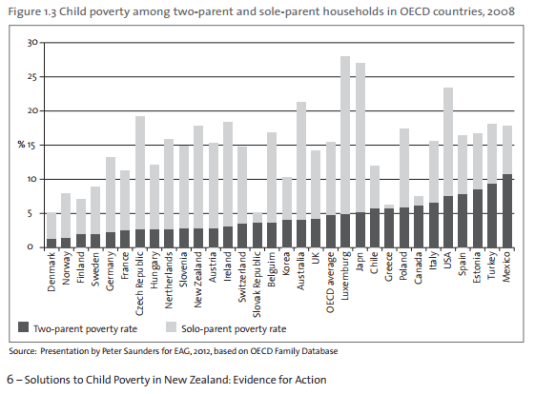
Around 60 percent of New Zealand children in poverty are in social welfare beneficiary households, and most of these are sole-parent households.

Child poverty rates are lower in the Nordic states but the Nordic states expectation that mothers will return to the workforce rapidly – when their child is 1 to 3 years old. Employment is front and centre in the Nordic welfare state strategy to reduce child poverty.

The notion that poverty is simply the result of a lack of money and giving people more money will abolish child poverty has never worked. As the OECD (2009, p. 171) observed:
It would be naïve to promote increasing the family income for children through the tax-transfer system as a cure-all to problems of child well-being.
The only major success in reducing beneficiary numbers anywhere has been time limits in the USA in 1996. Time limits on welfare for single parents reduced caseloads by two thirds, 90% in some states.

After the 1996 US Federal welfare reforms, the subsequent declines in welfare participation rates and gains in employment were largest among the single mothers previously thought to be most disadvantaged: young (ages 18-29), mothers with children aged under seven, high school drop-outs, and black and Hispanic mothers. These low-skilled single mothers were thought to face the greatest barriers to employment. Blank (2002) found that:
…nobody of any political persuasion predicted or would have believed possible the magnitude of change that occurred in the behaviour of low-income single-parent families.
Employment are never married mothers increased by 50% after the US well for a reforms: employment a single mothers with less than a high school education increased by two thirds: employment on-going single mothers string ages of 18 in 24 approximately doubled. With the enactment of welfare reform in 1996, black child poverty fell by more than a quarter to 30% in 2001. Over a six-year period after welfare reform, 1.2 million black children were lifted out of poverty. In 2001, despite a recession, the poverty rate for black children was at the lowest point in national history.
This great success of US welfare reforms was after a quarter of six century of no progress, poverty among single mothers and among black children declined dramatically.
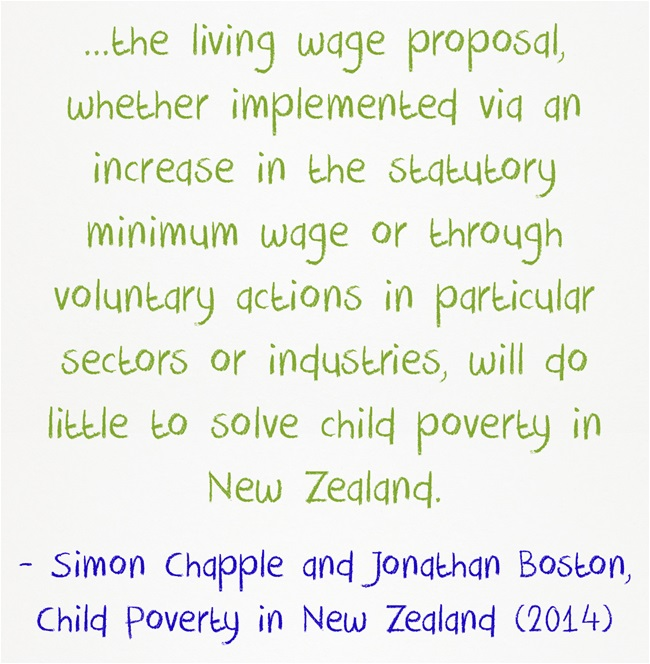
The best solution to child poverty is to move their parents into a job. Simon Chapple is also quite clear in his book last year with Jonathan Boston that a sole parent in full-time work, and a two parent family with one earner with one full-time and one part-time worker, even at low wages, will earn enough to lift their children above most poverty thresholds. Welfare benefits trap children in poverty.
Sustained full-time employment of sole parents and the fulltime and part-time employment of two parents, even at low wages, are sufficient to pull the majority of children above most poverty lines, given the various existing tax credits and family supports.
The best available analysis, the most credible analysis, the most independent analysis in New Zealand or anywhere else in the world that having a job and marrying the father of your child is the secret to the leaving poverty is recently by the Living Wage movement in New Zealand.
According to the calculations of the Living Wage movement, earning only $19.25 per hour with a second earner working only 20 hours affords their two children, including a teenager, Sky TV, pets, international travel, video games and 10 hours childcare. This analysis of the Living Wage movement shows that finishing school so your job pays something reasonable and marrying the father of your child affords a comfortable family life.
Taxes on wages rising, but are low in New Zealand
14 Apr 2015 Leave a comment
in politics - New Zealand, public economics
Taxes on #wages rising, even tho most governments did not raise rates in #OECD area. Why? See bit.ly/1IHNOvQ http://t.co/pX1v1rlFFf—
(@OECD) April 14, 2015
Taxes on wages have risen by about 1 percentage point for the average worker in OECD countries between 2010 and 2014 even though the majority of governments did not increase statutory income tax rates…
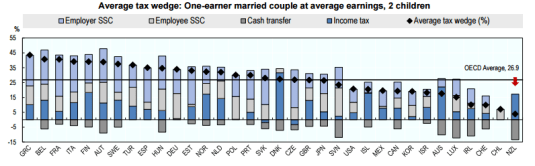
The highest tax wedges for one-earner families with two children at the average wage were in Greece (43.4%), Belgium (40.6%) and France (40.5%). New Zealand had the smallest tax wedge for these families (3.8%), followed by Chile (7%), Switzerland (9.8%) and Ireland (9.9%). The average for OECD countries was 26.9%… Child related benefits and tax provisions tend to reduce the tax wedge for workers with children compared with the average single worker. In New Zealand in 2014, this reduction (13.4 percentage points) was greater than for the OECD average (9.1 percentage points).
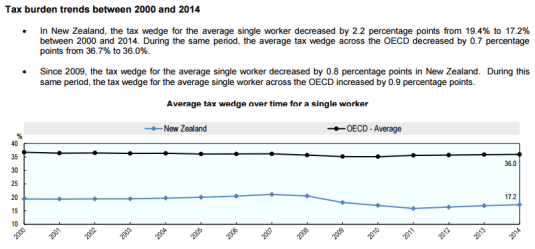
via OECD tax burdens on wages rising without tax rate increases – OECD.
Zero hour contracts may be outlawed in New Zealand–updated
13 Apr 2015 1 Comment
in entrepreneurship, industrial organisation, labour economics, labour supply, managerial economics, occupational choice, organisational economics, personnel economics, politics - New Zealand, survivor principle, unions Tags: Aaron Director, creative production, David Friedman, inherent inequality of bargaining power between workers and employers, Richard Epstein, Ronald Coase, The fatal conceit, The pretence to knowledge, zero hours contracts

In another triumph of the Socialist Left of the National Party, the supposedly centre-right New Zealand government is considering outlawing zero hours contracts:
ONE News can exclusively reveal the Workplace Relations Minister is leaning towards outlawing the contracts and other employment provisions that he sees as unfair…
The Minister of Workplace Relations said the most punitive aspects of zero-hour contracts will be banned:
Mr Woodhouse has previously said a ban of zero-hour contracts would be an overreaction, but signalled the outlawing of aspects including:
•Restraint of trade clauses that stop someone working for a competing business if an employer does not provide the desired hours of work.
•The cancellation of shifts at short or no notice.
One reason for this is to neutralise a wedge issue with the Labour Party. The labour parties in both New Zealand and United Kingdom plan to outlaw zero hours contracts.
The NZ Labour Party’s Certainty at Work private member’s bill would require employment agreements to include an indication of the hours an employee will have to work to complete tasks expected of them.

Aaron Director pointed out that there are many real world business practices that behave differently from the caricatures in textbooks and arouse suspicious responses from economists (as well as from lay observers including lay observers with no ideological agenda).
Director said that visions of market power dance their heads and some of these suspect practices have been regulated for reasons he attributed in a large part to intellectual laziness. Ronald Coase made the same observation about knee-jerk responses to perplexing new business practices:
One important result of this preoccupation with the monopoly problem is that if an economist finds something—a business practice of one sort or other—that he does not understand, he looks for a monopoly explanation.
And as in this field we are very ignorant, the number of ununderstandable practices tends to be rather large, and the reliance on a monopoly explanation, frequent.
Much of the lasting influence of Aaron Director and of Ronald Coase came from their ability to show that simple judgements about business practices often cannot withstand rigorous scrutiny.
The organisation of and the contracting practices in the labour market is not a complicated despite the best efforts of the Left over Left and unions to pretend that it is so, as Richard Epstein explains:
Labour markets are not characterized by tricky externalities. They do not pollute streams or require the creation of public goods.
They are not characterized by genuine breakdowns in information, as workers are in a position to observe the conditions of their employment on a day-to-day basis.
Left to their own devices, without explicit support from union activities, they will be highly competitive, and thus work hard to allocate scarce human capital to its most productive use.
Workers have the option to quit for higher wages, and employers can always seek out low cost techniques to reduce their labour costs. Any short-term dislocation for firms or individuals is more than offset by the overall increase in the system productivity, spurred in part by clear signals that should increase investments in human capital.
In the UK, the Work Foundation found that 80% of those on zero hours contracts are not looking for another job; only 26% wanted longer hours. This implies that 74% were content with their current work times arrangements.
Labour's zero hours myth breitbart.com/london/2015/04… http://t.co/M8JsW6NWSF—
Alex Wickham (@WikiGuido) April 07, 2015
The inherent inequality of bargaining power between employers and workers and the reserve army of the unemployed must not be all that they are cracked up to be these days if low paid workers have to sign legally enforceable restraint of trade agreements, which is a common complaint about zero hours contracts. The worker does not have guaranteed hours but must promise not to work for someone else in the same line of business.
Obviously, the few members of the reserve army of the unemployed lucky enough to have a low pay, insecure job that offers no regular hours have so many other job options that their employers must get them to agree not to quit and job-hop at will. Jobs must be readily available to low paid workers for otherwise why do employers insist on this restraint of trade in employment agreements?
If there is an inherent inequality of bargaining power between the bosses and the workers, why do employers seek restraint of trade agreements against these downtrodden workers who are supposed to have few options but to accept the miserable zero hours job offer before them?
The question that must always be asked is why do people deemed competent to vote and drive cars sign zero hours contract? What is in it for them – for the worker who signs these contracts – especially for workers who already have a job and are switching to a zero hours contract? David Friedman asked this question about the economics of restraint of trade agreements for employees:
…the employer who insists on an employee signing a non- competition agreement will find that he must pay, in additional wages or other terms of employment, the cost that the agreement imposes upon the employee, as measured by the employee and revealed in his actions.
It follows that the employer will insist on such an agreement only if he believes that its value to him is greater than its cost to the employee… The contract is designed, after all, with the objective of getting the other party to sign it.
If I am designing the contract and offering it to many other parties, that may put me in a position to commit myself to insisting on terms that give me a large fraction of the benefit that the contract produces. But it is still in my interest to maximize the size of that net benefit-which I do by only insisting on terms that are worth at least as much to me as they cost the other party.
If zero hours contracts are as bad as the Left over Left claim, the job quit rates for these contracts should be high, and people moving from existing jobs should be under-represented in this section of the labour force. If a worker already has a job, they have few reasons to sign up to such a purportedly poor job offer. Show me the evidence.
Unless we have a good idea about why firms are moving to zero hours contracts, which we don’t, and why employees sign these contracts rather than work for other employers who offer more regular hours of work, meddling in these still novel to the officious observer arrangements is risky.
The NZ Greens want to introduce food stamps, but only for part of the year?!
12 Apr 2015 Leave a comment
in income redistribution, politics - New Zealand, politics - USA, poverty and inequality, Public Choice Tags: expressive voting, food stamps, Left-wing hypocrisy, rational ignorance, rational irrationality, school breakfast programs, soup kitchens, welfare reform, welfare state
The welfare state has a long history of providing some of its support to the needy in kind rather than in cash. This can range from soup kitchens to public housing as well as food stamps.

In the USA, food stamps provide provide food-purchasing assistance for low- and no-income people living. Food stamps can only be exchanged for food.

Instead of requiring the poor and needy to attend a soup kitchen, they can be given vouchers to buy food at supermarkets and take it home and cook at themselves. These days some sort of debit card system can be used where purchases are restricted to food at supermarkets and other participating retailers.
A close parallel with food stamps, properly understood, is free school breakfast programs. The welfare state is providing in-kind support to hungry children. This is done at school, to ensure that the children eat the meals.
Rather than rely on their parents to spend their welfare benefits and income support on food for their children, the food is given directly to the children when they arrive at school in the morning. In New Zealand, these free school breakfast programs are restricted to schools in low income areas.
There is a Feed the Kids Bill in Parliament sponsored by the Green Party. I have frequently criticised this proposal as it doesn’t provide breakfast to needy children at the weekends and school holidays. They are left to go hungry. Abandoned by their so called social justice champions through lack of imagination and self-awareness.
If children are showing up at school without their breakfast on a regular basis, their parents should reported that the child protection authorities for intervention. This can start with budget advice and assistance with applying for any additional and emergency financial support they are eligible for from Work and Income New Zealand.
 Soup kitchens not only provides people with food, it provides various other assistance to help people to get back on their feet.
If you were proposing a food stamps program in New Zealand because children are going hungry, you’ll be laughed at if you suggested it should only apply the part of the year such as during the school term.
That is precisely what the Greens are doing. The only difference is how they are organised the provision of in-kind support to children, this case, food. Instead of their parents collecting a debit card that can only be used to buy food, the food is eaten by their children at school.
New Zealand, Australian and US real housing price index, 1975–2014, 2005 base
12 Apr 2015 Leave a comment
in business cycles, global financial crisis (GFC), great recession, macroeconomics, politics - Australia, politics - New Zealand, politics - USA, urban economics Tags: GFC, housing prices, land supply, zoning
The housing spikes in Australia and New Zealand preceded the global financial crisis, starting in about 1999, and were largely unaffected by the GFC. Housing prices in the USA were pretty calm except in the lead up to the GFC, and took a dive with the onset of the global financial crisis and great recession.
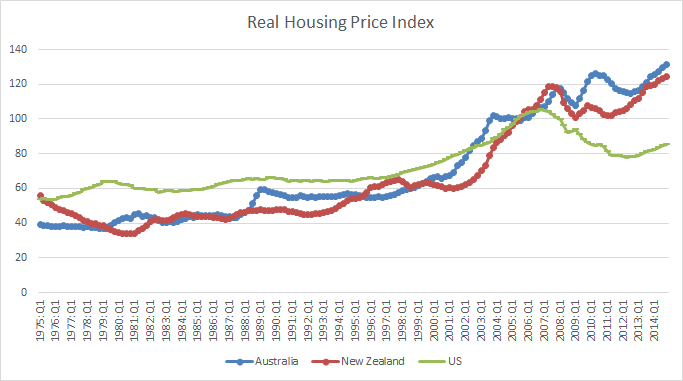
Source: Dallas Fed; Housing prices deflated by personal consumption expenditure (PCE) deflator.
.
A Guaranteed Minimum Income for New Zealand? The Treasury costings
12 Apr 2015 Leave a comment
in income redistribution, politics - New Zealand, politics - USA, welfare reform
The Treasury modelled a Guaranteed Minimum income (GMI) at the request of the Welfare Working Group in 2010. A GMI paying $300 per week – the mean benefit income among those on benefits – would cost $44.5 billion (model 1) or $52.6 billion if we extended it to super annuitants as a replacement for NZ Superannuation or old age pension (model 2). The former could be covered by a flat personal income tax rate of 45.4%; the latter, 48.6%.
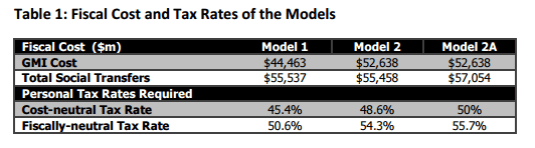
Full fiscal neutrality would require tax rates of 50.6% and 54.4% – the lower tax rates would be just enough to cover the transfers, but income tax revenues are currently also used to fund more than just transfers.
If we recognize that most parents are beneficiaries via Working for Families and compensate them for their loss with a $86 per child per week payment (model 3), we get a $57.1 billion fiscal cost and a personal tax rate of 50% (or 55.7% for fiscal neutrality).
Treasury noted that many beneficiaries (including the disabled, carers and sole parents) currently receive more than $300 per week and would be made financially worse off under a GMI scheme.
Treasury also warned about potential adverse labour supply responses to the necessary higher personal income tax rates. The large gap between company and personal tax rates would increase IRD’s enforcement costs.
In 1987, Finance Minister Roger Douglas announced a Guaranteed Minimum Family Income Scheme to accompany a new 22% flat income tax. The idea did not go ahead.
Richard Nixon also proposed a guaranteed minimum family income plan in 1969 to replace the Aid to Families with Dependent Children (AIDC) scheme at the behest of future Senator Daniel Patrick Moynihan. This was based on the negative income tax proposals of Milton Friedman and George Stigler. Nixon’s plan passed the House but not the Senate after 3 years of infighting.
The final outcome was the earned income tax credit (EITC) in 1975 that was expanded significantly in the 1990s to become the largest single federal income transfer programme. One attraction of the EITC is that because its benefits rise positively with earnings up to the phase-out point, so it can have a positive rather than negative effect on work incentives for workers on a low wage.
The power of ordinary citizens to effect change when there is federalism and upper houses
11 Apr 2015 Leave a comment
in constitutional political economy, election campaigns, politics - Australia, politics - New Zealand, Public Choice
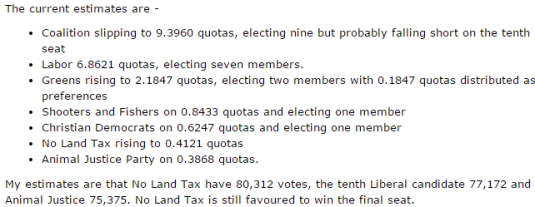
The latest counting in the New South Wales Legislative Council election shows the ease in which ordinary citizens can form a political party and be elected to Parliament when there is federalism and an upper house elected by proportional representation.
Five of the six Australian states have an upper house. In four of those states, the electoral system is proportional representation, with results in the election of many small parties.
In Tasmania, my home state, the Legislative Council as single member constituencies with two or three vacancies filled every year but is full of independents elected the six-year terms. The political parties having no chance of getting candidates elected in front of them. The Tasmanian voters simply don’t vote for party candidates in the Legislative Council elections. Out of 15 members, there is one Liberal Party member, and two members from the Labour Party
In the current New South Wales Legislative Council election, the favourite to win the last seat, and with it the balance of power in the upper house is a previously unheard of No Land Tax party. The Shooters and Fishers party is electing another member this year in New South Wales. The Christian Democrats also have two members.
In Victoria, the Australian Sex Party finally got a candidate elected to the upper house late last year through the courtesy of proportional representation.
Other small parties in the Victorian Legislative Council are the Shooters and Fishers Party with two members, the Democratic Labour Party with one member and a party of never heard of, Vote 1 Local Jobs, with the last seat. These small parties share the balance of power.
The South Australian Legislative Council includes two members from the No Pokies Party, two members from the Family First Party, and one from the Death with Dignity party. Again, this motley crew shares the balance of power.
Western Australian Legislative Council has a government majority, but there is one member from the Shooters and Fishers Party.
The crossbench in the Australian Senate is made up of eight independents and small parties. Several Australian senators on the crossbenchers are completely mad and ignorant; in one certain case, as thick as two short planks. This doesn’t harm, in the case of Jackie Lambie, her chances of being re-elected to the Senate for Tasmania for another six-year term in 2019. A number of Tasmanian voters, including members of my family, value her honesty, though they do admit she is not very bright and is rather rough around the edges.
The strength of democracy lies in the ability of small groups of concerned and thoughtful citizens to band together and change things by running for office and winning elections. That is how new Australian parties such as the ALP, the country party, DLP, Australian democrats and Greens changed Australia. One Nation even had its 15 minutes of fame. Most of these parties started in someone’s living room, full of concerned citizens aggrieved with the status quo.
In Australian elections in recent years, about a quarter of the electorate do not give their vote in upper house selections to the major parties: the Labour Party, the Liberal Party and the Australian Greens. That is fertile ground for small parties to flourish.
So fertile ground is the Australian Senate that the big parties want to change the election system to make it harder for the small parties to swap preferences to get elected through proportional representation and make it much harder to register a political party in the first place.
As would be expected, the far left parties get nowhere in the upper houses of the Australian State parliaments, despite the benefits of proportional representation and preferential voting. These upper houses are filled with small parties from both the left and the right, populist parties all, but the battle cry of socialism just doesn’t resonate with the Australian electorate.
Same thing happened in New Zealand in its recent parliamentary elections. New Zealand has no upper house, but does have proportional representation for the House of Representatives.
A pre-existing hard left party well-funded by a millionaire with an agenda to avoid extradition to the USA got 1.2% of the party vote, but it lost its electorate seat and so is out of Parliament since late last year’s general election.

Australia has the most targeted welfare state
10 Apr 2015 2 Comments
in politics - Australia, politics - New Zealand, politics - USA, poverty and inequality, welfare reform Tags: welfare state
In Mexico, most cash-based public social benefits go to households in the highest income quintile, per OECD. http://t.co/xykkPkDVZs—
Catherine Rampell (@crampell) November 24, 2014


Recent Comments