

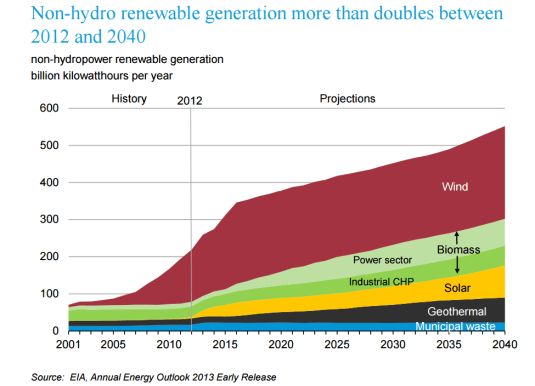
via eia.gov
The relationship between energy use & GDP
Technology is getting much more efficient
(Source bit.ly/1Anl8AJ) http://t.co/7zYDhXv2lu—
Max Roser (@MaxCRoser) March 15, 2015
Celebrating humanity's flourishing through the spread of capitalism and the rule of law
16 Mar 2015 Leave a comment
in energy economics, environmental economics, politics - Australia, politics - New Zealand, politics - USA Tags: Big Solar, Big Wind, climate alarmists, green rentseeking, solar power, wind power
via eia.gov
The relationship between energy use & GDP
Technology is getting much more efficient
(Source bit.ly/1Anl8AJ) http://t.co/7zYDhXv2lu—
Max Roser (@MaxCRoser) March 15, 2015
15 Mar 2015 Leave a comment
in economics of information, economics of media and culture, economics of regulation, environmental economics, global warming, health economics, politics - Australia, politics - New Zealand, politics - USA Tags: Anti-Science left, conjecture and refutation, expressive voting, Green Left, progressive left, rational ignorance, rational irrationality
13 Mar 2015 Leave a comment
in cats, liberalism, politics - Australia, politics - New Zealand, politics - USA Tags: cats, dogs
13 Mar 2015 Leave a comment
in politics - Australia, politics - New Zealand Tags: Australian elections
Thankfully only 16 of the 393 candidates running for the New South Wales Legislative Council have to have a preference from 1 to 16 to cast a valid vote.
https://twitter.com/_HelenDale/status/575926340303486978
In Senate elections, if you want to vote for individual candidates, you must fill out 100 or more boxes ranking each of the 100 or more candidates without error from say 1 to 100 to avoid your vote been declared informal.
13 Mar 2015 Leave a comment
Some nice charts about how ISIS is more a rabble that happens to survive because of the lack of unity among its many enemies which include the Iraqi government government and its army that runaway.


11 Mar 2015 Leave a comment
in economics of bureaucracy, industrial organisation, politics - New Zealand, privatisation Tags: privatisation, state owned enterprises
KiwiRail is such a dog that the Treasury reports on the rate of return to the taxpayer on the state owned enterprises portfolio by excluding KiwiRail from its calculations of rates of return.
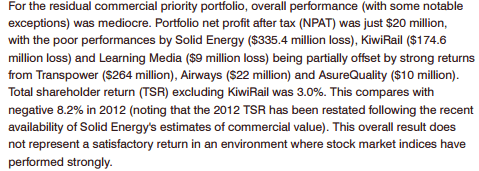
The Treasury doesn’t do similar adjustments for state owned enterprises that are performing unusually well, so total shareholder return figures should be reported without this KiwiRail exception. If you buy a dog, you should own up to the fleas it spreads to the rest of your portfolio.
Trying to pretend that KiwiRail is just not there, or survives on the largess of someone other than the one and only New Zealand taxpayer, does no one any favours. This KiwiRail exception will have to apply for at least 10 years to the annual commercial portfolio report of the Treasury. I want to know the total shareholder return, including KiwiRail every year without exception or special pleading.
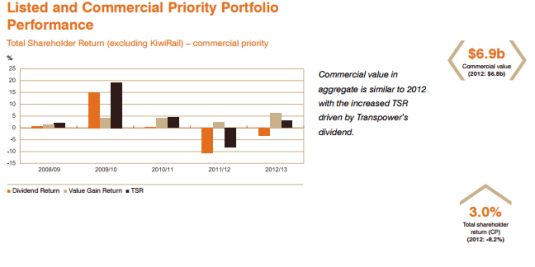
That total shareholder return of -8.2% in 2012 is worthy of comment too:
The portfolio generated a net loss after tax of $1.8 billion driven by a restructuring of KiwiRail’s balance sheet and reductions in bottom line results for Meridian and Solid Energy, affected by hydrology and coal market deterioration respectively.
11 Mar 2015 1 Comment
in economics of bureaucracy, politics - New Zealand, survivor principle Tags: corporate welfare
Government owned mining company Solid Energy lost $182 million last year. It is already received nearly $200 million in corporate welfare in bailouts from the New Zealand taxpayer. It’s time to call a halt.

The Christchurch-based coalminer is negotiating with banks in a bid to reduce its $320 million debt. In 2013, its annual revenue dropped by a third to $631 million.
Solid Energy invested heavily on a strategy that energy prices were going to go up and up. That investment strategy was against the market sentiment of that time, much less afterwards and the collapse of oil prices.

While Prime Minister John Key said on March 2 that it was not the Government’s preferred option to put more taxpayer cash into Solid Energy, Minister of Finance Bill English flatly ruled out cash, loans or guarantees. I hope Bill English wins that political struggle at the Cabinet table for the sake of the long-suffering New Zealand taxpayer.
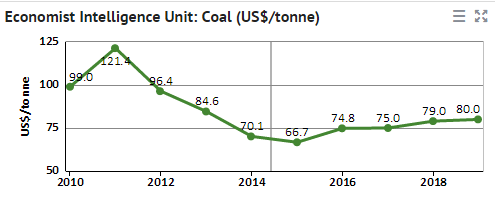
What is worse, the government has indemnified the directors of Solid Energy against unspecified liabilities thus giving them an open-ended cheque-book, from what I can see, to trade while insolvent:
State Owned Enterprises Minister Todd McClay confirmed last month that the Crown has offered an indemnity to the board of Solid Energy last year, but would not comment on what it was.
Asked if directors had raised concerns with him that they might be trading while insolvent, English said: “Any director of a company like this has that question uppermost in their mind. They need to be sure all the time that they’re not trading while insolvent.”
Directors’ duties regarding trading while insolvent is the last line of defence against financial irresponsibility. There are both civil liability and criminal penalties for trading while insolvent under company law.
Solid Energy has already been a black hole for nearly $200 million in taxpayers’ money as well as considerable bank write-offs of loans.
The company appeared before the Finance and Expenditure Select Committee of Parliament this morning. It told MPs the company was solvent and marginally cash positive, but looking at another significant loss this year.
It should be a matter of policy that the government, any government, should not indemnify directors of any company, be they government owned or not, for breaches of directors’ duties. It’s a matter of the rule of law and of governments not privileging itself in the marketplace at the expense of the taxpayer.
What is the point of having a State Owned Enterprises Act and setting up these businesses as companies with a duty to be as successful as a company not owned by the government if they don’t have to obey the most fundamental safeguards in company law when push comes to shove?
If these indemnities have indeed been issued by the government for breaches of directors’ duties regarding insolvency, and it seems as though they have been, what is the Crown liability to creditors if Solid Energy is indeed trading while insolvent? These indemnities may allow the creditors to pierce the corporate veil and sue the New Zealand government.
In the revenge of directors duties, the directors of banks and any other creditor will have a director’s duty to sue the New Zealand government for all it can get as a result of these indemnities.
At a minimum, the New Zealand government will have to settle out of court or go all the way to the Supreme Court because hundreds of millions of dollars are involved from the bank write-offs, past and present.
Naturally, the ideological blinkers of the opposition party in New Zealand prevents it from saying the obvious, which is calling for the Solid Energy to be put in receivership. The Labour Party spokesman on state owned enterprise attacked the stewardship of the Minister of Finance as a shareholding Minister, but had nothing to say in terms of solutions, including putting the company into receivership.
The Green Party did a little bit better in 2013 when its spokesman talked about a need for a transition to sustainable jobs – the Green party code for layoffs:
“The National Government need to take responsibility for their mismanagement of Solid Energy and cut their losses,” said Mr Hughes.
“The banks that made risky loans to Solid Energy need to bear the cost of their mistakes”. “Coal is not going to be the fuel of our future if we are to stabilise our climate”.
“New Zealanders and Solid Energy workers need a just transition into more sustainable jobs – jobs that don’t fry the planet.”
“The longer this Government effectively denies climate change, the more taxpayer money will go to subsidising coal and its foreign backers.”
Things are getting desperate when the Greens find a corporate welfare so appalling that they actually oppose it, if only because of support for lower carbon emissions. That is one green hypocrisy too many if it supported a bailout of a coal miner.
11 Mar 2015 Leave a comment
in economics of crime, politics - New Zealand
The owner of four Staffordshire bull terrier-cross dogs that attacked 7-year-old Sakurako Uehara in the Bay of Plenty in early 2014 has been ordered to pay a $7500 emotional-harm payment. He had earlier avoided a conviction in the Rotorua District Court.

Sakurako chan suffered critical injuries from more than 100 bites to her face and all her limbs.
Her plastic surgeon said that she would probably need reconstruction treatment until she reached adulthood. A fundraiser organised by the Middlemore Foundation to support the family throughout her treatment amassed more than $200,000.
New Zealand law allows criminals to be discharged without conviction if they plead and beg enough to the court. This is just plain wrong. I don’t know of any similar system in other countries.
If you break the law, one of the penalties and it’s a very cheap penalty for society to impose, is the stigma of a criminal conviction. Yes, it means the convicted criminal will have trouble travelling internationally and passing police checks were jobs, but that’s the point. New Zealand already has a spent convictions law that allows convictions to be expunged from the record in most cases after seven years of good behaviour.
If the criminal concerned that showed more regard for his fellow humanity and didn’t break the law in the first place, he wouldn’t have these misfortunes which he visited on himself through his offending. Do the crime, do the time and at a minimum, be convicted.

The New Zealand Parliament increase the penalties for owning a dog that causes serious injury from three months to 3 years in 2003 in response to public outrage over a series of savage maulings of children.
Some years later, a dog mauled a 51-year-old woman to death. The owner, who was her nephew, pleaded guilty and received 18 months in prison.
The court said that the starting point for his sentence was 27 months, but this was reduced by the judge to 18 months because he went on television and offered to plead guilty on the day the offence. He regarded his aunt is his second mother. This sentence was one of the few cases I know where the remorse of the offender was truly genuine and he deserved a significant discount on his sentence.
If you own four big strong dogs, and they savage a small child with life scarring injuries, you should expect to go to prison and for a considerable period of time. Strong penalties align incentives properly to make sure that dogs are well trained and any sign of bad behaviour is dealt with early and, if necessary by an early rehousing to doggie heaven.
Nothing like the prospect of a spell in prison to focus the mind of dog owners otherwise blinded by love for their pet.
11 Mar 2015 Leave a comment
in economics of crime, law and economics, politics - New Zealand
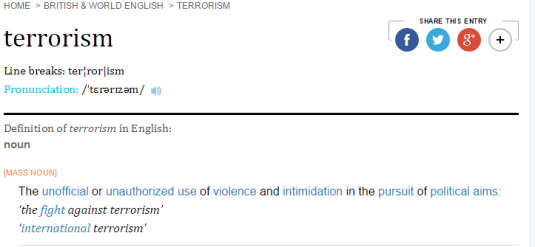
Tracy Watkins really dropped the ball today in the Dominion Post when she prevaricated on whether a threat to contaminate infant formula with 1080 poison unless the Government stops using the poison for pest eradication by March this year was a terrorist act:
There will also be questions over its rush to label it a terrorist act. Police were more circumspect, labelling it a criminal act.
Tracy Watkins is normally an astute observer, but this time she really dropped the ball. It is obvious that a threat of mass poisoning unless the government bends to your will is terrorism. If it isn’t, what is?
10 Mar 2015 Leave a comment
in economics of media and culture, economics of regulation, politics - Australia, politics - New Zealand, rentseeking Tags: barriers to entry, closer economic relations, creative destruction, export pricing, free trade, Hollywood economics, price discrimination, protectionism, rent seeking
Back in the day, New Zealand television programming was sold cheaply into the Australian market. Many cultural and other products are exported into foreign markets and sold for whatever they can get above the price of shipping or digital transmission. What else explains all that rubbish on cable TV?
Under the Closer Economic Relations agreement that creates a single market between Australia and New Zealand, New Zealand made television programming content must be treated the same way as Australian content so it was included in their 50% local content rules for commercial television back from whenever I remember this story from. There was a Federal Court of Australia case that ruled that New Zealand television programming was Australian content programming for the purposes of the relevant media regulations because of Closer Economic Relations.

From the late 1990s, with revival of the New Zealand film and television industry, New Zealand content was starting to flood the Australian market, especially in the off-season in the summer when stations were looking for cheap content to fill a low ratings period.

Naturally, this Kiwi invasion did not please the rent seeking Australian television programme production industry and many a mendicant actor, writer and producer
Where there is a will, where there is a way: minimum quality standards are introduced into the Australian content rules defined by price – a price that happen to be above what the television stations used to pay for New Zealand made programming.
10 Mar 2015 Leave a comment
in applied welfare economics, industrial organisation, politics - New Zealand, rentseeking, transport economics
In the first shot in the pork-barrelling for a by-election, veteran New Zealand populist Winston Peters wants to stop the expansion of the Port of Auckland and move the extra shipping traffic up north to the Port of Whangarei:
And we will upgrade the Auckland to Northland railway line and build the rail link to your port
The Port of Whangarei is about two hours north by car from Auckland. Auckland is a global city of approaching 2 million. Whangarei is the only city up North, with a population of 50,000.

45% of the import traffic to the Port of Auckland is cars. Around 90% of light vehicle imports in New Zealand come through the Port of Auckland. The rest may go through Littleton.

|
|
|
Jellicoe and Freyberg wharves are located between the two container terminals. |
Bledisloe multipurpose Wharf |
Striving to move some of this light vehicle imports from the Port of Auckland up north to the Port of Whangarei where they be unloaded from a ship onto trains for a short train ride to Auckland, unloaded again onto trucks all seems unnecessary expense.

Photo: Port of Whangarei.
Auckland appears to have spare container capacity up until at least 2035, so this port up North will simply not have much to do in terms of extra container traffic because it will have to compete on the basis of cost and proximity to markets.
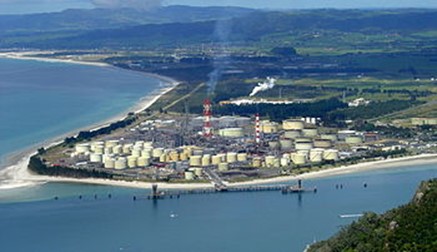
Photo: The Marsden Point Oil Refinery on the opposite shore of Whangarei Harbour.
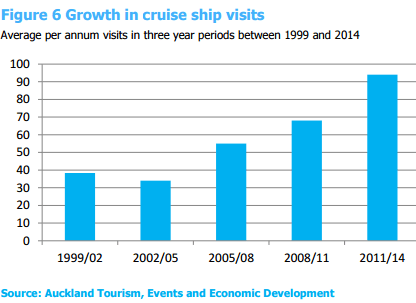
The traffic that is coming under pressure regarding capacity of the Port of Auckland is multi-cargo traffic such as building materials, vegetables, wheat, vehicles and other goods. The situation is further aggravated by the rapid increase in the number and increased size of cruise ships.
As a good part of the market for the multi cargo traffic is in Auckland, landing them away from their main market just makes no sense and will not happen unless the port of Auckland is prohibited by law from expanding and ships are not allowed to divert to ports such as Wellington and Christchurch.
The number of cruise ships visiting Auckland in the last 10 years to about 90 and is expected to reach one 20 by 2020 and 150 by 2030. That traffic cannot be diverted up north to the Port of Whangarei.
Any export traffic that would be viable to send through the Port of Whangarei up north will already be going through it. Export competitiveness is highly sensitive to costs as exporters must simply take the going price in the international market.
09 Mar 2015 Leave a comment
07 Mar 2015 Leave a comment
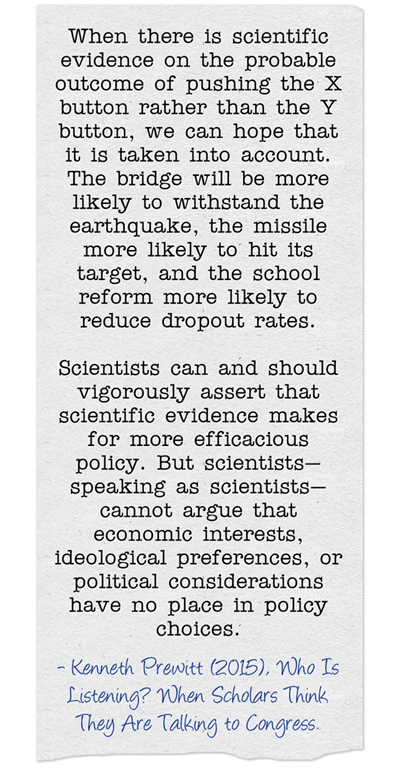
in comparative institutional analysis, politics - Australia, politics - New Zealand, politics - USA, Public Choice Tags: evidence-based policy, expressive voting, rational ignorance, rational irrationality, science and public policy
Celebrating humanity's flourishing through the spread of capitalism and the rule of law
Celebrating humanity's flourishing through the spread of capitalism and the rule of law
Celebrating humanity's flourishing through the spread of capitalism and the rule of law
Celebrating humanity's flourishing through the spread of capitalism and the rule of law
Celebrating humanity's flourishing through the spread of capitalism and the rule of law
Celebrating humanity's flourishing through the spread of capitalism and the rule of law
A History of the Alt-Right
Econ Prof at George Mason University, Economic Historian, Québécois
Celebrating humanity's flourishing through the spread of capitalism and the rule of law
Scholarly commentary on law, economics, and more
Beatrice Cherrier's blog
Celebrating humanity's flourishing through the spread of capitalism and the rule of law
Celebrating humanity's flourishing through the spread of capitalism and the rule of law
Celebrating humanity's flourishing through the spread of capitalism and the rule of law
Why Evolution is True is a blog written by Jerry Coyne, centered on evolution and biology but also dealing with diverse topics like politics, culture, and cats.
Celebrating humanity's flourishing through the spread of capitalism and the rule of law
A rural perspective with a blue tint by Ele Ludemann
DPF's Kiwiblog - Fomenting Happy Mischief since 2003
Celebrating humanity's flourishing through the spread of capitalism and the rule of law
The world's most viewed site on global warming and climate change
Tim Harding's writings on rationality, informal logic and skepticism
A window into Doc Freiberger's library
Let's examine hard decisions!
Commentary on monetary policy in the spirit of R. G. Hawtrey
Thoughts on public policy and the media
Celebrating humanity's flourishing through the spread of capitalism and the rule of law
Politics and the economy
A blog (primarily) on Canadian and Commonwealth political history and institutions
Reading between the lines, and underneath the hype.
Economics, and such stuff as dreams are made on
"The British constitution has always been puzzling, and always will be." --Queen Elizabeth II
Celebrating humanity's flourishing through the spread of capitalism and the rule of law
Celebrating humanity's flourishing through the spread of capitalism and the rule of law
WORLD WAR II, MUSIC, HISTORY, HOLOCAUST
Undisciplined scholar, recovering academic
Celebrating humanity's flourishing through the spread of capitalism and the rule of law
Res ipsa loquitur - The thing itself speaks
In Hume’s spirit, I will attempt to serve as an ambassador from my world of economics, and help in “finding topics of conversation fit for the entertainment of rational creatures.”
Researching the House of Commons, 1832-1868
Articles and research from the History of Parliament Trust
Reflections on books and art
Posts on the History of Law, Crime, and Justice
Celebrating humanity's flourishing through the spread of capitalism and the rule of law
Exploring the Monarchs of Europe
Cutting edge science you can dice with
Small Steps Toward A Much Better World




Recent Comments