
Ample Proof That Cell Phone Towers DO NOT Cause Cancer
06 Mar 2015 Leave a comment
in economics of regulation, health economics, politics - New Zealand Tags: Anti-Science left, Greens, Quacks
Tin foil hat brigade has a recruit in New Zealand. Thousands more cellphone antennas could be installed without community consultation under a proposed environmental rule change.
Green Party environment spokeswoman Julie Anne Genter said the Government appeared to have little regard for environmental outcomes or community input.
“We support National Environmental Standards but they need to be used to protect the environment, not to override the right of local communities to have a say,” she said.


|
View original post 304 more words
Who is on zero hours contracts in the UK?
06 Mar 2015 Leave a comment
in job search and matching, labour economics, labour supply, politics - New Zealand Tags: zero hours contracts
Firstly, those on zero hours contracts are overwhelmingly younger people and more often women. Both groups value flexible working hours more than others. That’s why they make up the majority of workers on zero hours contracts.
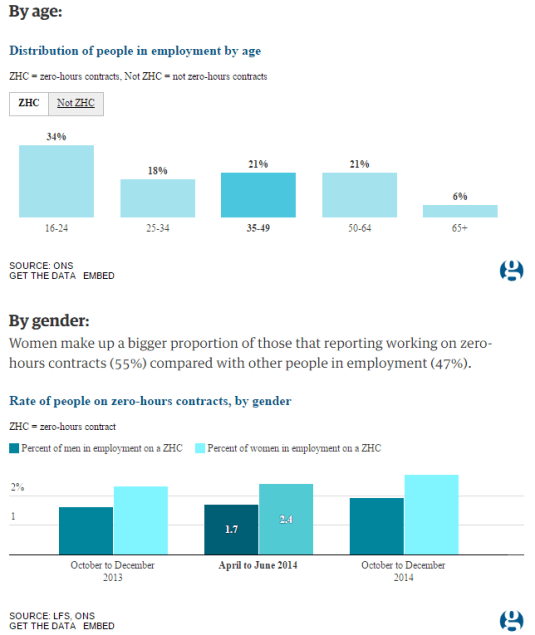
Also not surprisingly, people on zero hours contracts also tend to be more often in full-time education. Another group that values flexibility in hours. Furthermore, many of those on zero hours contracts have only been in the current job for less than 12 months. Again, suggesting they come from groups that change jobs frequently, which means they can easily quit and find another job if they don’t like a zero-hours contract.
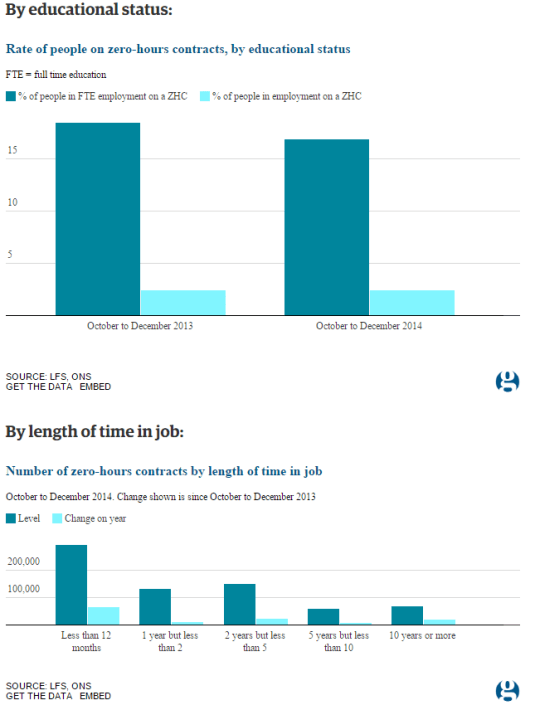
Via Zero-hours contracts in four charts | News | The Guardian
Darwin awards: The Islamic State was backed by 46,000 accounts on Twitter in 2014
06 Mar 2015 1 Comment
in politics - Australia, politics - New Zealand, politics - USA, war and peace Tags: Darwin awards, ISIS, Middle-East politics, Twitter, war on terror


Every time they tweet they put a well-deserved target on their back.

via Defining and describing the population of ISIS supporters on Twitter | Brookings Institution.
Security cameras in prison showers and the case for private prisons
06 Mar 2015 Leave a comment
in economics of crime, entrepreneurship, law and economics, organisational economics, politics - New Zealand, politics - USA Tags: do gooders, law and order, prisons
I was listening to a radio show the other day on the introduction of close circuit television into New Zealand prisons that were to be monitored by both male and female guards. This is regarded as an indignity by some because these new close circuit cameras would be in showers and toilets.

The initial commentators on the radio programme immediately said they had watched plenty of TV programs where people were shanked in the showers.

The close circuit television was for the safety of prisoners. Close circuit cameras in all parts of prisons made prisons a safer place and that was that. It was the price of safety, especially for prisoners vulnerable to intimidation and sexual assault.

Greg Newbold, a New Zealand criminologist and an ex-prisoner in itself, then came on air to criticise the introduction of close circuit televisions in showers and other intimate areas such as toilets as an indignity on prisoners. Prisoners have a right to intimate privacy in his view. He said only 12 prisoners had been murdered in the New Zealand prisons since 1979.
Only 12 murders is 12 murders too many. Every one of those murders would have been subject of outrage about the failure of the prison administration from the bleeding hearts brigade.
The most interesting thing that Greg Newbold said on the radio was about how these close circuit television systems first emerged in prisons, initially in the USA.
Close circuit television systems will put throughout prisons initially in private prisons to avoid being sued for wrongful death and injury. The private prisons introduced this rather obvious security measure to reduce liability in the civil courts.
Public prisons are supposedly a safer place for prisoners to be if you listen to the bleeding hearts brigade and the Left over Left. Pubic prisons but never got around introducing what seems to me to be a rather basic security measure in confined areas of prisons. Close circuit television systems would protect both inmates and guards.
The different incentives facing public and hybrid prisons, in this case, exposure to litigation, is an illustration of the superior efficiency of private prisons.

Private prisons did something because it affects the bottom line. One way to reduce liability for deaths and injuries is prison security measures that reduce the number of deaths and injuries in prisons.
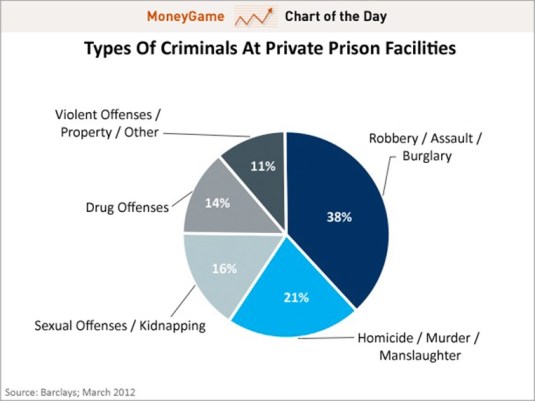
More importantly, private prisons have unforgiving critics in the form of the bleeding hearts brigade and Left over Left. No one on the Left will defend or protect a prison that is private from closure out of a knee-jerk defence of the public sector, and in particular, public-sector unions.
Oddly enough the only prison that the Left over Left want to close in New Zealand is the highest performing prison, Mt Eden, which happens to be privately run.

The main problem with private prisons is contracting over quality where it is difficult to define quality and measure performance against quality standards specified in a contract as Andrew Shleifer explains:
…critics of privatization often argue that private contractors would cut quality in the process of cutting costs because contracts do not adequately guard against this possibility
Privatisation for many government services is simply an extension of the make-or-buy decision. Every firm faces a make-or-buy decision – should the firm buy a production input from outside suppliers or should it make what it needs itself with existing or additional internal resources?
As any industry grows, there is more room for more specialised producers to supply to firms of all sizes at a lower cost than in-house production (Stigler 1951, 1987; Levy 1984). As an example, all with the largest firms intermittently hire legal, accounting and many other professional skills from specialists.
By contracting-out to these more specialised and niche suppliers, firms can enjoy all available economies of scale in production unless its needs are unique or the firm has some special competency in producing the input in-house (Lindsay and Maloney 1996; Shughart 1997; Roberts 2004). Firms in most industries capture all available economies of scale at relatively small sizes after which they have a long region of production where their marginal cost of further increases in production are constant (Stigler 1958; Lucas 1978; Barzel and Kochin 1992; Shughart 1997).
Put simply, an entrepreneur makes what he or she cannot buy at the quality preferred through contracting in market:
The case for in-house provision is generally stronger when non-contractible cost reductions have large deleterious effects on quality, when quality innovations are unimportant, and when corruption in government procurement is a severe problem. In contrast, the case for privatization is stronger when quality reducing cost reductions can be controlled through contract or competition, when quality innovations are important, and when patronage and powerful unions are a severe problem inside the government.
The way in which the market process dealt with chiselling on quality where quality reducing cost reductions where costly to control through contract or competition was the emergence of non-profit institutions. The competitive edge of these non-profit institutions was they had fewer incentives to dilute hard to measure qualities of the product transacted.

Any additional profits from this dilution of quality were not distributed to the owners because the non-profit organisation was either run by a charity or was owned mutually by the customers. The proceeds from cutting corners on quality could not be paid out to the owners in dividends because there were none.
Examples of non-profits competing successfully in the market are obvious, such as life insurance. Until recent decades, most life insurance companies were mutually owned by the policyholders. Life insurance companies were mutually owned as an assurance that no one could run off with the money by paying high dividends to the owners before policyholders died many years after they have paid their premiums.
Most private universities are run as non-profit institutions even when they are set up by private developers with profits in mind. The private university itself is owned by a charity with esteemed persons on the board to assure quality and probity. The active involvement of alumni is encouraged as a further guard of the future quality of the University from which they graduated. The private developers make their profit on the surrounding land as the university grows and prospers. Land grant universities in the USA may have operated this way.
Other examples of the emergence of non-profit institutions to assure quality in a competitive market are private schools, private hospitals, and private day care centres where concerns about the private provision of a quality service arise, with or without justification. Andrew Shleifer again:
…entrepreneurial not-for-profit firms can be more efficient than either the government or the for-profit private suppliers precisely … where soft incentives are desirable, and competitive and reputational mechanisms do not soften the incentives of private suppliers [to dilute quality].
Of course, any proper analysis must compare like with like and compare the dismal record of public prisons date in terms of prisoner and prison guard safety and preventing escapes with any scandals in the private prison systems. Few do that.
Bizarro lefties alert: @MaxRashbrooke “Maori and Pasifika children were disproportionately in poverty, highlighting systemic discrimination!”
05 Mar 2015 Leave a comment
in discrimination, politics - New Zealand, poverty and inequality
Lindsay Mitchell wrote a fine reply to the Amnesty International report suggesting that higher rates of child poverty among Māori and Pasifika is evidence of systematic discrimination.
Māori and Pasifika children were disproportionately in poverty, highlighting systemic discrimination
Figure 1: Real equivalised median household income (before housing costs) by ethnicity, 1988 to 2013 ($2013)

Source: Bryan Perry, Household incomes in New Zealand: Trends in indicators of inequality and hardship 1982 to 2013. Ministry of Social Development (July 2014).
The facts are clear, whatever systematic discrimination there might be, it must be falling rapidly because of the rapid increases in household real incomes in Mari and Pacific households in the last 20 years.
As shown in figure 1 below, between 1994 and 2010, real equivalised median New Zealand household income rose by 47%; for Māori, this rise was 68%; for Pasifika, the rise in real equivalised median household income was 77%.
Our friends on the Left cannot argue that an income gap is evidence of discrimination while arguing that a rapid closing of that gap is not evidence of falling discrimination? To do this, to paint pre-1984 New Zealand, pre-neoliberal New Zealand as an egalitarian paradise has to ignore up to two thirds of the population and the inequalities they suffered:
“New Zealand up until the 1980s was fairly egalitarian, apart from Māori and women, our increasing income gap started in the late 1980s and early 1990s,” says Max Rashbrooke.
The large improvements in Māori incomes since 1992 were based on rising Māori employment rates, fewer Māori on benefits or zero incomes, more Māori moving into higher paying jobs, and greater Māori educational attainment (Dixon and Maré 2007). Labour force participation rates of Māori increased from 45% in the late 1980s to about 62% in the last few years. Māori unemployment reached a 20-year low of 8 per cent from 2005 to 2008.
Rapid social improvement among Māori and Pasifika is simply ignored as an inconvenient truth for the Left over Left.
Who has the highest minimum wage in purchasing power parity terms?
05 Mar 2015 Leave a comment
in labour economics, minimum wage, politics - Australia, politics - New Zealand, politics - USA Tags: minimum wage, purchasing power parity
@greencatherine @PPTAWeb Teachers union concedes that NZ charter schools improve student outcomes?
04 Mar 2015 1 Comment
in economics of education, human capital, politics - New Zealand, politics - USA, unions Tags: charter schools, School choice
The New Zealand teachers union went into a very curious rant against chartered schools in a letter to the Dominion Post today. Instead of saying that they do not improve student outcomes, the usual propaganda, the author of the letter focused on system-wide outcomes after the introduction of charter schools.

It is usual for the teachers union to say that the schools themselves fail rather than argue that adding five or 10 schools to a system of thousands of public schools in New Zealand will through competition from these few schools to lift the entire system. For example, the teachers union sets a very high standard for the charter schools:
The United States has had charter schools for a more than a decade and there has been no measurable improvement in that country’s overall performance in literacy, maths and science. The United States lags far behind New Zealand on recent performance tests in all those areas.
It is unwise to say there is no evidence because that leaves you open to the cheap shot that will find one piece of evidence and then ask why you making things up. For example, the Maxim Institute found that:
The evidence from the small body of research that exists is mixed: some studies have found the presence of charter schools to have had a small negative impact on pupil achievement in regular state schools, while other studies have found charter schools to have had either a negligible or small positive impact…
There my work is done. All I had to show was that there was some evidence showing that charter schools improved the performance of neighbouring schools.

Why is the teachers union pretending that this evidence is not there when it can be found and so easily on the Internet?

Is the reason that the evidence that charter schools improve the outcomes of students that go to them is so strong that they have to move to new reasons for opposing them? The evidence is some chartered schools do very well and in particular for minority students. Their greatest strength is they are closed if they fail. No similar standard applies to failing public schools.

At a minimum, the teachers unions have conceded that the charter schools seem to work and that they do no harm to the rest of the system? If there was evidence of that, they would be quick to put it forward.
Will comparable worth increase the pay of male prison guards?
04 Mar 2015 Leave a comment
in discrimination, gender, labour economics, law and economics, politics - New Zealand
Late last year, the New Zealand Court of Appeal held that paying women in predominantly female occupations less than men in other occupations with similar skills and responsibilities may be illegal under the Equal Pay Act of 1972.
The Employment Court found that to assess whether a breach of the 1972 Act had occurred in a female intensive industry, it would be necessary, and within the scope of the Act to use external employers and other industries as comparators in determining what a notional male employee with similar skills and responsibilities would be paid. The comparison would not just be within the same workplace.
The Court of Appeal agreed with the Employment Court’s finding. In particular, the necessity to be able to look outside a female-intensive industry to properly ascertain what a notional male performing that role would be paid based on skills and similarities of duties where there is no appropriate comparator within the industry.

Rather than talk about this New Zealand employment case directly, my first post will be about the experiences in the USA. A later post will discuss New Zealand in more depth.
The US Supreme Court’s first decision on comparable worth was County of Washington v. Guenther. This 1981 case was about female prison guards being paid 70% of the wages of male guards in the same prison. The County of Washington did a study that show they should be paid 95% of male guards.
This particular case has a tremendous irony because it is actually reasonable to argue that male guards, and perhaps female guards in male prisons, should get danger money depending on the level of direct contact with high risk prisoners. Male prisoners are far more violent. I don’t think anyone disputes that.
Quite simply, a lot of people don’t accept that the wage setting processes results from two conditions: wages are limited from above by the workers’ marginal productivity in the job: a limited from below by the alternative job offers of other employers.
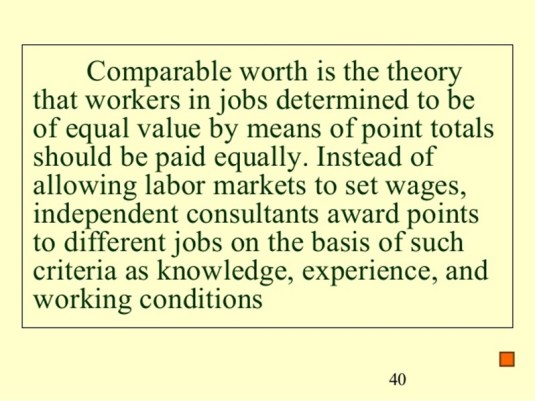
Rather than fight that battle for the 10,000th time, a considerable amount of the economic analysis of comparable worth in the 1980s took the principle of comparable worth for granted and simply traces out the unintended consequences of implementing comparable worth.
They then go on to argue, for example, Ed Lazear, that comparable worth is never the correct remedy for wage differentials and job segregation because it makes everything worse. Rather than persuade people that markets function well, he simply points out that comparable worth turns out to be a bizarre intervention and will do many things that its supporters don’t want.
As Richard Posner observed in a 1986 US appeal court opinion, under the principles of comparable worth, a perfectly decent and honest employer who behaves with complete honour towards women and their equality will nonetheless, if they lost comparable worth litigation, would have to pay back-pay despite the fact he paid the going wage and couldn’t afford to pay more.
The practical upshot of comparable worth is to introduce occupation by occupation and job by job minimum wages for women, with the burden of proof on the employer to show that a comparable worth ruling should not apply to them.
If comparable worth were to be applied to the aged care sector, such as is proposed in New Zealand, more women would move into that sector because of the higher wages, leaving to an over qualification problem with aged care workers.
Instead of moving women into better occupations – occupational upgrading – comparable worth based wage increases will keep low skilled women in the old occupations where they were previously supposedly discriminated against.
Furthermore, to the extent that the low pay of women in the aged care work is the product of sex discrimination and occupational segregation, comparable worth does nothing to reduce the barriers to entry into male dominated, better paid occupations.
To the extent that the wage increase because of comparable worth puts women out of work, not only do they not have a job, the purported barriers to entry into the better paid male dominated occupations are not addressed in any way.
Instead of reducing occupational segregation, comparable worth would increase it. More women would enter the low paid occupations to get the comparable worth wage increase, rather than try and move up the occupational ladder.
By increasing wages in the female dominated occupation, comparable worth causes more women and men to enter these occupations, not less, and at the same time shrinks the number of jobs available by driving down demand because of higher costs of labour.
One of the responses of employers to comparable worth is to change the composition of the recruitment poor from which they hire. They will hire better qualified workers and put out of work their existing workers. This is common with the teenage minimum wage: 17 and 18-year-olds tend to lose their jobs to more mature and responsible 18 to 19-year-olds after a minimum wage increase.
The better explanation of why so many women are in a particular occupation is job sorting: that particular job has flexible hours and the skills do not depreciate as fast for workers who take time off, working part-time or returning from time out of the workforce.
- Low job turnover workers will be employed by firms that invest more in training and job specific human capital.
- Higher job turnover workers, such as women with children, will tend to move into jobs that have less investment in specialised human capital, and where their human capital depreciates at a slower pace.
Women, including low paid women, select careers in jobs that match best in terms of work life balance and allows them to enter and leave the workforce with minimum penalty and loss of skills through depreciation and obsolescence.
This is the choice hypothesis of the gender wage gap. Women choose to train and be educated in occupations where human capital depreciates at a slower pace.
Comparable worth is a very 20th century concept:
- The wage gap in the late 20th century was driven by the education gap; and
- In the 21st century, it is driven by work flexibility.
Claudia Goldin has described pharmacy is the most family friendly occupation. She compares it to law. In law, if you work long hours, you are on partnership track and win the top clients. In pharmacy, the only advantage of working longer hours as you earn more money that week. Also, pharmacists are completely interchangeable. Do you care which pharmacist fills out your prescription at your local pharmacy or even know which one fills it out? Lawyers are not interchangeable: they cannot just handover a case. Detailed briefings would be required. You expect your lawyer to show up in court or at meetings on time anywhere without fail.
Claudia Goldin did a great study of Harvard MBA is using online surveys of their careers. She found that three proximate factors accounted for the large and rising gender gap in earnings:
- differences in training prior to MBA graduation,
- differences in career interruptions, and
- differences in weekly hours.
The greater career discontinuity and shorter work hours for female MBAs are largely associated with motherhood. There are some jobs that are severely penalise any time out of the workforce.
Goldin found one counterfactual that cancels out the gender wage gap amongst MBA professionals: hubby earns less! Female MBAs who’ve have a partner who earn less than them earn as much as the average MBA professional on an hourly basis but work a few less hours per week.
Interesting breakout of the gender wage gap by circumstances http://t.co/nzWiT6rXOu—
Chris (@forewit) December 11, 2014
When comparable worth was introduced by legislation in Ontario, any comparable worth wage increase was limited to 1% of the previous year’s payroll and then these payments could continue until pay equity is achieved. The pay equity legislation for the private sector in Ontario applied to any private sector employer with 10 or more employees.
A study found that the Ontario pay equity law had no effect on aggregate wages in female jobs or on the gender wage gap. Also, a lot of small firms completely ignored the law or didn’t even know about it.
The key point to make is if the New Zealand employment courts introduce comparable worth, it will be in one foul swoop with the possibility of substantial back-pay owing. If Parliament decided to act, it can introduce social reforms at a measured pace.
France, here the New Zealand labour market comes – part 2! How the Employment Court is re-regulating
04 Mar 2015 7 Comments
in applied price theory, Austrian economics, entrepreneurship, F.A. Hayek, George Stigler, human capital, industrial organisation, job search and matching, labour economics, law and economics, Ludwig von Mises, politics - New Zealand, survivor principle Tags: Armen Alchian, employment law, employment protection laws, entrepreneurial alertness, France, Israel Kirzner, The fatal conceit, The pretence to knowledge
As discussed yesterday, if the Employment Court had its way, New Zealand case law under the Employment Relations Act regarding redundancies and layoffs would be as job destroying as those in France.
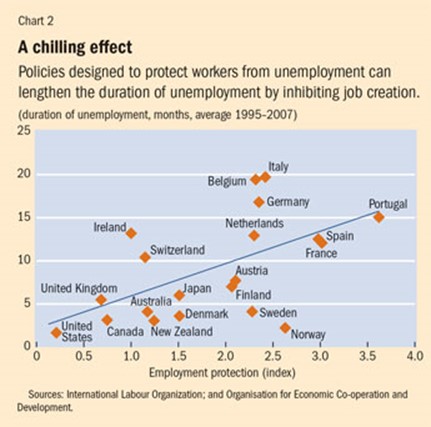
The Employment Court’s war against jobs goes back more than 20 years. To 1991 and G N Hale & Son Ltd v Wellington etc Caretakers etc IUW where the Court held that a redundancy to be justifiable under law it must be ‘unavoidable’, as in redundancies could only arise where the employer’s capacity for business survival was threatened.
The Court of Appeal slapped that down and affirm the right of the employer to manage his business in no uncertain terms:
…this Court must now make it clear that an employer is entitled to make his business more efficient, as for example by automation, abandonment of unprofitable activities, re-organisation or other cost-saving steps, no matter whether or not the business would otherwise go to the wall…
The personal grievance provisions … should not be treated as derogating from the rights of employers to make management decisions genuinely on such grounds. Nor could it be right for the Labour Court to substitute its own opinion as to the wisdom or the expediency of the employer’s decision.
When a dismissal is based on redundancy, it is the good faith of that basis and the fairness of the procedure followed that may fall to be examined on a complaint of unjustifiable dismissal
… the Court and the grievance committees cannot properly be concerned with an examination of the employer’s accounts except in so far as it bears on the true reason for dismissal.
The Employment Court could only inquire as to the genuineness of the employer’s decision and the procedures adopted. The Court could not substitute their views on management decisions. No second-guessing.
In Brake v Grace Team Accounting Ltd, the Employment Court found its way back into second-guessing employer’s decisions about how to manage their business. The figures used by the employer to decide that a redundancy was required were in error. The employer miscalculated.
The Employment Court had previously held in Rittson-Thomas T/A Totara Hills Farm v Hamish Davidson that the statutory test of what a fair and reasonable employer could have done in all the circumstances applies to the substantive reasoning for redundancies. Some enquiry into the employer’s substantive decision is required to establish that a hypothetical fair and reasonable employer could also make the same decision in all of the circumstances.
Subsequently in Brake v Grace Team Accounting Ltd, the Employment Court found that the actions by the employer were “not what a fair and reasonable employer would have done in all the circumstances” and “failed to discharge the burden of showing that the plaintiff’s dismissal for redundancy was justified”.
The Court found that the redundancy was “a genuine, but mistaken, dismissal”, but it still found that the dismissal was substantively unjustified. That is a major new development. Mistaken dismissals that are genuine are unlawful and grounds for compensation under the employment law.
The case was appealed where the issues were whether the correct test had been applied. The Court of Appeal, in a sad day for employers, job creation and the unemployed, found that the Employment Court was within its rights to do what it did and applied the statutory tests correctly:
GTA acted precipitously and did not exercise proper care in its evaluation of its business situation and it made its decision about Ms Brake’s redundancy on a false premise.
So it never turned its mind to what its proper business needs were but rather proceeded to evaluate its options based on incorrect information. We can see no error in the finding by the Employment Court that a fair and reasonable employer would not do this.
The test is now that fair and reasonable employers in New Zealand do not make mistakes. A much greater burden is now laid upon employers to show that not only that redundancies are justified, but they have made careful calculations and no mistakes.
No more seat of your pants entrepreneurship in New Zealand. No more entrepreneurial hunches – the essence of entrepreneurship is acting on hunches and other judgements that are incapable of being articulated to others and about which there is mighty disagreement in many cases. As Lavoie (1991) states:
…most acts of entrepreneurship are not like an isolated individual finding things on beaches; they require efforts of the creative imagination, skillful judgments of future costs and revenue possibilities, and an ability to read the significance of complex social situations.
The essence of entrepreneurship is your hunches are better than the next guy’s and you survive in competition by backing that hunch often to the consternation of the crowd. As Mises explains:
[Economics] also calls entrepreneurs those who are especially eager to profit from adjusting production to the expected changes in conditions, those who have more initiative, more venturesomeness, and a quicker eye than the crowd, the pushing and promoting pioneers of economic improvement…
The entrepreneurial idea that carries on and brings profits is precisely that idea which did not occur to the majority… The prize goes only to those dissenters who do not let themselves be misled by the errors accepted by the multitude
In many cases, those entrepreneurial hunches are sorted, sifted and selected on the basis of trial and error in the marketplace. Central to Hayek’s conception of the meaning of competition is it is a process of trial and error with many errors:
Although the result would, of course, within fairly wide margins be indeterminate, the market would still bring about a set of prices at which each commodity sold just cheap enough to outbid its potential close substitutes — and this in itself is no small thing when we consider the insurmountable difficulties of discovering even such a system of prices by any other method except that of trial and error in the market, with the individual participants gradually learning the relevant circumstances.
Remember Hayek’s conception of competition as a discovery procedure where prices and production emerge through the clash of entrepreneurial judgements and competitive rivalry:
…competition is important only because and insofar as its outcomes are unpredictable and on the whole different from those that anyone would have been able to consciously strive for; and that its salutary effects must manifest themselves by frustrating certain intentions and disappointing certain expectations
Errors are no longer permitted in the New Zealand labour market by the Employment Court. The Court has outlawed error in redundancy decisions.
This is despite the fact that the conception by Kirzner of the market process is that it is an error correction procedure without rival and a central role of entrepreneurial alertness is to correct errors in pricing and production:
It is important to notice the role played in this process of market discovery by pure entrepreneurial profit. Pure profit opportunities emerge continually as errors are made by market participants in a changing world. The inevitably fleeting character of these opportunities arises from the powerful market tendency for entrepreneurs to notice, exploit, and then eliminate these pure price differentials.
The paradox of pure profit opportunities is precisely that they are at the same time both continually emerging and yet continually disappearing. It is this incessant process of the creation and the destruction of opportunities for pure profit that makes up the discovery procedure of the market. It is this process that keeps entrepreneurs reasonably abreast of changes in consumer preferences, in available technologies, and in resource availabilities.
Rothbard made similar arguments about the centrality of discrepancies and error in entrepreneurship:
The capitalist-entrepreneur buys factors or factor services in the present; his product must be sold in the future. He is always on the alert, then, for discrepancies, for areas where he can earn more than the going rate of interest.
In Frank Knight’s conception of profit, there were temporary profits that arise from the correction of error:
In the theory of competition, all adjustments “tend” to be made correctly, through the correction of errors on the basis of experience, and pure profit accordingly tends to be temporary.
The Employment Court misunderstands the market process as a process of error correction. Those errors are identified through entrepreneurial alertness and trial and error. These errors are both of over-optimism and over-pessimism as Kirzner explains:
Errors of over-pessimism are those in which superior opportunities have been overlooked. They manifest themselves in the emergence of more than one price for a product which these resources can create. They generate pure profit opportunities which attract entrepreneurs who, by grasping them, correct these over-pessimistic errors.
The other kind of error, error due to over-optimism, has a different source and plays a different role in the entrepreneurial discovery process. Over-optimistic error occurs when a market participant expects to be able to complete a plan which cannot, in fact, be completed.
A considerable part of entrepreneurial alertness arises from the business opportunities created by sheer ignorance and pure error as Kirzner explains:
What distinguishes discovery (relevant to hitherto unknown profit opportunities) from successful search (relevant to the deliberate production of information which one knew one had lacked) is that the former (unlike the latter) involves that surprise which accompanies the realization that one had overlooked something in fact readily available. (“It was under my very nose!”)
The market process is a selection procedure where the more efficient survive for reasons that may be unknown to the entrepreneurs directly concerned as well as to observers and officious judges. Alchian pointed out the evolutionary struggle for survival in the face of market competition ensured that only the profit maximising firms survived:
- Realised profits, not maximum profits, are the marks of success and viability in any market. It does not matter through what process of reasoning or motivation that business success is achieved.
- Realised profit is the criterion by which the market process selects survivors.
- Positive profits accrue to those who are better than their competitors, even if the participants are ignorant, intelligent, skilful, etc. These lesser rivals will exhaust their retained earnings and fail to attract further investor support.
- As in a race, the prize goes to the relatively fastest ‘even if all the competitors loaf.’
- The firms which quickly imitate more successful firms increase their chances of survival. The firms that fail to adapt, or do so slowly, risk a greater likelihood of failure.
- The relatively fastest in this evolutionary process of learning, adaptation and imitation will, in fact, be the profit maximisers and market selection will lead to the survival only of these profit maximising firms.
The surviving firms may not know why they are successful, but they have survived and will keep surviving until overtaken by a better rival. All business needs to know is a practice is successful.
One method of organising production and supplying to the market will supplant another when it can supply at a lower price (Marshall 1920, Stigler 1958). Gary Becker (1962) argued that firms cannot survive for long in the market with inferior product and production methods regardless of what their motives are. They will not cover their costs.
The more efficient sized firms are the firm sizes that are currently expanding their market shares in the face of competition; the less efficient sized are those firms that are currently losing market share (Stigler 1958; Alchian 1950; Demsetz 1973, 1976). Business vitality and capacity for growth and innovation are only weakly related to cost conditions and often depends on many factors that are subtle and difficult to observe (Stigler 1958, 1987). The Employment Court pretends to know better than the outcome of the competitive struggle in the market for survival.
The Employment Court also believes employers have something akin to academic tenure. In 2010, the Court found that an employee’s redundancy was unjustified because the employer did not offer redeployment and there is no requirement that the right of the redeployment be written into the employment agreement (Wang v Hamilton Multicultural Services Trust). The particulars of this case were quite interesting:
- A new management role was created with significantly more responsibility for training, supervision and decision making than the redundant finance administrator role, with a 50% salary increase to recognise the increased responsibilities and duties.
- The vacancy was advertised externally but the existing finance administrator was encouraged to apply.
- His experience and qualifications meant that he could fulfil the new role, albeit with some up-skilling.
- He decided not to apply for it to avoid jeopardising a personal grievance claim that his redundancy was not genuine and therefore unjustified.
In the case at hand, the Employment Court held that the employer was obliged to look for alternatives to making the employee redundant. Given that he would be able to perform the new finance manager position with some up-skilling, the employer should have offered him the position rather than simply inviting him to apply for it.
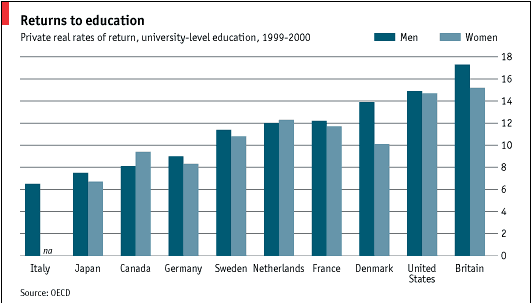
The notion that an employee through training can quickly increase their marginal productivity by 50% to fill a more senior role contradicts the modern labour economics of human capital. A 50% salary increase through a bit of training would imply extraordinary annual returns on other forms of on-the-job training and formal education as well as the training at hand in the Employment Court case.
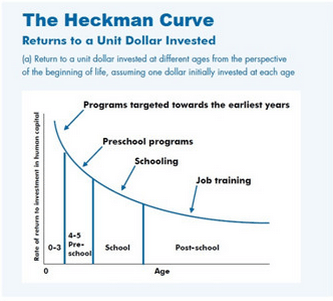
I would very much like to be in the position where I can get a 50% salary increase after a bit of training. As I recall, I required about 5-10 years of on-the-job human capital acquisition before my starting salary as a graduate was 50% higher through promotion and transfers.
In summary, the Employment Court stands apart from the modern labour economics of human capital and job search and matching as well as the modern theory of entrepreneurial alertness, and the market as a discovery procedure and an error correction mechanism. The Employment Court has fallen for both the pretence to knowledge and the fatal conceit.
France, here the New Zealand labour market comes! The Employment Court’s long march to re-regulate
03 Mar 2015 Leave a comment
in economics of regulation, job search and matching, labour economics, law and economics, organisational economics, politics - New Zealand Tags: employment protection laws, France, The fatal conceit, vexatious litigation
If the Employment Court had its way, New Zealand case law under the Employment Relations Act regarding redundancies and layoffs would be as strict as those in France. As top employment lawyer Peter Cullen explained in the Dominion Post today:
Former Employment Court chief justice Tom Goddard said employees could not be made redundant unless the company would otherwise go to the wall.
The employer appealed.
The Court of Appeal said something quite different. Its view was that if a business could be run more efficiently without a particular position, then it was entitled to disestablish it.
The Court of Appeal made it plain that it would not critically examine the logic behind the employer disestablishing a role. If the reason behind the redundancy was genuine, that was all that really mattered. Of course a fair process and consultation ought to precede any decision, but the outcome nevertheless was that the position could go.
The Employment Court wanted the position to be the same as at that in France where layoffs are permissible only to avoid bankruptcy:
…firms still cannot lay off workers to improve competitiveness when the business is healthy; they can only make economic dismissals to preserve competitiveness when already in financial straits. In France, it ought to be legal to fix small problems before they become big.
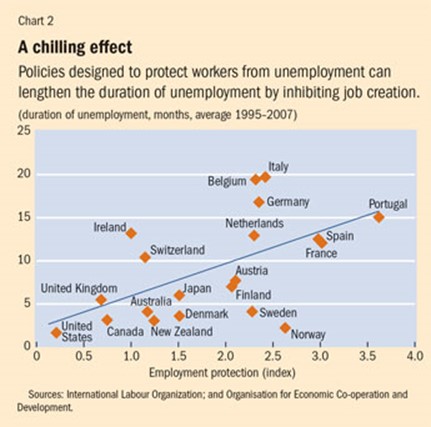
This French standard of regulation of layoffs and redundancies, if it had survived on appeal, would have come as a surprise to many, including the OECD who rates New Zealanders having no regulation of layoffs in its Index of Employment Protection.
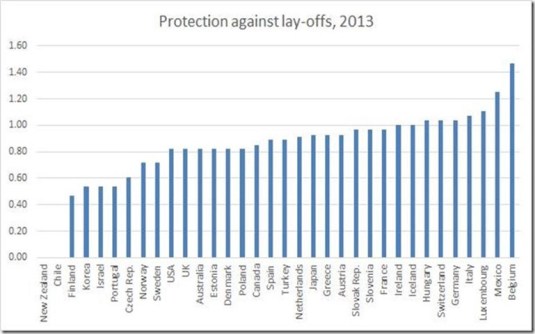
Source: OECD employment protection index.
But you can’t keep an activist Employment Court down. It’s next tactic was salami tactics. Chipping away at the right of the employer to run its business and decide how large its labour force is. Peter Cullen again with the Employment Court pretending it can second-guess entrepreneurial judgements and arithmetic:
In the case between Grace Team Accounting and employee Judith Brake, the Employment Court found that the decision to make Brake’s position redundant was based upon mistaken arithmetic. The Court of Appeal held that Brake’s redundancy amounted to an unjustified dismissal.
Next cab off the rank was requiring employers to give preference to redundant employees pretty much no matter what. Peter Cullen again:
In the case of Neil Wang and his employer the Hamilton Multicultural Services Trust, the trust encouraged Wang to apply for another role within the organisation.
However, the Employment Court said the trust should have considered whether they should have simply offered Wang the position without having to go through an application process.
The court found that even though the other role was not the same, it required the same skills and minimal retraining and so the trust should have simply given Wang the role.
It is standard in the redundancies and restructurings I’ve been involved with for non-managerial employees to go through internal reassignment panels. Some didn’t make it and were laid off.

It’s common for the managerial vacancies to be advertised externally so that redundant managers must compete with external applicants so that the workplace can renew itself. Quite a few managers don’t make it through this process because of the external competition.
This clear preference for existing employees is a major reregulation of the labour market. Now, every redundant employee can engage in vexatious litigation and squeeze a few thousand dollars extra out of the employer by threatening to go to the Employment Court for a second opinion on the entrepreneurial judgements of the employer. To save managerial time as well is legal fees, it’s cheaper for most employers to pay the redundant employee off with a small settlement.

Anything that makes it more expensive to fire an employee makes it more expensive to hire an employee. This will reduce job creation in New Zealand now that the French standard applies:
…businesses remain obligated to assist laid-off employees in finding other jobs and in retraining them for their new positions – a distinctly French phenomenon. For businesses with more than 1,000 employees, this limbo period before dismissal can last from four to nine months.

Back when Amazon One-Click would have required an import licence every time you used it
03 Mar 2015 Leave a comment
in economic history, economics of regulation, international economics, politics - New Zealand
Wilful ignorance is at its best when criticising the post-1984 economic reforms in New Zealand. Critics can’t be bothered, don’t want to know or pretend they don’t know how heavily regulated the New Zealand economy was up until 1984.

An example is the use of Amazon One-Click which everyone takes for granted. Back in 1984 it would have required an import licence:
To send money overseas you bought money orders from the Post Office. Above a certain amount “about $5 a day” you applied to the Reserve Bank. Same for international magazines – you filled out a form, sent it to the Reserve Bank, and got permission from Nanny to send funds offshore
Of course, when in our intrepid left-wing reactionaries hear of this, they would say that they would agree that that is a bit too much and that regulation should have been repealed. That just makes them Roger Douglas lite!
What else do they want to not bring back: give Telecom back its monopoly; marginal tax rates will go back to 66 per cent, kicking in at $30,000? All shops must close of the weekends?
Importing consumer goods generally required a licence prior to the economic reforms of the labour government that was elected in 1984. In addition, up until 1984, a wide range of goods had quotas that restricted how much could be imported in any one year.
Alan Gibbs recently told a story about every time his tractor company wanted to import a tractor, he needed a new import licence and his competitors could object to the issue of that licence! Nowadays, they would use the Resource Management Act resource consenting process to object to competitors when they try and expanded their business.
Why doesn’t capital flow from the rich countries to supposedly capital shallow New Zealand?
03 Mar 2015 Leave a comment
in econometerics, economic growth, industrial organisation, politics - New Zealand Tags: capital mobility, Trans-Tasman income gap
Hall and Scobie (2005) attributed 70 percent of the labour productivity gap with Australia to New Zealand workers using less capital per worker than their Australian counterparts, rather than their using w3capital less efficiently. Figure 1 shows that the capital labour ratio is lower in New Zealand than in Australia and has been lower than Australia for several decades and is getting worse.
Figure 1: Capital intensity in New Zealand relative to Australia: 1978-2002

Source: Hall and Scobie 2005.
In 1978, New Zealand and Australian workers had about the same amount of capital per hour worked. By 2002, capital intensity in Australia was over 50 percent greater than in New Zealand. This lower rate of capital intensity is capital shallowness.
Capital should flow to countries with the highest risk adjusted rates of return. If workers in a country work with less capital than in other countries, the rate of return on providing them with more capital is higher than the global average return to capital. As Stigler (1963) said:
There is no more important proposition in economic theory than that, under competition, the rate of return on investment tends toward equality in all industries.
Entrepreneurs will seek to leave relatively unprofitable industries and enter relatively profitable industries, and with competition there will be neither public nor private barriers to these movements.
This mobility of capital is crucial to the efficiency and growth of the economy: in a world of unending change in types of products that consumers and businesses and governments desire, in methods of producing given products, and in the relative availabilities of various resources—in such a world the immobility of resources would lead to catastrophic inefficiency
Hall and Scobie (2005) acknowledged that lower capital intensities could be entirely a by-product of lower MFP. New Zealand had the third worst MFP growth performance since 1985, one quarter the OECD average (OECD 2009).
Rather than money being left on the table by persistent, known but unexploited entrepreneurial opportunities for pure profit by investing more in under-capitalised New Zealand and providing additional capital and equipment and more advanced technologies for New Zealanders to work with, investors have done the best they could the relative poor investment opportunities here.
Figure 2: Differences in capital intensity: the case of different production functions

Source: Hall and Scobie 2005.
A divergence in labour productivity levels between Australia and New Zealand emerged in the 1970s and 1980s. Kehoe and Ruhl (2003) attributed 96 percent of the fall in labour productivity in New Zealand between 1974 and 1992 to a fall in MFP. Changes in capital intensities played a minor role.
Aghion and Howitt (2007) found that three-quarters of the growth in output per worker in Australia and New Zealand between 1960 and 2000 was due to growth in MFP. New Zealand’s annual MFP growth of 0.45 percent between 1960 and 2000 was simply much lower than Australia’s 1.26 percent per year. Capital deepening was equally lower in New Zealand with 0.16 percent comparing to 0.41 percent in Australia.
Less would be invested in a country if the returns are lower because the capital is poorly employed. There might be a lack of complementary skills and education and, more often, policy distortions that lower MFP (Alfaro et al 2007; Caselli and Feyrer 2007; Lucas 1990).Investment in ICT capital is greatest in the USA because it is the global industrial leader and has very flexible markets. Investment in ICT in the EU is proportionately less because less flexible markets make ICT investments in the EU members less fruitful to investors.
To explore the relative role of lower MFP and the cost of capital in capital shallowness, Hall and Scobie (2005) used national accounts data to estimate the cost of capital and found that New Zealand faced a higher cost of capital than Australia, the USA and the OECD average since the early 1990s. Research that is more recent disputes these concerns about a higher cost of capital in New Zealand.
In Caselli and Feyrer’s (2007) revised cost of capital estimates, the cost of capital is significantly lower in New Zealand than in Australia and elsewhere in the OECD area such as the USA, Japan and UK – see Figure 3. Caselli and Feyrer (2007) correct for an overestimation of the cost of capital that is prevalent for countries such as New Zealand where the value of land and natural resources are high.
Figure 3: Caselli and Feyrer’s Estimates of the Cost of Capital, 1996
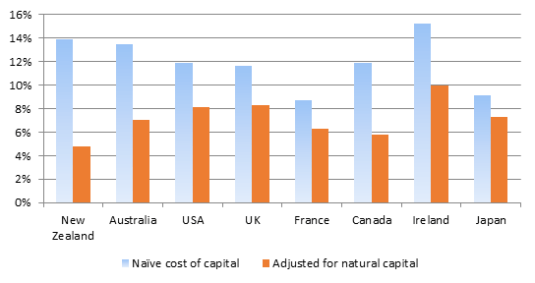
Source: Caselli and Feyrer (2007); Hsieh and Klenow (2011).
Notes: The measure of capital income used by Hall and Scobie (2005) to calculate the cost of capital includes payments to reproducible physical capital (equipment, machinery, ICT, buildings and other structures) as well as payments to natural capital (land and natural resources). Dividing the income that flows to all types of capital including land and natural resources by just the value of reproducible physical capital overestimates the cost of capital. Caselli and Feyrer (2007) used World Bank (2006) estimates of natural capital stocks in 1996 to estimate of income flows to reproducible physical capital. Their estimates excluded income flows to land and natural resources to estimate the cost of reproducible capital.
Caselli and Feyrer (2007) revised estimate in Figure 3 is for the cost of capital for investing in equipment, machinery, ICT, buildings and structures. When land and resources are included, shown in light blue as the naive cost of capital, the estimated cost of capital is one-half of percentage point higher in New Zealand than in Australia and two percent higher in New Zealand than the USA and UK in Figure 3. When land and natural resources are excluded, shown in red as the adjusted for natural capital estimate, the cost of capital is much lower in New Zealand than in Australia, the USA, Japan and UK – see Figure 3.
What Caselli and Feyrer (2007) show is the estimation of the cost of capital to New Zealand is fraught with statistical difficulties. A broader data set yields radically different results. That is the broader lesson.
At a minimum, safest thing to say, is there are no reliable estimates of the cost of capital in New Zealand. Depending on how you measure it, the cost of capital in New Zealand is either much higher or much lower than in the leading industrial countries such as the USA and UK. Such a broad range of estimates is no basis for public policy interventions.
When having to choose between arguing for a persistent, known but unexploited entrepreneurial opportunities for risk-free profit left on the table in New Zealand by foreign investors for decades, and measurement error in the case of one of the nastiest measurement jobs – measuring capital and natural resources – measurement error is more likely.
Capital is the most internationally mobile of factors of production. Entrepreneurs have every incentive to move it to new destinations with higher risk-adjusted rates of returns. Returns will not be exactly equal, but there will be a tendency for equalisation subject to these reservations listed by George Stigler in 1963:
- Some dispersion in rates of return exist because of imperfect knowledge of returns on alternative investments.
- Dispersion of returns would arise because of unexpected developments and events which call for movements of resources requiring considerable time to be completed.
- Dispersion in rates of return would arise because of differences among industries in monetary and nonmonetary supplements to the average rate of return.
- In any empirical study, there is also a fourth source of dispersion: the difference between the income concepts used in compiling the data and the income concepts relevant to the allocation of resources.
The last of these reservations listed by George Stigler in 1963 about the statistical concepts used in compiling what data can be collected and the concepts relevant to the entrepreneurial decisions about the allocation of resources appear to be crucial to the debate about capital shallowness in New Zealand. They also echo Hayek’s great reservation in his 1974 lecture The Pretence to Knowledge about focusing on what can be measured rather than what is important in both economic analysis and public policy making:
We know: of course, with regard to the market and similar social structures, a great many facts which we cannot measure and on which indeed we have only some very imprecise and general information. And because the effects of these facts in any particular instance cannot be confirmed by quantitative evidence, they are simply disregarded by those sworn to admit only what they regard as scientific evidence: they thereupon happily proceed on the fiction that the factors which they can measure are the only ones that are relevant.
Hall and Scobie (2005) were careful scholars who noted that possibility that the apparent capital shallowness in New Zealand is merely the result of measurement error because of the problems of measuring land and natural. Caselli and Feyrer (2007) justify their caution and vindicated the view that the marginal product of capital is pretty much the same all round the world. As Caselli and Feyrer (2007) explain:
There is no prima facie support for the view that international credit frictions play a major role in preventing capital flows from rich to poor countries.
Lower capital ratios in these countries are instead attributable to lower endowments of complementary factors and lower efficiency, as well as to lower prices of output goods relative to capital. We also show that properly accounting for the share of income accruing to reproducible capital is critical to reach these conclusions.
There is various debates in policy circles in New Zealand about this lack of capital per worker and a higher cost of capital in New Zealand.
But that debate and any policy measures that were introduced as a result may be misplaced and all due to measurement error, or more correctly the grave difficulties of measuring both the capital stock and the cost of capital, both generally and in New Zealand course of its large bounty of natural resources. The data was always in doubt, so any policy interventions should be very cautious and incremental.
It would have been surprising to find that lower productivity in New Zealand was due to a lack of access to capital. There is growing evidence that capital intensities are not a major contributor to cross-national per capita income gaps.
There is a broad empirical consensus that capital intensity explains about 20 per cent of cross-country income differences; differences in human capital account for 10 to 30 per cent of cross-national differences with MFP accounting for the remaining 50 to 70 percent (Hsieh and Klenow 2011).
The New Zealand capital shallowness hypothesis is too marred in measurement shortcomings to rebut this broad empirical consensus about MFP differences between all other countries. For example, when reviewing the trans-Atlantic productivity and income gap, Edward Prescott said:
The capital factor is not an important factor in accounting for differences in incomes across the OECD countries… [It] contributes at most 8 percent to the differences in income between any of these countries.”
At the broader level, this blind alley about capital shallowness in New Zealand illustrates the pretence to knowledge. The politicians and bureaucrats pretended to know the cost of capital and the size of the capital stock in New Zealand and then work out what to do in response while doing more good than harm. This was despite serious reservations about the quality of data at hand.
This blind alley about the cost of capital and capital shallowness in New Zealand illustrates Josh Lerner’s point about distractions such as these and their many equivalents overseas reinforce the importance of the neglected art of setting the table– of fostering a favourable business environment. The neglected art of setting the table includes:
- investing in a favourable tax regime (low taxes on capital gains relative to income tax are particularly important as studies show people respond to incentives); and
- making the labour market more flexible (again the opposite of what has happened in continental Europe ),
- reducing informal and formal sanctions on involvement in failed ventures;
- easing barriers to technology transfer, and
- providing entrepreneurship education for students and professionals alike.


Recent Comments