A Universal Basic Income, or UBI, is a superficially attractive idea. Under such a scheme, every adult would receive a regular payment from the government, regardless of income, employment or need. Supporters argue that it would reduce poverty, simplify welfare, provide security in an uncertain labour market and give people greater freedom to choose how […]
The Case Against a Universal Basic Income
The Case Against a Universal Basic Income
23 Jul 2026 1 Comment
in applied price theory, fiscal policy, income redistribution, labour economics, labour supply, macroeconomics, politics - New Zealand, poverty and inequality, Public Choice, welfare reform
Goldsmith on consent laws
21 Jul 2026 Leave a comment
in discrimination, economics of crime, gender, law and economics, politics - New Zealand
Paul Goldsmith announced: A re-elected National Government will modernise sexual consent laws to specify there must always be a “yes,” rather than an absence of a “no,” National’s Justice spokesperson Paul Goldsmith says. “National is focused on fixing the basics in law and order, and modernising our consent laws is an important part of that.…
Goldsmith on consent laws
Occupational Licensing Around the World
18 Jul 2026 1 Comment
in economics of regulation, labour economics, labour supply, occupational regulation, politics - New Zealand, politics - USA
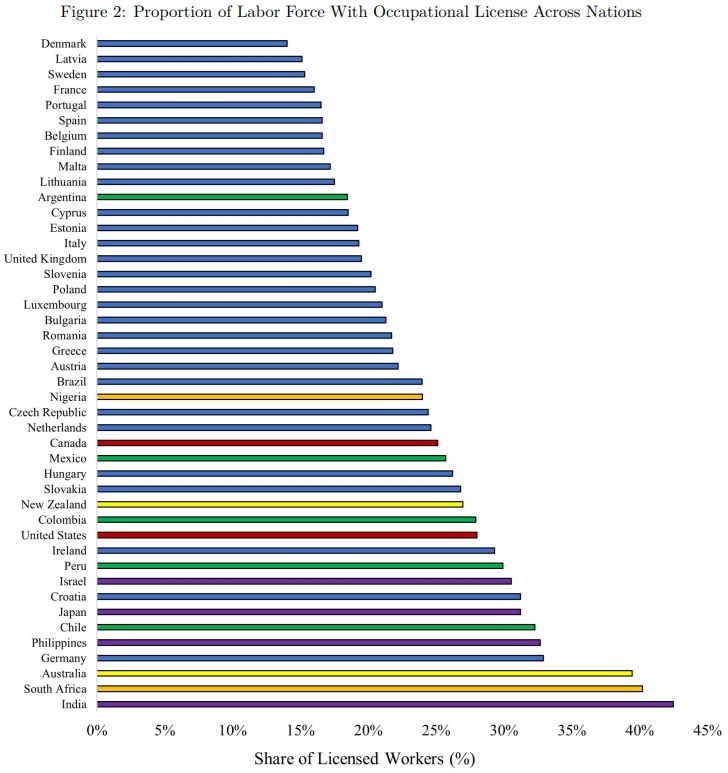
Hartley and Kleiner have a new Fed Minneapolis working paper surveying workers around the world to measure occupational licensing by country. In the United States, occupational licensing has increased substantially over time, so one might expect licensing to rise with income. Their headline result is the opposite: occupational licensing is negatively correlated with GDP per…
Occupational Licensing Around the World
ACT’s High Hopes for Henry
16 Jul 2026 Leave a comment
in politics - New Zealand Tags: 2026 general election
One of the rapidly emerging features of the 2026 election is the announcement of candidates carrying a profile from another sphere of activity. New Zealand First started the trend in April with former All Black captain Taine Randell announced as the candidate for Tukituki. He won’t win the seat but will surely be in the […]
ACT’s High Hopes for Henry
Was this Corrections case settled to avoid a precedent Crown Law & Human Rights Commission did not want?
15 Jul 2026 Leave a comment
in discrimination, economics of crime, gender, law and economics, politics - New Zealand Tags: sex discrimination
I am fuming. It is 2026 and the rest of the world is unwinding the destructive and nonsensical policies of the trans madness era, and here in New Zealand they are continuing to be embedded. Today, news broke that a female prison officer who now “identifies as a man” has managed not only to extract an apology and a […]
Was this Corrections case settled to avoid a precedent Crown Law & Human Rights Commission did not want?
Why is the PPTA not worried about far-left extremism?
15 Jul 2026 Leave a comment
in economics of bureaucracy, economics of education, Marxist economics, politics - New Zealand, Public Choice
The Press reports: A secondary teachers’ union is hiring an expert to develop guidelines for dealing with the rise in far-right extremism in the classroom. The successful applicant will be paid $10,000 to write “specific advice and guidelines for the membership on dealing with extremism in the classroom”. Do they mean Marxist extremists? I suspect…
Why is the PPTA not worried about far-left extremism?
The political malaise over New Zealand’s low wage problem
15 Jul 2026 Leave a comment
in economic growth, macroeconomics, politics - New Zealand
Among prosperous nations, New Zealand is relatively a low-income country. That hurts. In 2024, net national income per capita was 30% higher in Australia, according to the Paris-based OECD. It was only 19% higher on average over the four years to 2019.
The political malaise over New Zealand’s low wage problem
More academic censorship
14 Jul 2026 Leave a comment
in economics of regulation, health economics, law and economics, politics - New Zealand, property rights
The FSU released: A peer-reviewed paper by a Māori clinical psychologist has been removed from her profession’s journal on the grounds that keeping it accessible could harm Māori. It was not retracted for error, fraud or misconduct, which are ordinarily the only reasons for such an action. Censorship knows no bounds. How dare she have…
More academic censorship
Coyne is keeping an eye on the legislation to define women and men
10 Jul 2026 Leave a comment
in discrimination, gender, law and economics, politics - New Zealand, property rights Tags: sex discrimination
Bob Edlin writes – News has reached Professor Jerry Coyne of the New Zealand Parliament debating a bill (which passed on its first reading) that would legally define a “man” and a “woman” this way: 13A Meaning of woman or female In any legislation, regardless of gender identity,— (a) woman means an adult human biological […]
Coyne is keeping an eye on the legislation to define women and men
Scientists on sex
09 Jul 2026 Leave a comment
in health economics, politics - New Zealand
The Ad Hoc Working Group on sex denialism has submitted on the Legislation (Definitions of Woman and Man) Amendment Bill. Their stance is neither for nor against the Bill, it is to clarify the science.
Scientists on sex
One public servant we could survive without
03 Jul 2026 Leave a comment
in economics of regulation, health economics, law and economics, politics - New Zealand, property rights Tags: economics of smoking
Stuff reports: A Government ministry has taken the time to threaten legal action against Stuff, all over a photo of a 45-year-old magazine used in a Stuff Quiz. On June 26, question five of the Stuff morning trivia quiz asked who appeared on the debut cover of Playboy magazine. To accompany the question, the quiz featured an archive image of a person…
One public servant we could survive without
Opportunity is no longer a wasted vote
03 Jul 2026 Leave a comment
in politics - New Zealand Tags: 2026 general election

Something unusual has happened in the 2026 election campaign: a new party has started to matter. The Opportunity Party has moved from being a minor-party curiosity to being a possible parliamentary entrant. This does not mean Opportunity will definitely make it into Parliament. It might not. It could still collapse back to 2-3%, as small […]
Opportunity is no longer a wasted vote
No TOP is not a centrist party
02 Jul 2026 Leave a comment
Ashley Church sets out why TOP is not a centrist party. The evidence is overwhelming: It’s not even close. If TOP are in Parliament I would offer odds of 20:1 (if DIA allowed me) that they would support a Labour-Green-Te Pati Maori Government over a centre-right one. The post No TOP is not a centrist…
No TOP is not a centrist party
The Hollowing of the Political Centre
27 Jun 2026 1 Comment
in liberalism, Marxist economics, politics - Australia, politics - New Zealand, politics - USA Tags: voter demographics
Across the Western democracies, the political centre is under pressure. The populist right is rising, especially in Europe and the United States, while younger voters are showing renewed interest in socialism, or at least in much more interventionist economic policies. The result is not that the centre has vanished, but that it has lost much […]
The Hollowing of the Political Centre
The mighty hurdle facing The Opportunity Party
27 Jun 2026 Leave a comment
Since 1996 no new party has entered Parliament without either a sitting or former MP leading it. The Conservative Party in 2014 came close to doing so, scoring about 4% of the party vote, but ultimately failed and never attained that level of support again.
The mighty hurdle facing The Opportunity Party


Recent Comments