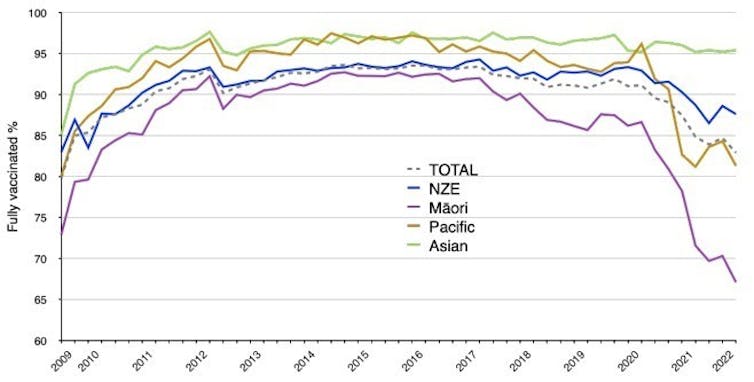
Anna Howe, Emma Best and Rachel Webb write – The recent confirmation of new measles cases unconnected to international travel suggests the highly contagious disease has likely started spreading through communities, according to Health New Zealand. This is a stark reminder of the pending danger of a larger measles outbreak. To prevent transmission once the measles virus […]
The Post reports: About one in five ACT local candidates won the seats they stand for and party leader David Seymour says he’s happy more weren’t successful because now they can stand to run for Parliament. “In some cases, I was kind of hoping they wouldn’t get elected so we can run them next year,” […]
Robert MacCulloch isn’t partisan in his political views. He is scathing about Labour and its potential partners and often goes very hard on National and the coalition government. But he’s found some good news: . . The Opposition’s Coalition of Chaos hasn’t come up with one sensible idea since losing power. Now the only brain […]
Labour and Greens want us to run out of gas, having banned future exploration. They think the country can be powered by 100% renewables. One problem is that many New Zealanders have gas powered heating and cooking. So what would be the cost of doing away with gas? We now have an answer with this […]
Media and Communications Minister, Paul Goldsmith’s handling of the BSA power grab follow 80 years of abysmal leadership by National Party governments re broadcasting, which have consistently betrayed their rhetoric about supporting competition and private enterprise. The National Party Holland/Holyoake government of 1949-1957, did nothing of consequence to roll back the Savage/Fraser Labour governments nationalisation […]
An interesting research note from Eric Crampton and at the NZ Initiative on the benefits of devolution on development. It details how Canadian First Nations have transformed their economic fortunes and have built thousands of new homes after gaining powers for planning, zoning, tax, and infrastructure finance. A couple of examples: The Squamish Nation’s 6,000-apartment […]
A report by the New Zealand Initiative shows that the state is a very expensive landlord: Why does the government need to continue owning or managing more than 77,000 housing units, given its poor track record in this area, especially when state assistance can be provided without extensive government ownership? And why does it not […]
Bob Edlin writes – Come in Chloe and your fellow champions of Palestinian statehood and tell us what you think of happenings in the Middle East in recent days. There was widespread celebration – not only in Israel and Gaza but around the world – of news of a cease-fire and that the hostages taken […]
A former vice-president of your party (and son of one of your MPs) says your party is run like a dictatorship. When this accusation is put to the co-leaders, the male co-leader refuses to answer and heads off. He sees the female co-leader is not following him and may be about to answer the question, […]
Roger Partridge writes: When Parliament says gang insignia “is forfeited to the Crown,” citizens are entitled to assume those words mean what they say. Yet on 11 August the District Court ruled otherwise. Judge Lance Rowe directed that a Mongrel Mob vest, seized under the Government’s new Gangs Act 2024 and forfeited following a guilty plea, should nevertheless […]
Governments of the left like to claim they are transformational, when they’re not. The Ardern Government achieved so little it was the opposite. They used wellbeing as a slogan, and did a couple of disastrous mergers. They spent a lot of money. To be fair the Clark Government did actually achieve some major stuff such […]
As I reported in September of last year, every entering student at New Zealand’s Auckland University was required to take an “indigeneity” course—and that includes prospective science majors. As I noted: . . . . at the University of Auckland—New Zealand’s most prestigious university—every student has to take a mandatory course related to indigenous knowledge, […]
Jerry Coyne writes – As I reported in September of last year, every entering student at New Zealand’s Auckland University was required to take an “indigeneity” course—and that includes prospective science majors. As I noted: . . . . at the University of Auckland—New Zealand’s most prestigious university—every student has to take a mandatory course […]
This week, my ECONS102 class covered inequality, and social security. Which is timely, because I have been meaning to blog about this Treasury Analytical Note from 2024, by Tod Wright and Hien Nguyen, for some time. Wright and Nguyen look at the distributional impact of taxes, transfers, and government spending (on healthcare and education).Importantly, they distinguish…
Why Evolution is True is a blog written by Jerry Coyne, centered on evolution and biology but also dealing with diverse topics like politics, culture, and cats.
“We do not believe any group of men adequate enough or wise enough to operate without scrutiny or without criticism. We know that the only way to avoid error is to detect it, that the only way to detect it is to be free to inquire. We know that in secrecy error undetected will flourish and subvert”. - J Robert Oppenheimer.





 Utopia, you are standing in it!
Recent Comments