Thank You Top 1% for Paying More Than Your Fair Share of Taxes: Almost As Much ($465B) as Entire Bottom 95% ($510B) pic.twitter.com/L3rVASvkCs
— Mark J. Perry (@Mark_J_Perry) December 20, 2015
Top 1% pays almost as much tax as the bottom 95%
27 Dec 2015 1 Comment
in politics - USA, public economics Tags: top 1%
Voter turnout rates among the less educated have collapsed since the 1970s
23 Dec 2015 Leave a comment
in economics of education, economics of media and culture, politics - USA, Public Choice Tags: expressive voting, rational ignorance, voter demographics, voter turnout
How much lower is youth voter turnout across the OECD?
23 Dec 2015 Leave a comment
in politics - Australia, politics - New Zealand, politics - USA, Public Choice Tags: rational ignorance, voter turnout
Teenage smoking rates by family affluence in the USA, Germany, France, Canada and UK
22 Dec 2015 Leave a comment
in health economics, politics - USA Tags: economics of smoking
Not only are there large differences in teen smoking rates by family affluence in North America, there are large differences in teen smoking rates between across the Atlantic and the English Channel.
Source: OECD Family Database – OECD.
Education and the risk of criminality
22 Dec 2015 Leave a comment
in economics of crime, economics of education, labour economics, labour supply, law and economics, occupational choice, politics - USA Tags: crime and punishment
The US-Mexican Border
22 Dec 2015 Leave a comment
in development economics, politics - USA Tags: economics of borders, Mexico
Roland Fryer on Education, Inequality, & Incentives
19 Dec 2015 1 Comment
in applied price theory, discrimination, economics of education, gender, human capital, labour economics, labour supply, politics - New Zealand, politics - USA, poverty and inequality Tags: charter schools, racial discrimination, Roland Fryer

US maternal employment rates by number and age of children
18 Dec 2015 Leave a comment
in discrimination, gender, labour economics, labour supply, politics - USA, poverty and inequality, welfare reform Tags: economics of fertility, female labour force participation, maternal labour force participation, single mothers
The Taylor rule and the Fed’s interest rate policies compared
17 Dec 2015 2 Comments
in economics of bureaucracy, macroeconomics, monetary economics, politics - USA
The gap between black and white students appears as early as kindergarten and grows with time
17 Dec 2015 Leave a comment
in discrimination, economics of education, labour economics, politics - USA Tags: early childhood education, racial discrimination
Young people supported the Vietnam War as much as older folk
16 Dec 2015 Leave a comment
in defence economics, politics - USA, war and peace Tags: Vietnam war, votor demographics
Why do @fightfor15 @LivingWageNZ @LivingWageUK aim so low?
16 Dec 2015 1 Comment
in applied price theory, labour economics, Marxist economics, minimum wage, politics - New Zealand, politics - USA, poverty and inequality Tags: expressive voting, Leftover Left, living wage
Choices that lead to poverty @GarethMorgannz @povertymonitor
15 Dec 2015 2 Comments
in applied welfare economics, labour economics, labour supply, politics - New Zealand, politics - USA, poverty and inequality, welfare reforms
The best evidence that poverty can be a choice is the success of the 1996 US welfare reforms and other carrot and stick approaches to poverty reduction. Poverty in the USA dropped dramatically in the mid-1990s after being stable for decades.
The stick is the most important part of poverty reduction programs that have succeeded. The poverty is not a choice movement deny to themselves the most successful child poverty reduction tool of modern times.
The success of the 1996 US federal welfare reforms were not discussed in an experts report on solutions to child poverty published a few years ago by the Children’s Commissioner. It should have been.
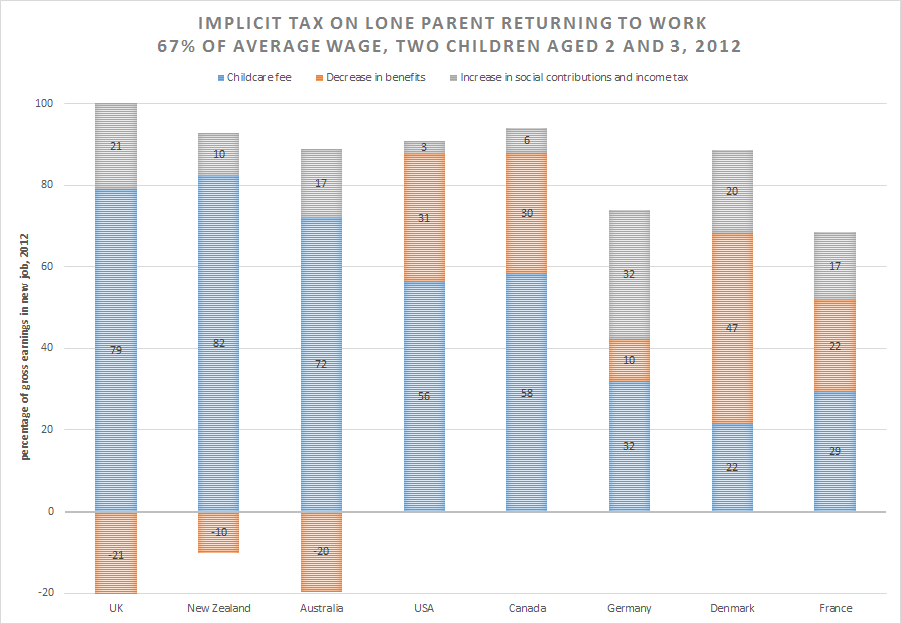
After decades of no progress against child poverty, five-year time limits on federal welfare assistance along with mandatory work requirements encouraged a large number of single mothers to find work. Many of these single mothers who joined the workforce in the USA were high school dropouts with small children.
Proposal to make child-care tax credit refundable would boost employment of working mothers bit.ly/1i1Xzcq https://t.co/2xlQQtPRJs—
The Hamilton Project (@hamiltonproj) October 29, 2015
Child poverty fell dramatically among minorities after the 1996 US federal welfare reforms. Everybody was surprised by the massive increases in the employment of single mothers and the reductions in child poverty. Nobody expected young mothers with small children to have so much control over their destiny.
That ability of single mothers to find a job as a condition of welfare benefits after the 1996 US federal welfare reform contradicts the belief that poverty is not a choice.
Child poverty is concentrated among single mothers and in particular single mothers on a welfare benefit. The subsequent declines in welfare participation rates and gains in employment were largest among the single mothers previously thought to be most disadvantaged: young (ages 18-29), mothers with children aged under seven, high school drop-outs, and black and Hispanic mothers.
When welfare benefits are linked to work requirements, the 1996 US federal welfare reforms showed that a surprisingly large number of single mothers can find and keep a job. Employment are never married mothers increased by 50% after these US reforms; employment of single mothers with less than a high school education increased by two-thirds; employment of single mothers aged of 18 to 24 approximately doubled.
Brian Caplan has been among those to link self-destructive behaviours to many of those in poverty. He argues there are a number of reasonable steps that healthy adults can take to avoid poverty for them and their children:
- Work full-time, even if the best job you can get isn’t fun.
- Spend your money on food and shelter before getting cigarettes and cable TV.
- Use contraception if you can’t afford a child.
Caplan specifically includes among the undeserving poor the children of poor or irresponsible parents.
Caplan along with Charles Murray point out that a number of pathologies are particularly prevalent among poor:
- alcoholism: Alcohol costs money, interferes with your ability to work, and leads to expensive reckless behaviour.
- drug addiction: Like alcohol, but more expensive, and likely to eventually lead to legal troubles you’re too poor to buy your way out of.
- single parenthood: Raising a child takes a lot of effort and a lot of money. One poor person rarely has enough resources to comfortably provide this combination of effort and money.
- unprotected sex: Unprotected sex quickly leads to single parenthood. See above.
- dropping out of high school: High school drop-outs earn much lower wages than graduates. Kids from rich families may be able to afford this sacrifice, but kids from poor families can’t.
- being single: Getting married lets couples avoid a lot of wasteful duplication of household expenses. These savings may not mean much to the rich, but they make a huge difference for the poor.
- non-remunerative crime: Drunk driving and bar fights don’t pay. In fact, they have high expected medical and legal expenses. The rich might be able to afford these costs. The poor can’t.
Caplan is disputing that healthy adults who are poor are victims. That is central to the poverty is not a choice movement: the poor are victims. Many are not, especially the healthy adults.
Policy debates about how to reduce poverty must break out of poverty is not a choice mentality because as Caplan says:
Being poor is a reason to save money, work hard, and control your impulses.
The choices people can make to avoid poverty are finish high school, seek a full-time job, delay children until you marry, and avoid crime. Working against this is as women’s labour market opportunities improved, their interest in low-status men has declined. As Charles Murray explains, working class males have become less industrious:
In 2003-5, men who were not employed spent less time on job search, education, and training, and doing useful things around the house than they had in 1985. They spent less time on civic and religious activities. They didn’t even spend their leisure time on active pastimes such as exercise, sports, hobbies, or reading…
How did they spend that extra leisure time? Sleeping and watching television. The increase in television viewing was especially large – from 27.7 hours per week in 1985 to 36.7 hours in 2003-5…
The demand to date and marry such men has declined because raising children as a solo mission has become more viable for mothers.
Saying poverty is not a choice undermines important messages about help but hassle that must be woven into the heart of the incentive structures of social insurance and the welfare state.

Recent Comments