https://twitter.com/PolitiFact/status/678444166016335872/photo/1
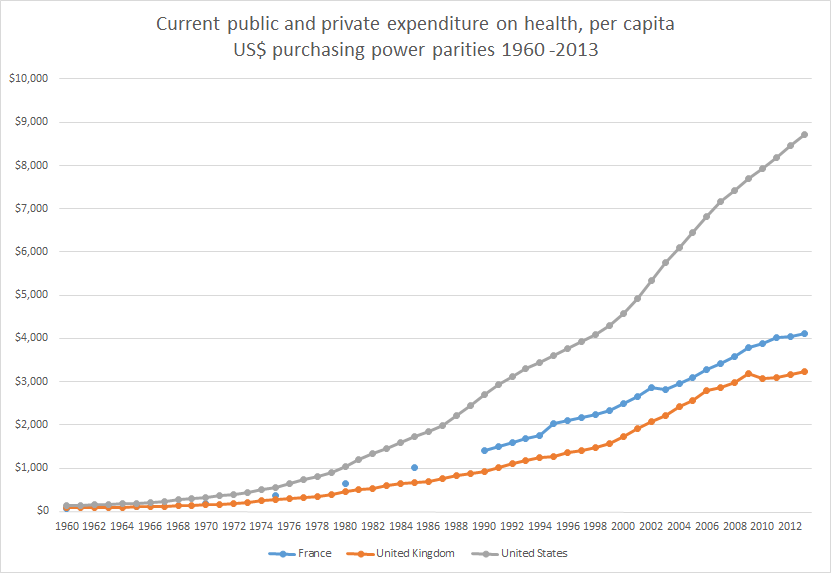
Source: OECD Health Statistics 2015.
Celebrating humanity's flourishing through the spread of capitalism and the rule of law
09 Jan 2016 Leave a comment
in economic history, health economics, politics - USA Tags: 2016 presidential election, Health spending
https://twitter.com/PolitiFact/status/678444166016335872/photo/1
Source: OECD Health Statistics 2015.
09 Jan 2016 2 Comments
in discrimination, economic history, politics - USA
The heat maps showing the density of the listings, first in 1947 and then in 1956 in the Green Book.

Source: The forgotten way African Americans stayed safe in a racist America – The Washington Post.
According to the Washington Post article today:
in 1936, a postal worker named Victor Green began publishing a guide to help African American travellers find friendly restaurants, auto shops and accommodations in far-off places. Green dubbed the guide after himself – the “Green Book” – and published it for decades. Green says he was inspired by the Jewish press, which had long published information on restricted places…
The Green Book included listings for hotels, restaurants, gas stations, bars and beauty salons across the U.S., as well as travel articles, paid advertisements, and stories about local attractions.
The rise of car ownership among the black middle class made it more and more costly for businesses to turn away their trade despite threats of local lawlessness sanctioned by the police and local and state governments.
08 Jan 2016 2 Comments
in applied price theory, economic history, politics - Australia, politics - New Zealand, politics - USA, poverty and inequality Tags: Australia, Leftover Left, top 1%
What slackers. Despite 30 years of neoliberalism oppressing the unions and working class, the top 1% in New Zealand (and Australia) are unable to do any better in terms of their share of national income than in the good old days of pre-1984 New Zealand looked upon with such fondness by the the Leftover Left.

Source: The World Wealth and Income Database.
08 Jan 2016 Leave a comment
in economics of education, politics - USA, unemployment
Fight for 15 want to argue that long-term unemployment and unemployment in general is a common problem for the skilled and unskilled. Unemployment and long-term unemployment are principally a problem of the low skilled – get over it.
Unemployment of 1-2% is not a problem, just turnover and job search.
June jobless rate for people 25+ with
B.A. or more 2.5%
High school diploma 5.4%
No H.S. 8.2%
on.wsj.com/1LG1B6z http://t.co/luUUuw9h1V—
Sudeep Reddy (@Reddy) July 02, 2015
08 Jan 2016 Leave a comment
in economic history, health economics, politics - USA Tags: 2016 presidential election, British economy, France, Health spending
https://twitter.com/PolitiFact/status/678444166016335872

Source: World Bank Health expenditure per capita, PPP (constant 2011 international$) | Data | Table.
08 Jan 2016 Leave a comment
in economics of education, labour economics, labour supply, occupational choice, politics - USA, poverty and inequality, welfare reform Tags: child poverty, family poverty, high school dropouts, marriage and divorce, single parents, success sequence
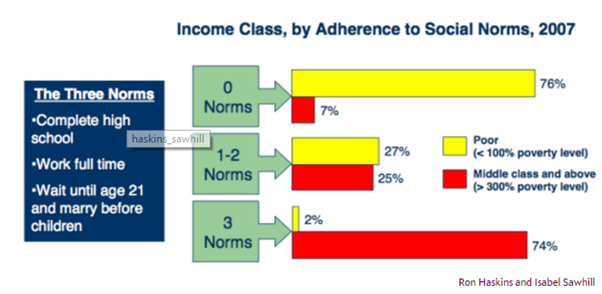
Source: The success sequence: Conservatives think they have a formula for raising people out of poverty.
.
08 Jan 2016 Leave a comment
in economics of crime, law and economics, politics - USA Tags: crime and punishment, law and order, tasers
07 Jan 2016 Leave a comment
in politics - Australia, politics - New Zealand, politics - USA, population economics, urban economics Tags: housing economics, living standards
There are quite large differences in the number of rooms per person in the European offshoots and the countries in Europe. Americans have much more room per person than the much exalted welfare states of northern Europe.
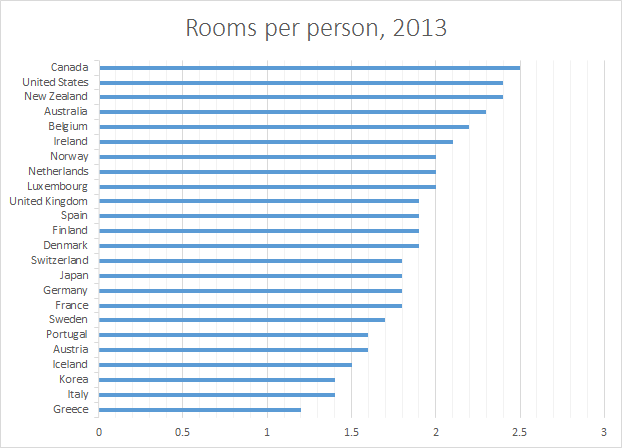
Source: OECD Better Life Index – Data extracted on 07 Jan 2016 06:55 UTC (GMT) from OECD.Stat
07 Jan 2016 Leave a comment
in economics of regulation, financial economics, politics - USA, Public Choice Tags: gun control
06 Jan 2016 Leave a comment
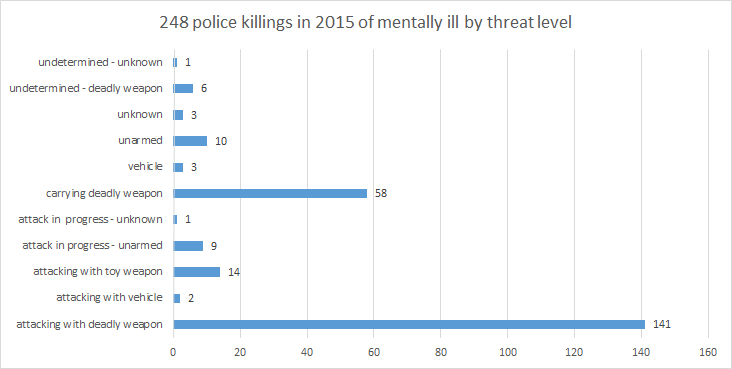
in economics of crime, law and economics, politics - USA Tags: crime and punishment, law and order, police shootings
Despite what you see on TV, surprisingly few unarmed people are shot because they are reaching for a weapon. Most unarmed suspects shot by police last year were resisting arrest. A few were killed in crossfire or by mistake. The chart below does not include unarmed Blacks who were attacking police when they were shot and killed according to Washington Post database.

06 Jan 2016 Leave a comment
in economics of crime, law and economics, politics - USA Tags: crime and punishment, law and order, police shootings
05 Jan 2016 Leave a comment
in economics of regulation, environmental economics, politics - New Zealand, politics - USA, Public Choice, rentseeking, urban economics Tags: housing affordability, land use planning, RMA, zoning
05 Jan 2016 1 Comment
in economics of crime, politics - USA Tags: law and order, police shootings
04 Jan 2016 Leave a comment
in economics of crime, politics - USA
Despite the media hype this year, surprisingly few people are shot by police who are unarmed and not resisting. The Washington Post estimated that less than 5% of police killings are in any way suspicious.
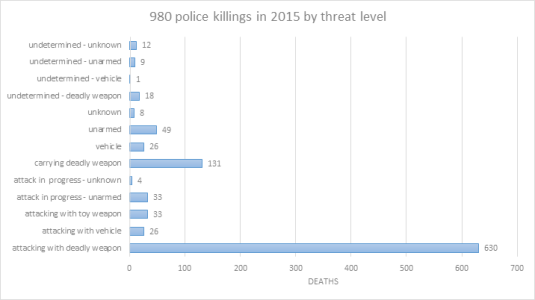
Source: Investigation: Police shootings – Washington Post.
When I previously posted data such as this on the Data is Beautiful sub-Reddit, some of the comments accused me of racism. Apparently, to post data from a highly reputable source on police shootings by threat level is a racist act.
27 Dec 2015 1 Comment
in politics - USA, public economics Tags: top 1%
Celebrating humanity's flourishing through the spread of capitalism and the rule of law
Celebrating humanity's flourishing through the spread of capitalism and the rule of law
Celebrating humanity's flourishing through the spread of capitalism and the rule of law
Celebrating humanity's flourishing through the spread of capitalism and the rule of law
Celebrating humanity's flourishing through the spread of capitalism and the rule of law
Celebrating humanity's flourishing through the spread of capitalism and the rule of law
Celebrating humanity's flourishing through the spread of capitalism and the rule of law
Celebrating humanity's flourishing through the spread of capitalism and the rule of law
A History of the Alt-Right
Econ Prof at George Mason University, Economic Historian, Québécois
Celebrating humanity's flourishing through the spread of capitalism and the rule of law
Scholarly commentary on law, economics, and more
Beatrice Cherrier's blog
Celebrating humanity's flourishing through the spread of capitalism and the rule of law
Celebrating humanity's flourishing through the spread of capitalism and the rule of law
Celebrating humanity's flourishing through the spread of capitalism and the rule of law
Why Evolution is True is a blog written by Jerry Coyne, centered on evolution and biology but also dealing with diverse topics like politics, culture, and cats.
Celebrating humanity's flourishing through the spread of capitalism and the rule of law
A rural perspective with a blue tint by Ele Ludemann
DPF's Kiwiblog - Fomenting Happy Mischief since 2003
Celebrating humanity's flourishing through the spread of capitalism and the rule of law
The world's most viewed site on global warming and climate change
Tim Harding's writings on rationality, informal logic and skepticism
A window into Doc Freiberger's library
Let's examine hard decisions!
Commentary on monetary policy in the spirit of R. G. Hawtrey
Thoughts on public policy and the media
Celebrating humanity's flourishing through the spread of capitalism and the rule of law
Politics and the economy
A blog (primarily) on Canadian and Commonwealth political history and institutions
Reading between the lines, and underneath the hype.
Economics, and such stuff as dreams are made on
"The British constitution has always been puzzling, and always will be." --Queen Elizabeth II
Celebrating humanity's flourishing through the spread of capitalism and the rule of law
Celebrating humanity's flourishing through the spread of capitalism and the rule of law
WORLD WAR II, MUSIC, HISTORY, HOLOCAUST
Undisciplined scholar, recovering academic
Celebrating humanity's flourishing through the spread of capitalism and the rule of law
Res ipsa loquitur - The thing itself speaks
In Hume’s spirit, I will attempt to serve as an ambassador from my world of economics, and help in “finding topics of conversation fit for the entertainment of rational creatures.”
Researching the House of Commons, 1832-1868
Reflections on books and art
Posts on the History of Law, Crime, and Justice
Celebrating humanity's flourishing through the spread of capitalism and the rule of law
Exploring the Monarchs of Europe
Cutting edge science you can dice with



Recent Comments