Donald Trump's drop in the polls related to a drop in media coverage. (cc @TheFix). washingtonpost.com/blogs/monkey-c… http://t.co/5uQMyJ1Lhj—
The Monkey Cage (@monkeycageblog) September 29, 2015
Peak Trump?
02 Oct 2015 Leave a comment
Why 41% of Americans wanted a fence on their northern border
01 Oct 2015 Leave a comment
in economics of crime, economics of media and culture, law and economics, politics - USA Tags: Canada, economics of immigration, Justin Bieber
@justinbieber #MUGSHOT http://t.co/ZuYwmdipIy—
Miami Beach Police (@MiamiBeachPD) January 23, 2014
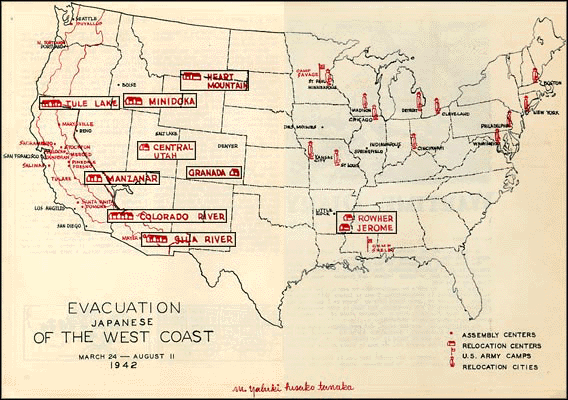
Life in an American concentration camp (Beautiful photos from a Japanese-American “internment camp.”)
01 Oct 2015 Leave a comment
in economics of media and culture, laws of war, Music, politics - USA, war and peace Tags: Civil Liberties, Japan, Rap music, wartime detention, wartime interment, World War II

The reversing gender gap in graduate education
01 Oct 2015 Leave a comment
in discrimination, economics of education, gender, human capital, labour economics, occupational choice, politics - USA Tags: College premium, graduate premium, reversing gender gap
6 years of women earning most PhDs, outnumbering men in grad school 136 to100 @Mark_J_Perry khttp://goo.gl/4uoYLV http://t.co/1hYfbDpdST—
AEIdeas Blog (@AEIdeas) September 17, 2015
The politics of marijuana in the USA
30 Sep 2015 Leave a comment
in comparative institutional analysis, constitutional political economy, economics of crime, law and economics, politics - Australia, politics - New Zealand, politics - USA, Public Choice Tags: economics of federalism, laboratory federalism, marijuana decriminalisation, meddlesome preferences, medical marijuana, nanny state
In representative democracy that is a unitary state such as New Zealand, the issue on marijuana decriminalisation is who will change their vote to vote against a party who advocates marijuana decriminalisation under a MMP system where all elections are close.
A plurality of Americans back marijuana reform. Another 20% don't care. Only 3 in 10 oppose.
msnbcmedia.msn.com/i/MSNBC/Sectio… http://t.co/UlvBT1D0ms—
Christopher Ingraham (@_cingraham) September 29, 2015
In a strong federal state, where some states allow citizen initiated referendums to change the law, it is possible to pioneer reform without that backlash. Then laboratory federalism takes over. Subsequent to the decriminalisation of marijuana or medical marijuana by various state governments, the Congress defunded federal marijuana drug law enforcement in states who had decriminalised marijuana. That major reform was underreported.
@RobinHoodTax @helenkellyCTU does the average worker earn less than 40 years ago?
30 Sep 2015 Leave a comment
in applied welfare economics, economic history, Marxist economics, politics - New Zealand, politics - USA Tags: good old days, living standards, measurement error, middle class stagnation, productivity measurement, The Great Enrichment, wage stagnation
https://twitter.com/RobinHoodTax/status/648963471690698752/photo/1
For Economic Justice, America Badly Needs Some Raises goo.gl/iA3Ecp #RobinHoodTaxUSA robinhoodtax.org/why http://t.co/0wx4kCpb4Q—
Robin Hood Tax (@RobinHoodTax) September 23, 2015
Innovation is letting us accomplish more with less. Learn more: buff.ly/1LmtAZD #tech #progress http://t.co/e2kQlGu3NA—
HumanProgress.org (@humanprogress) June 22, 2015
Why do inmates tattoo their faces?
30 Sep 2015 Leave a comment
Has the Democratic Party lost the white working class
29 Sep 2015 Leave a comment
in economic history, income redistribution, politics - USA, Public Choice, rentseeking Tags: American politics, Democratic Party, rational ignorance, rational rationality, suppressive voting, Withering away of the proletariat
Again, the decline in white working class support for Democrats is vastly overstated. I bid you a good night. http://t.co/bUNpME5o3B—
The Monkey Cage (@monkeycageblog) September 13, 2015
California police killings by race, 1 January – 29 September 2015
29 Sep 2015 Leave a comment
in economics of crime, law and economics, politics - USA

Justice Scalia on killing terrorists with drones
27 Sep 2015 Leave a comment
in laws of war, politics - USA, war and peace Tags: drones, Justice Scalia, war on terror

US Illegitimacy Rates
27 Sep 2015 Leave a comment
CHART of the DAY: US Illegitimacy Rates http://t.co/TcbPo1Yhf9—
Mark J. Perry (@Mark_J_Perry) May 12, 2015
RT @GreenpeaceNZ are right: Do not send anyone to @cop21 The summit is waste of time
25 Sep 2015 Leave a comment
in environmental economics, global warming, politics - Australia, politics - New Zealand, politics - USA, Public Choice Tags: China, climate alarmism, climate treaties, global warming, green tariffs, Greenpeace, international environmental law, Paris Summit 2015, Twitter left
Greenpeace is right in saying in their open letter with others that New Zealand should not send a minister to the climate talks in Paris later this year. I agree for different reasons.
An open letter from @GreenpeaceNZ, @350nz & @coalaction to @johnkeypm not to send anyone to #climate talks in Paris. http://t.co/C1hBJ1teNU—
ActionStation (@actionstation) September 25, 2015
In common with many previous climate summits, the Paris talks will be a futile gesture that will have no significant effect on the pace of global warming and holding the summit is a waste of taxpayers money.
Nothing will come of them because the developing countries have no interest in postponing their development because of a minor inconvenience from global warming.
Do us all a favour @JohnKeyPM, don't send Tim to Paris >> stuff.co.nz/environment/cl… #GroserDontGo #COP21 http://t.co/DaqvPGZ4Ls—
Greenpeace NZ (@GreenpeaceNZ) September 25, 2015
The easy way to tell if there is anything going to happen at a climate summit is the seniority of the delegation.

The Chinese made it clear at the Copenhagen summit in 2009 that they were not interested in an agreement by sending a Vice Minister of Foreign Affairs to a key side meeting of the American and French presidents, the British Prime Minister and the German Chancellor. All subsequent policy manoeuvrings by the Chinese on global warming are an attempt to head off green tariffs on their exports.
Trigger warning for American political junkies: latest US presidential polling
25 Sep 2015 Leave a comment
in politics - USA, Public Choice Tags: 2016 presidential election, expressive voting, opinion polls, rational ignorance, rational rationality, voter demographics
Here's @pollsterpolls avg since 6/1, w/ less smoothing. 2-pt drop for Trump. Not yet clear whether there's a trend. http://t.co/vrwXNC6hlo—
The Monkey Cage (@monkeycageblog) September 24, 2015
Here's some actual evidence on whether voter anger is helping "outsider" candidates. washingtonpost.com/blogs/monkey-c… http://t.co/RaragjjStV—
The Monkey Cage (@monkeycageblog) September 16, 2015
Ben Carson's decline and then surge in the polls tracks media attention. washingtonpost.com/blogs/monkey-c… http://t.co/mrddJMMAc0—
The Monkey Cage (@monkeycageblog) September 03, 2015
Another key graph: news coverage of Trump hasn't really become more negative. For more: washingtonpost.com/blogs/monkey-c… http://t.co/p8KpVcUlGd—
The Monkey Cage (@monkeycageblog) August 28, 2015
Here's a new graph of Trump's poll numbers and share of news coverage. For more see: washingtonpost.com/blogs/monkey-c… http://t.co/sdJCQCs5O5—
The Monkey Cage (@monkeycageblog) August 28, 2015


Recent Comments