% Republican
White evangelical 68%
White 49%
Gen. public 39%
Hispanic 26%
Asian 23%
Black 11%people-press.org/2015/04/07/a-d… http://t.co/DOLFJzCezu—
Conrad Hackett (@conradhackett) June 07, 2015
Who votes Democrat and Republican?
08 Jul 2015 Leave a comment
in politics - USA Tags: voter demographics
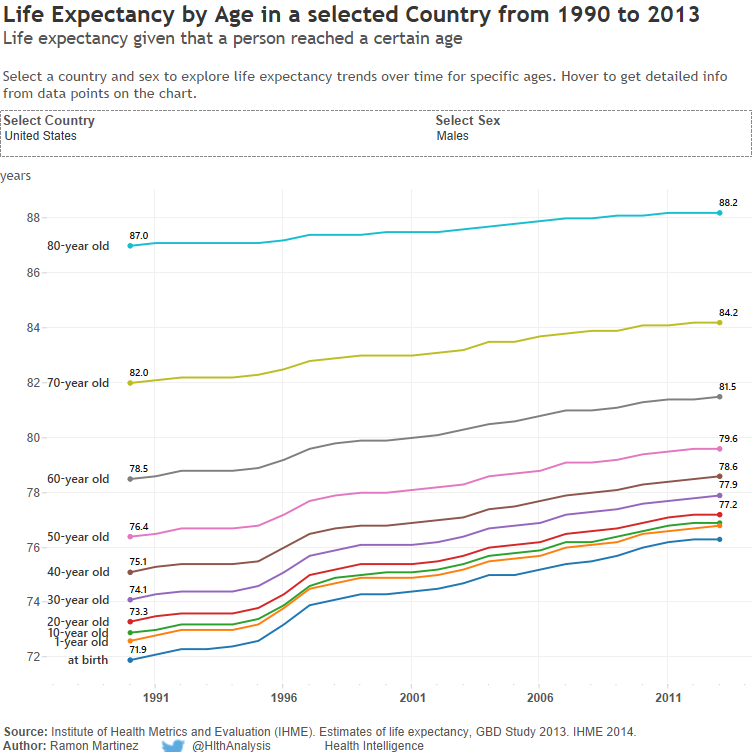
American life expectancy increases by age cohort from 1990
08 Jul 2015 Leave a comment
in economic history, health economics, politics - USA Tags: life expectancies

Why gender analysis is essential to empirical labour economics
07 Jul 2015 Leave a comment
U.S. wage growth doesn't look as weak when you account for benefit costs covered by employers on.wsj.com/1JJ2EmV http://t.co/s0tJutTjBy—
Nick Timiraos (@NickTimiraos) July 06, 2015
It’s a crowded presidential field
07 Jul 2015 Leave a comment
in politics - USA Tags: 2016 presidential election
Thirteen's a crowd. Presidential candidate annoucements econ.st/1SPBtIg http://t.co/4htJqdRNlj—
The Economist (@ECONdailycharts) June 26, 2015
200 years of American immigration
06 Jul 2015 Leave a comment
in economic history, labour economics, labour supply, politics - USA Tags: economics of immigration
.@ImmigrationGOP is wrong. Immigration today is not "beyond any historical precedent" niskanencenter.org/blog/niskanen-… http://t.co/0A9LIekqjb—
David Bier (@myfreesociety) May 28, 2015
The political bias of psychologists
05 Jul 2015 Leave a comment
in economics of bureaucracy, economics of education, economics of media and culture, politics - Australia, politics - New Zealand, politics - USA, Public Choice, rentseeking Tags: academic bias, bureaucratic bias, expressive voting, Leftover Left, media bias, occupational choice, political bias, rational ignorance, rational irrationality, social psychology, Twitter left
Why is it that the economics profession is the only profession questioned on the grounds of its political diversity?

1) Academic psychology once had considerable political diversity, but has lost nearly all of it in the last 50 years;
2) This lack of political diversity can undermine the validity of social psychological science via mechanisms such as the embedding of liberal values into research questions and methods, steering researchers away from important but politically unpalatable research topics, and producing conclusions that mischaracterize liberals and conservatives alike;
3) Increased political diversity would improve social psychological science by reducing the impact of bias mechanisms such as confirmation bias, and by empowering dissenting minorities to improve the quality of the majority’s thinking; and
4) The underrepresentation of non-liberals in social psychology is most likely due to a combination of self-selection, hostile climate, and discrimination.
via Psychology’s Political Diversity Problem | Psychology Today.
The case against waiting for trade agreements
05 Jul 2015 Leave a comment
in international economics, politics - Australia, politics - New Zealand, politics - USA Tags: free trade agreements, globalisation, preferential trading agreements, regional trade agreements, trade creation, trade version, unilateral free trade
Average age of marriage by gender since 1890 in the USA
05 Jul 2015 Leave a comment
in economic history, economics of love and marriage, economics of media and culture, law and economics, politics - USA Tags: economics of families, family demographics, marriage and divorce
Mawwiage. Mawwiage is wut bwings togetha… men who are about 2.5yrs older than their female counterparts. http://t.co/KQqKmNJn7P—
Tyler Vigen (@TylerVigen) May 25, 2015
Dual income nation
05 Jul 2015 Leave a comment
in economics of love and marriage, labour economics, labour supply, politics - USA, poverty and inequality Tags: asymmetric marriage premium, dual income couples, economics of families, reversing gender gap
America’s wars
05 Jul 2015 Leave a comment
in defence economics, politics - USA, war and peace Tags: American Civil War, Korean war, Revolutionary War, Vietnam war, War of 1812, World War I, World War II
Undeclared war:
bloom.bg/17bV5nM http://t.co/xx51J6R0sA—
Bloomberg VisualData (@BBGVisualData) May 31, 2015
Solar and wind power – forever just round the corner
05 Jul 2015 Leave a comment
in energy economics, environmental economics, global warming, politics - Australia, politics - New Zealand, politics - USA Tags: Big Solar, Big Wind, creative destruction, green rent seeking, renewable energy, solar power, wind power
The role of low wages in poverty
04 Jul 2015 Leave a comment
in labour economics, politics - USA, poverty and inequality Tags: expressive politics, Leftover Left, poverty, rational ignorance, rational irrationality
Gender wage gap, USA, UK, Australia and New Zealand since 2001
04 Jul 2015 Leave a comment
in discrimination, economic history, gender, labour economics, politics - Australia, politics - New Zealand, politics - USA Tags: Australia, British economy, gender wage gap
Figure 1: Gender wage gap (unadjusted % difference between median wages of male and female full-time employees)
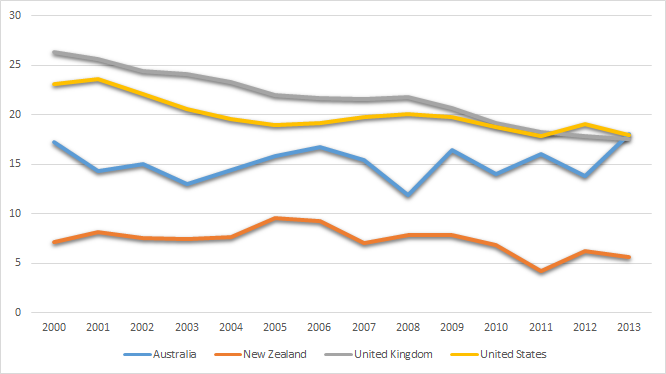
Source: OECD StatExtract.


Recent Comments