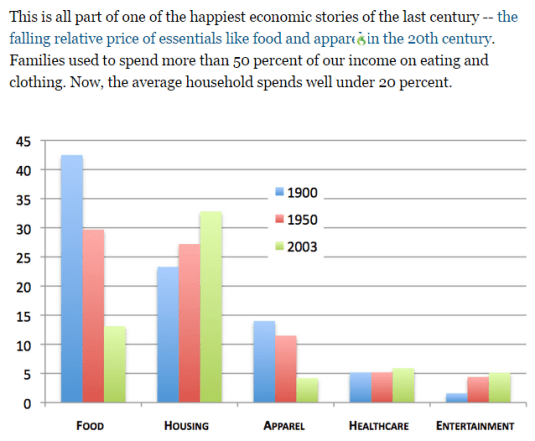
Via Cheap Eats: How America Spends Money on Food — The Atlantic
Celebrating humanity's flourishing through the spread of capitalism and the rule of law
20 Mar 2015 1 Comment
in applied welfare economics, economic history, politics - USA
20 Mar 2015 Leave a comment
in economics of love and marriage, gender, politics - USA, Public Choice Tags: abortion, political polarisation

On or about 1990, as a latter-day Virginia Woolf might say, American politics changed. I wouldn’t take the blip of the dotted line at 1990 very seriously–sampling variability and all that–but the general pattern in the graph above is real, and appear in all sorts of other data. In 1988 and before: zero correlations of partisanship with attitudes; since 1992, the correlations have been big and getting larger…
Not only is the abortion/party relationship primarily driven by whites, it is substantially stronger among white elites–that is, people with high income, education, or levels of political information.

via How better educated whites are driving political polarization – The Washington Post.
20 Mar 2015 Leave a comment
in politics - USA, war and peace Tags: military
19 Mar 2015 Leave a comment
in business cycles, economic growth, Euro crisis, politics - Australia, politics - New Zealand, politics - USA Tags: global economic integration
19 Mar 2015 Leave a comment
in politics, politics - USA Tags: Israel

the results reflect a consolidation within the right wing of Israeli politics rather than a decisive swing to the right. The increase in the right’s vote share can be readily explained by a shift of voters from the hawkish religious parties (ultra-Orthodox and religious Zionists). There is little reason to believe that there is significant overlap between the constituencies of these religious-right parties and those of either the left or Arab parties.
It is reasonable to assume however that voters from these religious parties migrated to the Likud rather than other parties. This shift would account for 87 percent of the rise in the vote share by the right bloc. The relatively small remainder likely came from the center parties, which also lost support.
Notably, when centrist voters shifted to vote for another bloc, they largely turned to the left parties rather than to the Likud. The increased vote share of the left is especially significant given the rise in the vote share of the Arab parties which, while likely largely a result of increased turnout relative to 2013, also cost the left votes.
via Why Netanyahu’s win isn’t that dramatic – The Washington Post.
19 Mar 2015 Leave a comment
in liberalism, politics - Australia, politics - New Zealand, politics - USA Tags: Anti-Science left, Leftover Left, quackery
18 Mar 2015 Leave a comment
in labour economics, labour supply, occupational choice, politics - Australia, politics - New Zealand, politics - USA Tags: ageing society, economics of retirement, labour demographics
18 Mar 2015 Leave a comment
in liberalism, politics - Australia, politics - New Zealand, politics - USA, Public Choice Tags: expressive voting, voter demographics
The lesbian, gay, bisexual and transgender population is one of the most Democratic demographic groups in the country. According to the 2012 national exit polls conducted by the National Election Pool, gay, lesbian, and bisexual adults voted for Barack Obama over Mitt Romney by more than three-to-one (76% vs. 22%).
This Democratic advantage can be seen in the partisan identification of LGBT adults, a majority of whom are Democrats. It also expresses itself in policy preferences across a range of issues, including size of government, attitudes about gun policy and immigration…
Half of LGBT adults (50%) self-identify as liberal, 37% are moderate, and just 12% say they are conservative.

That’s hardly surprising that people vote for the parties that welcome them given the deep hostility of the Republican Party on lesbian, gay, bisexual and transgender issues. Until the middle of the 20th century, few black Americans voted for the Democratic party because it was the party of racism. People rarely vote for parties that really dislike them.

The transferability of these American results on partisanship to New Zealand is rather limited because there is no cultural war as there is in the USA currently over same-sex marriages. A same-sex marriage bill passed the New Zealand Parliament in 2013 fairly easily. The Christian based socially conservative parties in New Zealand are pretty tame in their rhetoric and still struggling to get into Parliament.

As such, the centre right parties in New Zealand aren’t seen as particularly hostile to the lesbian, gay, bisexual and transgender population. On the same-sex marriage bill, for example, the National Party split evenly on voting for and against, reflecting its moderation in just about every issue.

People of all sexualities can vote for New Zealand parties on grounds other than the fact of how welcoming they are to who they are. That makes the American results on partisanship and sexuality less relevant to New Zealand
18 Mar 2015 Leave a comment
in economics of crime, economics of media and culture, health economics, liberalism, politics - USA, Public Choice Tags: marijuana decriminalisation, medical marijuana decriminalisation
For a lame duck president doing a lot to cultivate his legacy, Obama is really dragging his feet here if he is in any way a social liberal

via On marijuana, Obama is content to evolve rather than to lead the way – The Washington Post.
18 Mar 2015 Leave a comment
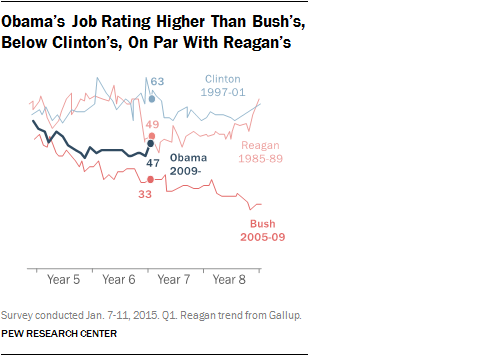
in politics - USA Tags: opinion polls

17 Mar 2015 Leave a comment
in environmental economics, politics - USA Tags: Carbon cap, carbon tax, carbon trading, European Union
Europe’s rate of decarbonization was essentially identical before and after the ETS was introduced. If the program has effects, decarbonization has not been detectable beyond historical business-as-usual rates.

HT: http://thebreakthrough.org/index.php/voices/roger-pielke-jr/europes-climate-fail
17 Mar 2015 Leave a comment
in politics - New Zealand, politics - USA Tags: 2014 New Zealand election, conspiracy theories, conspiratorial left, Edward Snowden, paranoid conspiracies, Twitter left
Edward Snowden made a last-minute intervention in the recent New Zealand election to claim that there is a secret American spy base located in Auckland. I have persistently asked on Twitter where it is so I can look it up on Google maps Street.
Today, Bryce Edwards revealed in a reply to one of my tweets that Edward Snowden got mixed up. It is yet to be revealed where this secret spy base really is so I can still look it up on Google Maps Street view.
If there is a secret spy base anywhere in New Zealand, I’m sure the neighbours would have noticed and lodged objections to the resource consent for the planning permission because of all the cell towers.

The GCSB’s Waihopai spy station pictured above which was built decades ago in rural New Zealand is decidedly conspicuous.

17 Mar 2015 Leave a comment
in politics - USA, population economics, poverty and inequality Tags: living standards, poverty and inequality, The Great Enrichment
For decades, the U.S. Census Bureau has reported that over 30 million Americans were living in “poverty,” but the bureau’s definition of poverty differs widely from that held by most Americans.
In fact, other government surveys show that most of the persons whom the government defines as “in poverty” are not poor in any ordinary sense of the term. The overwhelming majority of the poor have air conditioning, cable TV, and a host of other modern amenities. They are well housed, have an adequate and reasonably steady supply of food, and have met their other basic needs, including medical care.
Some poor Americans do experience significant hardships, including temporary food shortages or inadequate housing, but these individuals are a minority within the overall poverty population.
Celebrating humanity's flourishing through the spread of capitalism and the rule of law
Celebrating humanity's flourishing through the spread of capitalism and the rule of law
Celebrating humanity's flourishing through the spread of capitalism and the rule of law
Celebrating humanity's flourishing through the spread of capitalism and the rule of law
Celebrating humanity's flourishing through the spread of capitalism and the rule of law
Celebrating humanity's flourishing through the spread of capitalism and the rule of law
Celebrating humanity's flourishing through the spread of capitalism and the rule of law
Celebrating humanity's flourishing through the spread of capitalism and the rule of law
A History of the Alt-Right
Econ Prof at George Mason University, Economic Historian, Québécois
Celebrating humanity's flourishing through the spread of capitalism and the rule of law
Scholarly commentary on law, economics, and more
Beatrice Cherrier's blog
Celebrating humanity's flourishing through the spread of capitalism and the rule of law
Celebrating humanity's flourishing through the spread of capitalism and the rule of law
Celebrating humanity's flourishing through the spread of capitalism and the rule of law
Why Evolution is True is a blog written by Jerry Coyne, centered on evolution and biology but also dealing with diverse topics like politics, culture, and cats.
Celebrating humanity's flourishing through the spread of capitalism and the rule of law
A rural perspective with a blue tint by Ele Ludemann
DPF's Kiwiblog - Fomenting Happy Mischief since 2003
Celebrating humanity's flourishing through the spread of capitalism and the rule of law
The world's most viewed site on global warming and climate change
Tim Harding's writings on rationality, informal logic and skepticism
A window into Doc Freiberger's library
Let's examine hard decisions!
Commentary on monetary policy in the spirit of R. G. Hawtrey
Thoughts on public policy and the media
Celebrating humanity's flourishing through the spread of capitalism and the rule of law
Politics and the economy
A blog (primarily) on Canadian and Commonwealth political history and institutions
Reading between the lines, and underneath the hype.
Economics, and such stuff as dreams are made on
"The British constitution has always been puzzling, and always will be." --Queen Elizabeth II
Celebrating humanity's flourishing through the spread of capitalism and the rule of law
Celebrating humanity's flourishing through the spread of capitalism and the rule of law
WORLD WAR II, MUSIC, HISTORY, HOLOCAUST
Undisciplined scholar, recovering academic
Celebrating humanity's flourishing through the spread of capitalism and the rule of law
Res ipsa loquitur - The thing itself speaks
In Hume’s spirit, I will attempt to serve as an ambassador from my world of economics, and help in “finding topics of conversation fit for the entertainment of rational creatures.”
Researching the House of Commons, 1832-1868
Reflections on books and art
Posts on the History of Law, Crime, and Justice
Celebrating humanity's flourishing through the spread of capitalism and the rule of law
Exploring the Monarchs of Europe
Cutting edge science you can dice with


Recent Comments