


Celebrating humanity's flourishing through the spread of capitalism and the rule of law
13 Nov 2014 Leave a comment
in politics - USA, Public Choice Tags: Jonathan Gruber, Machiavelli, Obamacare, public choice, Yes Minister, Yes Prime Minister
12 Nov 2014 Leave a comment
in environmental economics, environmentalism, global warming, politics - USA Tags: climate alarmism, expressive politics, global warming, international law, Kyoto Protocol
Last week, I planned to write a blog about how Obama might do a Clinton: safe in the knowledge that Congress will never approve any of his climate change agreements, he will run round the world signing up to all sorts of ambitious carbon emission reduction goals.
The agreement Obama just signed today with the Chinese after the secret talks over the congressional election period is an example. This secret agreement goes to show that the Obama administration can actually keep a secret.
The agreement with China and any other futures similar agreements will win Obama brownie points with the Left of his party, but not bother anyone else in particular because they know they’ll never get through Congress.
The moment Bush took office in 2001, the Democrats started asking why wouldn’t Bush submit the Kyoto protocol to the Senate for ratification.
Bill Clinton had 801 days left in his administration after he signed the Kyoto protocol in December 1997 to submit it for Senate ratification. He did not lift a finger.
Clinton was safe in the knowledge that prior to the signing of the Kyoto protocol, the Senate voted 95 to nil in July 1997 to not ratify any treaty on climate change that did not impose mandatory obligations on Russia, China and other major developing countries.

President Clinton approved and signed into law appropriations bills for fiscal years 1999, 2000, and 2001 that included language prohibiting the Environmental Protection Agency from using its funds to “issue rules, regulations, decrees, or orders for the purpose of implementation, or in preparation for implementation, of the Kyoto Protocol” until the Protocol is ratified by the Senate and entered into force under the terms of the treaty.

The major feature of the Kyoto Protocol is that it sets binding targets for 37 industrialized countries and the European community for reducing greenhouse gas (GHG) emissions. These amount to an average of five per cent reduction against 1990 levels over the five-year period 2008-2012.

Developing countries, including China and India, weren’t mandated to reduce emissions, given that they’d contributed a relatively small share of the current century-plus build-up of CO2.
The Europeans were happy to sign the Kyoto Protocol after the Americans pulled out because the emissions trading price in any such protocol would be very low because no American companies would have to buy emission credits.
12 Nov 2014 1 Comment
in environmental economics, global warming, politics - New Zealand, politics - USA Tags: climate alarmism, expressive voting, global warming, international environmental law, international law, international trade law, Leftover Left, preferential trading agreements
The United States and China have unveiled a secretly negotiated deal to reduce their greenhouse gas output, with China agreeing to cap emissions for the first time and the US committing to deep reductions by 2025. Jointly announced in Beijing by President Obama and President Xi Jinping, includes new targets for carbon emissions reductions by the United States and a first-ever commitment by China to stop its emissions from growing by 2030.
https://twitter.com/CearaProut/status/531251207033982977
Will protestors take to streets about the secrecy that proceeded the negotiation of this international agreement?
The Left over Left picks and chooses the international law that it champion:
10 Nov 2014 Leave a comment
in politics - USA Tags: The Great Enrichment
10 Nov 2014 Leave a comment
in politics - USA, Public Choice Tags: gerrymanders
10 Nov 2014 Leave a comment
in politics - USA Tags: 2014 U, S. election
07 Nov 2014 Leave a comment
in economics of media and culture, politics - USA, urban economics Tags: World Trade Center
05 Nov 2014 Leave a comment
in economics of regulation, politics - New Zealand, politics - USA, urban economics Tags: Auckland urban limit, land use regulation, metropolitan urban limits, Resource Management Act, zoning
05 Nov 2014 Leave a comment
in applied welfare economics, income redistribution, politics - USA

02 Nov 2014 Leave a comment
in applied welfare economics, discrimination, gender, human capital, occupational choice, politics - USA Tags: gender wage gap, myths and fallacies
01 Nov 2014 Leave a comment
in environmentalism, politics - Australia, politics - New Zealand, politics - USA Tags: expressive voting, green rent seeking, green voters

The Greens are no more than a reincarnation of the 19th century British Tory Radicals with their aristocratic sensibilities that combined strong support for centralised power with a paternalistic concern for the plight of the poor:
Environmentalists have an aristocratic vision of a stratified, terraced society in which the knowing ones would order society for the rest of us.
Environmentalism offered the extraordinary opportunity to combine the qualities of virtue and selfishness
Many left-wingers thought they were expressing an entirely new and progressive philosophy as they mouthed the same prejudices as Trollope’s 19th century Tory squires: attacking any further expansion of industry and commerce as impossibly vulgar, because it was:
View original post 346 more words
30 Oct 2014 Leave a comment
in health economics, politics - New Zealand, politics - USA Tags: Anti-Science left, do gooders, GMOs, Quacks, vaccines
NZ Green MP Steffan Browning says giving his support to a call for the World Health Organisation to deploy homeopathic remedies to combat the Ebola epidemic in West Africa.

Mr Browning this week signed a petition started by Australian Fran Sheffield which calls on the World Health Organisation (WHO) to
End the suffering of the Ebola crisis. Test and distribute homeopathy as quickly as possible to contain the outbreaks.
Asked whether he thought homeopathy could cure Ebola, Mr Browning said:
It’s not for me to go down that track at all.
The World Health Organisation, world health authorities are doing that.
They will be considering I hope absolutely every possible options to this very concerning disease.
Green Party co-leader Russel Norman said the petition did not reflect the position of the party, and agreed it was unwise of Browning to have signed it.
Green party health spokesman Kevin Hague said he was "disappointed" Browning had signed the petition.
Browning is also on the record has been anti-GMOs, and is the green party spokesmen on genetic modification as well as the range of science-based portfolios such as agriculture and biosecurity.
To listen to most pundits, evolution, stem cells, and climate change are the only scientific issues worth mentioning—and the only people who are anti-science are on the right of politics.
Those on the left have numerous fallacies of their own. Aversion to clean energy programs, basic biological research, and even life-saving vaccines come naturally to many progressives. These are positions supported by little more than junk-science and paranoid thinking.
Concerns about vaccine safety and genetically modified organisms (GMOs) are often held up as evidence of anti-scientific beliefs among liberals. The anti-GMO movement is a product of the political left and has reached levels of delusion, paranoia and anti-intellectualism worthy of Michele Bachmann and young-earth creationists.
Though 70 percent of scientists support nuclear power, left-leaning organizations such as Greenpeace and the Sierra Club strongly oppose it.
27 Oct 2014 Leave a comment
in labour economics, politics - Australia, politics - New Zealand, politics - USA, unions Tags: Employment Contracts Act, union membership
The Encyclopaedia of New Zealand says that the rate of union membership dropped sharply to under 20% when the Employment Contracts Act was passed in 1991 using the chart below.
Figure 1: Percentage of union members

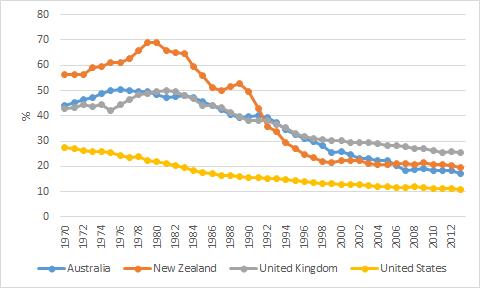
The OECD union density data, which allows international comparisons back to 1970, tells a different story. OECD data on union membership in New Zealand started in 1970.
Figure 2: Union density,New Zealand, Australia, the UK and USA 1970-2013
Source: OECD Stats Extract
Note: Trade union density corresponds to the ratio of wage and salary earners that are trade union members, divided by the total number of wage and salary earners (OECD Labour Force Statistics).
Figure 2 above shows that union membership has been in a long slow decline in New Zealand since the mid-1970s. This is been pretty much the pattern all round the world.
The much hated Employment Contracts Act 1991, much hated by the Left over Left, doesn’t really show up in the union density figures in figure 2. There is no sudden break in trend obvious in figure 2.
The longer time series in union membership in figure 1 compiled by the Encyclopaedia of New Zealand has long gaps between the data observations. Because of this, the sharp decline in union membership from the late 1970s, which it actually show up in its start-up , is not sufficiently distinguished from subsequent events because of the long gaps between observations reported in the figure 1.
If anything, union membership stopped declining in New Zealand in the late 1990s. Stabilising at about 20% of wage and salary earners.
Union membership continued to decline slowly in Australia, the UK and the USA subsequent to 1998. Union membership stabilised in New Zealand by contrast. Perhaps the Employment Contracts act should be able to claim credit for that?
Celebrating humanity's flourishing through the spread of capitalism and the rule of law
Celebrating humanity's flourishing through the spread of capitalism and the rule of law
Celebrating humanity's flourishing through the spread of capitalism and the rule of law
Celebrating humanity's flourishing through the spread of capitalism and the rule of law
Celebrating humanity's flourishing through the spread of capitalism and the rule of law
Celebrating humanity's flourishing through the spread of capitalism and the rule of law
Celebrating humanity's flourishing through the spread of capitalism and the rule of law
Celebrating humanity's flourishing through the spread of capitalism and the rule of law
A History of the Alt-Right
Econ Prof at George Mason University, Economic Historian, Québécois
Celebrating humanity's flourishing through the spread of capitalism and the rule of law
Scholarly commentary on law, economics, and more
Beatrice Cherrier's blog
Celebrating humanity's flourishing through the spread of capitalism and the rule of law
Celebrating humanity's flourishing through the spread of capitalism and the rule of law
Celebrating humanity's flourishing through the spread of capitalism and the rule of law
Why Evolution is True is a blog written by Jerry Coyne, centered on evolution and biology but also dealing with diverse topics like politics, culture, and cats.
Celebrating humanity's flourishing through the spread of capitalism and the rule of law
A rural perspective with a blue tint by Ele Ludemann
DPF's Kiwiblog - Fomenting Happy Mischief since 2003
Celebrating humanity's flourishing through the spread of capitalism and the rule of law
The world's most viewed site on global warming and climate change
Tim Harding's writings on rationality, informal logic and skepticism
A window into Doc Freiberger's library
Let's examine hard decisions!
Commentary on monetary policy in the spirit of R. G. Hawtrey
Thoughts on public policy and the media
Celebrating humanity's flourishing through the spread of capitalism and the rule of law
Politics and the economy
A blog (primarily) on Canadian and Commonwealth political history and institutions
Reading between the lines, and underneath the hype.
Economics, and such stuff as dreams are made on
"The British constitution has always been puzzling, and always will be." --Queen Elizabeth II
Celebrating humanity's flourishing through the spread of capitalism and the rule of law
Celebrating humanity's flourishing through the spread of capitalism and the rule of law
WORLD WAR II, MUSIC, HISTORY, HOLOCAUST
Undisciplined scholar, recovering academic
Celebrating humanity's flourishing through the spread of capitalism and the rule of law
Res ipsa loquitur - The thing itself speaks
In Hume’s spirit, I will attempt to serve as an ambassador from my world of economics, and help in “finding topics of conversation fit for the entertainment of rational creatures.”
Researching the House of Commons, 1832-1868
Reflections on books and art
Posts on the History of Law, Crime, and Justice
Celebrating humanity's flourishing through the spread of capitalism and the rule of law
Exploring the Monarchs of Europe
Cutting edge science you can dice with


Recent Comments