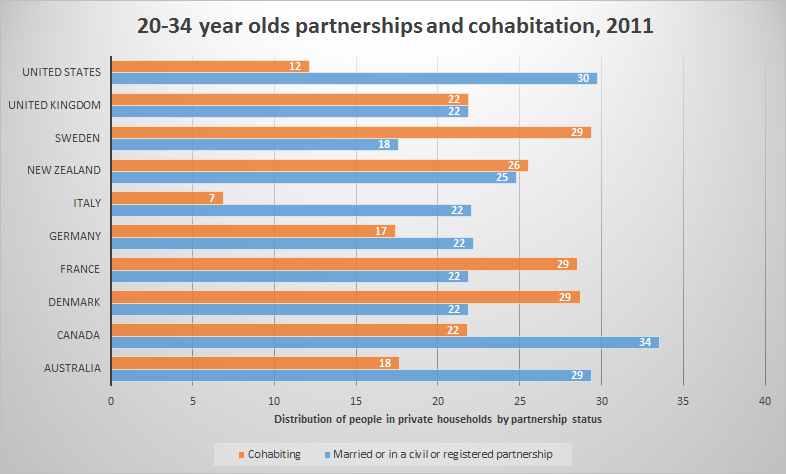
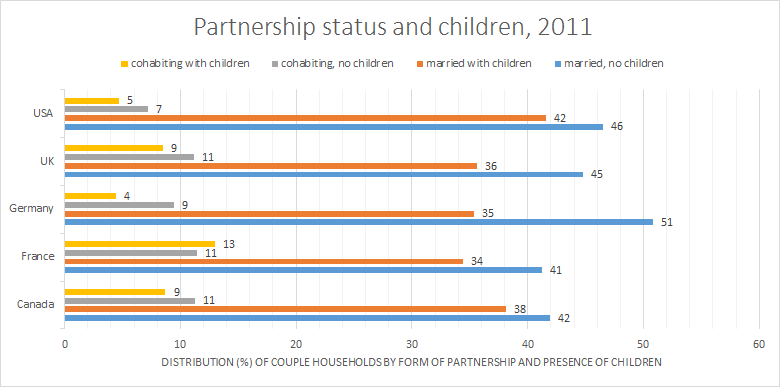
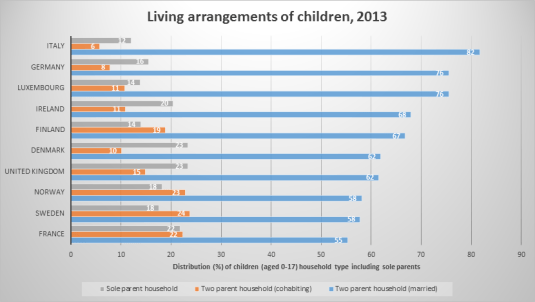
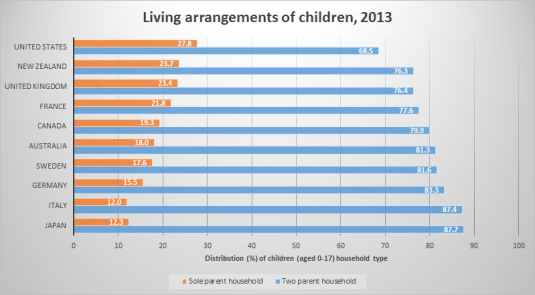
The percentage of sole parent households varies widely across the OECD member countries charted below including between the English-speaking countries.

Source: OECD Family Database.
Celebrating humanity's flourishing through the spread of capitalism and the rule of law
24 Oct 2015 Leave a comment
in economics of love and marriage, population economics
The percentage of sole parent households varies widely across the OECD member countries charted below including between the English-speaking countries.

Source: OECD Family Database.
23 Oct 2015 Leave a comment
in discrimination, gender, human capital, labour economics, occupational choice, politics - New Zealand, politics - USA, population economics Tags: gender wage gap
Unlike New Zealand or the USA, there is been steady progress up and down the entire British labour market in closing the gender pay gap.
Source: OECD Employment Database.
15 Oct 2015 Leave a comment
in population economics Tags: Canada, economics of borders, NAFTA
Half of Canada lives south of the red line, or 45.7 degrees north.
(via bit.ly/1MRF9cG) http://t.co/QTzV5cquj1—
Max Roser (@MaxCRoser) September 27, 2015
11 Oct 2015 Leave a comment
in economic history, population economics
The far left of the German Bundestag is so wacky that the Social Democratic prefer a grand coalition with the Conservative parties over teaming up with the Greens and the Left party.


Source: Wikipedia.
11 Oct 2015 Leave a comment
in economic history, population economics
New Zealand women have always had more children than British women with a sizeable gap in the 20th century. Putting the baby boom aside, British fertility has often not been much more than replacement rate since the 1920s.

Source: GapMinder data.
10 Oct 2015 1 Comment
in economic history, population economics, war and peace
I had to use two charts because Germany hosted so many refugees after in the early 1990s that it made the reading the remaining data not possible because of the scale of the axis.

UNHCR – UNHCR Statistical Online Population Database.

09 Oct 2015 Leave a comment
in economic history, population economics, war and peace
The Germans admitted so many asylum seekers in the early 1990s that I have had to reproduce the graph without Germany so some meaningful interpretation can be made of the three other countries.

Data extracted on 08 Oct 2015 09:06 UTC (GMT) from OECD.Stat.
The British started to admit a great many more refugees at the end of the 1990s compared to the already large number admitted at the beginning. Italy is only started offering shelter to a significant number of asylum seekers since the end of the 1990s. The French have been pretty consistently admitting reasonable numbers of asylum seekers and adjusting their quota upwards in a crisis.

Data extracted on 08 Oct 2015 09:06 UTC (GMT) from OECD.Stat.
09 Oct 2015 Leave a comment
in economic history, population economics, war and peace
Sweden took in so many asylum seekers in the early 1990s that I am reproducing the graph for the period after to give the data more meaning. Swedish generosity so dominates the rest of Scandinavia that it distorts any reading of the graph unless it is split into two.

Data extracted on 08 Oct 2015 09:06 UTC (GMT) from OECD.Stat

Data extracted on 08 Oct 2015 09:06 UTC (GMT) from OECD.Stat
09 Oct 2015 Leave a comment
in economic history, population economics, war and peace
When notoriously insular Japan and South Korea overtake New Zealand as a refuge for asylum seekers, the Left of New Zealand politics, which loves to lecture the rest of the world on peace and human rights, clearly dropped the ball as the self-appointed consciences of the nation. Being a nuclear free New Zealand is not a passport to moral superiority in the 21st century.

Source: Data extracted on 08 Oct 2015 09:06 UTC (GMT) from OECD.Stat.
The last time a large number of refugees were admitted to New Zealand was under the 1990s National Party government.
09 Oct 2015 Leave a comment
in economic history, population economics
New Zealand and the USA were much more serious about the post-war baby boom than were the British or Germans. The German fertility rates drop below replacement rates in the late 1960s with the British and Americans following them in in the 1970s. Only New Zealand still has a fertility rate of above replacement or thereabouts. German fertility has struggled to stay above replacement rates for coming on 100 years.

09 Oct 2015 Leave a comment
in economic history, population economics
Population ageing seemed to have passed the Irish by until the Global Financial Crisis. The British (in dark blue) started older but really did not have much of an ageing until this squiggly behaviour in the last 10 years in their population data. Canada simply got older. There is a long pause in ageing in the USA but ageing started again apace in the last 10 years. Population ageing in Australia (in light blue) and New Zealand was pretty consistent over the entire period since 1970. Australians and New Zealanders simply got older.

09 Oct 2015 Leave a comment
in economic history, population economics
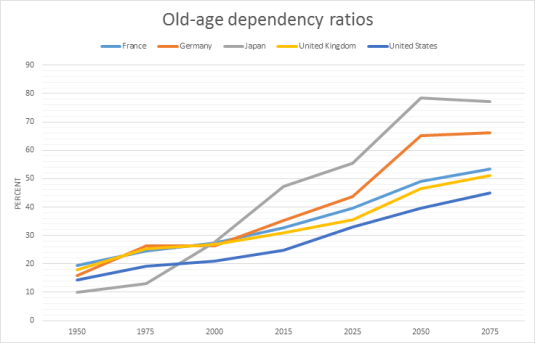
There are certainly rapid ageing in Japan but the Germans are doing their best to catch up with the French not far behind.

09 Oct 2015 Leave a comment
08 Oct 2015 Leave a comment
in economic history, Economics of international refugee law, International law, politics - Australia, politics - New Zealand, population economics Tags: Australia, British politics, economics of migration, refugees
New Zealand’s intake of asylum seekers has been embarrassingly low. The left-wing parties in New Zealand should be ashamed of themselves given the way they wear their international consciences on their sleeves about New Zealand being above it all morally, nuclear free, and can lecture the rest about war, peace and compassion from on high.

Data extracted on 08 Oct 2015 09:06 UTC (GMT) from OECD.Stat; Dataset: International Migration Database.
The UK absorbed an immense number of asylum seekers in the 1990 as did Canada. The data stops in 2013.
07 Oct 2015 Leave a comment
in labour economics, population economics
New Zealand is a humble 37th in the running. Mind you, the New Zealand resident population of the UK on a per capita basis of the home population and compares well with Canada and Australia are much larger countries such as the Philippines and the USA.

Source: Population by Country of Birth and Nationality Report, August 2015 – ONS.
Celebrating humanity's flourishing through the spread of capitalism and the rule of law
Scholarly commentary on law, economics, and more
Beatrice Cherrier's blog
Celebrating humanity's flourishing through the spread of capitalism and the rule of law
Why Evolution is True is a blog written by Jerry Coyne, centered on evolution and biology but also dealing with diverse topics like politics, culture, and cats.
Celebrating humanity's flourishing through the spread of capitalism and the rule of law
A rural perspective with a blue tint by Ele Ludemann
DPF's Kiwiblog - Fomenting Happy Mischief since 2003
Celebrating humanity's flourishing through the spread of capitalism and the rule of law
The world's most viewed site on global warming and climate change
Tim Harding's writings on rationality, informal logic and skepticism
A window into Doc Freiberger's library
Let's examine hard decisions!
Commentary on monetary policy in the spirit of R. G. Hawtrey
Thoughts on public policy and the media
Celebrating humanity's flourishing through the spread of capitalism and the rule of law
Politics and the economy
A blog (primarily) on Canadian and Commonwealth political history and institutions
Reading between the lines, and underneath the hype.
Economics, and such stuff as dreams are made on
"The British constitution has always been puzzling, and always will be." --Queen Elizabeth II
Celebrating humanity's flourishing through the spread of capitalism and the rule of law
WORLD WAR II, MUSIC, HISTORY, HOLOCAUST
Undisciplined scholar, recovering academic
Celebrating humanity's flourishing through the spread of capitalism and the rule of law
Res ipsa loquitur - The thing itself speaks
Celebrating humanity's flourishing through the spread of capitalism and the rule of law
Researching the House of Commons, 1832-1868
Articles and research from the History of Parliament Trust
Reflections on books and art
Posts on the History of Law, Crime, and Justice
Celebrating humanity's flourishing through the spread of capitalism and the rule of law
Exploring the Monarchs of Europe
Cutting edge science you can dice with
Small Steps Toward A Much Better World
“We do not believe any group of men adequate enough or wise enough to operate without scrutiny or without criticism. We know that the only way to avoid error is to detect it, that the only way to detect it is to be free to inquire. We know that in secrecy error undetected will flourish and subvert”. - J Robert Oppenheimer.
The truth about the great wind power fraud - we're not here to debate the wind industry, we're here to destroy it.
Celebrating humanity's flourishing through the spread of capitalism and the rule of law
Economics, public policy, monetary policy, financial regulation, with a New Zealand perspective
Celebrating humanity's flourishing through the spread of capitalism and the rule of law
Restraining Government in America and Around the World
Recent Comments