John Rawls and war and peace and temporary doves
15 Jun 2014 Leave a comment
in economics, laws of war, Rawls and Nozick, war and peace Tags: international law, John Rawls

John Rawls’ Law of Peoples had as its key point that the fundamental division is not between democratic and non-democratic peoples or liberal and non-liberal, but decent and non-decent or outlaw peoples. Decent peoples allow toleration and subscribe to eight principles:
- Peoples are free and independent, and their freedom and independence are to be respected by other peoples.
-
Peoples are to observe treaties and undertakings.
-
Peoples are equal and are parties to the agreements that bind them.
-
Peoples are to observe a duty of non-intervention.
-
Peoples have the right of self-defence but no right to instigate war for reasons other than self-defence.
-
Peoples are to honour human rights.
-
Peoples are to observe certain specified restrictions in the conduct of war.
-
Peoples have a duty to assist other peoples living under unfavourable conditions that prevent their having a just or decent political and social regime.
Libertarians such as Murray Rothbard define a just war thus:
· A just war exists when a people tries to ward off the threat of coercive domination by another people, or to overthrow an already-existing domination; and
· A war is unjust, when a people try to impose domination on another people, or try to retain an already existing coercive rule over them.
A condition for a just war is force may be used only after all peaceful and viable alternatives have been seriously tried and exhausted or are clearly not practical.

Most of all, save me from self-styled anti-war activists what Matt Welch called temporary doves. Temporary doves spit bile at those that support the wars they oppose – denouncing them as moral pigmies. The temporary doves then make exceptions for the wars they support and spite bile once again at those that question the whimsical nature and application of their values about just and unjust wars and the just conduct of wars.
The wars championed by the temporary doves can be equally or more bloody in civilian casualties as the wars they oppose either because of the reasons they were started or because of how these wars are conducted – civilian casualties In Iraq and Afghanistan.
Civilian casualties are put forward by the temporary doves as a moral trump card against the Iraq and Afghan wars and the atomic bombings. Many of the architects and champions of the NATO bombings in the Kosovo war opposed Gulf War II. Slobodan Milosevic, like Saddam Hussein, was described as a modern-day Hitler, eager to practice genocide against minorities and menace peaceful neighbours.
Is Bill Clinton a war criminal because he bombed Iraq and Sudan, but a human rights hero because he bombed Serbia? All of these bombings resulted in civilian deaths.
The supporters of both wars frequently invoked the Munich Agreement of 1938 and sought regime change. Perhaps less bloody but certainly slower social and political emancipation from oppression and mass murder is OK for the temporary doves for Iraq and Afghanistan but not for Kosovo. Temporary doves are just as prepared to wade up to their armpits in civilian casualties as the next warmonger, but they then put themselves forward as free of sin when they call for war crimes trials and citizen’s arrests of those that supported and conducted equally bloody wars.
Edward Luttwick argued that the Kosovo war proved that precision modern air bombardments can be effective as humanitarian interventions only in unique circumstances:
• An enemy sufficiently economically developed to offer targets worth bombing, and
• sufficiently democratic to respond to the inconvenience thereby inflicted on civilians at large; and
• yet sufficiently primitive and authoritarian to become the target of a humanitarian bombing campaign in the first place.
In most cases, from the Taliban’s Afghanistan to Zaire and from Rwanda to Sierra Leone, there were no identifiable, high-value, and relevant targets. In Bosnia, the post-heroic behaviour of almost all peacekeeping troops in UN service ranged from doing little or nothing to protect civilians while engaging in every possible form of misconduct, from black-market trafficking to cowardly passivity in the face of mass murder.
The Rawlsian social justice case for super-entrepreneurs and many more billionaires
04 May 2014 Leave a comment
in applied welfare economics, economic growth, entrepreneurship, industrial organisation, market efficiency, Rawls and Nozick, technological progress Tags: envy, John Rawls, super-rich, SuperEntrepreneurs, top 1%, top talent
The report SuperEntrepreneurs shows that:
- SuperEntrepreneurs founded half the largest new firms created since the end of the Second World War
- There is a strong correlation between high rates of SuperEntrepreneurship in a country and low tax rates
- a low regulatory burden and high rates of philanthropy both correlate strongly with high rates of SuperEntrepreneurship
- Active government and supranational programmes to encourage entrepreneurship – such as the EU’s Lisbon Strategy – have largely failed.
- Yet governments can encourage entrepreneurialism by lowering taxes (particularly capital gains taxes which have a particularly high impact on entrepreneurialism while raising relatively insignificant revenues); by reducing regulations; and by vigorously enforcing property rights.
- High rates of self-employment and innovative entrepreneurship are both important for the economy.
- Yet policy makers should recognise that they are not synonymous and should not assume policies which encourage self-employment necessarily promote entrepreneurship.
- Policy makers should use a definition of entrepreneurship which is based on innovation.
SuperEntrepreneurs examined about 1,000 self-made men and women who have earned at least $1 billion dollars and who appeared in Forbes magazine list of the world’s richest people between 1996 and 2010.

Hong Kong has the most, with around three SuperEntrepreneurs per million inhabitants, followed by Israel, the US, Switzerland and Singapore.
The US is roughly four times more super-entrepreneurial than Western Europe and three times more super-entrepreneurial than Japan.
Super-entrepreneurs tend to be well-educated – 84% have a university degree.
Many started their own company but there is no clear relationship between self-employment and successful entrepreneurship
Steven Kaplan and Joshua Rauh’s “It’s the Market: The Broad-Based Rise in the Return to Top Talent” Journal of Economic Perspectives 2013 found that those in the Forbes 400 richest are less likely to have inherited their wealth or grown-up wealthy.
Today’s super-rich are self-made rich because they produce new and better products and services that people wanted and are willing to pay for.
John Rawls was alive to the importance of incentives in a just and prosperous society.
With his emphasis on fair distributions of income, Rawls’ initial appeal was to the Left. Left-wing thinkers then started to dislike his acceptance of capitalism and his tolerance of large discrepancies in income and wealth.
Rawls excluded envy when we are behind his veil of ignorance designed the social contract about how the society will be organised. He believed that principles of justice should not be affected by individual inclinations, which are mere accidents.
Rawls also argued that the liberties and political status of equal citizens encourage self-respect even when one is less well off than others; and background institutions (including a competitive economy) make it likely that excessive inequalities will not be the rule. He supposes that
the main psychological root of our liability to envy is a lack of self-confidence in our own worth combined with a sense of impotence
Then there is the old Russian joke that tells the story of a peasant with one cow who hates his neighbour because he has two. A sorcerer offers to grant the envious farmer a single wish any thing he wants: “Shoot my neighbour’s cow!” he demands.
Why I am not reviewing Thomas Piketty’s Capital in the Twenty-First Century – updated again
29 Apr 2014 Leave a comment
in applied welfare economics, entrepreneurship, macroeconomics, market efficiency, politics, Rawls and Nozick, taxation, technological progress Tags: Greg Mankiw, Jon Elster, Mirrlees Review, Robert Lucas, Thomas Piketty, Tyler Cowen
It’s 700 pages long and goes on about Marx. Some people were watching the other channel when the Berlin Wall fell.

My 1 o’clock lecture at ANU in 1990 was next to a room rented out ironically from 12 to 1 to the Campus Trots and then to the Campus Christians for an hour of prayer to another saviour.
The Twitter summary of Piketty is this:
Karl Marx wasn’t wrong, just early. Pretty much. Sorry, capitalism. #inequalityforevah
The only Marxist I bother with is Jon Elster. He is a leading proponent of Analytical Marxism and one of the last polymaths. Brian Barry once wrote that to review one of Elster’s books one:
would either have to have taken off several years to master the many fields which fall within Elster’s purview or would be a consortium of at least twenty carefully-chosen experts.
All of Elster’s books and writings are worth reading, including
- Ulysses and the Sirens (1979);
- Sour Grapes: Studies in the Subversion of Rationality (1983);
- Making Sense of Marx (1985); and
- An Introduction to Karl Marx (1986).
As Jon Elster noted:
Marxian economics is, with a few exceptions, intellectually dead
and Marx’s labour theory of value is:
useless at best, harmful and misleading at its not infrequent worst.
To go on with my non-review, I will quote Tyler Cowen:
The crude seven-word version of Piketty’s argument is “rates of return on capital won’t diminish.”
Piketty’s reasons why rates of return on capital won’t diminish are fairly specific and restricted to only a small share of capital.
.. In any case this is pure speculation and Piketty’s entire argument depends upon it.
… Piketty converts the entrepreneur into the rentier.
To the extent capital reaps high returns, it is by assuming risk…
Yet the concept of risk hardly plays a role in the major arguments of this book.
Once you introduce risk, the long-run fate of capital returns again becomes far from certain.
In fact the entire book ought to be about risk but instead we get the rentier…
Overall, the main argument is based on two (false) claims.
First, that capital returns will be high and non-diminishing, relative to other factors.
Second, that this can happen without significant increases in real wages.
Piketty’s advocacy of a top marginal income tax rate of 80% and a an international treaty for a wealth tax are wildly impractical and destructive of economic growth and entrepreneurship. His advocacy of 60% marginal tax rates on incomes above $200,000 strike at the heart of the professional and managerial occupations that are the backbone of day-to-day capitalism. Piketty’s wealth tax would tax the homes and the retirement savings of the ordinary middle class:
- wealth below 200,000 euros be taxed at a rate of 0.1 percent,
- wealth between 200,000 and one million euros at 0.5 percent,
- wealth between one million and five million euros at 1.0 percent, and
- wealth above five million euros at 2.0 percent.
Piketty’s reason for these high top tax rates is not to bring in more revenue or to redistribute wealth to poor and the downtrodden but simply “to put an end to such incomes.” Harsanyi argues that:
Like many progressives, Piketty doesn’t really believe that most people deserve their wealth anyway, so confiscating it presents no real moral dilemma.
He also argues that we can measure a person’s productivity and the value of a worker (namely, low-skilled labourers) while arguing that other groups of workers (namely, the kind of people he doesn’t admire) are bequeathed undeserved, “arbitrary” salaries. What tangible benefit does a stockbroker or a kulak or an explanatory journalist offer society, after all?
This takes me back to Jon Elster who had this to say on socialism:
Optimism and wishful thinking have been features of socialist thought from its inception.
In Marx, for instance, two main premises appear to be that whatever is desirable is possible, and that whatever is desirable and possible is inevitable.
…It has become clear that classical socialism massively underestimated the importance of economic incentives
.
Greg Mankiw is less harsh, but still to the point:
Like President Obama and others on the left, Piketty wants to spread the wealth around.
Another philosophical viewpoint is that it is the government’s job to enforce rules such as contracts and property rights and promote opportunity rather than to achieve a particular distribution of economic outcomes.
No amount of economic history will tell you that John Rawls (and Thomas Piketty) offers a better political philosophy than Robert Nozick (and Milton Friedman).
John Rawls was actually very much alive to the importance of incentives in a just and prosperous society.
Unequal incomes might turn out to be to the advantage of everyone. Work effort and entrepreneurial alertness respond to incentives; incentives channel people into the occupations and jobs where they produce more.
Rawls lent qualified support to the idea of a flat-rate consumption tax because these taxes:
impose a levy according to how much a person takes out of the common store of goods and not according to how much he contributes.
A simple way to have a progressive consumption tax is to exempt all savings from taxation.
With his emphasis on fair distributions of income, Rawls’ initial appeal was to the Left. Left-wing thinkers then started to dislike his acceptance of capitalism and his tolerance of large discrepancies in income and wealth.
It’s impossible to make the workers better off by taxing capital. The optimal rate of tax on income from capital is zero. This is why the Mirrlees Review of the UK taxation system argued for zero taxation of the returns to capital.
Robert Lucas estimated in 1990 that eliminating all taxes on income from capital would increase the U.S. capital stock by about 35% and consumption by 7%.
Hans Fehr, Sabine Jokisch, Ashwin Kambhampati, and Laurence J. Kotlikoff (2014) found that eliminating the corporate income tax completely would raise the U.S. capital stock (machines and buildings) by 23%, output by 8% and the real wages of unskilled and skilled workers each by 12%.
Book reviews serve the same purpose as film reviews. They are filters for our time. Do you agree?
I made a time management decision to not read a long book plenty of others reviewed and some even understood.
As for the growing income inequality, there is a long literature dating back 25-years arguing that skill-biased technological change is increasing the returns to investing in education as Gary Becker blogged in 2011:
Earnings inequality in the United States and many other countries has increased greatly since the late 1970s, due in large measure to globalization and technological progress that raised the productivity of more educated and more skilled individuals.
While the average American college graduate earned about a 40% premium over the average high school graduate in 1980, this premium increased to over 70% in 2000.
The good side of this higher education-based earnings inequality is that it induced more young men, and especially more young women, to go to and finish college.
The bad side is that many sufficiently able children could not take advantage of the greater returns from a college education because their parents did not prepare them to perform well in school, or they went to bad schools, or they lacked the financing to attend college.
As a result, the incomes of high school dropouts and of many high school graduates stagnated while incomes boomed for many persons who graduated college, and even more so for those with post graduate education.
There is nothing new under the sun.
John Rawls and are the super-rich unjustly over-taxed?
28 Mar 2014 1 Comment
in labour economics, public economics, Rawls and Nozick Tags: company tax, economic growth, flat rate consumption tax, higher wages, income tax, inequality
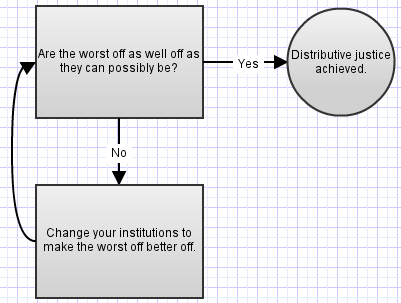
John Rawls is often put forward by political progressives as the starting point for political philosophy. Rawls pointed out that behind the veil of ignorance, people will agree to inequality as long as it is to everyone’s advantage.
Rawls was attuned to the importance of incentives in a just and prosperous society. If unequal incomes are allowed, this might turn out to be to the advantage of everyone.

Rawls lent qualified support to the idea of a flat-rate consumption tax (see A Theory of Justice, pp. 278-79). He said that:
A proportional expenditure tax may be part of the best scheme [and that adding such tax] can contain all the usual exemptions.
The reason why Rawls lent qualified support to the idea of a flat-rate consumption tax was because these taxes:
impose a levy according to how much a person takes out of the common store of goods and not according to how much he contributes.
A simple way to have a progressive consumption tax is to exempt all savings from taxation. Taxable consumption is calculated as income minus savings minus a large standard deduction. Different countries use different terms to describe the minimum amount that must be earned before any taxes are paid.
Income tax must be opposed on social justice grounds, but not progressive consumption taxes.
Given that the super-rich – the top 0.1% of income earners – do not spend much of their incomes, especially on the way up building their businesses, they could be rather over-taxed!
Steven Kaplan and Joshua Rauh’s “It’s the Market: The Broad-Based Rise in the Return to Top Talent”, Journal of Economic Perspectives (2013) found that:
- Rising inequality is due to technical changes that allow highly talented individuals or “superstars” to manage or perform on a much larger scale.
- These superstars can now apply their talents to greater pools of resources and reach larger numbers of people and markets at home and abroad. They thus became more productive, and higher paid.
- Those in the Forbes 400 richest are less likely to have inherited their wealth or have grown up wealthy.
- Today’s rich are working rich who accessed education in their youth and then applied their natural talents and acquired skills to the most scalable industries such as ICT, finance, entertainment, sport and mass retailing.
- The U.S. evidence on income and wealth shares for the top 1% is most consistent with a “superstar” explanation. This evidence is less consistent with the gains in earnings of the top 1% coming from greater managerial power over the determination of their own pay in the corporate world, or changes in social norms about what managers could earn.
Today’s super-rich are highly productive because they produce new and better products and services that people want and are willing to pay for. These rewards for entrepreneurship and hard work guide people of different talents and skills into the occupations and industries where their talents are valued the most. The efficient allocation of talent and income maximising occupational choices were important to Rawls’ framework.
Another important role for incentives is it rewards entrepreneurial alertness. People will look for and take advantage of hitherto unnoticed business opportunities if they are rewarded for doing so. These private rewards for greater effort, excellence and superior alertness are the driving force of the market. Most of the innovation that drives modern prosperity would not have occurred but for the lure of profit.
Rawls was keen on stiff inheritance taxes to prevent the “large-scale private concentrations of capital from coming to have a dominant role in economic and political life”. His support for inheritance taxes was out of concern with a concentration of political power rather than improving incentives.
Rawls overrated the power of the rich to buy political influence as do many on the Left. They do not understand Director’s law of public expenditure and the theories of the median voter and the expressive voter. The major political parties all chase the swinging voter in the middle class.
Rawls’ views on incomes taxes and the rich are rather under-discussed among his champions on the progressive Left. Google John Rawls and income taxes and you do not get many hits or papers of any substance.
With his emphasis on fair distribution of income, Rawls’ initial appeal was to the Left, but left-wing thinkers started to dislike his acceptance of capitalism and tolerance of large discrepancies in income. Many moved on. Rawls excluded envy from deliberations behind the veil of ignorance. This may be why he lost some of his initial appeal to some.
You must admire his consistency. Rawls was happy for people to be super-rich as long as they saved and invested their resources. Everyone in society gains from those investments and is better off.
Robert Lucas (1990) estimated that a revenue neutral elimination of all taxes on income from capital and on capital gains would increase the U.S. capital stock by about 35% and consumption by 7%. Hans Fehr, Sabine Jokisch, Ashwin Kambhampati, and Laurence J. Kotlikoff (2014) found that eliminating the corporate income tax would raise the U.S capital stock (machines and buildings) by 23%, output by 8% and the real wages of unskilled and skilled workers by 12%. Is taxing the rich worth this large a lost wage rise?
Civil disobedience and political activism are overrated
24 Mar 2014 Leave a comment
in politics - Australia, Rawls and Nozick Tags: Australian political parties, civil disobedience, John Rawls, non-violent direct action, political activism
Most activists take to the streets because if they ran openly for office, they would struggle to get 1% of the vote. Their best options are entryism and branch stacking.
The strength of democracy lies in the ability of small groups of concerned and thoughtful citizens to band together and change things by running for office and winning elections.
That is how new Australian parties such as the ALP, the country party, DLP, Australian democrats and Greens changed Australia. One Nation even had its 15 minutes of fame. Australian state upper houses even have Christian and shooters parties and many independents. Many started in someone’s living room.
Some find democracy frustrating because they cannot win openly at the ballot box even under proportional representation in federal and state upper houses.
When the “shooters” party and “no aircraft noise” party can win ahead of you, it is time to accept that your message of struggle and direct action simply does not resonate with the electorate.
John Rawls, discussing non-violent direct action, argues that in a nearly just society, those who resort to civil disobedience present themselves to the majority to show that, in their considered opinion, the principles of justice governing cooperation amongst free and equal persons have not been respected.

Rawls argues that civil disobedience is never covert or secretive; it is only ever committed in public, openly, and with fair notice to legal authorities. Openness and publicity, even at the cost of having one’s protest frustrated, offers ways for the protesters to show their willingness to deal fairly with authorities.
Rawls argues:
- for a public, non-violent, conscientious yet political act contrary to law being done (usually) with the aim of bringing about a change in the law or policies of the government;
- that appeals to the sense of justice of the majority;
- which may be direct or indirect;
- within the bounds of fidelity to the law; and
- whose protesters are willing to accept punishment. Although civil disobedience involves breaking the law, it is for moral rather than selfish reasons; the willingness to accept arrest is proof of the integrity of the act.
Rawls argues, and too many forget, that civil disobedience and dissent more generally contribute to the democratic exchange of ideas by forcing the champions of dominant opinion to defend their views.
Legitimate non-violent direct action are publicity stunts to gain attention and provoke debate within the democratic framework, where we resolve our differences by trying to persuade each other and convince the electorate.
Too many acts of non-violent direct action aim to impose their will on others rather than peaceful protests designed to bring about democratic change in the laws or policies of the incumbent government. That ‘might does not make right’ is fundamental to the rule of law.
Robert Nozick and J.K. Rowling
15 Mar 2014 Leave a comment
in Rawls and Nozick Tags: distributive justice, Harry Potter, J.K. Rowling, Robert Nozick, top 1%
Tyler Cowen summarised Robert Nozick’s Wilt Chamberlain example, thus: a bunch of poor kids pay to see Wilt Chamberlain play basketball. Wilt gets the money, the kids get to see the game. Wilt is millions of dollars richer by the end of the season and the kids poorer. Since we wouldn’t object to any one of these individual voluntary market transactions, why should we object to the resulting new distributional pattern of income and wealth? Is this new pattern unjust?
Robert Nozick argued that most notions of distributive justice would require a continual and unjustified interference in personal liberties to stop people undoing equality by trading with people such as Wilt Chamberlain. Individuals would be stopped from using the fruits of their talents, abilities, and labour as they see fit.
Isn’t it time to update and internationalise the Wilt Chamberlain example?
- A Scottish welfare mum decides to cheer herself up and write a book, going to local cafés to do so to escape from her unheated flat.
- The initial print run was 1,000 books, five hundred of which were distributed to libraries.
- J.K. Rowling is the first to become a billionaire by writing books.
- Every one of those book purchases was voluntary.
- Every one willingly gave up their money for her books.
- Is this new distributional pattern of wealth and income unjust?
G.A. Cohen twisted and turned to argue that the fruits of Rowling’s mind and willingness to work, in effect, belong to us all?!
How many more Harry Potter books would have been written if Cohen is right and his ideas applied about taxing the rich?
Are you willing to risk explaining your answer to the young and not so young fans of Rowling’s books about how it would be part of a better world for them that the additional Harry Potter books were not written?
Instead of just letting young people buy her books if they want them, we must put up with constant interference with people’s liberties to prevent injustices from J.K. Rowling’s royalties stream getting too high.
Liberty upsets patterns. Allowing individuals freely to use their equal wealth and income as they choose will inevitably destroy any distributional pattern advocated by socialists and egalitarians. If anyone evaluates how just this or that pattern of income and wealth distribution is based on how things end up, they must constantly support interferences with people’s liberties. That people having rights and resources have moral histories was central to Nozick’s attack on Rawls. Nozick rejected Rawl’s notion of resources and talents being collective assets to be assigned by a central distributor.
More and more of the top 1% of income earners these days are superstar celebrities, athletes and entertainers. J.K. Rowling and most top celebrities, athletes and entertainers get a pass on distributional injustices and growing inequality resulting from their membership of the top 1% of income earners. Why?
Philosophers do spend a lot of time arguing over whether we own our own eyes and thus can can take our eyes with us behind the veil of ignorance or whether our spare good eye instead should be left outside to be redistributed through an eye lottery to the blind. But if we own our own eyes no matter what, why not our other natural gifts, talents, good health and work ethic?
P.S. J.K. Rowling is a socialist who gave millions to British Labour. She would not be able to do that if the 83% top income tax rates of 1970s British Labour had applied. Maybe she would have been another of the legion of left-wing tax exiles such as in the 1970s?
Robert Nozick’s framework for utopias
13 Mar 2014 Leave a comment
in liberalism, Rawls and Nozick Tags: Liberalism, Robert Nozick
Robert Nozick’s framework for utopias has the following features:
- The main problem in any utopian project is people are different, and their preferences for an ideal community also differ;
- Utopia will consist of many different and divergent communities in which people lead different kinds of lives under different institutions;
- People in these utopias are free to leave; and
- If they do not enjoy any of the utopian worlds currently available, they can create the world they would prefer to live in.
Nozick’s framework tries to open up as many options as possible for as many people as possible, with people free to leave for what they think is a better place.
Utopias are many federal systems with a right to emigrate to other states or countries. Is people and their talents, education and capital being free to leave really part of a progressive Left utopia?
Freedom has many difficulties, and democracy is not perfect.
But we have never had to put a wall up to keep our people in, to prevent them from leaving us!
JFK – ‘Ich bin ein Berliner’ Speech
Any utopia must have exit, voice and loyalty. That has been the case as the world embraced free market policies and democracy since 1980. A major step towards utopias was the collapse of communism and the rejection of big government.
Exit, competition from abroad, and new entry are the cornerstones of utopias.
The progressive Left talks of a single utopia with a great sense of community but also with a certain disdain for tax exiles.
The libertarian Right talks of utopias where people lead lives under different institutions they can vote in and out or reject and just migrate to somewhere better. Everyone can live their lives in accordance with their own preferences. Welfare state utopias are free to compete with Hong Kong style utopias. Good luck.
What did Robert Fogel and John Rawls learn from getting chickenpox and pneumonia as a child?
13 Mar 2014 1 Comment
in economics, liberalism, Rawls and Nozick Tags: difference principle, John Rawls, poverty and inequality, Robert Fogel
Robert Fogel was a Nobel Prize winning economist. His first career was as a full-time communist party organiser in the late 1940s and early 1950s.

John Rawls was much more famous as a political philosopher who developed the difference principle.
![]()
Rawls suggested that behind a view of ignorance concerning where we would end up in life and in terms of luck and talents, we would all agree that social and economic inequalities must satisfy two conditions:
(a) they are to be attached to positions and offices open to all under conditions of fair equality of opportunity; and
(b) they are to be to the greatest benefit of the least advantaged members of society.
Rawls was attuned to the importance of incentives in a just and prosperous society. If unequal incomes are allowed, this might turn out to be to the advantage of everyone because everyone could be wealthier than in a more equal society. Rawls excluded envy from considerations behind the veil of ignorance.
Robert Fogel had an interesting life that contrasts with that of John Rawls:
- Rawls was sick as a small child with diphtheria and then pneumonia.
- In each case, a brother caught the disease from him and died.
- Rawls spent his life wrestling with the arbitrary nature of good fortune and bad luck.
Robert Fogel contracted chickenpox as a small boy in 1932.
The city health department quarantined his family’s apartment within 2 hours for the next few weeks. His father was out of the house at the time so he could leave groceries at the door but not enter.
In the early 1950s, Fogel’s son contracted chickenpox:
- He contacted the family doctor full of fear based on his own childhood.
- The doctor was calm and routinely said it was a mild year for chickenpox.
- His son was back in school within a few days.
Fogel made a second career studying the economics of physiology and how much healthier and long-lived people have become because of the industrial revolution.
Rawls made no similar contribution to remedying the blights of his childhood, explaining what institutions made them a relic of recent 20th century history.
Innovation and entrepreneurship produced major improvements in overall well-being, with disproportionate advances for the poor. No egalitarian theory of society can deliver on the promise to level differences in income and wealth without seriously compromising overall levels of social welfare, and in particular of the poor.
Rawls was a profound thinker and open to different interpretations. It is hard to disagree with his ideas of equal liberty, equal opportunity, and such inequalities that are to everyone’s advantage!? Robert Nozick had to box real clever to get passed Rawls. That topic is for another post about the rags to riches story of J. K. Rowling.


Recent Comments