


UK Labour supporters admit it: taxes are to punish the rich, not to raise revenue
08 Jul 2014 Leave a comment
in labour supply, liberalism, Public Choice, Rawls and Nozick, taxation Tags: envy, expressive voting, top tax rate

via Labour supporters admit it: taxes are to punish the rich, not to raise revenue – Telegraph Blogs and http://danieljmitchell.wordpress.com/2014/02/04/what-motivates-the-left-envy-or-greed/
The application of John Rawls difference principle to New Zealand
07 Jul 2014 Leave a comment
in applied price theory, income redistribution, politics - New Zealand, Rawls and Nozick Tags: difference principle, income distribution, John Rawls, Maori economic development, Pasifika economic development
An urban legend in New Zealand is that income inequality is going from bad to worse.
Since the mid 1990s to around 2011 there was a small net fall in New Zealand’s income inequality trend line in the graph for the Gini coefficient for the income distribution for New Zealand shows. inequality in New Zealand is similar to that in Australia, Ireland, Canada and Japan.
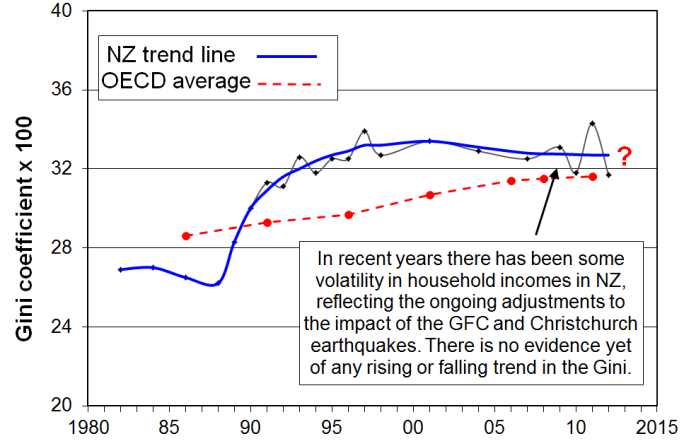
Source: Ministry of Social Development (2014)
Taxes and transfers have reduced inequality in New Zealand when measured by Gini coefficients, but the trend is been relatively stable for many years.
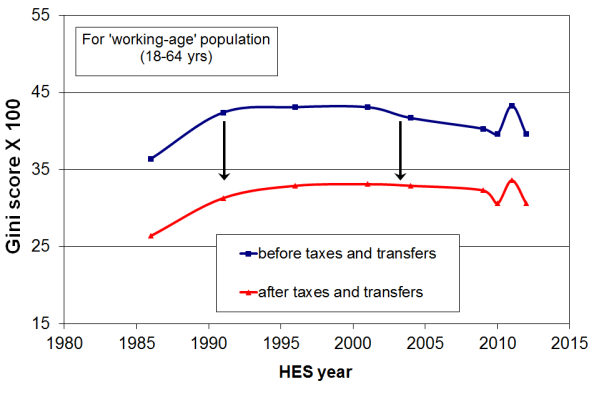
Source: Ministry of Social Development (2014)
Rawls pointed out that behind the veil of ignorance, people will agree to inequality as long as it is to everyone’s advantage. Rawls was attuned to the importance of incentives in a just and prosperous society. If unequal incomes are allowed, this might turn out to be to the advantage of everyone. Robert Nozick said that:
Political philosophers must now either work within Rawls’s theory or explain why not.
The groups that have been doing best in New Zealand have been Maori and Pasifika. In real terms, overall median household income rose 47% from 1994 to 2010; for Maori, this rise was 68%; for Pacific, 77%!
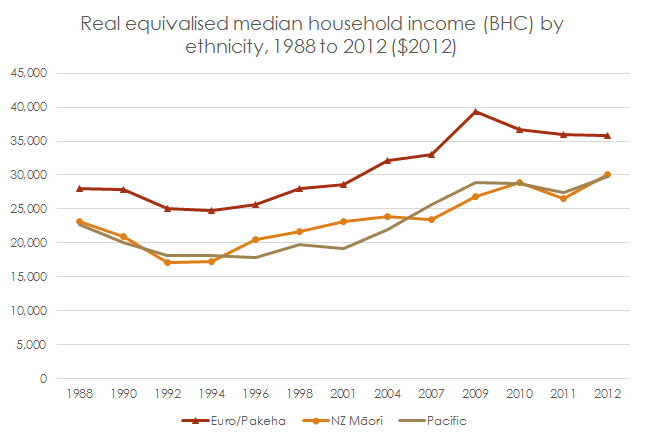
Source: Ministry of Social Development (2014)
The large improvements in Māori incomes since 1992 were based on rising Māori employment rates, fewer Māori on benefits or zero incomes, more Māori moving into higher paying jobs, and greater Māori educational attainment (Dixon and Maré 2007).
Maori unemployment reached a 20-year low of 8 per cent from 2005 to 2008. Labour force participation by Maori increased from 45% in the late 1980s to about 62% in the last few years.
Most of the remaining income disparities between Māori and non-Māori flow from differences in educational attainment and demographic and socio-economic characteristics including household composition (Chapple 2000; Maani 2004; Dixon and Maré 2007).
How much of the massive increases in incomes over the last 20 years spread throughout the entire community are you willing to give up for a little more equality? How much of your income will you donate to charity to lead the way?
.
Inequality is in; discrimination is out for Next Generation Left
02 Jul 2014 1 Comment
in applied price theory, income redistribution, politics - USA, Public Choice, Rawls and Nozick Tags: discrimination, inequality, Leftover Left, poverty, The Progressive Left


Political philosophers have weird debates
02 Jul 2014 Leave a comment
in liberalism, Rawls and Nozick Tags: distributive justice, G.A. Cohen, thought experiments

The debate with Robert Nozick over self-ownership got to the level of do we own our own eyes or are they open for harvest and redistribution to be blind. Two working eyes is a matter of genetic luck
G.A. Cohen in Self-Ownership, Freedom, and Equality says your right to your own body outweighs commonly used socialist principles that mandate redistribution. You are entitled to keep your eyes even if the fact that you have two working eyes is a matter of genetic luck and even if a blind person needs an eye more than you do. Good eyes are the winnings of the genetic lottery and yet
They do not immediately agree that, were eye transplants easy to achieve, it would then be acceptable for the state to conscribe potential eye donors into a lottery whose losers must yield an eye to beneficiaries who would other- wise be not one-eyed but blind.
Cohen then concluded that our real objection to an eye lottery in the actual world is not that it violates self-ownership but that people have a right to bodily integrity.
p.s. English moral philosopher, John Harris, does support a compulsory organ lottery
HT: David Gordon
Jon Elster and Robert Nozick on the economics of Karl Marx
29 Jun 2014 Leave a comment
in Marxist economics, Rawls and Nozick Tags: Jon Elster, Karl Popper, Robert Nozick


Popper held that Marxism had been initially scientific: Karl Marx postulated a theory which was genuinely predictive.
When these predictions were not in fact borne out, the theory was saved from falsification by adding ad hoc hypotheses to explain away inconvenient facts. By this, a theory which was genuinely scientific became pseudo-scientific dogma.
Popper criticizes theorists like Marx who attempt to accumulate evidence that corroborates their theories and not looking for evidence that would demonstrate that their hypothesis is false.
Popper claimed that falsifiability was an essential feature of any useful scientific theory. If a theory cannot be falsified, neither it nor its predictions can be validated, for everything that happens is by definition consistent with the theory.
As Popper and Kuhn understood it, bold, risky hypotheses are at the heart of great advances in the sciences and scholarship generally.

Nozick’s view is that people are entitled only to what others are willing to give them as gifts or in economic exchange
28 Jun 2014 Leave a comment
in Rawls and Nozick Tags: distributive justice, justice and acquisition, justice in exchange, Robert Nozick

Nozick was correct to point out that resources are not manna the fell magically from heaven where:
If things fell from heaven like manna, and no one had any special entitlement to any portion of it…
Resources have moral histories that count. Individuals who hold resources through the scattered efforts and transactions of innumerable individuals themselves and these individual efforts and separate transactions give them a moral claim over what they have created, created, acquired and exchanged:
In the non-manna-from-heaven world in which things have to be made or produced or transformed by people, there is no separate process of distribution for a theory of distributions to be a theory of…
According to Nozick there are three sets of rules of justice, defining:
- how things not previously possessed by anyone may be acquired;
- how possession may be transferred from one person to another; and
- what must be done to rectify injustices arising from violations of (1) and (2).
A distribution is just if it has arisen in accordance with these three sets of rules. What matters is the moral history of who has what.We cannot escape that because resources do not fall’s manner from heaven.
These resources came from somewhere and from whence they came they have a moral claim over them. That claim must be treated seriously.
There are individual exchanges, in which the parties do not usually care about desert or handicaps, but simply about what they get in exchange:
No centralized process judges people’s use of the opportunities they had; that is not what the process of social cooperation and exchange are for‘
When people freely to use their property as they choose, any income and wealth distribution advocated by socialist and egalitarian liberal will be undone. Attempts to enforce a particular distributional pattern or structure over time will necessarily involve forbidding individuals from using the fruits of their talents, abilities, and labour as they see fit. As Nozick puts it:
the socialist society would have to forbid capitalist acts between consenting adults


Recent Comments