
Thomas C. Schelling on why international terrorism is so rare
09 Jan 2015 Leave a comment
in applied price theory, defence economics, economics of crime, industrial organisation, managerial economics, occupational choice, organisational economics, personnel economics, politics - USA, Thomas Schelling, war and peace Tags: terrorism, Thomas Schelling, war against terror

The value of a statistical life through time in the USA
06 Jul 2014 Leave a comment
in economics of regulation, environmental economics, health economics, technological progress, Thomas Schelling, transport economics Tags: Thomas Schelling, value of life

Thomas Schelling’s crucial contribution in 1968 at RAND was the notion of statistical lives—mortality risks—in contrast to valuing the lives of specific, identified individuals. His insight was that economists could evade the moral thicket of valuing life and instead focus on people’s willingness to trade-off money for small reductions in the risks they face.
Anything by Tom Schelling is worth a listen
01 Jul 2014 Leave a comment
in Thomas Schelling Tags: arms control, game theory, mutual deterrence, nuclear strategy, strategy and conflict, Tom Schelling
Table of Contents:
1) Early Life – 0:37
2) Outbreak of World War II – 2:32
3) Studying During the War – 5:45
4) Negotiating the Marshall Plan – 7:40
5) Academia and Government Service – 11:14
6) Self-Taught in Game Theory – 13:14
7) “Games and Decisions” – 14:47
8) The RAND Corp. & Nuclear Strategy – 16:00
9) “Strategy and Arms Control – 18:34
10) The “Red Telephone” – 21:37
11) Arms Control & Mutual Deterrence – 24:46
12) Influence within the Kennedy Administration – 30:05
13) The Problem with Ballistic Missile Defenses – 31:51
14) Dr. Strangelove – 35:42
15) The Kennedy School – 43:20
16) Expansion of the Kennedy School – 47:44
17) The Early Faculty – 49:51
18) Evaluation of Human Life – 51:42
19) Organized Crime, Beer and Laundry – 53:13
20) Modeling Racial Self-Segregation – 58:04
21) Winning the Nobel Prize – 1:00:21
22) Contributions to Scholarship and Public Policy – 1:06:03
I found the best writer on global warming to be Thomas Schelling
09 Jun 2014 2 Comments
in applied welfare economics, environmental economics, global warming, international economics, Thomas Schelling Tags: game theory, global warming
Tom Schelling has been involved with the global warming debate since chairing a commission on the subject for President Carter in 1980.
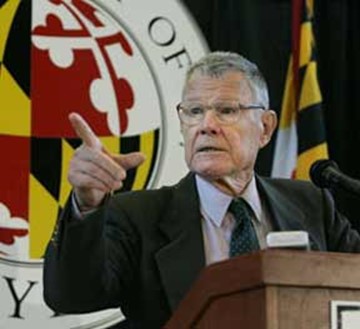
Schelling is an economist who specialises in strategy so he focuses on climate change as a bargaining problem. Schelling drew in his experiences with the negotiation of the Marshall Plan and NATO.
International agreements rarely work if they talk in terms of results. They work better if signatories promise to supply specific inputs – to perform specific actions now.
Individual NATO members did not, for example, promise to slow the Soviet invasion by 90 minutes if it happened after 1962.
NATO members promised to raise and train troops, procure equipment and supplies, and deploy these assets geographically.
All of these actions can be observed, estimated and compared quickly. The NATO treaty was a few pages long.
The Kyoto Protocol commitments were made not about actions but to results that were to be measured after more than a decade and several elections.
Climate treaties should promise to do certain actions now such as invest in R&D and develop carbon taxes that return the revenue as tax cuts. If the carbon tax revenue is fully refunded as tax cuts, less reliable countries, in particular, have an additional incentive to collect the carbon tax properly to keep their budget deficits under control.
Schelling is a genius at problem definition when he asked this
Suppose the kind of climate change expected between now and, say, 2080 had already taken place, since 1900.
Ask a seventy-five-year-old farm couple living on the same farm where they were born: would the change in the climate be among the most dramatic changes in either their farming or their lifestyle?
The answer most likely would be no. Changes from horses to tractors and from kerosene to electricity would be much more important.
Climate change would have made a vastly greater difference to the way people lived and earned their living in 1900 than today.
Today, little of our gross domestic product is produced outdoors, and therefore, little is susceptible to climate. Agriculture and forestry are less than 3 per cent of total output, and little else is much affected.
Even if agricultural productivity declined by a third over the next half-century, the per capita GNP we might have achieved by 2050 we would still achieve in 2051.
Considering that agricultural productivity in most parts of the world continues to improve (and that many crops may benefit directly from enhanced photosynthesis due to increased carbon dioxide), it is not at all certain that the net impact on agriculture will be negative or much noticed in the developed world.
As for the chances of a global treaty, Schelling has said:
The Chinese, Indonesians, or Bangladeshis are not going to divert resources from their own development to reduce the greenhouse effect, which is caused by the presence of carbon-based gases in the earth’s atmosphere.
This is a prediction, but it is also sound advice.
Their best defence against climate change and vulnerability to weather in general is their own development, reducing their reliance on agriculture and other such outdoor livelihoods.
Furthermore, they have immediate environmental problems — air and water pollution, poor sanitation, disease — that demand earlier attention.
The relative contributions of Thomas Schelling and the peace movement to the risks of war
26 May 2014 1 Comment
in Thomas Schelling, war and peace Tags: arms races, deterrence, disarmament, mutually assured destruction, peace movements, Robert Aumann
Thomas Schelling (and Robert Aumann) did terrible things such as work out how not to blunder into wars and how to deter wars rather than have to actually fight them.
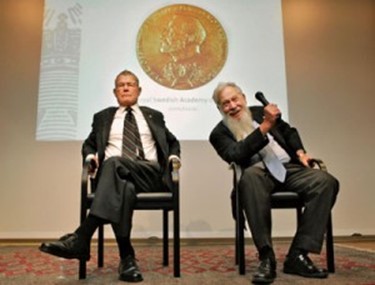
Schelling’s unique contribution at the Rand Corporation involved viewing strategic situations as bargaining processes.
Focusing on the stand-off between the United States and the Soviet Union, Schelling observed that the two superpowers had both shared and opposing interests.
Their shared interests involved avoiding a nuclear war, while their opposing interests concerned dominating the other. Conflict and cooperation became inseparable.
Iran and Israel are moving down that same path if both have nuclear weapons.
Schelling focused in particular on how the United States and Soviet Union could arrive at and stick to bargains by means of deterrence and compellence.
Deterrence involves dissuading the other from doing something, while compellence referred to persuading the other to do something.
- Deterrence and compellence are supported by threats and promises.
- Threats are costly when they fail and successful when they are not carried out.
- Promises are costly when they succeed and successful when they are carried out. A threat is cheaper than a promise because you do not have to carry it out if your threats work in intimidating others to do what you want.
Since the exploitation of potential force is better than the application of force, it is key to use threats and promises while avoiding having to act upon these.
The challenge is to communicate threats and promises in a credible manner.
The ability to hurt people is conducive to peace, while the ability to destroy weapons increases the risk of war. This is the paradox of deterrence. A country needs a credible second-strike capacity to deter a pre-emptive first strike. A country needs its missiles to survive such an attack.
Populations are better protected by protecting the missiles. By protecting the missiles rather than their cities, each side was offering their populations as a hostage to the other.
With each side holding the other’s cities as hostage, neither has an incentive to strike first. This is much safer than having each side worried about their weapons been destroyed and they therefore use them before they are destroyed in some minor crisis.
That is one of Schelling’s many contributions to peace.
What were the contributions of the peace movements?
Robert Aumann argued well that the way to peace is like bargaining in a medieval bazaar. Never look too keen, and bargain long and hard. Aumann argues that:
If you are ready for war, you will not need to fight. If you cry ‘peace, peace,’ you will end up fighting…
What brings war is that you signal weakness and concessions.
Countries are more likely to cooperate if they have frequent interactions and have a long time horizon. The chances of cooperation increase when it is backed by the threat of punishment.
Disarmament, Aumann argues, “would do exactly the opposite” and increase the chances of war. He gave the example of the Cold War as an example of how their stockpiles of nuclear weapons and fleets of bombers prevented a hot war from starting:
In the long years of the cold war between the US and the Soviet Union, what prevented “hot” war was that bombers carrying nuclear weapons were in the air 24 hours a day, 365 days a year? Disarming would have led to war.
Aumann has quoted the passage from the biblical Book of Isaiah:
Isaiah is saying that the nations can beat their swords into ploughshares when there is a central government – a Lord, recognized by all.
In the absence of that, one can perhaps have peace – no nation lifting up its sword against another.
But the swords must continue to be there – they cannot be beaten into ploughshares – and the nations must continue to learn war, in order not to fight!
Thomas Schelling on the impossibility of nuclear disarmament
20 May 2014 Leave a comment
in Thomas Schelling, war and peace Tags: arms control, disarmament

We cannot abolish conventional wars for the same reason:

While I have your attention, imagine if all nuclear weapons were abolished:

Compare the sleepy world we have now with one where the first country to reacquire one nuclear weapon would be dominant. Some practice a variation of this with nuclear weapons now.
Because latent capacity to develop nuclear weapons is not prescribed by the Nuclear Non-Proliferation Treaty, as a work-around of the treaty, this is sometimes called the “Japan Option”. Japan is a clear case of a significant advanced country with the complete technical prowess and nuclear materials to develop a nuclear weapon quickly.
A country does not need to test weapons nor declare its latent nuclear potential. Yet just keep the resources for a latent nuclear potential on hand for a crash programme.
The Crusader State versus the Foreign Policy of the Old Right
26 Apr 2014 Leave a comment
in Thomas Schelling, war and peace Tags: Ivan Eland, Murray Rothbard, Old Right, Robert Aumann, Robert Taft
The foreign policy of the Old Right of the Republican Party is undergoing a revival through the now retired Congressmen Ron Paul and now his son, Senator Rand Paul. They are the joint heirs of the Old Right of the Republican Party and Senator Robert A. Taft.

In The Republican Road Not Taken: The Foreign-Policy Vision of Robert A. Taft Michael T. Hayes argues that Taft was isolationist, which is opposition to binding commitments by the U.S. that would create new, or expand existing, obligations to foreign nations. Like many Americans of his era – the 1940s and early 1950s – Taft gladly would have:
let the rest of the world go its own way if it would only go without bothering the United States
Taft advocated what he called the policy of the free hand, whereby the United States would avoid entangling alliances and interferences in foreign disputes:
- This policy permitted government leaders the freedom of action to decide in particular cases whether a vital U.S. interest warranted involvement.
- Taft correctly pointed to features of the United Nations that would prevent its serving as a real force for peace and equality under the law.
- He challenged the Truman administration’s assessment of the Soviet military threat against Western Europe.
- He anticipated correctly that a steady rise in defence outlays could lead to a “garrison state” and the erosion of civil liberties.
- Taft was prescient in warning that even well-meaning internationalism would degenerate over time into a form of imperialism that would breed resentment against the United States around the globe, eventually endangering U.S. national security.
In Putting “Defense” Back into U.S. Defense Policy, Ivan Eland argues for an urgent rethinking of America’s national interests:
- America’s natural geo-strategic position places it at a natural advantage, rendering unnecessary a forward defence posture.
- A non-interventionist foreign policy would mean lower defence budgets.
- An America less willing to get involved in complex overseas disputes unrelated to its vital interests would also be less likely to make enemies around the world.
Further to the Libertarian Right, in Where the Left goes wrong on Foreign Policy the late Murray Rothbard asked whether:
- The Left is prepared to accept a foreign policy in which the United States government allies itself with no one and retires from the world scene, leaving all international encounters to the private realm of free trade, travel, and cultural and social exchange.
- That is what a policy of genuine non-interventionism and anti-imperialism would mean: a world in which the US government no longer tries to push other people around, on behalf of any cause, anywhere.
One area of agreement between classical liberals and the new left used to be opposition to foreign aid. Foreign aid was a system to subsidise US exports and prop up client states.
Rothbard used a revisionist perspective on foreign policy to argue that:
- Taking the twentieth century as a whole, the single most warlike, most interventionist, most imperialist government has been the United States;
- The main thrust of Soviet foreign policy was to preserve what it already has at home and abroad, not to jeopardise it;
- A conservative Soviet government is capable of dangerous militaristic actions, but these are acts of imperial protectionism, not revolutionary or aggrandisement;
- National communist movements were not monolithic but independent-minded – the wars between china, the USSR and China and Vietnam are examples; and
- There vast differences between the various communist regimes throughout the globe spell the difference between life and death for a large part of their subject populations.
History did not perhaps hold up well on Soviet intentions for Rothbard, and Thomas Schelling and Robert Aumann are better writers on how if you want peace, you must prepare for war, but the Old Right did have a point about the crusader state.
In The Empire Has No Clothes U.S. Foreign Policy Exposed, Eland argued that:
In a post–Cold War world, taking into account only the security of American citizens, their property, and U.S. territory, the benefits of an interventionist foreign policy have declined, and the costs have escalated dramatically.
Americans continue to pay excessive taxes to defend countries that are rich enough to defend themselves or to occupy conquered countries in the world’s backwaters (e.g., Iraq and Afghanistan)…
Their sons and daughters are killed on remote foreign battlefields for reasons even remoter from U.S. vital interests.
Crusader states can stumble into wars that they had no intention of fighting both in terms of scale and length. Remember World War 1 where everyone thought they would be home by Christmas after a negotiated settlement.
Tom Schelling looked at going to war as an emergent process. He argues that what a country does today in a crisis affects what one can be expected to do tomorrow. To quote Schelling:
A government never knows just how committed it is to action until the occasion when its commitment is challenged.
Nations, like people, are continually engaged in demonstrations of resolve, tests of nerve, and explorations for understandings and misunderstandings….
This is why there is a genuine risk of major war not from ‘accidents’ in the military machine but through a diplomatic process of commitment that is itself unpredictable.
Schelling goes on to argue wars to save face are, nonetheless, rational:
It is often argued that ‘face’ is a frivolous asset to preserve, and that it is a sign of immaturity that a government can’t swallow its pride and lose face.
But there is also the more serious kind of ‘face’, the kind that modern jargon is known as a country’s ‘image’, consisting of other countries’ beliefs (their leaders’ beliefs, that is) about how the country can be expected to behave.
It relates not to a country’s ‘worth’ or ‘status’ or even ‘honor’, but to its reputation for action.
If the question is raised whether this kind of ‘face’ is worth fighting over, the answer is that this kind of face is one of few things worth fighting over.
Robert Aumann argues well that the way to peace is like bargaining in a medieval bazaar. Never look too keen, and bargain long and hard. Aumann argues that:
If you are ready for war, you will not need to fight. If you cry ‘peace, peace,’ you will end up fighting… What brings war is that you signal weakness and concessions.
Obama, Iran, Tom Schelling and the Bomb
22 Mar 2014 1 Comment
in Public Choice, Thomas Schelling, war and peace Tags: Dr Strangelove, Iran's nuclear weapons, nuclear proliferation, Obama and Iran, Stanley Kubrick
If Obama was interested in peace, he should pay more attention to the writings of Thomas Schelling.
Schelling said that he did not know of any way to stop the Iranians from acquiring nuclear weapons and it is therefore important to have sophisticated enemies.
- It took the U.S. 15 years after World War II to think seriously about the security of its nuclear weapons.
- Before that, U.S. nuclear weapons did not even have combination locks, let alone complex electronic security codes!
- Now, most nuclear weapons will not detonate even if given the right codes unless they are at their designated targets.
The Soviet Union always had civilian officials in charge of nuclear weapons, and never let an aircraft carrying these weapons out of Soviet airspace. China has a separate army unit for this purpose too.
What are the safeguards against theft, sabotage or unauthorised use, and how will the Iranian weapons be protected? Iran must learn from this. Schelling’s and Herman Kahn’s writings in the early 1960s on nuclear wars starting through accidents and misunderstandings led them to work with Kubrick on the script of Dr. Stangelove.

The ayatollahs do not want their own nation wiped off the map. They know that Israel has enough nuclear weapons and delivery systems to destroy Iran in retaliation for any attack. This would deter them.
The government of Iran is repulsive, but it has never given evidence that it is suicidal. In all likelihood, rhetoric about wiping Israel off the map is ideological blather.
Any government in Tehran would have to realise that an attack on America would be a regime-extinguishing event. Such an attack would be suicide, both politically and literally.
The United States managed to deter some unpleasant and unpredictable people, including Stalin and Mao Zedong, from using nuclear weapons during the Cold War despite the USA’s own best efforts to provoke them from time to time. Israel and Iran may have noticed the success of that strategy too.
The USSR and China also played the ‘I am a crazy ideological zealot’ card too. Remember Mao and Khrushchev.
- China became a nuclear power under Mao Zedong, a leader who exceeded even Stalin’s record of genocide. Mao’s publicly enunciated views on nuclear warfare were also alarming in the extreme.
- China also emerged as a nuclear power on the eve of the Cultural Revolution. China, during that orgy of fanaticism, makes today’s Iran look like a normal, even sedate, country.
The Iranian mullahs take full political advantage of appearing to be mad and unpredictable. Iran’s leaders have nonetheless exhibited remarkably well timed moments of prudence and pragmatism. They have even fully reversed course when confronted with defeat such as when they started to really lose their war with Iraq.
Iran could always go for nuclear latency: the condition of a country possessing the technology to quickly build nuclear weapons without having actually yet done so. This avoids the costs and risks by refraining from exercising the overt nuclear capability option.
Because such latent capability is not proscribed by the Nuclear Non-Proliferation Treaty, a work-around of the treaty is sometimes called the “Japan Option”. Japan is a clear case of a big advanced country with the complete technical prowess and nuclear materials to develop a nuclear weapon quickly.
A country does not test weapons nor declare its latent nuclear potential. Yet just keep the resources for a latent nuclear potential on hand for a crash programme.
Schelling defined diplomacy as being based on having some control over something that the other country wants. There must be something each has to bargain over.
No communications should be sent to Iran; there should be no informal dialogues. Wait for Iran to come to you because you have something they want. Only then will it become serious in striking a bargain.
How to negotiate a treaty on global warming
20 Mar 2014 Leave a comment
in climate change, economics, environmental economics, politics, Thomas Schelling Tags: credible commitments, free riding, international collective action, treaty negotiations
I found the best writer on global warming to be Thomas Schelling. Schelling has been involved with the global warming debate since chairing a commission on the subject for President Carter in 1980.

Schelling is an economist who specialises in strategy so he focuses on climate change as a bargaining problem. Schelling drew from his experiences with the negotiation of the Marshall Plan and NATO.
International agreements rarely work if they talk in terms of results. They work better if signatories promise to supply specific inputs – to perform specific actions now.
- Individual NATO members did not, for example, promise to slow the Soviet invasion by 90 minutes if it happened after 1962.
- NATO members promised to raise and train troops, procure equipment and supplies, and immediately deploy these assets geographically. All of these actions can be observed, estimated and compared quickly. The NATO treaty was a few pages long.
The Kyoto Protocol commitments were not based on actions but on results, to be measured after more than a decade and several elections and a recession or two in between.
Climate treaties should promise to do certain actions now such as invest in R&D and develop carbon taxes that return the revenue as tax cuts. If the carbon tax revenue is fully refunded as tax cuts, less reliable countries, in particular, have an additional incentive to collect the carbon tax properly to keep their budget deficits under control.
Si vies pacem, para bellum
17 Mar 2014 Leave a comment
in Public Choice, Thomas Schelling, war and peace Tags: credible commitments, Strategy of Conflict, Thomas Schelling, war and diplomacy
The Roman maxim ‘If you want peace, prepare for war’ is about the power of credible commitments in avoiding a violent form of bargaining called war. If you look threatening – have a great power to hurt – you can compel people to do what you want, which includes not attack you. Threats are cheap especially when you do not have to carry them out. You get what you want without any fighting.
Those that show the greatest credible prior commitment – those that burn their bridges – extract much more from bargaining that those that have options to fall back on. People fear cornered opponents.
Who picks a fight with someone who looks crazy or cannot back down? Who picks a fight with someone who carries himself or herself like a seasoned bar fighter?
As explained by David Friedman:
“Consider a bar room quarrel that starts with two customers arguing about baseball teams and ends with one dead and the other standing there with a knife in his hand and a dazed expression on his face.
Seen from one standpoint, this is a clear example of irrational and therefore uneconomic behaviour; the killer regrets what he has done as soon as he does it, so he obviously cannot have acted to maximize his own welfare.
Seen from another standpoint, it is the working out of a rational commitment to irrational action – the equivalent, on a small scale, of a doomsday machine going off.
Suppose I am strong, fierce, and known to have a short temper with people who do not do what I want. I benefit from that reputation; people are careful not to do things that offend me.
Actually beating someone up is expensive; he may fight back, and I may get arrested for assault. But if my reputation is bad enough, I may not have to beat anyone up.
To maintain that reputation, I train myself to be short-tempered. I tell myself and others that I am a real he-man, and he-men don’t let other people push them around. I gradually expand my definition of “push me around” until it is equivalent to “don’t do what I want.”
We usually describe this as an aggressive personality, but it may make just as much sense to think of it as a deliberate strategy rationally adopted.
Once the strategy is in place, I am no longer free to choose the optimal response in each situation; I have invested too much in my own self-image to be able to back down…
Not backing down once deterrence has failed may be irrational, but putting yourself in a situation where you cannot back down is not. Most of the time I get my own way; once in a while I have to pay for it.
I have no monopoly on my strategy; there are other short-tempered people in the world.
I get into a conversation in a bar. The other guy fails to show adequate deference to my opinions.
I start pushing. He pushes back. When it is over, one of us is dead.”
Tom Schelling’s fellow Nobel Prize winning game theorist Robert Aumann argued well that the way to peace is like bargaining in a medieval bazaar. Never look too keen, and bargain long and hard, for otherwise people will take great advantage of you! But again to quote Schelling:
“A government never knows just how committed it is to action until the occasion when its commitment is challenged.
Nations, like people, are continually engaged in demonstrations of resolve, tests of nerve, and explorations for understandings and misunderstandings…
This is why there is a genuine risk of major war not from ‘accidents’ in the military machine but through a diplomatic process of commitment that is itself unpredictable.”
That is why there was World War I. A state also can be tempted to start a war now to avoid having to deal with a stronger opponent in the future. That is why Britain and France declared war on Germany in 1939.
 Utopia, you are standing in it!
Recent Comments