Carbon Fiber – The Material Of The Future?
21 Aug 2020 Leave a comment
in economics of media and culture
Qinghai–Tibet Railway: The Highest Railway in the World
21 Aug 2020 Leave a comment
in development economics, growth miracles, transport economics
The Dunning-Kruger Effect on stature
20 Aug 2020 Leave a comment

With the collapse of a false sense of stature comes a disintegration of perceptions of personal dignity. The Dunning-Kruger Effect says that a person’s incompetence masks his or her ability to recognize his own (and others’) incompetence. Building off this concept, I hypothesize that many of the social tensions we are experiencing today are a result of a type Dunning-Kruger Effect wherein those who are incapable eventually become aware of their inability or unsuitability.
In 2010, Dr. David Dunning, now retired from Cornell University and one half of the Dunning-Kruger name, gave an interview to the NYT on the eponymous Effect. The genesis of Dunning’s research came when he read about a bank robber who made no attempt to conceal his face, resulting in his being apprehended in less than a day. During his interrogation, the man revealed that he had covered his face with lemon juice, having developed the…
View original post 725 more words
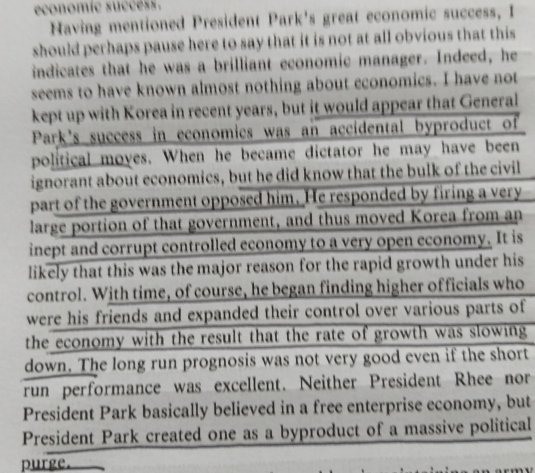
Gordon Tullock on an accidental economic miracle
20 Aug 2020 Leave a comment
in comparative institutional analysis, constitutional political economy, defence economics, development economics, economic history, economics of bureaucracy, economics of crime, economics of regulation, Gordon Tullock, growth disasters, growth miracles, history of economic thought, income redistribution, industrial organisation, international economics, labour economics, labour supply, law and economics, managerial economics, Marxist economics, organisational economics, property rights, Public Choice, rentseeking Tags: South Korea, The Great Escape
Batting blind on unconscious bias! @NZHumanRights relies on newspapers, blogs and YouTube clips!!
20 Aug 2020 Leave a comment
in discrimination, economics of bureaucracy, economics of education, human capital, labour economics, labour supply, law and economics, managerial economics, market efficiency, organisational economics, personnel economics, politics - New Zealand, Public Choice Tags: political correctness, racial discrimination, regressive left, sex discrimination

How Should Risk Managers be Held Accountable for their Failed Policies?
20 Aug 2020 Leave a comment

During the early days of the COVID-19 risk management disaster, I noted how farmers do more to protect their livestock than Western governments have done to protect their elderly in nursing homes from the horrible consequences of the coronavirus pandemic.
Why is that?
For a farmer, every cow, pig, chicken and egg has an economic value; failure to manage risks leads to financial losses so applying risk reduction measures and protecting livestock from diseases while promoting animal health is common sense.
For a government risk manager, old people are a massive financial burden on the state in pensions, healthcare, non-productive care-sector labour and resources; having the inactive, sick and infirm die earlier and restore a more balanced demographic is common sense.
If you think this is distastefully dystopian, and that no one would ever consider such a (final) solution (especially on the great generation that fought for our freedom in…
View original post 2,501 more words
Choices and options, public and private
20 Aug 2020 Leave a comment

I was going to move on to another topic, but last night University of Waikato economics academic John Gibson sent me the links to a couple of other papers I hadn’t seen, and I thought it might be worth writing about them. Gibson is one of New Zealand leading empirical research economists and during the lockdown I wrote about one of his efforts to think through, and put numbers on, the costs and benefits of the lockdown, linking lost GDP to possible reductions in life expectancy.
The first of the links Gibson sent through probably won’t appeal to most readers. In this paper, two Motu research economists, Arthur Grimes and Benjmain Davies, set out to formalise how one would apply what is known as “real options analysis” to the choices the government made in late March. Real options analysis was an addition to the economics literature in the 1990s. …
View original post 3,461 more words
Did the Trojan War Really Happen?
20 Aug 2020 Leave a comment

Troy invites war. Its location, where Europe and Asia meet, made it rich and visible. At Troy, the steel-blue water of the Dardanelles Straits pours into the Aegean and opens the way to the Black Sea. Although the north wind often blocked ancient shipping there, Troy has a protected harbor, and so it beckoned to merchants—and marauders. Walls, warriors, and blood were the city’s lot.
People had already fought over Troy for two thousand years by the time Homer’s Greeks are said to have attacked it. Over the centuries since then, armies have swept past Troy’s ancient walls, from Alexander the Great to the Gallipoli Campaign of 1915.
And then there are the archaeologists. In 1871 Heinrich Schliemann amazed the world with the announcement that a mound near the entrance to the Dardanelles contained the ruins of Troy. Schliemann, who relied on preliminary work by Frank Calvert, was an inspired…
View original post 3,925 more words
#globalwarming #climateemergency @greenpeaceusa @AOC @BernieSanders
20 Aug 2020 Leave a comment
in energy economics, environmental economics, global warming, politics - USA Tags: 2020 presidential election, climate alarmists, offsetting behaviour, solar power, The fatal conceit, unintended consequences, wind power

#globalwarming #climateemergency @GreenpeaceAP @Greens
20 Aug 2020 Leave a comment
in energy economics, environmental economics, global warming, politics - Australia Tags: climate alarmists

The Nazi Weather Station in North America
20 Aug 2020 Leave a comment
in defence economics, war and peace Tags: World War II
Greco-Turkish War – Treaty of Sèvres I THE GREAT WAR 1920
20 Aug 2020 Leave a comment
in defence economics, war and peace Tags: World War I
Why didn’t the Germans copy the T-34?
20 Aug 2020 Leave a comment
in defence economics, war and peace Tags: World War II


Recent Comments