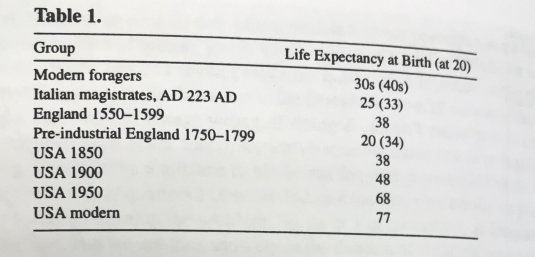
Public Safety in an Era of Criminal Justice Reform Roland Fryer Jason Riley
02 Jun 2020 Leave a comment
in econometerics, economics of crime, law and economics, politics - USA Tags: crime and punishment, law and order, offsetting behaviour, unintended consequences
#GeorgeLloydProtests
02 Jun 2020 Leave a comment
in economic history, economics of crime, law and economics, politics - USA Tags: law and order, police shootings
How culture explains our weak response to the coronavirus
01 Jun 2020 Leave a comment

The sneakiness of the novel coronavirus virus has wreaked havoc worldwide.
Not only have countries been forced to adopt emergency measures never seen in living memory, the outbreak has decimated the global economy and claimed hundreds of thousands of lives.
Although the coronavirus is a global pandemic, it’s striking how the pathogen’s destruction has varied across regions.
Whilst East Asia has largely got a grip on the virus, Europe is still reeling. The United Kingdom recently pipped Italy to take Europe’s highest death toll, with a tally that dwarfs all but a handful of nations. The United States has established itself as the world’s coronavirus leader— although not in the way President Trump would want us to believe. And Brazil appears to be the new epicentre of the pandemic, with growing fears that their healthcare system will not survive the oncoming onslaught.
This all begs the question: why…
View original post 1,789 more words
COVID19 update, May 31, 2020: which patients benefit most from Remdesivir; asymptomatic infection rate; the post-lockdown economy; miscellaneous updates
01 Jun 2020 Leave a comment

(1) Dr. Seheult discusses remdesivir for different categories of patients, and suggests that the drug is most beneficial (in terms of quicker recovery) for patients sick enough to require oxygen, but not so sick as to require mechanical ventilation or ECMOs (“heart-lung machines”). In this latter group, the virus has already done so much damage that remdesivir amounts to “closing the barn door after the horses have fled”, while mild cases will resolve on their own.
The conventional division of patients is (averaged across age groups):
- 80% self-limiting, self-resolving disease
- 15% get more severely ill
- 5% critically ill
So it would be the 15% where the drug can make most of the difference, probably by keeping patients from moving into the 5% critical group.
(2) Dr. John Campbell’s video looks at the asymptomatic infection rate, which he frustratingly places “between 5% and 80%”, and briefly highlights different studies that arrive…
View original post 266 more words
J’Accuse anti-science virtue signalling @eugeniesage @NZGreens @jamespeshaw @mfe_news @Greenpeace @AOC crazy @BernieSanders @SenWarren sleepy @JoeBiden
01 Jun 2020 Leave a comment
in environmental economics, politics - New Zealand Tags: Anti-Science left, offsetting behaviour, recycling, The fatal conceit, unintended consequences

Economic fortunes of Her Majesty’s realms
01 Jun 2020 Leave a comment
One error is to refer to the Channel Islands as Crown territory. Her claim to them is a residue of her claim to the dukedom of Normandy. That is why the royal toast their includes a reference to her as the Duke.

We mark today the official birthday of our head of state, Her Majesty, Queen Elizabeth II, queen of New Zealand and of her other realms and territories. Her actual birthday was 21 April 1926, when her grandfather George V was on the throne.
When she was born, the United Kingdom and the Dominions (as they were then called) were still among the most prosperous countries in the world. Using the Maddison compilation of real GDP estimates (and averaging across 1925-27, on account of some considerable year to year volatility in some of the series), here is how things looked at about the time the Queen was born.
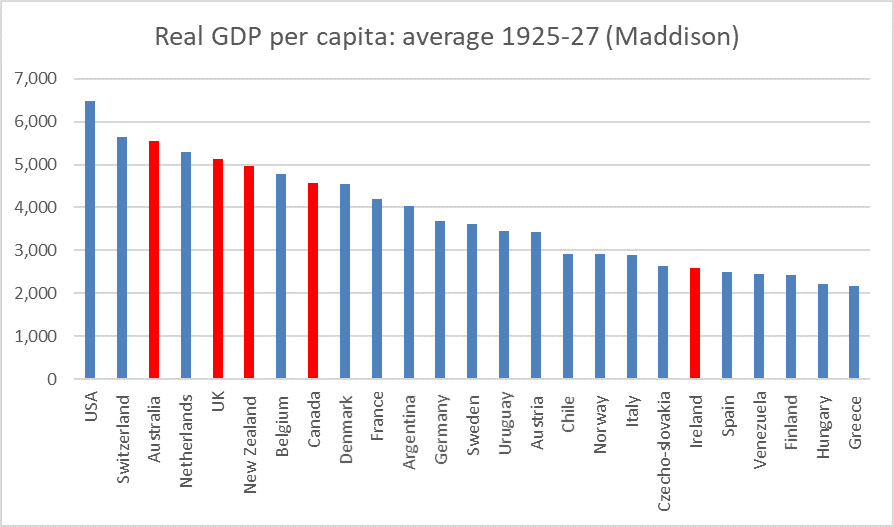
At the time, Newfoundland was an independent dominion (for which there is no data, but presumably it was a bit poorer than Canada), and South Africa was also still a domininion. Maddison has no data for South Africa in the 1920s…
View original post 483 more words
Modern Monetary Theory: Neither modern, nor monetary, nor (mainly) theoretical ?
01 Jun 2020 Leave a comment

I’ve been working for some time on a review of the first full-length text based on Modern Monetary Policy, Macroeconomics by William Mitchell, Randall Wray and Martin Watts. A near-final draft is over the fold
View original post 1,751 more words
When both sides are wrong: George Floyd’s death and the violent responses
01 Jun 2020 Leave a comment

Let me state at the outset that I am not equating what the police did to George Floyd with the violence of the rioters responding to his murder. Looting, burning, and breaking into stores is not as horrible as murder, and of course most of the protestors against Floyd’s murder were peaceful. But violent protest is also unconscionable. And so I’ll call out both the cops and the rioters, but am not trying to say there’s a moral equivalence—not at all. But I don’t think there is any excuse for rioting.
What the Minneapolis police did to George Floyd, with one kneeling on his neck while he was prone for a full eight minutes and 46 seconds (two minutes after Floyd became unresponsive), suffocating him to death, while three cops stood by, is unconscionable. The cop who knelt on his neck has been rightly indicted for third-degree murder. The other…
View original post 1,250 more words
Rationing in WWII (British Homefront)
01 Jun 2020 Leave a comment
in defence economics, war and peace Tags: World War II


Recent Comments