Want To Wreck A Power Grid? Add Chaotically Intermittent Wind & Solar Power
03 Apr 2020 Leave a comment


Thomas Edison and George Westinghouse battled over whether America would run on DC or AC power, but they never had to battle with the chaotic intermittency of wind and solar.
Celebrated in the recently released film, The Current War, Westinghouse and Edison fought a pitched battle over technology, patents, media approval and the support of legislators in their efforts to dominate the generation and distribution of electricity across the USA. Spoiler alert: Westinghouse won and AC remains the delivery system of choice.
In wind and solar obsessed Australia, the battle raging today about power generation and delivery is simply about keeping the lights on.
Rafe Champion takes a look at how the chaotic delivery of heavily subsidised wind and solar is the real Current War.
How intermittent energy kills coal-fired power and the grid
Catallaxy Files
Rafe Champion
16 March 2020
The damage inflicted by a good wind day. The…
View original post 385 more words
New Book: ESCAPING PATERNALISM
03 Apr 2020 Leave a comment

by Mario J. Rizzo and Glen Whitman
Book description
The burgeoning field of behavioral economics has produced a new set of justifications for paternalism. This book challenges behavioral paternalism on multiple levels, from the abstract and conceptual to the pragmatic and applied.
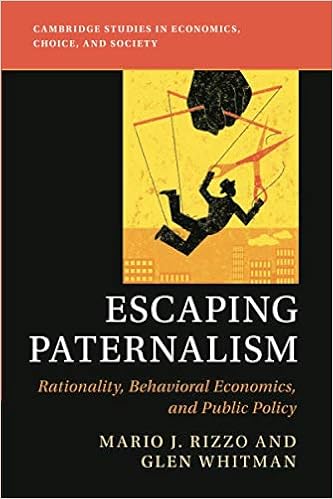 Behavioral paternalism relies on a needlessly restrictive definition of rational behavior. It neglects nonstandard preferences, experimentation, and self-discovery. It relies on behavioral research that is often incomplete and unreliable. It demands a level of knowledge from policymakers that they cannot reasonably obtain. It assumes a political process largely immune to the effects of ignorance, irrationality, and the influence of special interests and moralists.
Overall, behavioral paternalism underestimates the capacity of people to solve their own problems, while overestimating the ability of experts and policymakers to design beneficial interventions. The authors argue instead for a more inclusive theory of rationality in economic policymaking.
Reviews
Gerd Gigerenzer (Director of the…
View original post 264 more words
Parker’s readiness to relax the RMA rules should be extended to freshwater constraints on farmers
03 Apr 2020 Leave a comment

Environment Minister David Parker has directed officials to find ways to fast-track consents for infrastructure and development projects. He says his goal is to help create a pipeline of projects so that some can start immediately once Covid-19 restrictions are lifted “so people can get back into work as fast as possible”.
Parker sees the Covid-19 pandemic as a serious global crisis that will have a wide ranging and lasting impact on almost every part of the economy for some time.
He recognises many New Zealanders have lost their jobs, or may do so in coming months, and many businesses are doing it hard.
“These are extraordinary times that need extraordinary solutions. We need to support NZers through this crisis, and position our economy for recovery”.
His aim is to short-circuit the standard Resource Management Act consenting processes and he wants Cabinet to put its stamp of approval on…
View original post 482 more words
10 Public Safety Regulations Set Aside to fight #COVID19
03 Apr 2020 Leave a comment
in economics of regulation, health economics Tags: economics of pandemics
Choices
03 Apr 2020 Leave a comment

Choices that matter are often hard. That is one of the messages of Matthew Hooton’s lengthy column in the Herald this morning, which people really should read if you possibly can. It isn’t that Hooton is saying anything particularly new, but he is putting it firmly in a contemporary New Zealand context. He poses the choices around handling the coronavirus pandemic as primarily those for the Prime Minister (and Cabinet), but really we should think of them as choices for New Zealanders as a whole, for which elected leaders – none of whom here was seriously chosen for their ability to confront the gravest crisis in many many decades – really should primarily be there to facilitate and articulate, but perhaps help shape too, our collective view; the choices we wish to make on matters that affect life and death – perhaps for many – and the functioning of our…
View original post 2,159 more words
Rowan Williams, Lord Oystermouth and former Archbishop of Canterbury, faults Dawkins and New Atheists for damaging Christianity and not knowing theology
03 Apr 2020 Leave a comment

Good God, here we go again! Rowan Williams, formerly a “sophisticated” Archbishop of Canterbury, now bearing the appropriate title of Lord Williams of Mealymouth Oystermouth, is still kvetching about Richard Dawkins and his supposed New Atheist posse, and on two grounds.
First, Dawkins (and we) damaged Christianity, and it needs to be repaired.
Second, New Atheists don’t know jack about theology.
As to the first, I say “GOOD FOR US! Christianity needs to be damaged, for it’s harmful and delusional, and enables the vice of belief without evidence—in other words, faith. As to the second claim, I’ve dealt with it many times before (it’s gone under the name of “the courtier’s reply“), and address it here only briefly.
Here’s the short article from The Tablet. Click to read, and shake your head about the lucubrations of poor Lord Oystermouth:
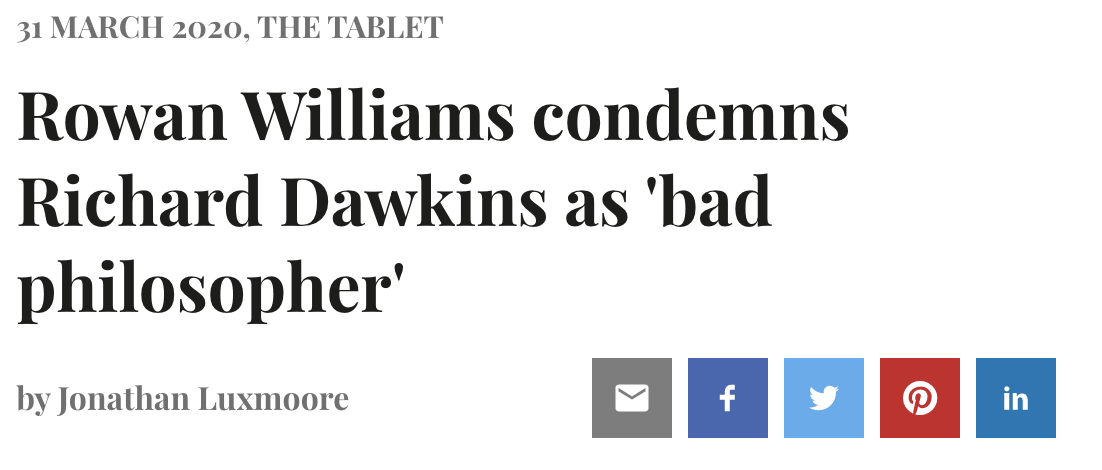
A few short excerpts:
The former Archbishop of…
View original post 782 more words


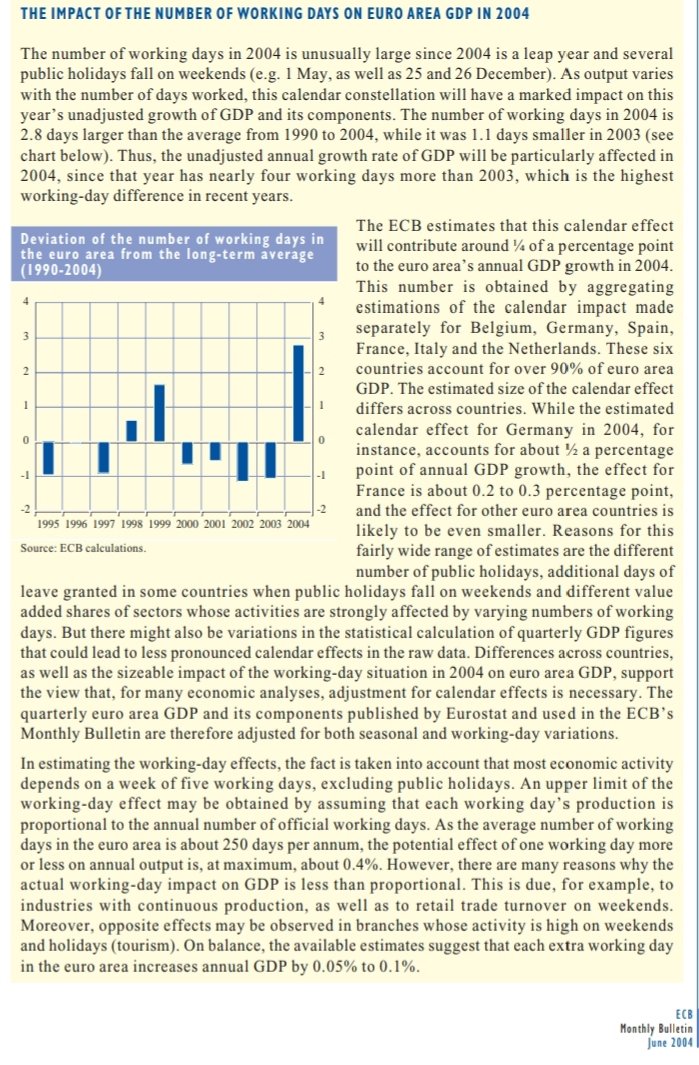
The calendar effect: changing number of public holidays falling in the working week measures the upper bound of the lockdown on GDP?
03 Apr 2020 Leave a comment
in econometerics, economic growth, health economics, labour economics, labour supply, law and economics, macroeconomics Tags: economics of pandemics
Where can you flush toilet paper?
03 Apr 2020 Leave a comment
in development economics, economics of media and culture, growth disasters, growth miracles, health economics Tags: The Great Escape


Asteroid Collision Power Comparison
03 Apr 2020 Leave a comment
in economics of education, economics of media and culture
Cinematographer Explains 3 Different Camera Lenses | @VanityFair
03 Apr 2020 Leave a comment
in movies
Grand Theft: US Taxpayers Liable For $120,000,000,000 In Subsidies to Wind & Solar
02 Apr 2020 Leave a comment

In the absence of endless subsidies there would be no wind or solar industries. Period.
The minute talk turns to cutting those subsidies, the rent-seekers profiting from the wind and solar scam scream ‘blue murder’.
In the USA, the greatest economic and environmental fraud of all time is on a scale and magnitude that would make Croesus turn green with envy.
If the wind and solar scam continues unabated, American taxpayers will be forced to fork out more than $120 billion, in the form of direct subsidies, tax credits, and mandates for the generation and transmission of chaotically intermittent wind and solar.
Bill Peacock takes a look at the staggering burden placed on American households and businesses for an obsession with sunshine and breezes.
Renewable Subsidies Leading America Toward European-Style Energy Poverty
RealClear Energy
Bill Peacock
3 March 2020
Recent headlines have touted the record $55 billion renewable sector investments…
View original post 762 more words


Recent Comments