The 1918 Pandemic: why the Spanish Flu was the Deadliest Flu in History
03 Mar 2020 Leave a comment
in defence economics, economic history, health economics, war and peace Tags: World War I

Frank Ramsey
03 Mar 2020 Leave a comment
“Ramsey published a grand total of eight pages in pure mathematics. He had been working the Entscheidungsproblem in the foundations of mathematics, which asked whether there is a way of deciding whether or not any particular sentence in a formal system is valid or true. He solved a special case of the problem, pushed its general expression to the limit, and saw that limit clearly. A theorem he proved along the way showed that in apparently disordered systems, there must be some order. The branch of mathematics that studies the conditions under which order must occur is now named Ramsey Theory, with more discrete parts of it called Ramsey’s Theorem and Ramsey Numbers.
In 1927-28, Ramsey published two papers in economics, with the encouragement of John Maynard Keynes. When the Economic Journal celebrated its 125th anniversary with a special edition in 2015, both papers were included. That is, looking back over a century and a quarter, one of the world’s best journals of economics decided that two of its 13 most important papers were written by Frank Ramsey when he was 25 years old. The editors explained themselves by saying that the papers initiated “entirely new fields”—optimal savings and optimal taxation theory. In addition, they produced the Ramsey-Cass-Koopmans model, Ramsey Pricing, Ramsey’s Problem, the Keynes-Ramsey Rule, and more.
Ramsey was also the first to set out the subjective conception of probability and expected utility theory that underpins much of contemporary economics. That is, he figured out how to measure degrees of belief and preferences and then showed how we might determine what a rational decision would be, given what someone believes and desires. He was a socialist and wouldn’t have been happy with what became of his idea—he didn’t think that all human action and decision should be crammed into the strictures of rational choice theory, as many economists and social scientists today seem to assume. Nonetheless, in this domain we find the Ramsey/de Finetti Theorem, the Ramsey-Good Result, Ramsey’s Procedure for measuring the intensity of preferences, and more.
In philosophy, he was just as impressive. When an undergraduate, he translated Ludwig Wittgenstein’s Tractatus and wrote a critical notice of it that still stands as one of its most important commentaries. He went on to have a profound influence on Wittgenstein, persuading him to drop the quest for certainty and purity, and turn to ordinary language and human practices. Ramsey was in search of a realistic philosophy and was leaning in the direction of American pragmatism when he died.”

Frank Plumpton Ramsey (February 22, 1903 – January 19, 1930) was a British mathematician who, in addition to mathematics, made significant contributions in philosophy and economics.
He was born on 22 February 1903 in Cambridge where his father, also a mathematician, was President of Magdalene College. He was the eldest of one brother and two sisters, and his brother Michael Ramsey later became Archbishop of Canterbury. He entered Winchester College in 1915 and later returned to Cambridge to study mathematics at Trinity College. Easy-going, simple and modest, Ramsey had many interests besides his scientific work. Even as a teenager Ramsey showed both his profound abilities and the heterogeneity of the issues that concerned him. His brother Lord Ramsey was well aware of both these facts:
“Though we were at different schools, in holiday times we saw a great deal of each other and we spent a lot of time together…
View original post 1,957 more words
Content warnings at Tate
03 Mar 2020 Leave a comment

Warning: This blog post contains strong and sometimes challenging imagery, including depictions of slavery, violence and suffering.
Baroque Britain
When I visited the Baroque Britain exhibition at Tate Britain I was surprised that there was a Content Warning at the entrance to the second room. This warned us that some of the images were disturbing and might upset visitors. Specifically, a massive painting by Benedetto Gennari the Younger which shows black people in collars and chains. Slaves, in other words.
 Portrait of Hortense Mancini, Duchess of Mazarin by Benedetto Gennari the Younger (1674)
A handful of other paintings show rich people – men and women – being served or accompanied by black servants, but this is the only one where the black people (all boys, I think) are wearing very obvious metal slave collars round their throats.
William Blake
This is the second warning notice I’m aware of Tate putting…
View original post 1,871 more words
Voting with their feet @AOC @BernieSanders from the Venona Tapes
03 Mar 2020 Leave a comment
in defence economics, Marxist economics, politics - USA, war and peace Tags: 2020 presidential election, Korean war

Has @greenpeaceusa @oxfam ever campaigned against indoor air pollution caused by energy poverty?
03 Mar 2020 Leave a comment
in development economics, energy economics, environmental economics, environmentalism, politics - USA


Class war cancelled @AOC @BernieSanders @SenWarren @jeremycorbyn
03 Mar 2020 Leave a comment
in income redistribution, politics - Australia, politics - New Zealand, politics - USA, Public Choice, public economics Tags: tax havens

Acemoglu on how democracy came to America
03 Mar 2020 Leave a comment
in comparative institutional analysis, constitutional political economy, development economics, economic history, economics of bureaucracy, growth disasters, growth miracles, income redistribution, industrial organisation, international economic law, international economics, International law, labour economics, labour supply, law and economics, politics - USA, property rights, Public Choice, public economics, rentseeking Tags: Age of Discovery, age of empires, Age of Enlightenment, economics of colonialism

Are there no competent baby boomer Democratic party politicians?! Two of these old geezers are in the race solely to stop crazy @BernieSanders losing the House
03 Mar 2020 Leave a comment
in politics - USA Tags: 2020 presidential election


Nanny-in-Chief
03 Mar 2020 Leave a comment
in economics of bureaucracy, economics of regulation, health economics, politics - USA, Public Choice Tags: 2020 presidential election, meddlesome preferences, nanny state
Global Decarbonization Update
03 Mar 2020 Leave a comment

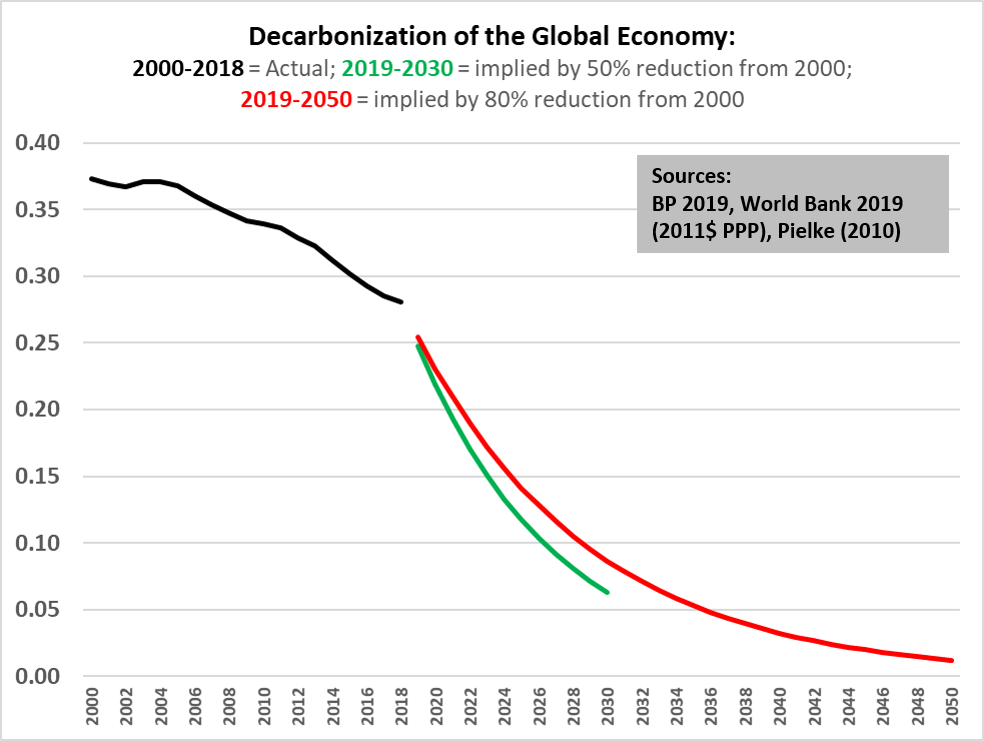
The figure above provides an update (to 2018) on global decarbonization rates (that is, rate of reduction in carbon dioxide emissions from fossil fuels divided by global GDP, in 2011$ PPP).
- Annual decarbonization 2000-2018 = 1.6%
- Implied by a 50% reduction (from 2000 emissions) by 2030 = 8.4%
- Implied by an 80% reduction (from 2000 emissions) by 2050 = 6.0%
For details on methods and significance, see The Climate Fix (2010).


Recent Comments