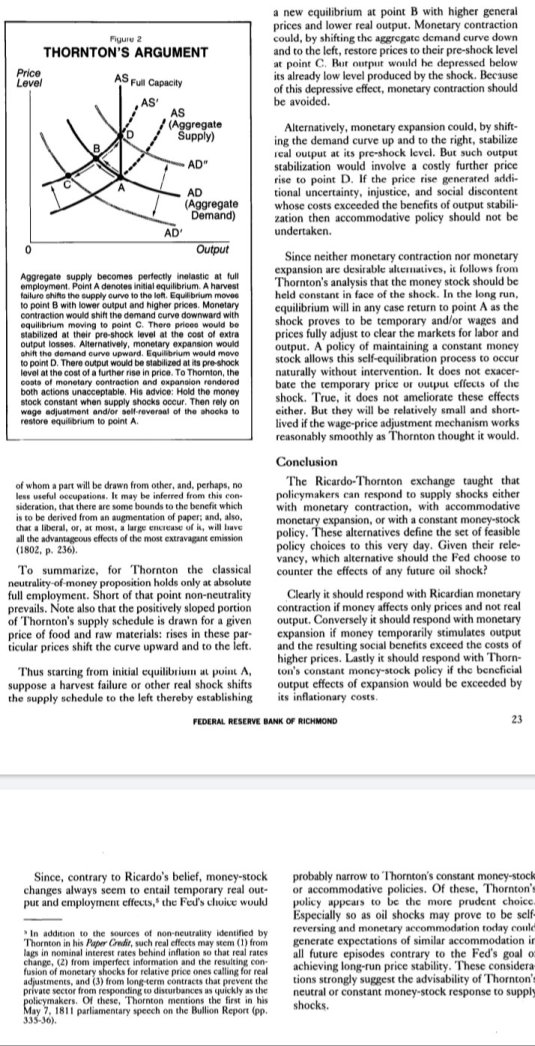
Thomas Humphrey recall Ricardo and Thornton on monetary policy and supply shocks
04 Mar 2020 Leave a comment
in business cycles, economic growth, fiscal policy, history of economic thought, labour economics, labour supply, macroeconomics, monetary economics, Thomas M. Humphrey Tags: monetary policy, real business cycle theory
Gary Becker on affirmative action
04 Mar 2020 Leave a comment
in applied price theory, discrimination, economics of education, Gary Becker, labour economics

Jason Riley On “False Black Power?”
04 Mar 2020 Leave a comment
in discrimination, economic history, economics of education, human capital, labour economics, labour supply, occupational choice, politics - USA, poverty and inequality, unemployment, welfare reform Tags: affirmative action, racial discrimination, regressive left
Stossel: End Racial Preferences at Colleges?
04 Mar 2020 Leave a comment
in economics of education, income redistribution, politics - USA, Public Choice, rentseeking Tags: affirmative action, political correctness, racial discrimination, regressive left
The envelope (theorem) please: Profits, efficiency wages, and monopsony
04 Mar 2020 Leave a comment

In a very helpful blog post, Paul Krugman tries to make sense of Wal-Mart’s recent statement that it is already reaping some gains from raising wages via reduced turnover costs. Krugman’s main point is as follows. If worker productivity is a function of the wage (through improved morale, lower turnover, etc.), and Wal-Mart was initially maximizing profits, then a small change in wages will leave profits largely unchanged.
As Krugman points out, this is logic of the “envelope theorem.” What I want to clarify in this post is that the logic behind this argument is more general than the particular efficiency wage model Krugman works through. Any time firms are choosing wages to balance various concerns—as opposed to simply accepting a “market wage” as a constraint—the logic of the envelope theorem applies. What’s more, two types of empirically relevant models of the labor market—monopsonistic competition and efficiency wages—look pretty similar in this regard, and can be thought of as…
View original post 618 more words
Resistance in China – Myth or Reality? – WW2 – War Against Humanity 009
04 Mar 2020 Leave a comment
in defence economics, laws of war, war and peace Tags: World War II
Is @BernieSanders A Democratic Socialist? Or Just a Socialist?
04 Mar 2020 Leave a comment
in income redistribution, Marxist economics, politics - USA, Public Choice, public economics, rentseeking Tags: 2020 presidential election
Episode 8: Rosolino Candela on Price Theory
04 Mar 2020 Leave a comment

Mercatus Center Associate Director of Academic and Student Programs Rosolino Candela joins the podcast to talk about price theory. In an example-filled episode, we discuss free parking at shopping centers, lighthouses and lightships in 18th-century Britain, and the sugar contents of Fanta. Dr. Candela also talks about who he considers the best price theorists: Mises, Hayek, Buchanan, Tullock, Alchian, and Demsetz. Marcus Shera cohosts.
Loose, Vague, and Indeterminate is available on Spotify, Apple Podcasts, Google Podcasts, Podcast Addict, Overcast, RadioPublic, PocketCasts, and Breaker. You can listen and catch up on old episodes on any of those platforms in addition to our Anchor page at go.gmu.edu/LVI.
Supreme Court searches for path through byzantine federal land laws
04 Mar 2020 Leave a comment

Federal lands are governed by a complex thicket of laws built up over more than a century, often with too little thought to how the different generations fit together. The Supreme Court confronted that problem last week, when it considered whether federal permits for the Atlantic Coast Pipeline are void because the pipeline would pass several hundred feet below the Appalachian Trail.

The challengers argue that only Congress can approve a pipeline right-of-way because the trail is the equivalent of a national park. Because Atlantic Coast’s permit was from the Forest Service, they argue, it is invalid. From there, things get complicated quickly.
The trail isn’t a national park. But the Secretary of Interior has delegated the trail’s management to the National Park Service. So the challengers argue that the trail is “lands in the National Park System”–which, they further argue, means it has to be treated as if a…
View original post 814 more words




Recent Comments