
What Happened to the Flying Wing?
13 Feb 2020 Leave a comment
in defence economics, transport economics
The politics of the royal bedchamber: what The Favourite does (and does not) tell us about party, Parliament and the court of Queen Anne
12 Feb 2020 Leave a comment

In this latest blog for the Georgian Lords, Dr Charles Littleton offers some insights into the political background of the world presented in the award-winning movie The Favourite.

The critical reception that has greeted Yorgos Lanthimos’s film provides an excellent opportunity to re-examine the role of politics and the court in the reign of Queen Anne, a critical time in the development of the British state and Parliament. Indeed, it saw the formation of the British state itself, as it was under Anne’s rule that the political union of England and Scotland was effected. The film has provoked much discussion and the often sterile arguments about the accuracy required of a historical drama have risen again, particularly as Anne’s reign is widely acknowledged to be one of the lesser known periods of British history.
The film is accurate in that the figures depicted existed and the general narrative trajectory did…
View original post 1,200 more words
#climateemergency #globalwarming @GreenpeaceAP @Greens @NZGreens
12 Feb 2020 Leave a comment
in economics of natural disasters, energy economics, environmental economics, global warming, politics - Australia Tags: climate alarmists, pessimism bias

Elections before the secret ballot
12 Feb 2020 Leave a comment

This month marks the 141st anniversary of the first use of the secret ballot to elect an MP, at a by-election in the Yorkshire borough of Pontefract. Before the 1872 Ballot Act, and throughout the period covered by our Victorian Commons project, MPs who faced a contest were elected in public by viva voce voting at a designated polling booth.
At its most basic the booth was little more than a table with chairs for the poll clerks, who would ask electors to confirm their identity and qualification (sometimes with an oath) before inquiring how they wished to vote, often surrounded by cheering onlookers and the agents of the candidates. The voter would state his preferences – “I vote for William Biggs and Thomas Harding” or “I give a plumper for James Gordon” – and the clerk would then mark the choices in an official poll book, based…
View original post 634 more words
Elections and electioneering, 1832-1868
12 Feb 2020 Leave a comment

As voters across the country head to the polls this month, we thought it was an ideal opportunity to look back at some of the research on 19th century elections we have featured in our blogs over the past few years. These draw on our work for the History of Parliament’s House of Commons, 1832-68 project, which is producing biographical profiles of the 2,591 MPs who sat between the first and second Reform Acts and accounts of the 401 constituencies in England, Ireland, Scotland and Wales across the nine general elections which took place during this period. You can find more details about our project here.
The system under which electors cast their votes between 1832 and 1868 was very different in many ways from the modern British electoral system. As our editor, Philip Salmon, explains in this post, before the introduction of the secret ballot in 1872…
View original post 758 more words
The 14th century origins of the impeachment process
12 Feb 2020 Leave a comment

In light of recent proceedings in the United States, in our latest blog Dr Charles Moreton, senior research fellow with our medieval project, House of Commons 1461-1504, discusses the historic origins of impeachment in English parliaments…
Thanks to the actions of Donald Trump’s political opponents in the United States, impeachment is very much in the news at the moment. It is therefore an opportune moment to consider the English parliamentary origins of the process.
The first recorded example of parliamentary impeachment dates back to the ‘Good Parliament’ of 1376. This, the penultimate Parliament of Edward III’s reign, was an assembly of great consequence which also saw the first record of the election of a Speaker by the Commons. Highly critical of the government, the Lower House submitted the longest list of petitions ever sent to a King in a medieval Parliament, conducted its own investigations into maladministration and…
View original post 543 more words
Milton Friedman on old fallacies that never die at central banks
12 Feb 2020 Leave a comment
in business cycles, financial economics, great depression, inflation targeting, macroeconomics, Milton Friedman, monetary economics, politics - New Zealand, Public Choice

Crunch Time: Germany’s Wind & Solar Disaster Leaves Germans Scrambling For Reliable Power
12 Feb 2020 Leave a comment


Germany’s obsession with intermittent wind and solar was never going to end well. Power prices are now the highest in Europe, if not the world. But paying for power is only a problem for those Germans who are lucky enough to be supplied with it.
Wherever there’s an attempt to run on sunshine and breezes, power consumers find themselves in a perpetual game of musical chairs.
Delivering electricity at chaotic random intervals, thanks to sunset and calm weather, wind and solar are bound to leave power punters short. And the more reliance that’s placed on that heavily subsidised pair, the more disappointed consumers there will inevitably be.
And nowhere is that truism more evident than Germany, as Paul Homewood details below.
The looming German capacity crunch
Not a Lot of People Know That
Paul Homewood
27 January 2020
A pertinent update from Timera:
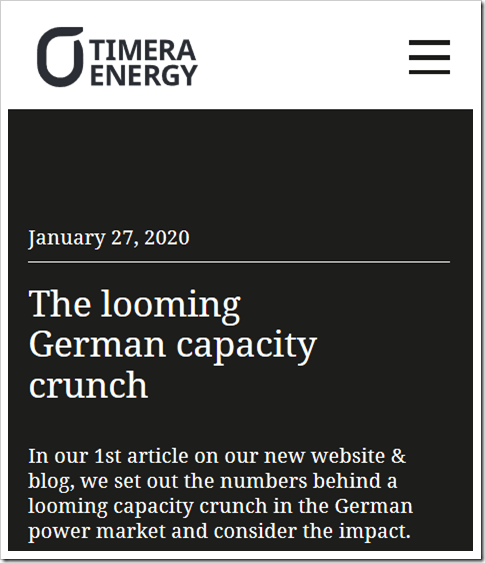
The looming German capacity crunch
The…
View original post 887 more words
Edward Prescott, Monetary Policy with 100% Reserve Banking: An Exploration
12 Feb 2020 Leave a comment
in applied price theory, applied welfare economics, budget deficits, business cycles, econometerics, economic history, Edward Prescott, global financial crisis (GFC), great depression, great recession, industrial organisation, macroeconomics, Milton Friedman, monetarism, monetary economics, property rights, Public Choice, Robert E. Lucas Tags: real business cycles
#climateemergency #globalwarming @GreenpeaceAP @Greens don’t remember Cyclone Tracy
12 Feb 2020 3 Comments
in economic history, economics of natural disasters, energy economics, environmental economics, global warming, politics - Australia Tags: climate alarmists, pessimism bias

Nobel Symposium Emi Nakamura Monetary policy: Conventional and unconventional
12 Feb 2020 Leave a comment
in budget deficits, business cycles, econometerics, economic growth, economic history, Euro crisis, fiscal policy, global financial crisis (GFC), great depression, great recession, macroeconomics, monetarism, monetary economics Tags: New Keynesian macroeconomics
1.5 degrees
12 Feb 2020 Leave a comment

by Judith Curry
The IPCC Special Report on Global Warming of 1.5C is now published [link].
View original post 740 more words


Recent Comments