
The Sixth Extinction: An Unnatural History by Elizabeth Kolbert (2014)
18 Jan 2020 Leave a comment

Back in the late 1980s and 1990s there was a fashion for popular science books, and I read as many as I could, becoming better informed about the three major subjects which dominated the lists – cosmology, paleontology with an emphasis on human origins, and environmental biology.
Among them were a number of books by E.O. Wilson, particularly the brilliant Diversity of Life (1992), which gives an unparalleled sense of the wonder and diversity of the natural world, and Richard Leakey’s book, The Sixth Extinction (1995). This latter is an often quite technical account of discoveries and debates in paleontology and environmental biology which, taken together, suggest that the rate at which humanity is killing off species of animals, plants, fish and other fauna amounts to a holocaust, a global extermination, which ranks with the other Big Five mass extinction events that have punctuated the 500-million year story of life…
View original post 3,650 more words
Edward Prescott on the GFC
17 Jan 2020 Leave a comment
in business cycles, economic history, Edward Prescott, financial economics, global financial crisis (GFC), great depression, great recession, macroeconomics, monetary economics, politics - USA Tags: New Keynesian macroeconomics, real business cycle theory

Real business cycle theory ensures the questions are correctly posed
17 Jan 2020 Leave a comment
in budget deficits, business cycles, fiscal policy, global financial crisis (GFC), great depression, great recession, macroeconomics, monetary economics Tags: real business cycle theory

Who was president maybe for one day
17 Jan 2020 Leave a comment
in politics - USA Tags: constitutional law
5. No Effect OR Catastrophe” on YouTube
17 Jan 2020 Leave a comment
in applied welfare economics, energy economics, environmental economics, global warming Tags: climate alarmists
January 16, 1547 – Grand Duke Ivan IV of Muscovy becomes the first Czar of Russia.
17 Jan 2020 Leave a comment

January 16, 1547 – Grand Duke Ivan IV of Muscovy becomes the first Czar of Russia, replacing the 264-year-old Grand Duchy of Moscow with the Czardom of Russia.
Ivan IV Vasilyevich (August 25, 1530 – March 28, 1584), commonly known as Ivan the Terrible, or more accurately, “Ivan the Formidable” or “Ivan the Fearsome”, was the Grand Prince of Moscow from 1533 to 1547 and the first Czar of Russia from 1547 to 1584.
Ivan IV was the son of Vasili III Ivanovich Grand Prince of Moscow (1479 – 1533) and and his second wife, Elena Glinskaya, daughter of Prince Vasili Lvovich Glinsky from Grand Duchy of Lithuania and Serb Princess Ana Jakšić, member of the Jakšić family.
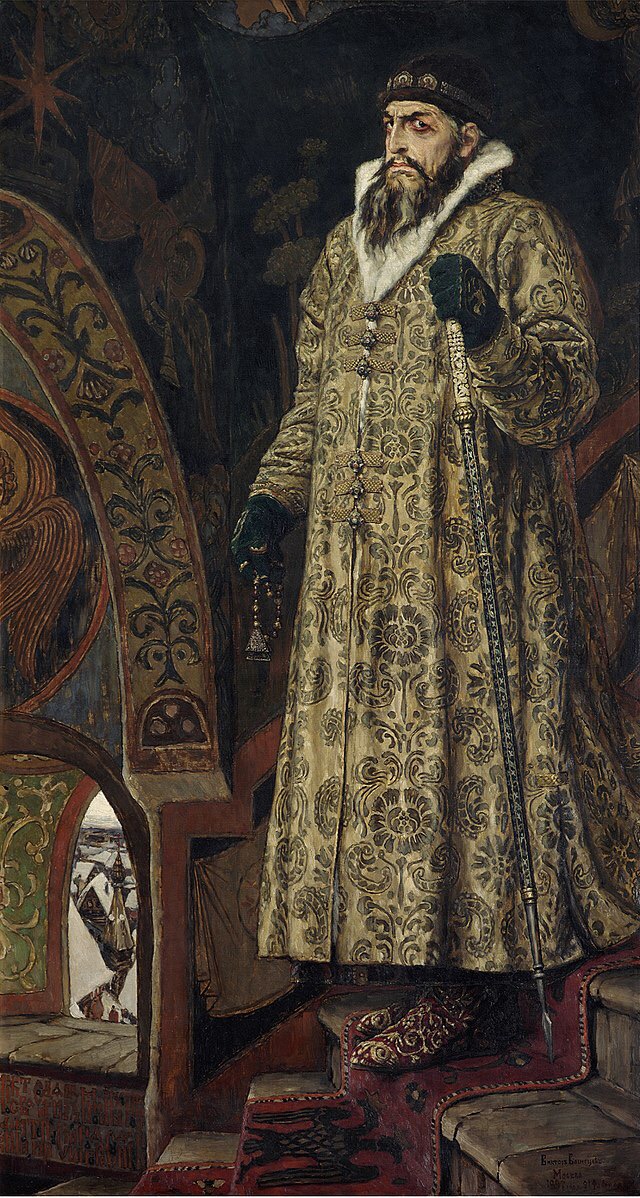
Ivan IV, Czar of all the Russia’s.
When Ivan was three years old, his father died from an abscess and inflammation on his leg that developed into blood poisoning. Ivan was proclaimed the Grand…
View original post 1,088 more words
Top 10 Movies that Started Shooting Without a Completed Script
16 Jan 2020 Leave a comment
in movies
Ross McKitrick 2014 on the hiatus and the Nordhaus damage estimates
16 Jan 2020 Leave a comment
in applied price theory, applied welfare economics, econometerics, energy economics, environmental economics, global warming, politics - Australia, politics - New Zealand, politics - USA, public economics Tags: carbon tax, climate alarmists
River Out of Eden by Richard Dawkins (1995)
16 Jan 2020 Leave a comment
Nature is not cruel, only pitilessly indifferent. That is one of the hardest lessons for humans to learn.
(River out of Eden, page 112)
Three things become clear early in this book:
1. Dawkins is very argumentative He can barely state a fact or idea without immediately imagining a scientific illiterate misunderstanding it, or a creationist arguing against it, or the tradition of thinkers who’ve adopted a contrary position, and then – whooosh! – he’s off on one of his long-winded digressions devising metaphors and analogies and thought experiments (‘imagine 20 million typists sitting in a row…’) devoted to demolishing these opponents and their silly beliefs.
The neutral reader sits back, puzzled as to why Dawkins feels such a continual necessity to find enemies and argue against them, constantly and endlessly, instead of just stating the facts about the natural world in a lucid, calm way and letting them speak…
View original post 2,521 more words

Ross McKitrick uses pure theory to trace Canada’s (Australia’s and NZ’s) marginal abatement cost and marginal damage curves for carbon emissions @mfe_news @jamespeshaw
16 Jan 2020 Leave a comment
in applied price theory, applied welfare economics, energy economics, environmental economics, global warming, politics - Australia, politics - New Zealand, Public Choice, public economics Tags: carbon tax


Recent Comments