#OTD The fall of the #BerlinWall @guardian @jeremycorbyn @SenSanders @Ocasio2018
09 Nov 2019 Leave a comment
in development economics, economic history, growth disasters, Marxist economics, Public Choice Tags: East Germany, fall of communism, fall of the Berlin wall
Liberal NY Times writer condemns woke Democrats
09 Nov 2019 Leave a comment

Timothy Egan is a liberal op-ed columnist for the New York Times, and has the credentials to prove it, including a share in the Times’s Pulitzer Prize for its series “How Race is Lived in America”. (He also has a National Book Award for nonfiction for his 2009 book The Big Burn: Teddy Roosevelt and the Fire that Saved America.)
It would be hard, then, for leftists to dismiss Egan as an alt-righter or white supremacist, though I suppose that, as he was born in 1954, he could be denigrated as a “boomer.” (That, of course, is ageism.) But I suppose they’ll try, as is always the case when somebody writes a piece like Egan’s latest for the NYT (click on the screenshot below):
The exemplar of someone who’s turned off by “insufferable wokeness” is Egan’s sister, who works cleaning toilets at Wal-Mart:
No matter how…
View original post 984 more words
The Great Escape
09 Nov 2019 Leave a comment
in development economics, economic history, growth disasters, growth miracles, health economics Tags: child mortality, child poverty, infant mortality, The Great Escape

Where did the Age of Enlightenment start?
09 Nov 2019 Leave a comment
in Thomas Sowell Tags: Age of Enlightenment

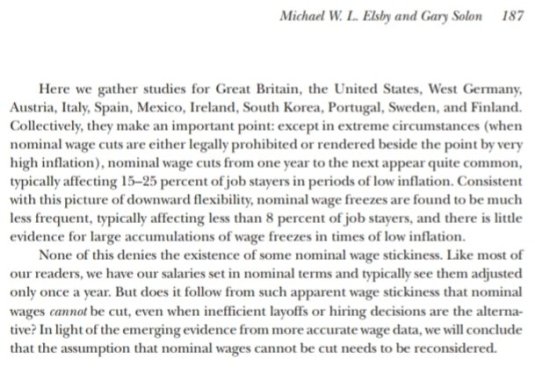
Pay slip data shows wage cuts are common
09 Nov 2019 Leave a comment
in applied price theory, business cycles, econometerics, economic history, job search and matching, labour economics, labour supply, macroeconomics, unemployment Tags: search and matching

Unlike @AOC, @BernieSanders only wants to give the Boston marathon bomber the right to vote
09 Nov 2019 Leave a comment
in economics of crime, law and economics, politics - USA Tags: 2020 presidential election

The mistake that toppled the Berlin Wall #OTD 6.53 pm CET
09 Nov 2019 1 Comment
in International law, Marxist economics Tags: Berlin wall, East Germany, fall of communism
Worried about droughts? Embrace water markets
08 Nov 2019 Leave a comment

In the last few years, California experienced a long, severe drought. It was extremely painful, but not as painful as it might have been because California has water markets that helped the water flow to those who needed it most. Strengthening and expanding water markets could have furthered reduced this pain.
 Courtesy of Jose Manuel Suarez
Yet in Water Deeply, environmental activist Gary Wockner bemoans that so many environmentalists are embracing markets to resolve environmental conflicts. His critique says more about the growing schisms between environmentalists than the merits of water markets.
Wockner offers three criticisms of water markets: (1) they commoditize water; (2) he hasn’t seen a quantified analysis of whether they are successful, under a test that he has devised but does not articulate; and (3) they, along with other free market environmental reforms, are pushing environmentalists away from his preferred model of lobbying and litigation (political…
View original post 889 more words
If the goal is to guide human action, environmental markets work better than indecipherable regulations
08 Nov 2019 Leave a comment
One of the greatest strengths of free market environmentalism approaches to environmental problems is that they facilitate the development of new information about the environment and provide an effective means for people to act on that information. Where there’s a market for some environmental benefit, the people who value it have a strong incentive to discover more information about it and, thanks to the price signal, others can act on that new knowledge without having to know it themselves.
 For instance, suppose a plucky environmentalist discovers that a farmer’s practices reduce water quality to a distant stream through a complex hydrological process. If there’s a cost effective substitute or a means of mitigating its effects on the stream, the environmentalist can pay the farmer to change his behavior. If the price is right, the farmer will change his behavior without having to understand the complex process by which his…
View original post 602 more words
History of Styles and Titles Part III: Hanover to Windsor.
08 Nov 2019 Leave a comment

The kingdoms of England and Scotland were formally united into a single Kingdom of Great Britain in 1707 by the Act of Union. Queen Anne consequently assumed the title “Queen of Great Britain, France and Ireland, Defender of the Faith, etc.”. It remained in use until 1801, when Great Britain and Ireland combined to become the United Kingdom. George III used the opportunity to drop both the reference to France and “etc.” from the style. It was suggested to him that he assume the title “Emperor”, but he rejected the proposal. Instead, the style became “King of the United Kingdom of Great Britain and Ireland, Defender of the Faith”.

King of the United Kingdom of Great Britain and Ireland, Defender of the Faith
In 1876 “Empress of India” was added to Queen Victoria’s titles by the Royal Titles Act 1876, so that the Queen of the United Kingdom, the ruler…
View original post 464 more words


Recent Comments