No Deal… Herr Hitler! – WW2 – 048 – July 27 1940
28 Jul 2019 Leave a comment
in defence economics, war and peace Tags: World War II
@NYTimes: A Black Professor Says in 1970 on affirmative action at elite universities
27 Jul 2019 Leave a comment
in discrimination, economic history, economics of education, labour economics, law and economics, politics - USA Tags: affirmative action, racial discrimination, The fatal conceit, unintended consequences

Origins of Agricultural Crops
27 Jul 2019 Leave a comment


“The recovery of the people is tied to recovery of food, since food itself is medicine—not only for the body but also for the soul and the spiritual connection to history, ancestors, and the land.” —Winona LaDuke
This map highlights regions where crops were initially domesticated and evolved over long periods of time, and where the diversity of traditional crop varieties and related wild plants is especially high.
Decolonizing our diets is a process of healing our bodies through reclaiming our indigenous foodways. We must recover our ancestors’ wisdom before it’s gone forever. What foods did they eat? How was food prepared? What herbs and plants did they use for medicine? How did they conduct their ceremonies? Despite colonial suppression, indigenous foodways have survived in the daily acts of resistance that include story telling, recipe sharing, ceremony, and the planting and preserving of heirloom seeds.
Sam Peltzman asks how many people @US_FDA @minhealthnz #medsafe killed today?
27 Jul 2019 Leave a comment
in applied welfare economics, economics of bureaucracy, economics of regulation, health economics, politics - New Zealand, politics - USA, Public Choice

Why No Extinction Rebellion Against Wind Turbines’ Wholesale Bird, Bat & Bug Slaughter?
27 Jul 2019 Leave a comment


You know you’re down the rabbit hole when breathless teenagers, dictating world economic policy are actually taken seriously. That vacuous ninnies like Greta Thunberg get any air time at all, speaks volumes about the witless, gullible and naïve that permeate the mainstream press.
As they lose their grip on public attention, climate alarmists are now ramping up the rhetoric with ridiculous claims that an increase of few degrees C is all set to wipe out whole species, leaving the planet a barren wasteland. [Note to Ed: what was that story about a boy who kept crying ‘wolf’?].
Bullying and berating the proletariat about how our current lifestyle (not theirs, mind you) – and the energy systems that critically support it – is destroying life before our very eyes, Extinction Rebellion, Greta Thunberg & Co are only the latest in a long line of deranged zealots, fixated on wrecking jobs, wealth…
View original post 2,629 more words
Armen Alchian and Kenneth Arrow on labour market shortages or when the nouveau riche priced the old rich out of household servants
27 Jul 2019 Leave a comment
in applied price theory, Armen Alchian, labour economics, labour supply
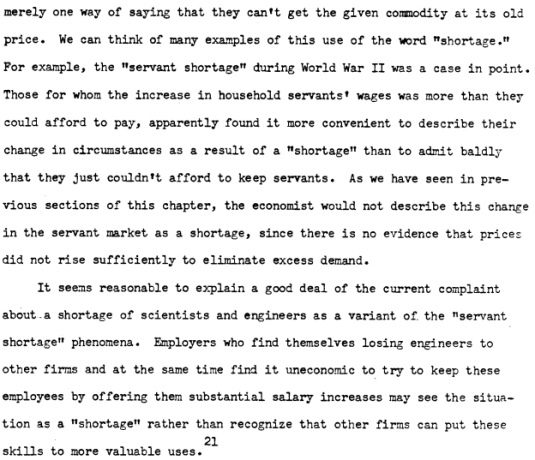
From https://www.rand.org/pubs/research_memoranda/RM2190.html
An Economic Analysis of the Market for Scientists and Engineers by Armen Albert Alchian, Kenneth Arrow, William M. Capron
The Victims of Cuban Socialism
27 Jul 2019 Leave a comment
Cuba was a relatively rich country in the 1950s. So much so that it attracted migrants from Spain and Italy and the rest of Latin America

Cuba has a very sad history.
It traded a regular dictatorship for a communist dictatorship six decades ago, and the results have been predictably awful.
Oppression, persecution, rationing, spying, deprivation, and suffering are facts of life in that socialist hellhole.
For a while, it was subsidized by the Soviet Union, but that communist system eventually collapsed. More recently, it’s been subsidized by Venezuela, but now that socialist system also is collapsing.
And this means extra hardship for the people of Cuba.
Jose Nino explains one of the grim consequences of Cuba’s central planning.
Cuba is now implementing a rationing program to combat its very own shortages of basic goods. A CBC report indicates this program would cover basic items such as chicken, eggs, rice, beans, and soap. …When Fidel Castro took control of Cuba in 1959, the Cuban state maintained an iron grip on the economy.
For decades…
View original post 1,329 more words
If you love nature, move to the city @NZGreens @Greens @Greenpeace
27 Jul 2019 Leave a comment
in comparative institutional analysis, environmental economics, environmentalism, law and economics Tags: expressive voting, offsetting behaviour, The fatal conceit, unintended consequences

Deconstructing Chomsky @AOC @SenSanders @jeremycorbyn
27 Jul 2019 Leave a comment
in comparative institutional analysis, constitutional political economy, defence economics, development economics, economic history, economics of crime, growth disasters, law and economics, Marxist economics, Public Choice Tags: regressive left, The fatal conceit

Do @AOC or @SenSanders disagree?
27 Jul 2019 Leave a comment
in comparative institutional analysis, constitutional political economy, development economics, economic history, growth disasters, law and economics, Marxist economics, Public Choice Tags: Berlin, East Germany, fall of communism, regressive left, The fatal conceit

Pointed
27 Jul 2019 Leave a comment
in discrimination, economic history, economics of religion, gender, law and economics Tags: political correctness, regressive left, sex discrimination

Were the Maori rebels in the New Zealand Land Wars as degenerate as the Confederate States of America?
27 Jul 2019 Leave a comment
in economic history, law and economics, politics - New Zealand

Law and order rules are being rewritten as Ardern bridles at accusations of leadership failure
27 Jul 2019 Leave a comment

It has been a momentous week for the country’s justice system and old-fashioned notions of “law and order”.
First, the Ardern government has said it is considering a report which recommends the abolition of prisons. A Maori-led review of the justice system is also urged by this report.
Second, the PM has intervened in a land dispute in Auckland and thereby over-ridden the role of the courts.
Getting rid of prisons is the remedy ingeniously proposed to reduce the high ratio of Maori inmates in our prisons.
The proposal is contained in the Ināia Tonu Nei: Māori Justice Hui report (here) released during the week.
View original post 484 more words


Recent Comments