Chomsky: Russia is not imperialist, conquest of Crimea is interactive
24 Feb 2019 Leave a comment
in defence economics, International law, law and economics, laws of war, Marxist economics, war and peace Tags: Russia
Gulag: A History by Anne Applebaum (2003)
24 Feb 2019 Leave a comment

I went back to my apartment from which no policeman could evict me now. There was no one home, and finally I was able to weep freely. To weep for my husband, who perished in the cellars of the Lubyanka, when he was thirty-seven years old, at the height of his powers and talent; for my children, who grew up orphans, stigmatised as the children of enemies of the people; for my parents, who died of grief; for Nikolai, who was tortured in the camps; and for all of my friends who never lived to be rehabilitated but lie beneath the frozen earth of Kolyma.
(Olga Adamova-Sliozberg, labour economist, arrested in 1936, released in 1954, describing her formal exoneration in 1956, quoted on page 461)
Applebaum is not just a leading researcher and scholar of 20th century Russian history, she is also a senior journalist, having worked for The Economist
View original post 4,244 more words
Stossel: Jordan Peterson vs. “Social Justice Warriors”
24 Feb 2019 Leave a comment
in development economics, discrimination, economic history, economics of crime, gender, growth disasters, growth miracles, human capital, income redistribution, labour supply, law and economics, Marxist economics, occupational choice, politics - New Zealand, politics - USA, poverty and inequality, Public Choice, rentseeking Tags: Cultural Marxism, political correctness, regressive left
Some plain truths; woman will be reduced to the second sex again
23 Feb 2019 Leave a comment
in discrimination, gender, health economics, politics - Australia, politics - New Zealand, politics - USA, sports economics Tags: political correctness, regressive left

John Cochrane Explains Neo-Fisherism
23 Feb 2019 Leave a comment

In a recent post, John Cochrane, responding to an earlier post by Nick Rowe about Neo-Fisherism, has tried to explain why raising interest rates could plausibly cause inflation to rise and reducing interest rates could plausibly cause inflation to fall, even though almost everyone, including central bankers, seems to think that when central banks raise interest rates, inflation falls, and when they reduce interest rates, inflation goes up.
In his explanation, Cochrane concedes that there is an immediate short-term tendency for increased interest rates to reduce inflation and for reduced interest rates to raise inflation, but he also argues that these effects (liquidity effects in Keynesian terminology) are transitory and would be dominated by the Fisher effects if the central bank committed itself to a permanent change in its interest-rate target. Of course, the proviso that the central bank commit itself to a permanent interest-rate peg is a pretty…
View original post 1,061 more words
Monetary Theory on the Neo-Fisherite Edge
23 Feb 2019 Leave a comment
The week before last, Noah Smith wrote a post “The Neo-Fisherite Rebellion” discussing, rather sympathetically I thought, the contrarian school of monetary thought emerging from the Great American Heartland, according to which, notwithstanding everything monetary economists since Henry Thornton have taught, high interest rates are inflationary and low interest rates deflationary. This view of the relationship between interest rates and inflation was advanced (but later retracted) by Narayana Kocherlakota, President of the Minneapolis Fed in a 2010 lecture, and was embraced and expounded with increased steadfastness by Stephen Williamson of Washington University in St. Louis and the St. Louis Fed in at least one working paper and in a series of posts over the past five or six months (e.g. here, here and here). And John Cochrane of the University of Chicago has picked up on the idea as well in two recent blog posts (here
View original post 2,398 more words
The Problem with Modern Monetary Theory
23 Feb 2019 Leave a comment

“Modern Monetary Theory,” a doctrine about fiat money, has captured the attention of some reformers and progressives. This doctrine – a set of propositions contrary to logic and evidence – purports to explain why the US and other economies are ailing, but is beset by contradictions with the historic facts and within the doctrine.
For example, The New Inquiry on 11 April 2014 featured an article by Rebecca Rojer on “The World According to Modern Monetary Theory.” The author regards it as a revelation of MMT that the “rules of money are not immutable laws of nature.” Since the science of economics explains the effects of incentives and decisions, evidently these money “rules” are the outcomes of private and governmental decisions, and since the effects are not immutable laws, people can arbitrarily create whatever outcomes they wish. That would indeed be wonderful, to just print money are thereby eliminate unemployment…
View original post 985 more words
PANIC DENIED : Sea Levels In And Around Sydney Harbour 1886 to 2018
23 Feb 2019 Leave a comment

 Sydney Harbour Sea Levels 1886-2018 | CLIMATISM
“CLIMATE alarmism is a gigantic fraud:
it only survives by suppressing dissent and by spending
tens of billions of dollars of public money
every year on pseudo-scientific propaganda.”
– Leo Goldstein
***
SEA-LEVEL RISE alarmism is just one in a long line of propaganda tools used by the Climate Crisis Industry to promote the narrative that human CO2 emissions are causing dangerous global warming climate change.
VERY little of the carefully orchestrated fear-mongering is based on observed reality and empirical evidence, rather, worst-case climate model scenarios pushed into the unaccountable future, designed to scare you and policy makers into (costly) “climate action now!”.
SEA level alarmism holds significant implications for the public who bear the burden of carbon-dioxide related taxes. Those living within coastal areas, constrained by further punitive imposts as insurance companies exploit the climate of fear for their own profit.
SEA…
View original post 2,429 more words
#OTD Jeff Sachs retired as a serious economist
23 Feb 2019 Leave a comment
in applied price theory, economics of bureaucracy, energy economics, environmental economics, global warming, politics - USA, Public Choice, public economics, rentseeking, transport economics, urban economics Tags: climate alarmism
Flat Battery: Busting the Myth of Grid Scale Storage of Wind & Solar Power
23 Feb 2019 1 Comment

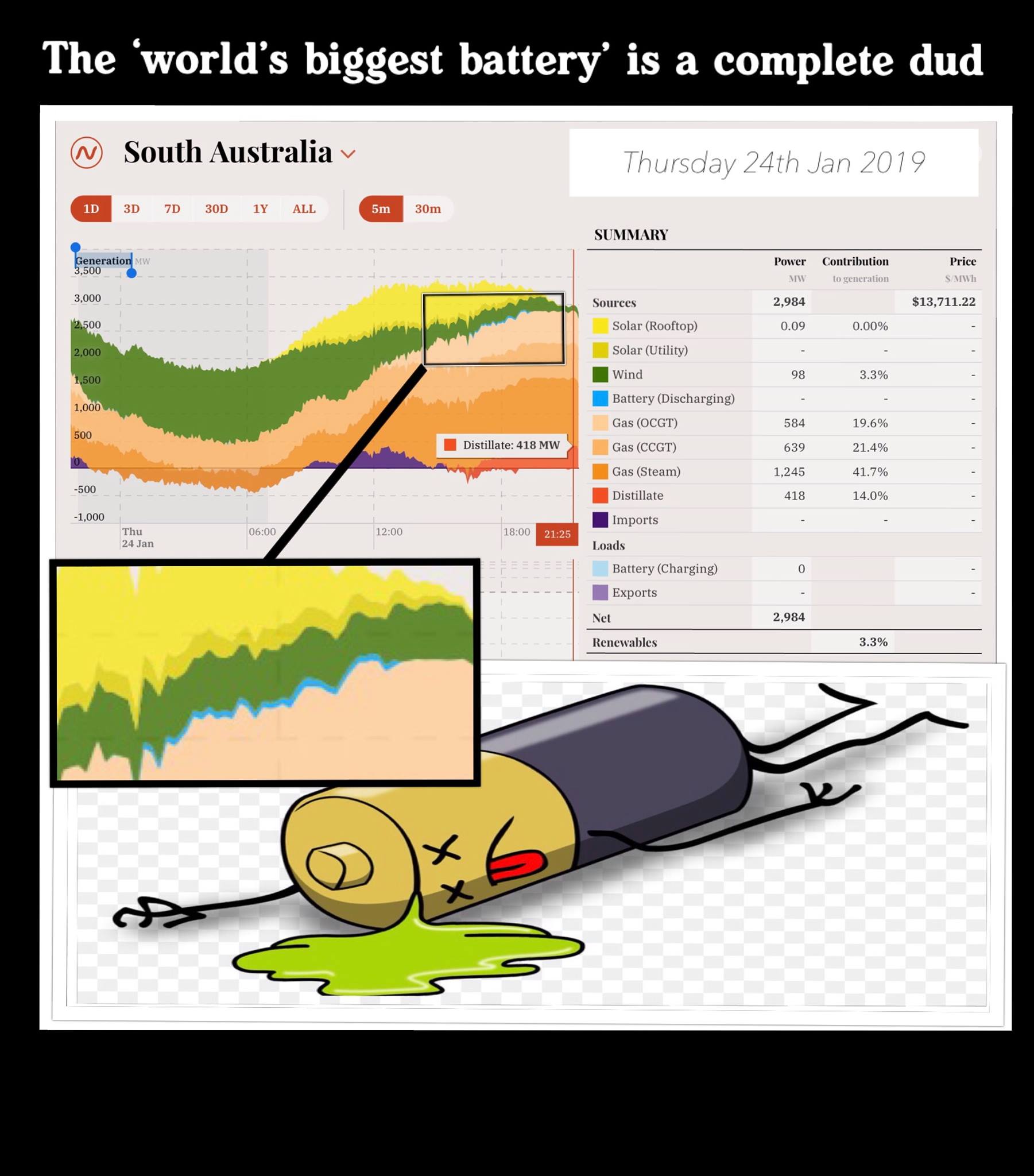
STT will keep smashing the line about giant batteries overcoming the chaotic delivery of wind and solar, while RE zealots keep pushing it.
Over recent posts we focused on the insane cost and limited capacity of giant lithium-ion batteries of the kind peddled by reefer-smoking Californian carpetbagger, Elon Musk (see above and our post here).
In this post, we hand over to Jack Ponton for a dissertation on the whole range of purported storage methods claimed by those peddling wind and solar as solutions to the hopeless intermittency of wind and solar.
Jack Ponton is Emeritus Professor of Engineering at the University of Edinburgh, a fellow of the Royal Academy of Engineering and of the Institution of Chemical Engineers (of which he is a past vice-president). His main research work was in mathematical modelling of complex engineering phenomena and software development. He has also worked in and with the chemical industry on a…
View original post 3,906 more words


Recent Comments