Socialism Humor
23 Jul 2023 Leave a comment

I did a three-part series (here, here, and here) to explain why socialism is a miserable economic system.
As Winston Churchill sagely observed, “Socialism is the philosophy of failure, the creed of ignorance, and the gospel of envy.”
But it is good for a few laughs.
For today’s column, let’s add to our collection of socialism satire.
We’ll start by noting that East Germany was the most successful part of the Soviet Empire, but even it was an utter failure.

Next, some of my lefty friends make a big thing about belonging to the “party of science,” but I have a hard time taking them seriously given their infantile views on economics.

For our third item, I wonder if our left-leaning friends ever wonder why people try to escape from places such as Cuba and Venezuela so they can be “exploited” in…
View original post 144 more words
Total Calamity: Wind & Solar ‘Transition’ On Collision Course With Bitter Reality
22 Jul 2023 Leave a comment


If what has been done to energy policy was the work of outside forces, it’d be called an ‘act of war’. Sadly, it’s all from the home team and better described as ‘outright treason.’
Australia is, without doubt, the most over governed country on earth, with more mouthpieces and slackers per head of population than anywhere else.
But, proving that quantity ain’t quality, the clowns in charge have ignored every shred of empirical evidence and, instead, plump for ludicrous models based on risible assumptions.
The result is the destruction of Australia’s once reliable and affordable power supplies.
The damage done is generational; the chaos appears irremediable, with much worse to come.
And yet, as Nick Cater observes below, we’re assured that all’s in hand. Believe that, and you’ll believe anything.
Renewables vision is blind to the cost of calamity
The Australian
Nick Cater
17 July 2021
Given the cost of…
View original post 1,015 more words
The Welfare State’s Damaging Impact on Europe, Part III
21 Jul 2023 Leave a comment
Part I of this series reviewed some data about the United States growing much faster than the welfare states of the European Union.
Part II of the series looked at some very depressing data about the European Union losing ground compared to the United States, even though convergence theory tells us that should not happen.
For today’s installment, let’s see what the European Union’s statistical body concluded in a new report about the region’s economic performance. We’ll start with this chart showing that inflation-adjusted disposable income (the blue line) declined last year.
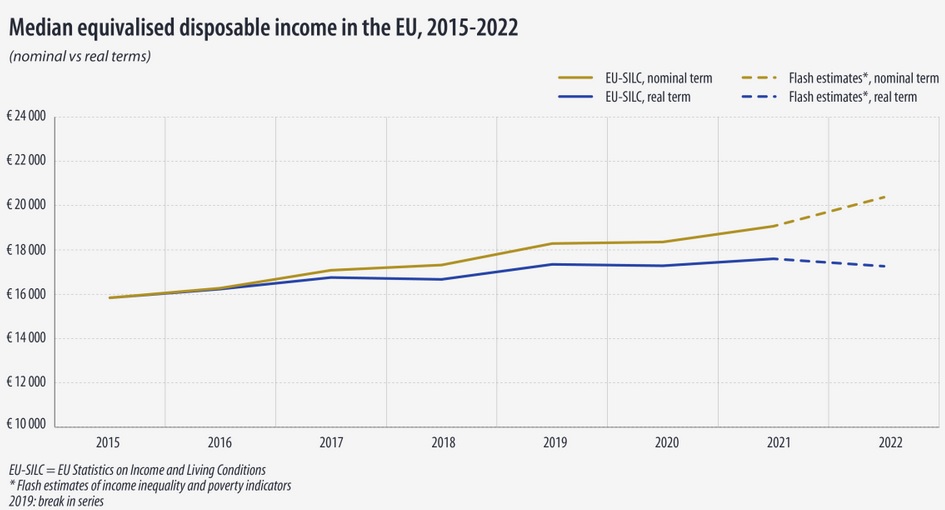
To be sure, American households also suffered a decline in inflation-adjusted income, so this is not just a Europe-specific problem.
Here’s some of Eurostat’s analysis.
…the nowcasted median disposable income will decrease in real terms in most EU countries. Rising prices for essential items (goods and services), such as food, energy and transport were the main reason for…
View original post 204 more words
The risk the Greens’ wealth tax poses to our economy
21 Jul 2023 Leave a comment
in applied price theory, applied welfare economics, economic history, entrepreneurship, financial economics, income redistribution, industrial organisation, labour economics, labour supply, occupational choice, politics - New Zealand, Public Choice, public economics Tags: taxation and entrepreneurship, taxation and investment
The Seinfelds Won’t Have Dinner With The Costanzas | The Raincoats | Seinfeld
21 Jul 2023 Leave a comment
in television, TV shows
Debunking the Debunkers – The TRUTH Behind CO2, Forrest Fires, and Climate Change
21 Jul 2023 Leave a comment
in energy economics, environmental economics, global warming Tags: climate alarmism
Creative destruction
21 Jul 2023 Leave a comment
in economic history, economics of media and culture Tags: creative destruction

Australia’s Darkest Hour – The Battle of Fromelles I THE GREAT WAR – Week 104
21 Jul 2023 Leave a comment
in defence economics, war and peace Tags: World War I
The Welfare State’s Damaging Impact on Europe, Part II
20 Jul 2023 Leave a comment
In Part I of this series, we learned from a report in the Wall Street Journal that the combined economies of the European Union have grown by only 6 percent over the past 15 years compared to 82 percent growth in the United States.
That is stunning evidence that big welfare states lead to economic stagnation.
For Part II, let’s look at a remarkable new study by the Brussels-based European Centre for International Political Economy.
We’ll start with this chart, which shows that the U.S. is much richer. But what’s especially noteworthy is that the gap between the U.S. and E.U. keeps widening even though convergence theory says poorer nations should grow faster than richer nations.
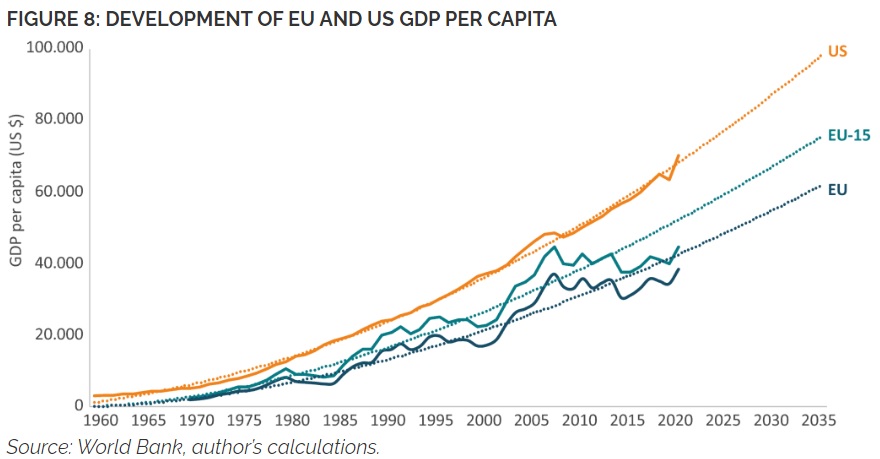
Given the E.U.’s dismal performance over the past 15 years, it seems like the “anti-convergence” is becoming even more pronounced.
Here is some of the analysis from the report, authored…
View original post 409 more words
Inflation, monetary policy, and central bank spin
20 Jul 2023 Leave a comment

The CPI data out yesterday were not good news.
Annual headline inflation was, more or less as expected, down, but at around 6 per cent is miles from the 2 per cent target midpoint the Reserve Bank’s MPC has been required to focus on delivering. Much more importantly, core inflation measures show little or no sign of any reduction.
Six months ago I had been intrigued by this chart
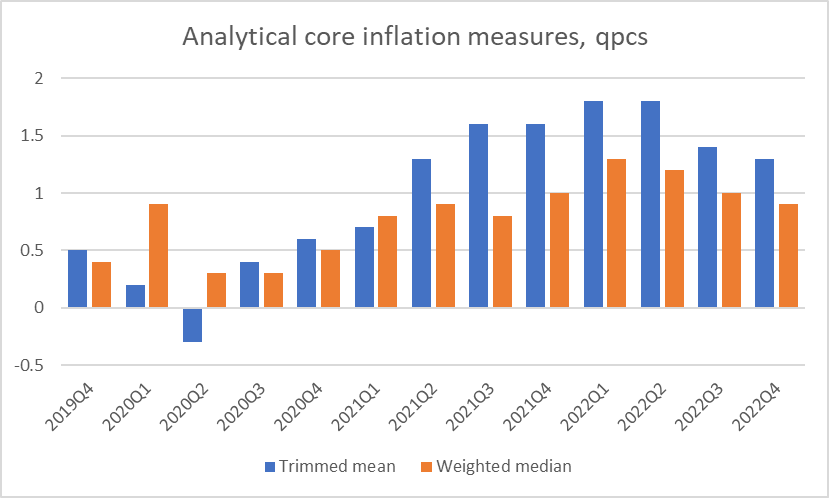
It looked as though a reasonable case could then be made that core inflation had peaked a year earlier and was now falling (albeit still far too high).
But jump forward to today and the chart now looks like this

If it still suggests a peak at the start of last year (at least on one of the measures), it is no longer a picture of (core) inflation falling now. (NB: You cannot put much weight on the absolute level of…
View original post 1,948 more words
The Welfare State’s Damaging Impact on Europe, Part I
20 Jul 2023 Leave a comment
At the risk of being repetitive, I’ve been arguing (and arguing, and arguing) that the United States should not turn its medium-sized welfare state into a European-style, large-sized welfare state.
Simply stated, that’s a route to economic anemia.
If you don’t believe me, look at this shocking chart, which compares European stagnation to American growth over the past 15 years.
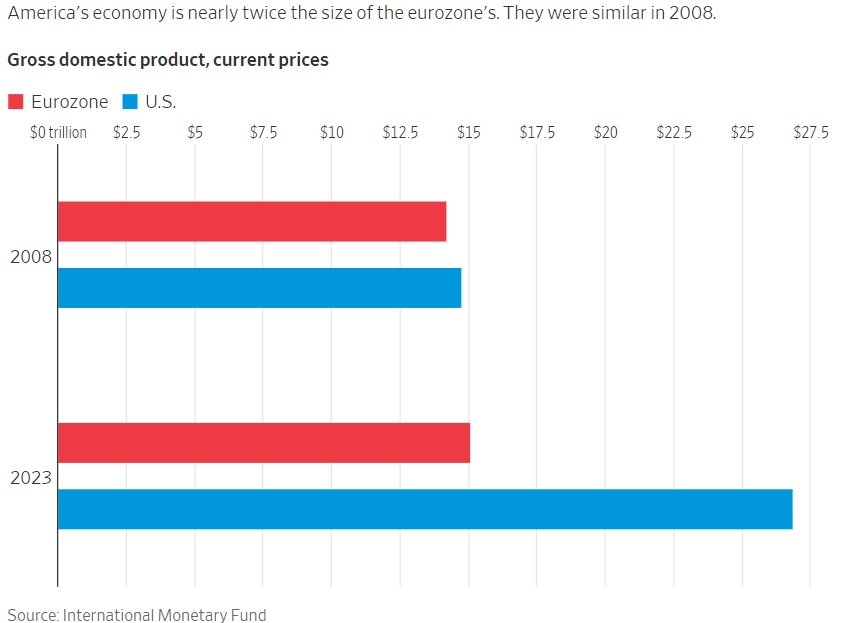
The chart comes from a report in the Wall Street Journal. Here are some excerpts from that article.
Europeans are facing a new economic reality… They are becoming poorer. …Private consumption has declined by about 1% in the 20-nation eurozone since the end of 2019 after adjusting for inflation… In the U.S., where households enjoy a strong labor market and rising incomes, it has increased by nearly 9%. …Adjusted for inflation and purchasing power, wages have declined by about 3% since 2019 in Germany, by…
View original post 242 more words


Recent Comments