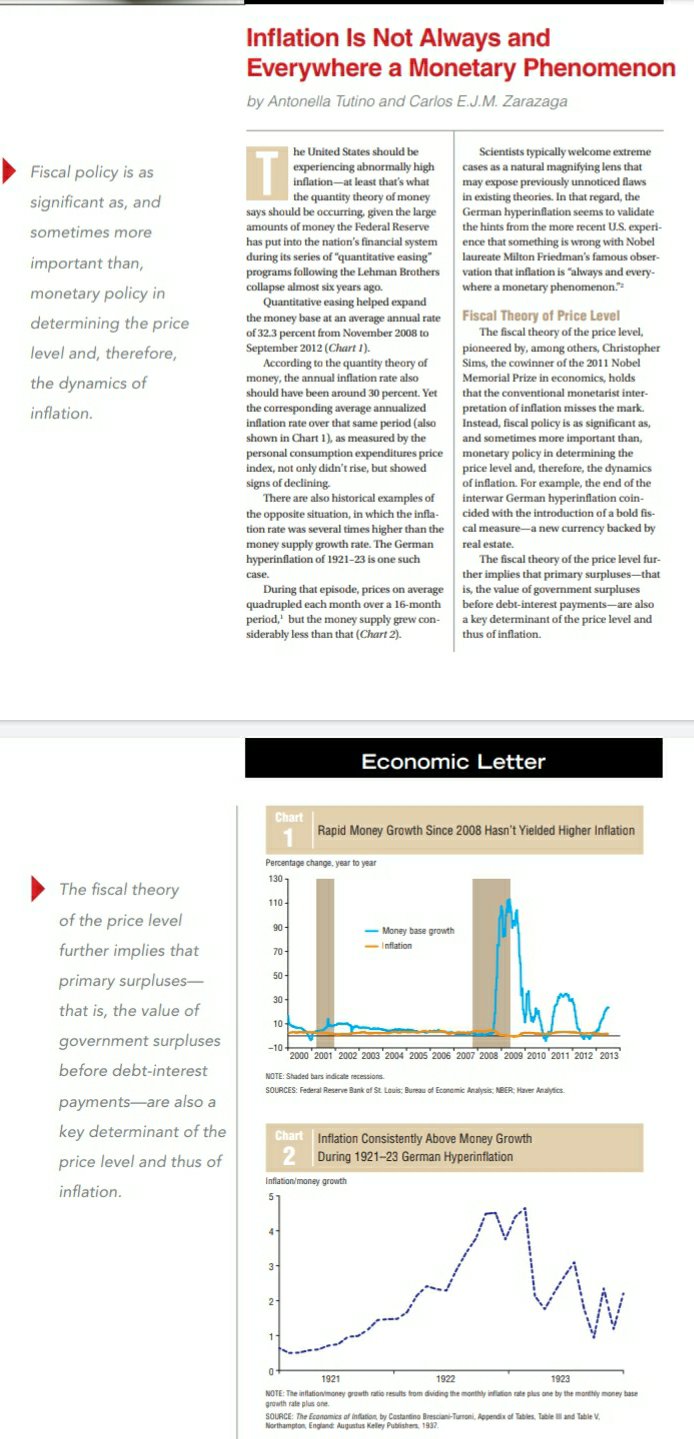
But the quantitative easings after the GFC didn’t lead to inflation!?
29 Jul 2022 Leave a comment
in budget deficits, business cycles, economic history, fiscal policy, global financial crisis (GFC), macroeconomics, monetarism, monetary economics, public economics Tags: monetary policy
Origins of the Second World War AJP Taylor
29 Jul 2022 Leave a comment
in defence economics, war and peace Tags: World War II
America’s Horrific Long-Run Fiscal Forecast
29 Jul 2022 Leave a comment

The Congressional Budget Office has released its new long-run fiscal forecast. Like I did last year (and the year before, and the year before, etc), let’s look at some very worrisome data.
We’ll start with projections over the next three decades for taxes and spending, measured as a share of economic output (gross domestic product). As you can see, the tax burden is increasing, but the spending burden is increasing even faster.
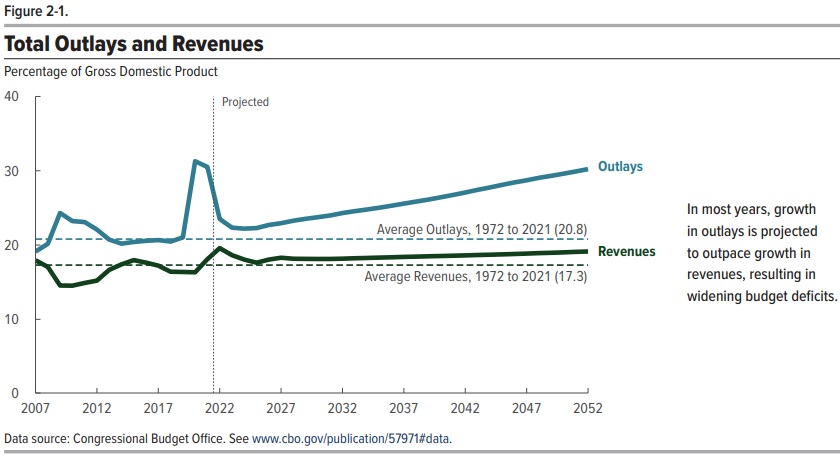
By the way, some people think America’s main fiscal problem is the gap between the two lines. In other words, they worry about deficits and debt.
But the real problem is government spending. And that’s true whether the spending burden is financed by taxes, borrowing, or printing money.
So why is the burden of government spending projected to get larger?
As you can see from Figure 2-2, entitlement programs deserve the lion’s share of the…
View original post 168 more words
July 28, 1540: King Henry VIII of England, Lord of Ireland marries his fifth wife, Catherine Howard
29 Jul 2022 Leave a comment

King Henry VIII considered the matter of the need for a politically aligned marriage. As a new Protestant nation England needed Protestant allies. Chancellor, Thomas Cromwell suggested Anne, the 25-year-old sister of the Duke Wilhelm I-V of Jülich-Cleves-Berg who was seen as an important ally in case of a Roman Catholic attack on England, for the duke fell between Lutheranism and Catholicism.
Hans Holbein the Younger was dispatched to Cleves to paint a portrait of Anne for the king. Despite speculation that Holbein painted her in an overly flattering light, it is more likely that the portrait was accurate; Holbein remained in favour at court.

Henry VIII, King of England and Lord of Ireland
After seeing Holbein’s portrait, and urged on by the complimentary description of Anne given by his courtiers, the 49-year-old king agreed to wed Anne. However, it was not long before Henry wished to annul the marriage…
View original post 428 more words
Did it make a difference?
29 Jul 2022 Leave a comment

I’ll get back to some extensive original material next week, but I have been reflecting a bit on the attack on the Reserve Bank by Arthur Grimes, former chief economist of the Bank (and later chair of the Bank’s monitoring board). The most recent version ran on Radio New Zealand yesterday morning. As I noted on Twitter, there was a fair amount there I agreed with (notably the observations on the poor quality make-up of the MPC) and a fair amount I disagreed with.
Grimes has been critical of the Bank (and the government) for some considerable time, going back to the amendment to the statutory objective (adding a secondary element of “supporting maximum sustainable employment). Since the pandemic descended on us, his criticism has centred not on CPI inflation (actual or prospective) but on house prices.
Almost a year ago, he had an impassioned piece on these themes published…
View original post 1,518 more words
Tackling a growing methane problem starts with the pipes | FT Energy Source
29 Jul 2022 Leave a comment
in energy economics, environmental economics, global warming
Silvio Informs Tony That Chris Is Not Doing Well At His Job
29 Jul 2022 Leave a comment
in television, TV shows
Three Propagation Mechanisms in Lucas and Sargent with a Response from Brad DeLong
28 Jul 2022 Leave a comment

UPDATE (4/3/2022): Reupping this post with the response to my query sent by Brad DeLong.
I’m writing this post in hopes of eliciting some guidance from readers about the three propagation mechanisms to which Robert Lucas and Thomas Sargent refer in their famous 1978 article, “After Keynesian Macroeconomics.” The three propagation mechanisms were mentioned to parry criticisms of the rational-expectations principle underlying the New Classical macroeconomics that Lucas and Sargent were then developing as an alternative to Keynesian macroeconomics. I am wondering how subsequent research has dealt with these propagation mechanisms and how they are now treated in current macro-theory. Here is the relevant passage from Lucas and Sargent:
A second line of criticism stems from the correct observation that if agents’ expectations are rational and if their information sets include lagged values of the variable being forecast, then agents’ forecast errors must be a serially uncorrelated random…
View original post 1,827 more words
Penn Station Expansion is Based on Fraud
28 Jul 2022 Leave a comment

New York is asking for $20 billion for reconstruction ($7 billion) and physical expansion ($13 billion) of Penn Station. The state is treating it as a foregone conclusion that it will happen and it will get other people’s money for it; the state oversight board just voted for it despite the uncertain funding. Facing criticism from technical advocates who have proposed alternatives that can use Penn Station’s existing infrastructure, lead agency Empire State Development (ESD) has pushed back. The document I’ve been looking at lately is not new – it’s a presentation from May 2021 – but the discussion I’ve seen of it is. The bad news is that the presentation makes fraudulent claims about the capabilities of railroads in defense of its intention to waste $20 billion, to the point that people should lose their jobs and until they do federal funding for New York projects…
View original post 2,940 more words
A tidal wave of cash?
28 Jul 2022 Leave a comment
One thing in the National Party’s call for a public inquiry into monetary policy that I didn’t comment on yesterday was the framing. The press release is headed “Inquiry needed into impact of tidal wave of cash”. It is a framing I have never liked, whether coming from critics on the left or the right.
My point here isn’t to bag National. They ran with a catchy headline, but the body of their release talks more generally about the overall conduct of monetary policy. But it is a framing that isn’t uncommon (loose talk of “money printing”) so it is an opportunity to restate my view – probably a minority view, but I stand by it – of the macroeconomic irrelevance (to a first approximation) of the Reserve Bank’s LSAP programme.
Rather than write something fresh, here I’ve reproduced the relevant sections of a lecture I gave to some Victoria…
View original post 634 more words
Milton Friedman commented on Powell’s Fed in 1978
28 Jul 2022 Leave a comment

Watching today’s press conference with Fed chief Jerome Powell reminded me of something Milton Friedman said in 1978:
“Nearly a dozen years ago, I warned of an inflationary recession (Newsweek, Oct. 17, 1966). We have since then had three inflationary recessions and a fourth is almost surely on the way. During the first, the brief mini-recession of 1967, consumer prices rose 2.4 per cent per year; during the longer and more severe recession from December 1969 to November 1970, prices rose 5.3 per cent per year; during the still longer and even more severe recession from November 1973 to March 1975, prices rose 10.8 per cent per year; during the coming recession, prices are likely to rise at least 7 per cent per year.
Each scenario has been the same: rapid growth in the quantity of money followed by economic expansion and then, much later, by rising inflation; a…
View original post 247 more words


Recent Comments