Who Decides What the Constitution Is and Says? Quebec Modifies the Text of the Constitution Act, 1867
30 Jun 2022 Leave a comment


Introduction
Law 96 has generated controversy and opposition amongst English-speakers in Quebec and, to a lesser extent, in the rest of Canada when the Legislature of Quebec enacted it last week for its provisions on language.
But it contains one other significant innovation which most of English Canada has overlooked. Through Law 96, the Legislature of Quebec enacted a constitutional amendment under the Section 45 Amending Procedure, which allows provincial legislatures to alter their provincial constitutions, and added two new sections directly to the text of the Constitution Act, 1867 as sections 90.1 and 90.2. Section 90 falls under Part V of the Constitution Act, 1867, the section on “Provincial Constitutions.”
As far as I know, provinces have thus far only impliedly repealed or amended provisions in Part V of the Constitution Act, 1867 through organic statutes without necessarily invoking the Section 45 Amending Procedure by name. But Quebec’s…
View original post 2,173 more words
Kenneth A Armstrong: A Matter for Another Day? Will the Supreme Court Accept the Lord Advocate’s Independence Referendum Reference?
30 Jun 2022 Leave a comment

 Scotland’s First Minister, Nicola Sturgeon has set out the ‘next steps’ in the campaign for Scotland’s independence, including asking the Lord Advocate for Scotland to make a reference to the UK Supreme Court on whether a draft Scottish Independence Referendum Bill relates to ‘reserved matters’ set out in Schedule 5 of the Scotland Act 1998. This reference brings to a head the question whether – without a section 30 order to expressly give the Scottish Parliament such a competence (as was done for the 2014 referendum) – a new independence referendum would have a sound legal basis.
But whereas many may have assumed that if this matter came before the Supreme Court it would do so via Section 33(1) of the 1998 Act once a Referendum Bill had been passed by the Parliament (but before Royal Assent was granted), the vehicle chosen is the wider power contained in paragraph 34…
View original post 1,474 more words
End of an era
30 Jun 2022 Leave a comment

Today marks the end of an era at the Reserve Bank, as the last of the “Governor as single decisionmaker” model is dismantled, and tomorrow the new Board takes over the primary responsibility for the Bank’s affairs. The single decisionmaker model was an experiment, but with time it was increasingly apparent that it was a poor one, increasingly unfit for purpose. No other country reforming its central banking and bank etc regulatory arrangements followed us. It is to the government’s credit that they have moved the governance model for the Reserve Bank back towards the international mainstream (even if the specifics of the 2018 and 2021 are less than ideal, and in some respect a dog’s breakfast).
(NB note that most of the new Board, to take up office tomorrow, has not yet been appointed – or at least announced. With the new Board reportedly supposed to be meeting tomorrow…
View original post 2,339 more words
Europe’s Soon-to-Implode Welfare States
30 Jun 2022 Leave a comment

What’s the most depressing chart in the world?
If you believe in limited government and you’re looking back in time, this example or this example are good candidates.
But if we’re looking into the future, this chart from a new study by the European Central Bank is very sobering.
And it’s a depressing chart because it doesn’t matter whether you believe in big government or small government. That’s because this chart shows a dramatic shift in population demographics.
Simply stated, Europe’s welfare states are in deep trouble because over time there will be fewer and fewer workers to pay taxes and more and more old people expecting benefits.
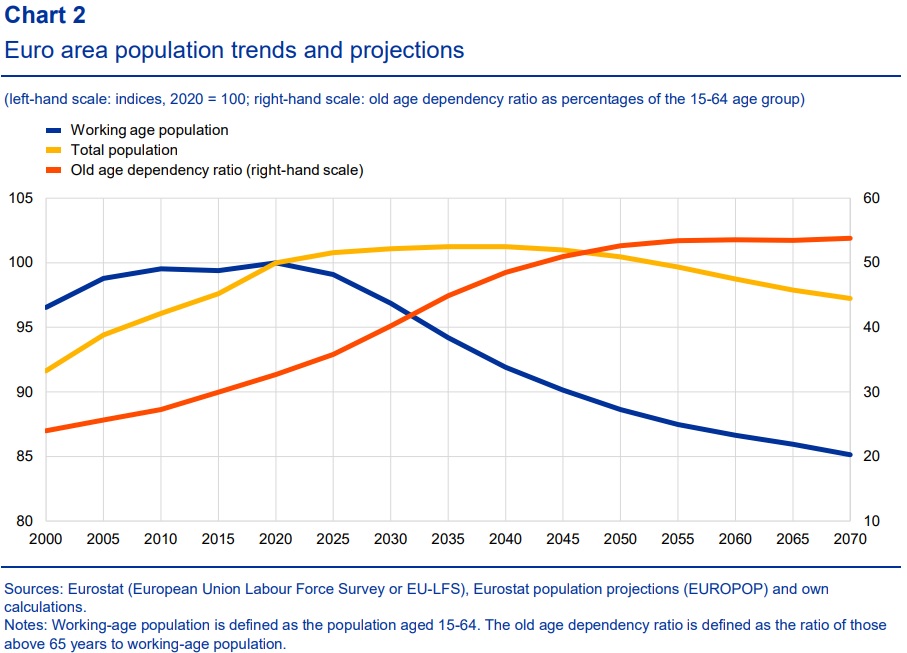
Here’s what the ECB experts, Katalin Bodnár and Carolin Nerlich, wrote about their findings.
The euro area, like many other advanced economies, has entered an era of drastic demographic change. …Declining birth rates and rising life expectancy are causing the number of…
View original post 396 more words
How Do German Schools Teach About WWII?
30 Jun 2022 Leave a comment
in defence economics, laws of war, war and peace Tags: Nazi Germany, The Holocaust, World War II
The reason Japan attacked Pearl Harbor
30 Jun 2022 Leave a comment
in defence economics, war and peace Tags: World War II
New Keynesianism in central banking: friend or foe? Robert Hetzel
30 Jun 2022 Leave a comment
in business cycles, economic history, fiscal policy, great recession, history of economic thought, macroeconomics, monetarism, monetary economics Tags: monetary policy
P-51 Mustang | The Fighter with the range of a Bomber
30 Jun 2022 Leave a comment
in defence economics, war and peace Tags: World War II
New Rule: Hollywood’s Culture of Violence | Real Time with Bill Maher
30 Jun 2022 Leave a comment
in television
Guy Baldwin: The Proposed Bill of Rights and Constitutionalism in the UK
29 Jun 2022 Leave a comment
 On an orthodox approach, legislation of the UK Parliament is interpreted by courts, but not reviewed by them against legal standards. The Human Rights Act 1998 enables such review and empowers courts to declare Acts of Parliament in contravention of those standards. In so doing, it advances constitutionalism, in the sense of there being legal limits on governmental power (putting to one side other potential sources of limitation such as the now repealed European Communities Act 1972). However, there may be some tension between the balancing stage of the proportionality test applied in the adjudication of human rights violations and the position that the limits imposed by the Human Rights Act are “legal” in nature.
The UK government now proposes to repeal the Human Rights Act and replace it with a Bill of Rights. This post examines two aspects of the proposed Bill of Rights – the preservation…
View original post 2,224 more words


Recent Comments