Trade creation and trade diversion for NZ lamb imports into the UK
14 Mar 2022 Leave a comment
in applied price theory, applied welfare economics, income redistribution, industrial organisation, international economic law, international economics, International law, Public Choice, rentseeking Tags: free trade agreements, preferential trade agreements, trade creation, trade diversion
Submission on international treaty select committee examination of the UK trade agreement
13 Mar 2022 Leave a comment
I am submitting in my personal capacity opposing the agreement. To quote John Cochrane on how long free trade agreements should be:
Nafta and the like are often called “free trade agreements.” Economists like me wonder, why does that take tens of thousands of pages? “We do not charge border taxes (tariffs), nor restrict quantities, nor will government purchases favor American companies.” “We do the same.” Done. That’s free trade. This little snippet reminds us what trade pacts really are.
Free trade agreements (longer than a few sentences) are at best suspect. That is not me saying this. That is Paul Krugman, his generation’s leading trade theorist. Krugman argues that you should start as a mild opponent of any free trade agreement. Closely inspect the baggage they carry; environment and labour chapters, intellectual property, investor state dispute settlement (ISDS) and government procurement such as Pharmac. Start with a sceptical eye.
These add-on chapters are the costs of free trade agreements that are relatively obvious to the untrained eye. No technical economics is yet required to suspect that any trade agreement will be an opportunity for special interests on the right and the left, both unions and big corporations, to feather their own nest. Longer patent lives, more stringent enforcement of overseas copyrights, Pharmac buying more expensive drugs, and so on in return for tariff cuts in export markets.
But let us start with what is claimed as the benefits by the government. In about 20-years’ time, the agreement will boost New Zealand’s annual real GDP by between NZ$710 million and NZ$811 million (0.10% – 0.12%) relative to the 2040 modelled baseline. A tiny amount.
The gains from behind the border changes are never easy to quantify because even the most impartial spectators can disagree amongst themselves on whether these regulations are a plus or minus to begin with, so they cannot agree on whether reducing or increasing them are a plus or not.
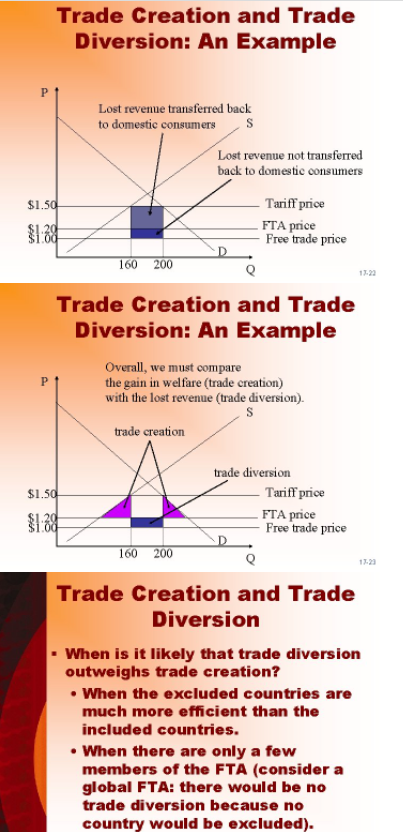
The only time tariff cuts are suspect is when they are part of a free trade agreement. The reason is trade diversion. A technical concept which MFAT does not know about because I received a nil response to an Official Information Act request about their TPPA advice to ministers about the costs and benefits including any reference to trade diversion. Trade diversion in not mentioned in the national interests analysis of the UK agreement.
We have been of the rough end of trade diversion in the two biggest trade agreements to affect us. When Britain entered the Common Market in 1973, they stop buying cheap New Zealand lamb in favour of expensive French lamb. The tariff revenue collected by the British on our lamb exports was converted into payments to prop up hopelessly inefficient French farmers. British consumers paid the same or more for lamb and there was no tariff revenue to collect.
New Zealand car buyers then got screwed by Closer Economic Relations. Instead of buying cheap Japanese imports and collecting a tariff, Holdens and Fords became cheap because they did not pay this tariff. Cars were not cheaper for New Zealand buyers; the tariff revenue went off to Australian car manufacturers as higher import prices to keep their hopelessly inefficient car plants open.
Thankfully, there is no investor-state dispute settlement chapter in the agreement. Investor-state dispute settlement has no place in trade agreements between democracies. They have the rule of law where investors can take their chances in domestic politics just like the rest of us. Yes, there will be breathless populism from the left or right from time to time, such as recently over foreign land sales, but by and large foreign investment is welcome and gets a fair deal.
Developing countries offered to sign on to investor state dispute settlement because their own courts are corrupt. Maybe investor state dispute settlement worked 50 years ago when investment in developing countries was tiny and handled by a few big players who might get picked on by politicians looking for a few cheap votes or more likely, a backhander to the Swiss bank account.
Now there is broad-based trade and investment in developing countries despite their corrupt courts and dodgy politicians. Many exporters and investors are willing to take their chances. When the local politicians and bureaucrats get rough, investors have already factored that in by backing investments with high enough returns to compensate for these risks. Tourists buy travel insurance and keep their eyes open; investors know the rules abroad are different and must be just as watchful.
Japan, Singapore, South Korea, Hong Kong, Taiwan and the other Asian Tigers and now India too managed to have development miracles without investor state dispute settlement. Extreme poverty dropped by about 1/3rd around the globe over the decade or so course of the TPPA negotiations and far more than that in China so I think they are getting on pretty well without it.
Most of these points are lost in the debate on the TPPA because too many of its opponents are motivated by anti-capitalist or anti-foreign sentiments rather than cost benefit analysis. They would oppose a trade agreement solely about tariffs that lowered prices to New Zealand consumers.
Not every trade negotiation is successful. For some, you reach the point where you must walk away. More so because of all the baggage loaded up into trade agreements in the last few decades.
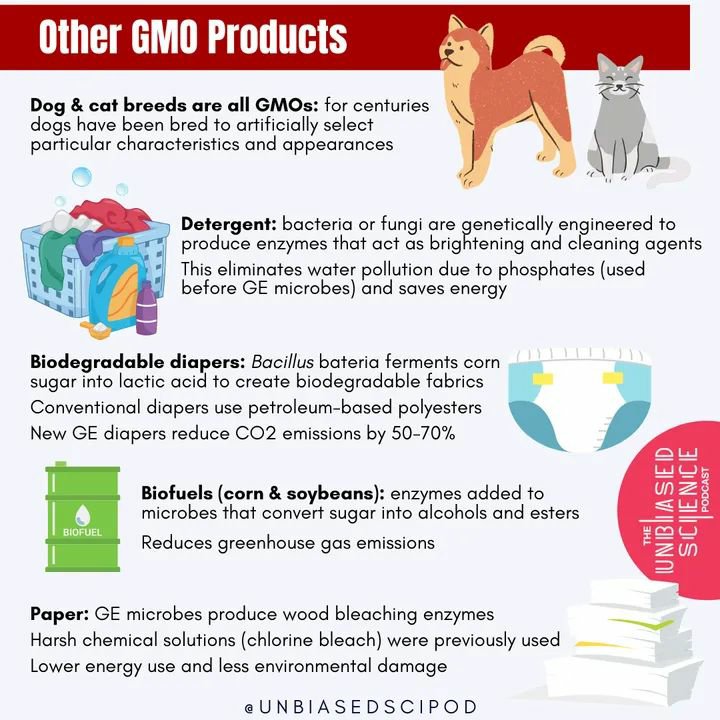
Speaking of the anti-science left
13 Mar 2022 Leave a comment
in economics of regulation, health economics Tags: anti-GMOs movement, Anti-Science left
The Original Climate Crisis: How the Little Ice Age Devastated Early Modern Europe
13 Mar 2022 Leave a comment

 Frost fair
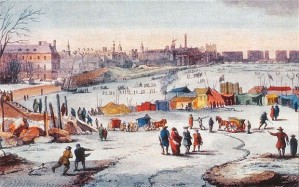
The key phrases in this article could be: ‘Whatever its causes’ and ‘Average temperatures in the British Isles cooled by 2°C’. Climate science is unable to offer a specific explanation, although theories abound, but natural variation for whatever reasons is built-in and always will be. Quantifying it remains out of reach, but computer models are still supposed to be the answer to everything climate.
– – –
Just as the UK was recovering from storms Eunice and Franklin, scientists of UN’s Intergovernmental Panel on Climate Change (IPCC) released a landmark report warning of a future with spiraling weather extremes, fiercer storms, flash flooding, and wildfires, says The Conversation (via Singularity Hub).
This isn’t the first time that Britain has experienced drastic climate change, however. By the 16th and 17th centuries, northern Europe had left its medieval warm period and was languishing in what is sometimes called the…
View original post 283 more words
The Style Council – Walls Come Tumbling Down – Countdown Australia – 1985
13 Mar 2022 Leave a comment
in Music, television, TV shows
Why the V1 Flying Bomb couldn’t turn the tide of WW2
13 Mar 2022 Leave a comment
in defence economics, war and peace Tags: World War II

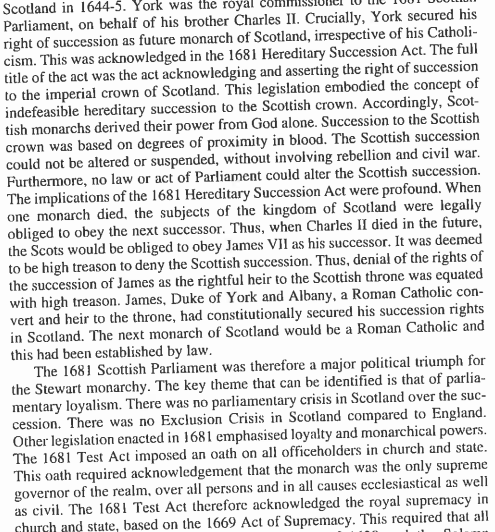
No exclusion crisis in Scotland
12 Mar 2022 Leave a comment
in constitutional political economy, economic history, economics of religion
The Economics of War, Part II: Trade Restrictions Make a Nation Weaker
12 Mar 2022 Leave a comment

Way back in 2010, I explained that Paul Krugman was wrong to think that wars were good for the economy.
 Indeed, he was more wrong than usual. The additional spending for the military isn’t “stimulus,” so his usual Keynesian argument was misguided.
Moreover, he didn’t seem to understand that wars also destroy existing wealth.
Today we are going to look at how war can teach us another economic lesson.
The United States and other major nations have responded to Russia’s assault on Ukraine by imposing trade restrictions with Russia.
If protectionists are correct, these steps (effectively imposing an extreme Russian version of Biden’s “buy America” policy) should strengthen Putin.
Yet that’s obviously not the purpose of the sanctions.
Instead, officials from western nations understand that these trade barriers will weaken Russia’s economy.
By the way, this isn’t the only example of nations using trade restrictions to hurt their enemies.
View original post 176 more words
No End Date For Coal & Nuclear: Gas Crunch Drives Germany’s Grand Renewables Backflip
12 Mar 2022 Leave a comment

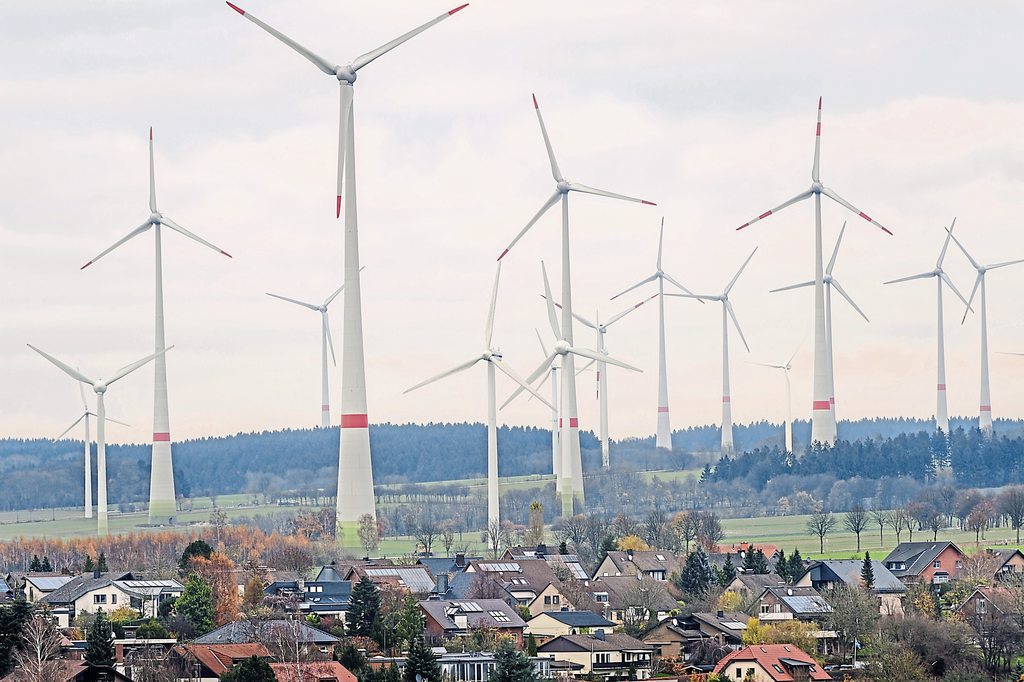
A month or so back, Germany’s green-infested government was talking up the end of coal and nuclear power plants; the last phase in its ‘inevitable’ transition to an all wind and sun-powered future, as the wind and sun cult would have it.
Well. That was then, this is now.
With the squeeze on Russian gas and oil supplies, Germany (among others) has been forced to meet reality, head-on.
All of a sudden, even its rabid the anti-fossil fuel Greens have backflipped on plans to kill off Germany’s nuclear and coal-fired plants. Necessity being, in this case, the mother of ideological reinvention.
Tsvetana Paraskova tells the tale of how reality is driving Germany’s grand renewables reversal.
Germany Goes For Full Energy Policy Overhaul Amid Ukraine Crisis
Oil Price
Tsvetana Paraskova
28 February 2022
The Russian invasion of Ukraine upended the energy policy of Germany. In just a few days since Putin…
View original post 655 more words
Still No Global Warming, Cool February Land and Sea
12 Mar 2022 Leave a comment

The post below updates the UAH record of air temperatures over land and ocean. But as an overview consider how recent rapid cooling has now completely overcome the warming from the last 3 El Ninos (1998, 2010 and 2016). The UAH record shows that the effects of the last one were gone as of April 2021, again in November, 2021 and now in January and February 2022. (UAH baseline is now 1991-2020).
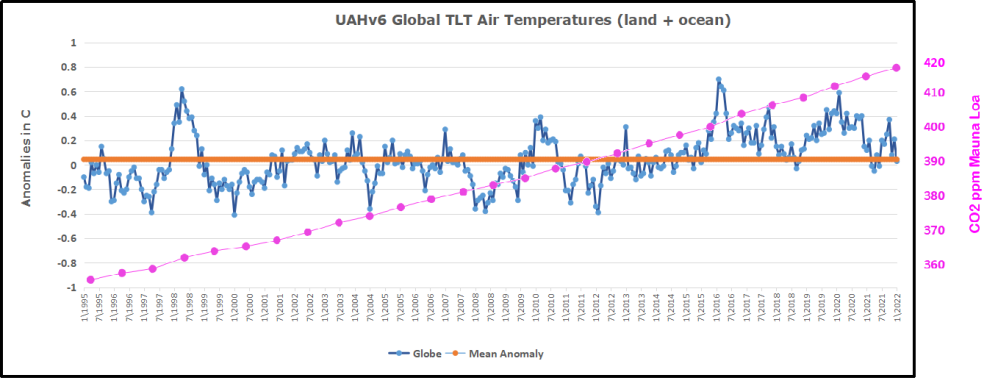
For reference I added an overlay of CO2 annual concentrations as measured at Mauna Loa. While temperatures fluctuated up and down ending flat, CO2 went up steadily by ~55 ppm, a 15% increase.
Furthermore, going back to previous warmings prior to the satellite record shows that the entire rise of 0.8C since 1947 is due to oceanic, not human activity.
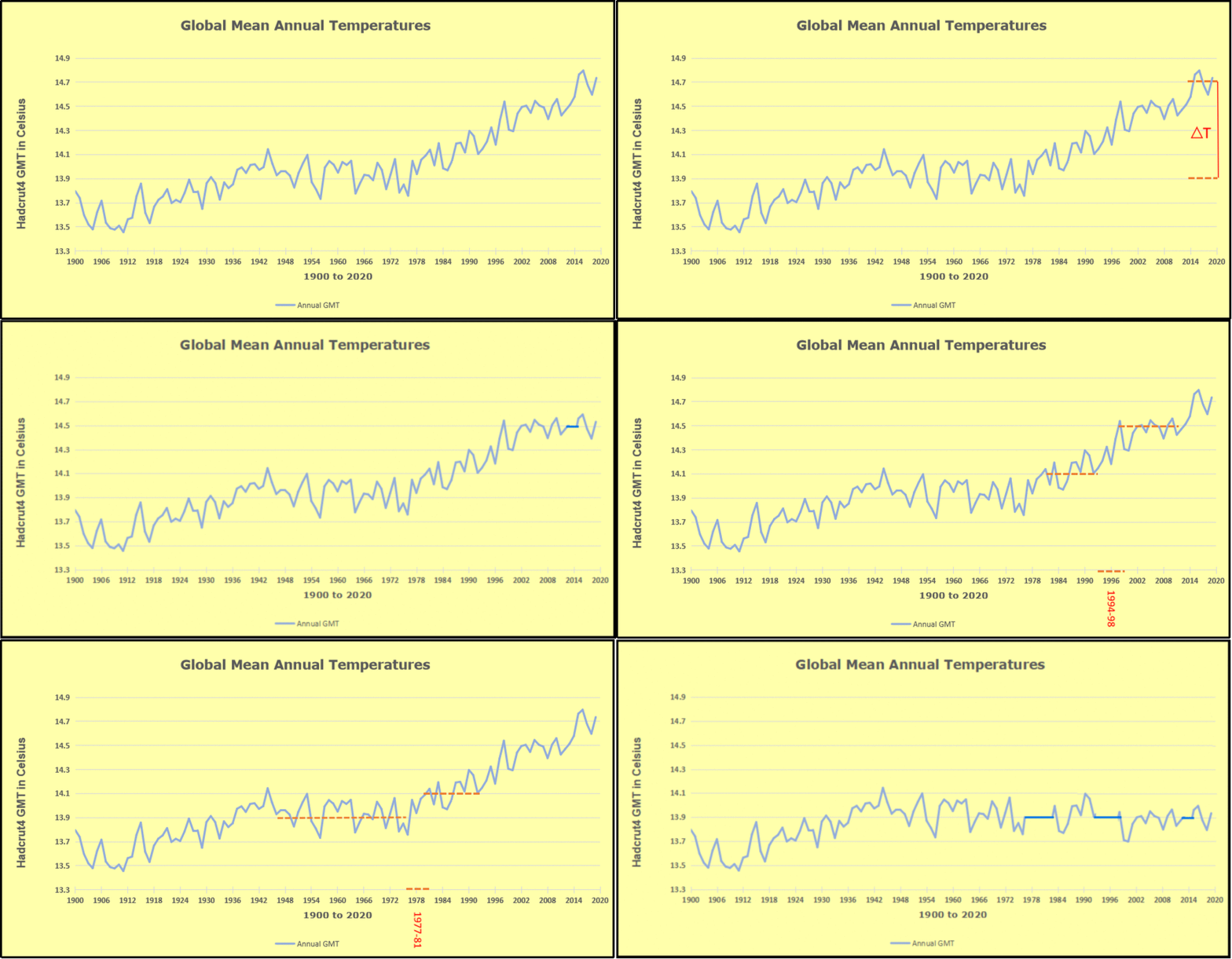
The animation is an update of a previous analysis from Dr. Murry Salby. These graphs use Hadcrut4 and…
View original post 1,147 more words


Recent Comments