How Did Portugal Happen?
20 Jan 2021 Leave a comment
in defence economics, economic history Tags: maps
The UK government should still be cutting corporation tax, not raising it
20 Jan 2021 Leave a comment

Corporation tax hikes are apparently back on the agenda for the March Budget, with the Financial Timessuggesting that the Chancellor believes it would be fair to ask businesses for more after taxpayer support during pandemic. This argument might score a few points with focus groups and play well on social media, but it is still poor economics.
For a start, there is no immediate need for tax rises of any kind. The UK economy has held up better than expected over the last few months and the early rollout of the Covid vaccines should contribute to a strong recovery from the third nationwide lockdown. This in turn will do far more good for the public finances than any fiddling with tax rates.
Government borrowing will fall sharply as the economy rebounds. In the meantime, the increase in debt is cheap and easy to finance, and the financial markets…
View original post 945 more words
Unknown Colonial Empires
20 Jan 2021 Leave a comment
in economic history, international economic law, International law Tags: Age of Discovery, age of empires, economics of colonialism
The “King of the Bootleggers” and a loophole in the Volstead Act
20 Jan 2021 Leave a comment
in economics of regulation, politics - USA Tags: economics of prohibition
The Plantagenets: Henry VI, Edward IV, & The War of the Roses (1422-1483)
19 Jan 2021 Leave a comment

Among the most charitable observers of English history, Henry VI has been judged a gentle and pious king who was sadly unfit for the kingship of England, however even a cursory reading of history shows Henry to be nothing other than a failure: a feeble-minded simpleton and a weakling who was physically incapable of carrying out even the most elementary duties of his station. He was certainly not a great military leader like his father, Henry V, and his legacy was forever stained by the loss of English imperial lands in France. Henry’s reign was also egregiously marred by widespread popular unrest and growing factionalism at his court, all of which culminated in the destructive civil war later known as “The War of the Roses.”
Henry was a deeply pious man; well-educated, gentle, and infirm. He was tall, slender, and something of a religious scholar -he founded Eton College and…
View original post 2,626 more words
Nonviolent Civil Resistance works: let’s spread the word!
19 Jan 2021 Leave a comment

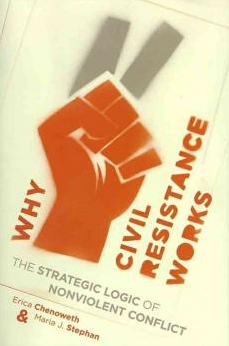 In 2011, Erica Chenowethand Maria Stephanpublished a groundbreaking study on civil resistance, Why Civil Resistance Works, the strategic logic of nonviolent conflict.While the prevailing view is that the most effective means of waging political struggle entails violence, they found that civil resistance campaigns were more than twice as successful in achieving their objectives than violent campaigns. They examined 323 nonviolent and violent campaigns between 1900-2006, involving more than 1,000 people, and that related to a country’s secession, overthrow of a dictatorship or removal of a foreign occupation. They also explore four case studies: Iran, Burma, the Philippines, and the Palestinian Territories.
Another interesting outcome of their study is that the governments of countries where the peaceful resistance took place were far more likely to become or remain stable democracies afterward. The book won several prizes including the 2012 Woodrow Wilson Foundation Award for best book published in…
View original post 365 more words
Sliced Bread and the Second World War
19 Jan 2021 Leave a comment
in defence economics, economic history Tags: The fatal conceit, World War II
Creative destruction
19 Jan 2021 Leave a comment
in economic history, economics of regulation, industrial organisation, survivor principle
Germany: A change to overhang provision in MMP?
19 Jan 2021 Leave a comment

Is Germany about to revoke or modify its provision on “overhang” seats? Evidently there has been a Constitutional Court finding today against the current practice, ((I vaguely recall someone might have mentioned this case in another thread here.)) and there is now a debate about how to respond.
All I know at this point is a not-very-detailed story from The Montreal Gazette that Rob Richie of The Center for Voting and Democracy sent me. (Thanks, Rob!) Here are some excerpts, with the usual journalese about “complex” electoral systems.
Germany’s highest court declared the country’s complex electoral law unconstitutional Wednesday and ordered for it to be overhauled before the next general election…
The current voting system was passed only last year by Chancellor Angela Merkel’s governing coalition in an attempt to satisfy previous criticism by the Federal constitutional Court.
…the constitutional court again criticized that parties which win more seats than…
View original post 237 more words
Housing poverty
19 Jan 2021 Leave a comment
in economics of bureaucracy, income redistribution, politics - Australia, politics - New Zealand, politics - USA, Public Choice, rentseeking, urban economics Tags: housing affordability, land supply, zoning
Why has the UK economy been among the worst hit by Covid?
19 Jan 2021 Leave a comment
According to the latest official data, the UK has seen a much larger fall in GDP during the pandemic than almost any country in Europe. The worst hit economies are actually Greece and Spain. But the UK appears to have suffered much more than France, Germany, Italy, or Sweden. This needs some explaining.
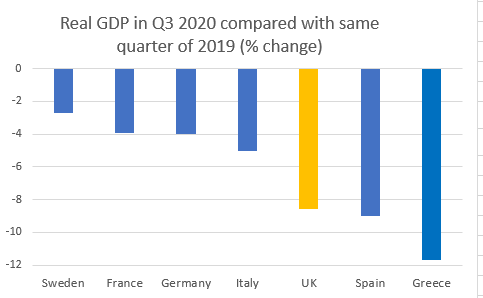
Let’s deal first with differences in how GDP is measured – and especially the impact of the pandemic on the output of the public sector. I first blogged about this back in August and David Smith was kind enough to quote me at the time. Mike Haynes was also one of the first to explore these issues and continues to do excellent work here. More recently, Ed Conway has picked up on this too.
In short, UK statisticians have put a lot more effort into estimating how much activity actually took place in sectors such as public…
View original post 599 more words


Recent Comments