Why They Trash Talk Sweden

Ron Clutz's avatarScience Matters

Dan Hannan explains in his Washington Examiner article The better Sweden does on the coronavirus, the angrier they get.  Excerpts in italics with my bolds.

My columns on Sweden’s laissez-faire approach to the coronavirus always provoke an angry response. But it is striking that, the better Sweden does, the angrier its critics become.

Like anti-Trumpers who couldn’t hide their annoyance at the success of the U.S. economy, or British Remainers who longed for a recession so as to be able to say “I told you so” about Brexit, lockdown enthusiasts determinedly screen out the good news.

They trot out three main arguments. First, they say, “You can’t compare us to Sweden. It has a low population density.” Second, they argue that “Sweden hasn’t succeeded; it has had more deaths per capita than neighboring countries.” Third, the claim that “Sweden has taken an economic hit as well — the…

View original post 664 more words

Catholic Forfeitures during the English Revolution: Parliament and the Role of Sequestration Agents

History of Parliament's avatarThe History of Parliament

Ahead of Tuesday’sVirtual IHRParliaments, Politics and People seminar, we hear from Dr Eilish Gregory at the University of Reading. She will be responding to your questions about her research on Catholic Forfeitures during the English Revolution on Zoom between 5:15 p.m. and 6:30 p.m. on 20 October 2020. Details on how to join the discussion are available here or by contacting seminar@histparl.ac.uk.

This blog is based on Eilish’s full-length seminar paper, ‘Catholic Forfeitures during the English Revolution: Parliament and the Role of Sequestration Agents’, which is available here.

In November 1656, the Catholic delinquent William Blundell wrote to his nephew Thomas Selby, mentioning his recent dealings with the agent and lawyer Gilbert Crouch who was managing his sequestration affairs in London. Blundell’s estates in Little Crosby, Lancashire, were sequestered during the English Revolution because Blundell had fought for King Charles I against Parliament.

William Blundell (1620-1698), whose…

View original post 1,143 more words

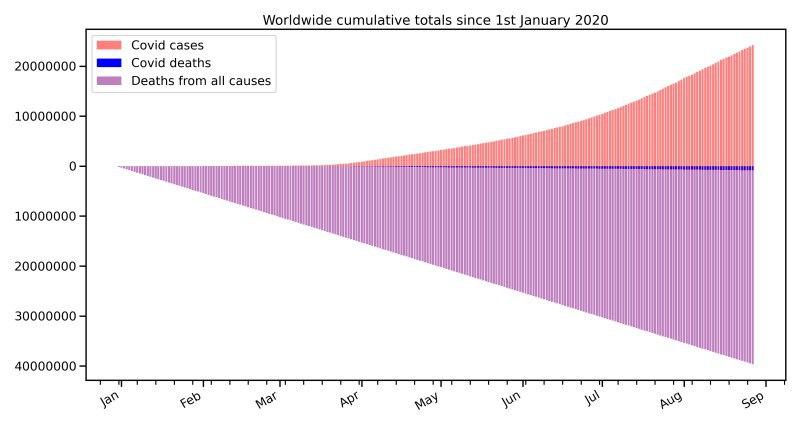
Covid: The Big Picture in 7 Charts

Ron Clutz's avatarScience Matters

Thanks to Swiss Policy Research for providing perspective on the coronavirus contagion in a few charts.  Their article is Covid: The Big Picture in 7 Charts, updated to October 10, 2020.  Excerpts in italics with my bolds.

1) Global covid “cases” and deaths vs. all-cause deaths

Chart number one shows global covid deaths by September in blue (about 1 million) versus global all-cause deaths in purple (about 40 million). The chart also shows the cumulative number of global covid “cases” (i.e. positive PCR tests) – the so-called “casedemic” on top of the pandemic.

In contrast, the UN expects that the political reaction to the pandemic may put the livelihood of up to 1.6 billion people at immediate risk and may, by the end of 2020, push an additional 130 million people “to the brink of starvation” and an additional 150 million children into poverty.

Global covid deaths and…

View original post 785 more words

Noam Chomsky on the Harper’s Letter and Cancel Culture

John Gibson Gibson lockdown costs Plan B weekly webinar – 12/10/2020

Operations Research and the Rise of Applied Game Theory – A Nobel for Milgrom and Wilson

afinetheorem's avatarA Fine Theorem

Today’s Nobel Prize to Paul Milgrom and Robert Wilson is the capstone of an incredibly fruitful research line which began in the 1970s in a few small departments of Operations Research. Game theory, or the mathematical study of strategic interaction, dates back to work by Zermelo, Borel and von Neumann in the early 20th century. The famed book by von Neumann and Morganstern was published in 1944, and widely reviewed as one of the most important social scientific works of the century. And yet, it would be three decades before applications of game theory revolutionized antitrust, organizational policy, political theory, trade, finance, and more. Alongside the “credibility revolution” of causal econometrics, and to a lesser extent behavioral economics, applied game theory has been the most important development in economics in the past half century. The prize to Milgrom and Wilson is likely the final one that will go for early…

View original post 3,927 more words

Another reason to abolish Medsafe. Months lost duplicting far better resourced overseas drug safety agencies #COVID19

Little River Band – Help Is On Its Way (Countdown 1977)

Behind on my vaccination blogging

Boardwalk Empire- Gaston Means is arrested for perjury

What Was Hygiene Like In The Wild West?

Heather Mac Donald And Glenn Loury On Policing, Race, And Ideological Conformity

The Rules of Logic Part 1: Why Logic Always Works

Fallacy Man's avatarThe Logic of Science

An Introduction to Logic

In debates, I often find that people are unwilling to accept the rules of logic, and they make foolish comments like, “well you’re entitled to your opinion.” In reality, the rules of logic are like the rules of mathematics. They are an inherent and immutable property of existence, not opinions. Just as 2+2 always equals four, the rules of logic are always true and must always be followed. To illustrate, the most basic rule upon which all other rules rely is known as the Law of Noncontradiction. It states that something cannot be A and not A simultaneously. In other words, two mutually exclusive things cannot exist simultaneously. For example, you cannot have a circular triangle, because a circle, by definition, has no straight lines and no corners, and a triangle, by definition, has three straight lines and three corners. An object cannot simultaneously have…

View original post 1,096 more words

The Rules of Logic Part 3: Logical Fallacies

Fallacy Man's avatarThe Logic of Science

Perhaps the most common mistake that people make in debates is the use of logical fallacies. This occurs largely because people generally are not taught logical fallacies, and, therefore, don’t recognize them when they use or see them. Knowing logical fallacies and being able to recognize them is, however, extremely important, because, as previously explained, the presence of even a single fallacy will completely destroy an argument and force you to reject it. So this post is my attempt to help my readers learn the how to spot logical fallacies. What follows is a list of some of the most commonly committed fallacies. For each of them, I attempted to provide examples to illustrate how they work (or, rather, fail to work). I have grouped these fallacies by “type.” These are not officially recognized distinctions (such as formal and informal fallacies), rather, they are groupings that I find useful…

View original post 10,580 more words

Sabine Hossenfelder says we don’t have free will, but its nonexistence shouldn’t bother us

whyevolutionistrue's avatarWhy Evolution Is True

Here we have the German theoretical physicist, author, and science popularizer Sabine Hossenfelder giving an 11-minute talk called “You don’t have free will, but don’t worry”. (My own talk on the subject is the first five words she uses, and I think we should be concerned—though not in the sense she means.)  The video and a written transcript are on her website Backreaction.

If you’ve read this site, you’ll know that my own views are pretty much the same as hers, at least about free will. We don’t have it, and the fundamental indeterminacy of quantum mechanics doesn’t give it to us either. Hossenfelder doesn’t pull any punches:

This means in a nutshell that the whole story of the universe in every single detail was determined already at the big bang. We are just watching it play out.

These deterministic laws of nature apply to you and your brain…

View original post 1,407 more words

Previous Older Entries Next Newer Entries

Coordination Problem

Celebrating humanity's flourishing through the spread of capitalism and the rule of law

Libertarian Land

Celebrating humanity's flourishing through the spread of capitalism and the rule of law

Arin’s Substack

Celebrating humanity's flourishing through the spread of capitalism and the rule of law

David Andolfatto

Celebrating humanity's flourishing through the spread of capitalism and the rule of law

Monetary Non-Neutrality

Celebrating humanity's flourishing through the spread of capitalism and the rule of law

Reason Magazine

Celebrating humanity's flourishing through the spread of capitalism and the rule of law

Coyote Blog

Celebrating humanity's flourishing through the spread of capitalism and the rule of law

Thoughts from the North

Celebrating humanity's flourishing through the spread of capitalism and the rule of law

Fardels Bear

A History of the Alt-Right

Vincent Geloso

Econ Prof at George Mason University, Economic Historian, Québécois

Bassett, Brash & Hide

Celebrating humanity's flourishing through the spread of capitalism and the rule of law

Truth on the Market

Scholarly commentary on law, economics, and more

The Undercover Historian

Beatrice Cherrier's blog

Matua Kahurangi

Celebrating humanity's flourishing through the spread of capitalism and the rule of law

Temple of Sociology

Celebrating humanity's flourishing through the spread of capitalism and the rule of law

Velvet Glove, Iron Fist

Celebrating humanity's flourishing through the spread of capitalism and the rule of law

Why Evolution Is True

Why Evolution is True is a blog written by Jerry Coyne, centered on evolution and biology but also dealing with diverse topics like politics, culture, and cats.

NoTricksZone

Celebrating humanity's flourishing through the spread of capitalism and the rule of law

Homepaddock

A rural perspective with a blue tint by Ele Ludemann

Kiwiblog

DPF's Kiwiblog - Fomenting Happy Mischief since 2003

The Dangerous Economist

Celebrating humanity's flourishing through the spread of capitalism and the rule of law

Watts Up With That?

The world's most viewed site on global warming and climate change

The Logical Place

Tim Harding's writings on rationality, informal logic and skepticism

Doc's Books

A window into Doc Freiberger's library

The Risk-Monger

Let's examine hard decisions!

Uneasy Money

Commentary on monetary policy in the spirit of R. G. Hawtrey

Barrie Saunders

Thoughts on public policy and the media

Liberty Scott

Celebrating humanity's flourishing through the spread of capitalism and the rule of law

Point of Order

Politics and the economy

James Bowden's Blog

A blog (primarily) on Canadian and Commonwealth political history and institutions

Science Matters

Reading between the lines, and underneath the hype.

Peter Winsley

Economics, and such stuff as dreams are made on

A Venerable Puzzle

"The British constitution has always been puzzling, and always will be." --Queen Elizabeth II

The Antiplanner

Celebrating humanity's flourishing through the spread of capitalism and the rule of law

Bet On It

Celebrating humanity's flourishing through the spread of capitalism and the rule of law

History of Sorts

WORLD WAR II, MUSIC, HISTORY, HOLOCAUST

Roger Pielke Jr.

Undisciplined scholar, recovering academic

Offsetting Behaviour

Celebrating humanity's flourishing through the spread of capitalism and the rule of law

JONATHAN TURLEY

Res ipsa loquitur - The thing itself speaks

Conversable Economist

In Hume’s spirit, I will attempt to serve as an ambassador from my world of economics, and help in “finding topics of conversation fit for the entertainment of rational creatures.”

The Victorian Commons

Researching the House of Commons, 1832-1868

The History of Parliament

Articles and research from the History of Parliament Trust

Books & Boots

Reflections on books and art

Legal History Miscellany

Posts on the History of Law, Crime, and Justice

Sex, Drugs and Economics

Celebrating humanity's flourishing through the spread of capitalism and the rule of law

European Royal History

Exploring the Monarchs of Europe