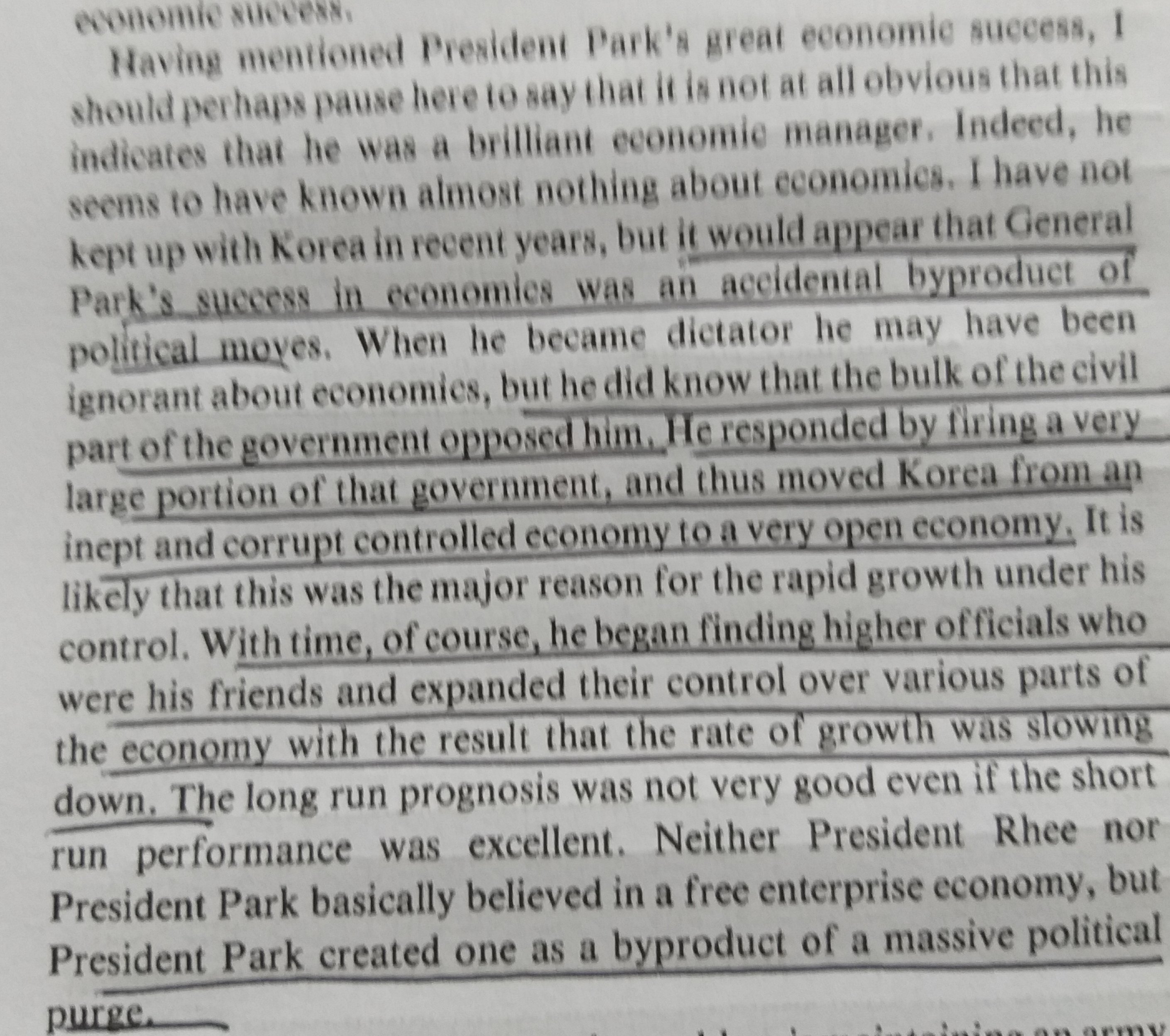
Gordon Tullock on the accidental Korean economic miracle
04 Oct 2020 Leave a comment
in comparative institutional analysis, constitutional political economy, defence economics, development economics, economic growth, economic history, economics of bureaucracy, economics of crime, economics of regulation, entrepreneurship, Gordon Tullock, growth disasters, growth miracles, history of economic thought, industrial organisation, international economics, law and economics, macroeconomics, property rights, Public Choice, rentseeking, survivor principle Tags: South Korea
Ramifications Of California Governor Newsom’s Ban On Gas-Powered Vehicles
04 Oct 2020 Leave a comment

 By Ronald Stein ~
Before sky diving, you need to plan ahead by having a parachute before you jump. California Governor Newsom’s recent suicidal jump onto the EV train has a minimum of eight (8) lack-of-a-plan ramifications from his recent Executive order to ban the sale of gas-powered vehicles by 2035 that will be devastating to the state’s economy and environment:
-
 Vehicle ownership: With 45 percent of the California population – that’s a whopping 18 of the 40 million residents of the state – being Hispanic and African American – having average incomes of less than half of present EV owners, the Governor is incentivizing those least likely being able to afford a new car to continuously re-register their existing vehicles. Additionally, California has the highest homeless population, and the fifth largest percentage of homeless (behind D.C., New York, and Hawaii, and Oregon, and has the second highest poverty rate.
View original post 768 more words
The Reading List: The Legacy of Wounded Knee
04 Oct 2020 Leave a comment
The nobel savage myth permeates the Left

Wounded Knee has become a byword for awful relationships between native North American Indians and the US government, as well as White racism, colonialism and a bunch of other bad “isms” brought to the New World.
So this review of a new book on the subject, The Legacy of Wounded Knee, is of interest. Just a bit of background first:
The American name “Wounded Knee” referred to the site near Wounded Knee Creek in southwestern South Dakota where troops of the U.S. 7th Cavalry, under orders to disarm a group of several hundred Miniconjou and Hunkpapa Sioux, stumbled into a chaotic fight on December 29, 1890, in which they killed probably more than 150 Indians, including dozens of women and children, and lost 25 men.
But the term did not catch on until a book by that name was published in 1972, with the author, Dee Brown, taking the…
View original post 968 more words
Anti-science left @Greens @Greenpeace @NZGreens on #GMOs #vaccination #nuclearpower #recycling #fluoridation & economics #globalwarming
04 Oct 2020 Leave a comment
in environmental economics, global warming, health economics, politics - Australia, politics - New Zealand Tags: anti-GMO movement, Anti-Science left, fluoridation, nuclear energy, recycling, solar power, vaccination, vaccines, wind power
The Orville Season 2 | Deleted Scene from “Lasting Impressions
04 Oct 2020 Leave a comment
in television
Hoodoo Gurus – Whats My Scene – Countdown Australia – 26 April 1987
04 Oct 2020 Leave a comment
in Music, television
Milton Friedman on Spending
04 Oct 2020 Leave a comment

I identified four heroes from the “Battle of Ideas” video I shared in late August – Friedrich Hayek, Milton Friedman, Ronald Reagan, and Margaret Thatcher. Here’s one of those heroes, Milton Friedman, explaining what’s needed to control big government.
For all intents and purposes, Friedman is pointing out that there’s a “public choice” incentive for government to expand.
To counteract that disturbing trend, he explains that we need a high level of “societal capital.” In other words, we need a self-reliant and ethical populace – i.e., people who realize it’s wrong to use the coercive power of government to take from others.
Sadly, I don’t think that’s an accurate description of today’s United States.
So how, then, can we get control of government?
Since politicians are unlikely to control spending in the short run (their time horizon is always the next election)…
View original post 142 more words


Recent Comments