
Posting this before progressive left outlaws it as blasphemy
29 Sep 2020 Leave a comment
in law and economics, liberalism, libertarianism, Marxist economics, politics - New Zealand Tags: Age of Enlightenment, Blasphemy, free speech, Freedom of religion, political correctness, regressive left
How (and Why) Kubrick Recreated Vietnam in England | Full Metal Jacket
29 Sep 2020 Leave a comment
in movies
Richard Dawkins canceled at Trinity College Dublin
29 Sep 2020 Leave a comment

The University Times, the student newspaper of Trinity College Dublin, reports that an invited address by Richard Dawkins has been canceled. The rescinded invitation was initially tendered by “The Hist”, the University Historical Society, who withdrew it. Why? Because Dawkins’s past statements on Islam and sexual assault might cause “discomfort” to the students. Click on the screenshot to read:
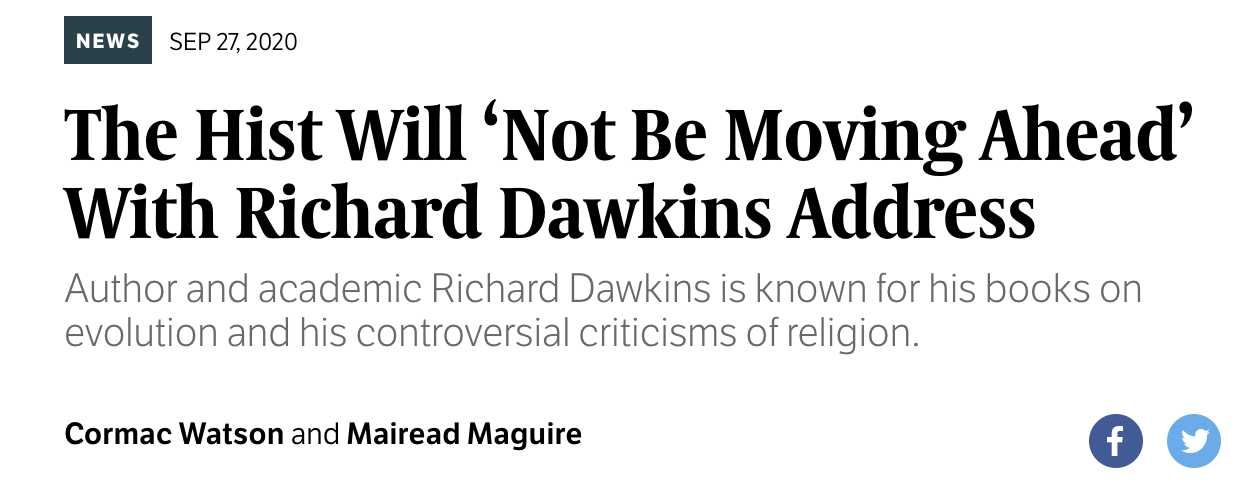
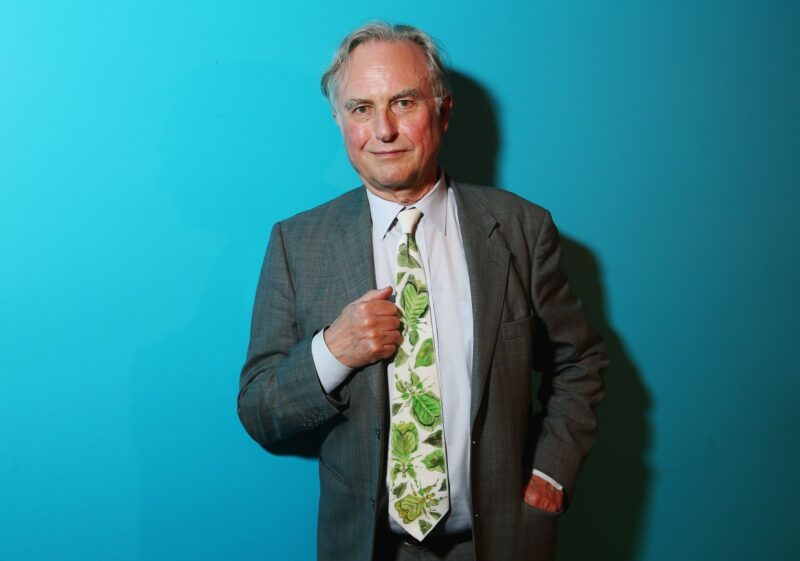
Here’s a summary of what happened, which is almost humorous in the emphasis on “discomfort”—apparently the most important factor in deciding whether a speaker is appropriate (my emphasis):
The College Historical Society (the Hist) has tonight rescinded its invitation to Richard Dawkins to address the society next year.
Auditor of the Hist Bríd O’Donnell announced the cancellation in a statement on her [actually The Hist’s] Instagram page, saying that she had been “unaware of Richard Dawkins’ opinions on Islam and sexual assault until this evening”, adding that the society “will…
View original post 722 more words
Having Children in Poverty: Kathryn Edin
29 Sep 2020 Leave a comment
in economics of crime, economics of love and marriage, gender, human capital, labour economics, labour supply, law and economics, occupational choice, poverty and inequality, unemployment, welfare reform Tags: child poverty, economic of fertility, family poverty, marriage and divorce
The Great Stagnation by Tyler Cowen
28 Sep 2020 Leave a comment
in applied price theory, comparative institutional analysis, constitutional political economy, development economics, econometerics, economic growth, economic history, growth disasters, growth miracles, history of economic thought, human capital, industrial organisation, labour economics, labour supply, law and economics, macroeconomics, poverty and inequality Tags: creative destruction, endogenous growth theory
S-O-S: Coal-Fired Power Only Answer to Australia’s Power Pricing & Supply Calamity
28 Sep 2020 Leave a comment

 That’s right boys, it’s in the ground & it’s powering us 24 x 365.
Faced with rocketing power prices and a grid on the brink of collapse, the Morrison Federal government remains committed to the policies that caused the debacle.
Instead of ensuring the survival of Australia’s extensive coal-fired power fleet and building new High Efficiency Low Emissions coal-plants, the PM and his Energy Minister have selected a grab bag of green-left fantasies, including squandering hundreds of $millions on converting excess wind and solar power to hydrogen gas, pumped hydro and batteries.
The treatment of Australia’s most reliable and affordable generation source – coal – is a mixture of insanity and contempt. And that contempt extends to whole industries and the thousands of jobs that depend upon them.
The Australian’s Greg Sheridan provides a pretty fair rundown on how a notionally conservative government has abandoned not only its principles, but…
View original post 1,185 more words

Race and racism in America (video)
28 Sep 2020 Leave a comment

In my Social Problems class we’re spending the next few weeks on race, racial inequality, and racial politics. Step one is this lecture on race and racism.
After a tangent on racial identity, idealism and its enemies, I address biology and race, describing the classic racist racial categories in relation to vast human diversity in Africa and the world overall, with discussion of biological evolution and the sources of human variation. Then I turn to the US and discuss social definition and self-definition, race versus ethnicity, definitions of racism and discrimination, and how the Census Bureau measures US race and ethnicity, before summarizing current and projected race/ethnic composition. And I used the new Zoom feature where your PowerPoint slides are the virtual background (which is harder than it looks because your image isn’t mirrored while you speak!).
It’s 35 minutes. The slides are here, CC-BY: osf.io/uafvp. To see all…
View original post 7 more words
Keynesian Economics Is Wrong…Again
28 Sep 2020 Leave a comment

I’ve previously written that Keynesian economics is like Freddy Kreuger. No matter how many times it is killed off by real-world evidence, it comes back to life whenever a politician wants to justify a vote-buying orgy of new spending.
And there will always be Keynesian economists who will then crank up their simplistic models that churn out results 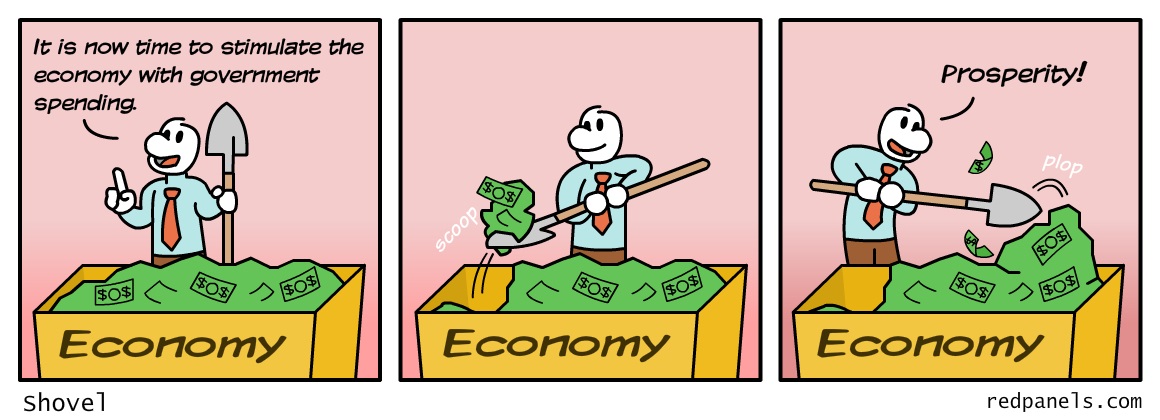 predicting that a bigger burden of government spending somehow will produce additional growth.
They never bother to explain why they think draining funds from the private sector is good for growth, of course, or why they think politicians supposedly spend money more wisely than households and businesses.
Nonetheless, there are some journalists who are willing to act as stenographers for their assertions.
In a September 25 story for the Washington Post, Tory Newmyer gives free publicity to Keynesian predictions that the economy will grow faster if Biden wins and…
View original post 766 more words
Minneapolis fails to defund police
28 Sep 2020 Leave a comment
When a person or group cries “Defund the police!”, it could mean several things:
1.) Completely eliminate the budget of the police department, and hence the department itself. This is the demand that the University of Chicago’s #CareNotCops group makes for our campus police, saying they want the University Police gone by 2022. For a case like this, the police department (PD) isn’t supposed to be replaced with another law-enforcement organization.
2.) Reduce the police budget, spending the extra money either on social-service programs or grants given to minority or crime-ridden communities.
3.) Change the method of policing, for example eliminating no-knock warrants or chokeholds.
4.) Supplement police services with social services, like having psychologists or psychiatric social workers respond to calls instead of the cops. That’s not practical, but some places have “ride along” programs where social workers go to relevant calls (domestic violence, child endangerment) with police. Other…
View original post 959 more words


Recent Comments