
California’s rolling blackouts this summer were caused by decades of costly and poorly planned decisions to replace coal, nuclear, and gas-powered plants with solar and wind, according to some energy experts. Critics say the state’s dependence on solar and wind have made the power grid unreliable and overly expensive.
When solar and wind capacity increase
26 Sep 2020 Leave a comment

When pointing to the huge fluctuations of solar and wind production in previous post, I wrote that these fluctuations will only grow when South Australia advances on its path towards 100% renewable energy. Looking at the fuel mix and demand data that I had gathered until then, I noticed a fine example of exactly that. Just look at the fuel mix and demand data:
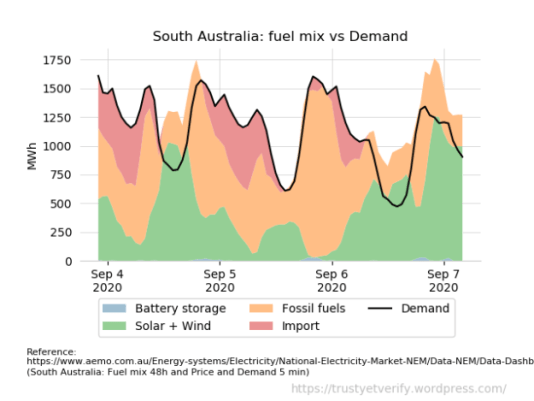
Let’s focus on the minimum on September 5 at 20:00. That is around the time that I looked for the first time at the overview panel (see previous post). The data showed that the total production of solar and wind was 4.341 MWh, which is 0.29% of what was produced at that moment. Contrast this to the peak of 1,258.486 MW the next day around 22:00, just after the evening peak when energy demand was slowly starting to decrease. It is this dynamics that will lead…
View original post 344 more words
Importing Price Controls from Europe Will Undermine Pharmaceutical Innovation
26 Sep 2020 Leave a comment

Last November, I criticized Nancy Pelosi’s scheme to impose European-style price controls on pharmaceutical drugs in the United States.
I wasn’t the only one who objected to Pelosi’s reckless idea.
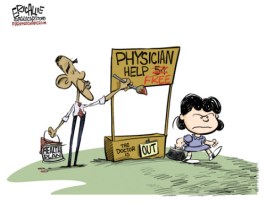 We have forty centuries of experience demonstrating that price controls don’t work. The inevitable result is shortages and diminished production (sellers won’t produce sufficient quantities of a product if they are forced to lose money on additional sales).
Which helps to explain why the Wall Street Journal also was not a fan of Pelosi’s proposal
Here’s some of the paper’s editorial on the adverse impact of her proposed intervention.
Mrs. Pelosi’s legislation would direct the secretary of Health and Human Services to “negotiate” a “fair price” with drug manufacturers… Any company that refuses to negotiate would get slapped with a 65% excise tax on its annual gross sales that would escalate by 10% each quarter. Yes, 65% on sales.
…The…
View original post 1,152 more words
Gender wage gap
26 Sep 2020 Leave a comment
in discrimination, economics of education, gender, human capital, labour economics, labour supply, occupational choice, poverty and inequality Tags: gender wage gap
Autism and Personality Traits | William von Hippel
26 Sep 2020 Leave a comment
in health economics Tags: economics of mental illness
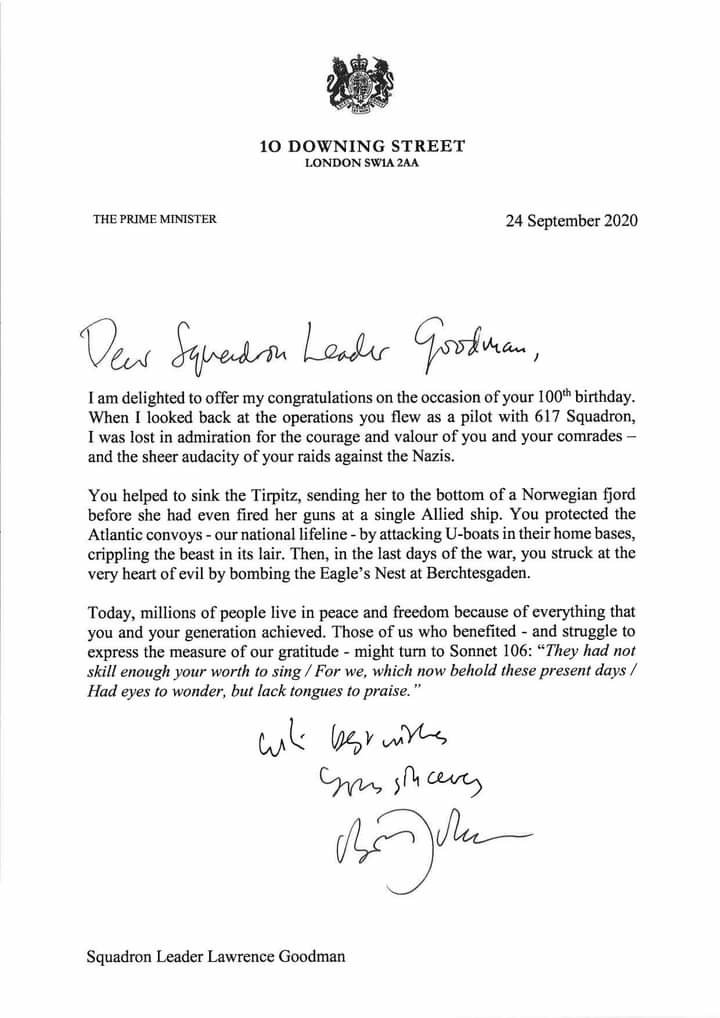
Happy birthday squadron leader
25 Sep 2020 Leave a comment
in defence economics, war and peace Tags: World War II
Is the Left becoming anti-Semitic?
25 Sep 2020 Leave a comment

Well, Roger Cohen of the New York Times thinks so, pointing out in a new op-ed the increased blurring of lines between dislike of Israel and dislike of Jews, as well as the increasing acceptability of slurs against Jews in both British and American academia. And Cohen, like me, always has to include in his articles a caveat about the bad things that, we agree, are done by the Israeli government, including the support of illegal settlements. But the malfeasance of the Israeli government does not justify demonizing Jews, just as the perfidies of ISIS or Saudi Arabia doesn’t warrant the demonization of Muslims. Yet Jews are regularly murdered by terrorists simply for being Jewish, regardlessof their views on Israel.
One can argue about Israel’s right to exist, or whether we should have a refuge state based on Judaism. (Of course, much of the Middle East comprises states not only undergirded by…
View original post 810 more words
Alan Dershowitz gives non-confrontational talk on Israel at Berkeley, then called a Nazi and anti-Semitically caricatured
25 Sep 2020 Leave a comment
The line between anti-Semitism and anti-Zionism is nearly invisible—if it exists at all—but was surely crossed by the behavior of students at the University of California at Berkeley (UCB), where Harvard emeritus law professor Alan Dershowitz, a liberal Democrat, recently spoke on Israel. His October 11 talk was called “The liberal case for Israel,” and was sponsored on campus by Berkeley Law, Bears for Israel, and the Chabad Jewish Center.
As Dershowitz reported yesterday at the Gatestone Institute, his talk was not a one-sided pro-Israel talk, but called for an end to occupation as well as a two state solution:
I was recently invited to present the liberal case for Israel at Berkeley. In my remarks I advocated the establishment of a Palestinian state and a negotiated end of the conflict. I encouraged hostile questions from protestors and answered all of them. The audience responded positively to the dialogue…
View original post 1,755 more words


Recent Comments