Édith Piaf during World War Two, Kerensky, & the German Journey to N. Africa – WW2 – OOTF 017
19 Sep 2020 Leave a comment
in defence economics, laws of war, war and peace Tags: World War II
The hierarchy of evidence: Is the study’s design robust?
18 Sep 2020 Leave a comment

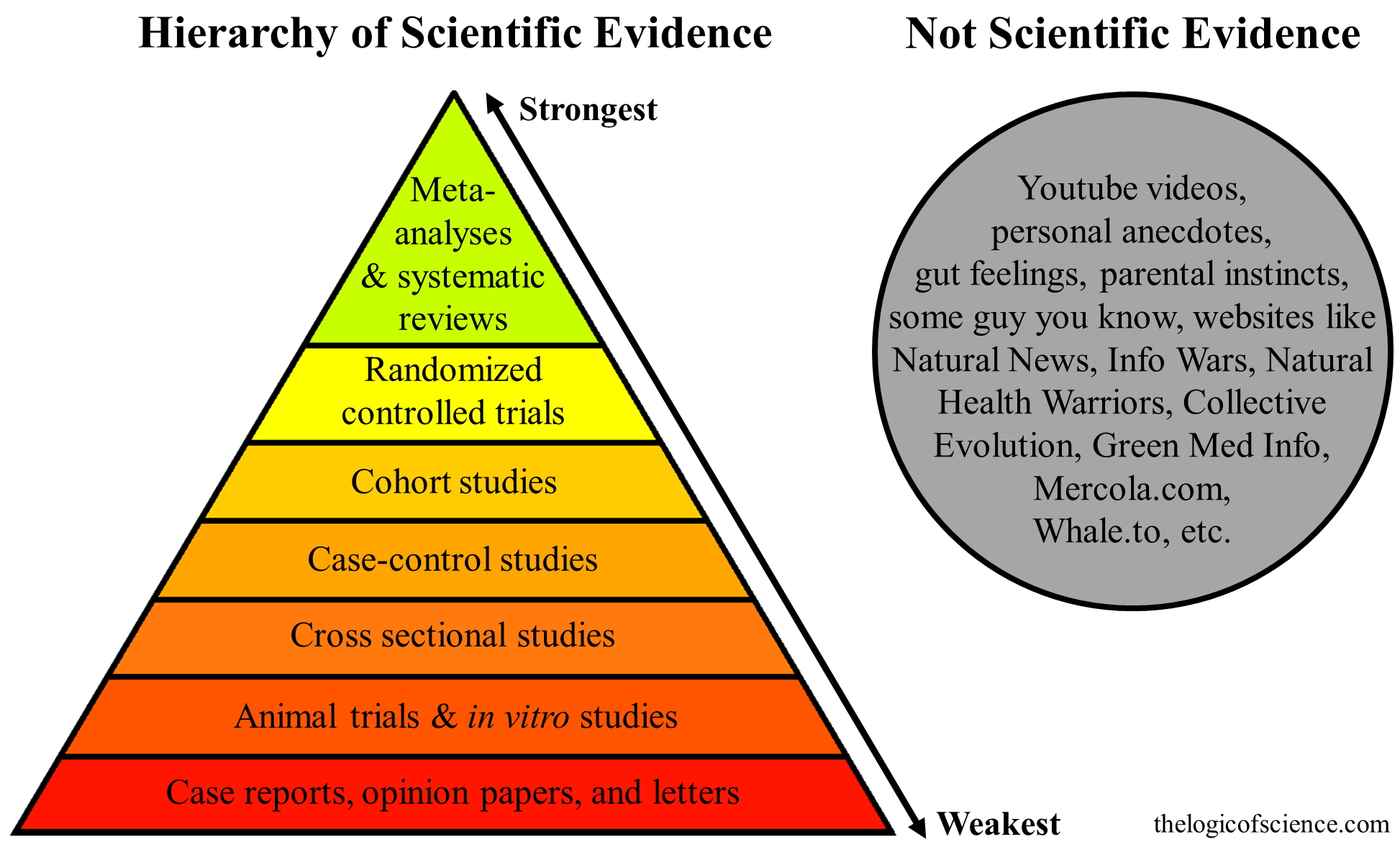 People are extraordinarily prone to confirmation biases. We have a strong tendency to latch onto anything that supports our position and blindly ignore anything that doesn’t. This is especially true when it comes to scientific topics. People love to think that science is on their side, and they often use scientific papers to bolster their position. Citing scientific literature can, of course, be a very good thing. In fact, I frequently insist that we have to rely on the peer-reviewed literature for scientific matters. The problem is that not all scientific papers are of a high quality. Shoddy research does sometimes get published, and we’ve reached a point in history where there is so much research being published that if you look hard enough, you can find at least one paper in support of almost any position that you can imagine. Therefore, we must always be cautious about eagerly accepting…
View original post 4,780 more words
Most scientific studies are wrong, but that doesn’t mean what you think it means
18 Sep 2020 Leave a comment
When faced with scientific studies that disagree with them, many people are prone to claim that they don’t have to accept those studies because most scientific studies are actually wrong. They generally try to support this claim by either citing the work of John P. A. Ioannidis (especially his paper titled, “Why most published research findings are false”) or by quoting Dr. Richard Horton who said,
“The case against science is straightforward: much of the scientific literature, perhaps half, may simply be untrue. Afflicted by studies with small sample sizes, tiny effects, invalid exploratory analyses, and flagrant conflicts of interest, together with an obsession for pursuing fashionable trends of dubious importance, science has taken a turn towards darkness.”
To the anti-scientist, these are “get out of jail free” cards that let them dismiss any study that they don’t like. In reality, of course, those who oppose science…
View original post 3,803 more words
A question of confidence? The Constitution Committee’s view on the Fixed-term Parliaments Act 2011
18 Sep 2020 Leave a comment


Nine years after the passage of the Fixed-term Parliaments Act, both government and opposition have expressed a desire to repeal it, following two general elections: one brought about about using the provisions of the Act and another by circumventing them. The Constitution Committee has produced a report setting out what any replacement legislation needs to address. Its Chair, Baroness Taylor, discusses the Committee’s conclusions below.
On its introduction in 2011, the Fixed-term Parliaments Act (FTPA) was heralded by the then Deputy Prime Minister, Nick Clegg, as a ‘constitutional innovation’ that would no longer allow the timing of general elections to be a ‘plaything of Governments’. Nine years on, it is safe to say that the FTPA has not had the effect that he and others envisaged. The FTPA has been stress-tested and found wanting by political parties and commentators alike.
The FTPA sets the length of parliaments at five…
View original post 1,352 more words
Angus Deaton – “The Great Escape: Health, Wealth, and the Origins of Inequality”
18 Sep 2020 Leave a comment
in development economics, economic history, economics of education, environmental economics, growth disasters, growth miracles, health and safety, health economics, history of economic thought, human capital, labour economics, labour supply, law and economics, poverty and inequality, property rights, Public Choice, public economics Tags: child mortality, infant mortality, The Great Escape
German Failure to Develop a Four-Engine Bomber
18 Sep 2020 Leave a comment


“Amerika” bomber Amerika Bomber: A group of Me 264 aircraft getting ready to take off.
The answer lies with Germany’s theory of war in general. Everyone knew that Germany could not sustain a long-drawn-out war like WWI. Blitzkrieg, to use a simple term, was developed to achieve quick victories of the kind that were essential to Germany’s success. As a result, the sole purpose of the Luftwaffe was to directly support the ground troops in getting that victory through direct intervention on the battlefield.
In general, the twin engine bombers (Do17, Ju88, etc.) were to function in an interdiction role, disrupting supplies and the flow of reinforcements directly behind the battlefield. Strategic bombing, the only use for four-engined bombers, was a waste of time if the war was only going to last weeks or months. If Germany needed strategic bombing, then she had already lost.
A very decent four-engine plane…
View original post 1,617 more words
Can You Go a Day Without Fossil Fuels?
18 Sep 2020 Leave a comment
in energy economics, environmental economics, global warming Tags: The fatal conceit
That Time North America Tried to Tear Itself Apart
18 Sep 2020 Leave a comment
in economics of media and culture
NOT MUCH TO ADD
17 Sep 2020 Leave a comment

Reproduced, a FaceBook post that ended with a “Please share”.
Over the weekend I had a phone call from a mate who lives in urban Auckland and he wanted to have a yarn about the new Green Party Agricultural Policy, that to his mind seemed logical, fair and reasonable, almost an exciting step forward, but he wanted to see the policy through the lens of a farmer as well.
I have been reflecting on his question regarding the launching of the Green Party Agricultural “Policy” trying to quantify the feeling of hopelessness that I and many farmers feel.
So let’s unpack this a bit. How our business works is we have a farm income, that is the culmination of all the stock we sell and the grain and seed crops that we grow and sell to processors as it eventually makes its way to your local Supermarket.
Out of…
View original post 618 more words


Recent Comments