In “$2.00 a day: living on almost nothing on America”, Edin and Shaefer argued welfare reform led to a surge in extreme poverty, families living in ‘extreme destitution’!
29 Apr 2018 Leave a comment
in labour economics, politics - USA, poverty and inequality Tags: 1996 federal welfare reforms, child poverty, family poverty

Is welfare dependence optimal for whom – part 6: mandatory work requirements and labour supply
14 Dec 2014 Leave a comment
in labour economics, labour supply, occupational choice, welfare reform Tags: 1996 federal welfare reforms, Labour leisure trade-off, labour supply, mandatory work requirements, welfare reform
A mechanism for reducing welfare programme entries while increasing welfare exits is work requirements. These minimum hours can be spent working part time, in study and training, work preparation and job search assistance or volunteering.
A work requirement is a screening device removes any advantage of moving on to welfare in terms of more leisure time. U.S. welfare reform side-stepped the problem of programme entry with lifetime time limits on eligibility and work requirements making entry unrewarding. A lifetime time limit on eligibility also reduces inflow in to welfare receipt because workers have an incentive to bank their eligibility to hard time arise. Different work tests and abatement regimes that vary with circumstances on length of time on the benefit also increase exits without increasing entry.
Most work requirement schemes have waivers for those unable to work. Work requirements make welfare receipt less attractive and more hassle while not making welfare receipt any more or any less financially rewarding to those in work.
The gap between working and welfare receipt is larger because of the work requirements make the benefit less pleasant but no additional cash payments are made to encourage welfare programme entry.
Most welfare systems experiment with policy options to separate those who can work from the truly needy. Changes in financial incentives arising from abatement regimes, benefit levels and benefit durations are welfare reform workhorses. The clear-cut labour supply effects of work requirements are a useful contrast to the ambiguity of labour supply changes when benefit levels and abatement regimes change.
Figure 1 illustrates work requirements by introducing a minimum working hours requirement, which eliminates part of the budget constraint before the minimum hours. Work requirements combine a negative tied transfer – an obligation to work – with cash to induce those with a higher ability to work to self-select and opt out of the welfare system entirely.
Figure 1: The labour supply effects of mandatory work requirements as a condition of welfare benefit receipt
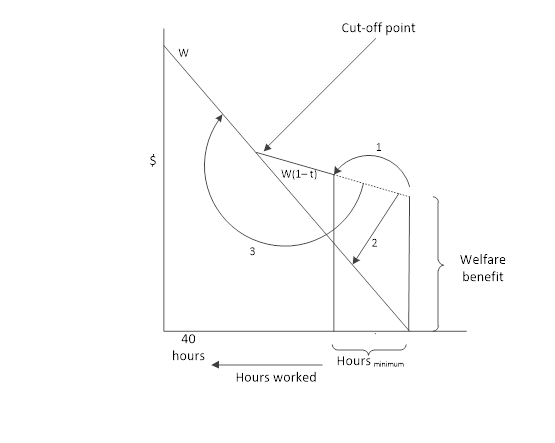
Arrows 1, 2 and 3 in Figure 1 represent possible labour supply responses to work requirements which lead to an increase in the hours worked by different types of workers, some moving to working part-time and others not working at all.
Arrow 1 shows some beneficiaries who are marginal workers increasing their hours from zero to the minimum. Other marginal workers will work more but no longer work enough hours to qualify for a benefit as shown by arrow 2.
This increase in labour supply, as shown by arrows 1 and 2 in Figure 1, is to be expected because a work requirement eliminates welfare benefits altogether over a certain range.
Welfare payments reduce the supply of labour unambiguously so reducing the generosity of welfare reduces the disincentives to supply labour.
A work requirement also reduces entry into and increases exit from the welfare system by more persistent workers as shown by arrow 3 in Figure 1.
This welfare exit effect and entry deterrence arises from the relative non-financial rewards of working and not working have changed in favour of staying in full-time and semi-work for persistent workers temporarily on a welfare benefit.
Persistent workers gain from anticipating the onerous nature of work requirements and searching more intensively for jobs which are more stable and enduring.
These job seekers may reduce their asking wage to win a lower paid but steadier job. Seasonal and temporary jobs will be less attractive if there are work requirements.
The incentive to cycle between the benefit and part-time and full-time work including seasonal and temporary jobs are reduce because work requirements make welfare receipt more onerous.
Those job seekers with fewer outside of the workforce obligations such as young children are the most likely to move to (stable) full-time work because of work requirements.
Those with more extensive outside commitments such as pre-schoolers work the minimum hours or make other arrangements because they now fail to qualify for welfare.
A work requirement unambiguously increases net labour supply and reduces the number of people relying on the welfare system now and into the future.
In contrast to abatement regime reforms, no one enters the welfare system as a new benefit claimant as the result of introducing work requirements.
The number of people working increase and some leave welfare rather than comply with the work programmes. Work requirements make welfare receipt unambiguously less attractive and will close the gap between earning full-time wages and the net rewards of not working or part-time work and partial benefit receipt.
The 60 per cent reduction in welfare caseloads that followed the 1996 federal welfare reform in the USA that introduced work requirement and time limits on a national basis.

The subsequent declines in welfare participation rates and gains in employment were largest among the single mothers previously thought to be most disadvantaged: young (ages 18-29), mothers with children aged under seven, high school drop-outs, and black and Hispanic mothers. These low-skilled single mothers who were thought to face the greatest barriers to employment. Blank (2002) found that:
At the same time as major changes in program structure occurred during the 1990s, there were also stunning changes in behaviour. Strong adjectives are appropriate to describe these behavioural changes.
Nobody of any political persuasion-predicted or would have believed possible the magnitude of change that occurred in the behaviour of low-income single-parent families over this decade.
The blogs so far
part-one-the-labour-leisure-trade-off-and-the-rewards-for-working
part-two-the-labour-supply-effects-of-welfare-benefit-abatement-rate-changes
part-3-abatement-free-income-thresholds-and-labour-supply
part-4-in-work-tax-credits-and-labour-supply
part-5-higher-abatement-rates-and-labour-supply
Robert Doar on 10 welfare reform lessons
26 Apr 2014 Leave a comment
in applied welfare economics, labour economics, welfare reform Tags: 1996 federal welfare reforms, Rebecca Blank, Robert Doar
In the National Review, Robert Doar set-out these from his time as commissioner of the New York City social service agency between 2007 and 2013:
- Always promote personal responsibility.
- Employment is far better than training and education.
- Making work pay is welfare reform too.
- Be honest about the importance of married two-parent families.
- Caseworkers don’t cost much; benefits do.
- Medicaid is where the money is.
- Immigrants get welfare too.
- Welfare recipients (and workers too) will try to "get over." "To get over" is a very New York expression meaning to steal
- When it comes to the disabled, trust but verify.
- Always cheer for the economy.
Figure 1: WELFARE CASELOADS AND RECIPIENTS (AFDC AND TANF PROGRAMS), IN THOUSANDS

Source: Administration for Children and Families, TANF caseload data, 2011.
I should add that after the 1996 federal welfare reforms in the USA that time limited life-time federal welfare receipt to 5-years, the 2/3rd decline in welfare participation and the gains in employment were largest among the single mothers previously thought to be most disadvantaged: young (ages 18-29), mothers with children aged under seven, high school drop-outs, and black and Hispanic mothers. These low-skilled single mothers were thought to face the greatest barriers to employment. Blank (2002) found that:
nobody of any political persuasion predicted or would have believed possible the magnitude of change that occurred in the behaviour of low-income single-parent families.
 Utopia, you are standing in it!
Recent Comments