Greg Mankiw on the zero influence of modern macroeconomics on monetary policy making

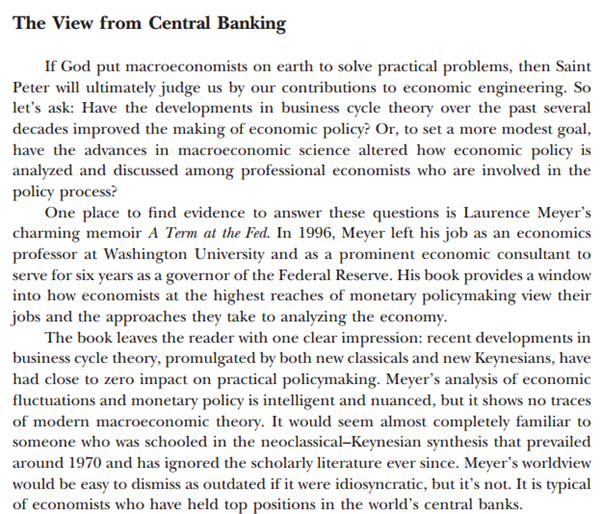
Two of my brothers studied economics in the early 1970s and then went on to different paths in law and computing respectively. If Greg Mankiw is right, my two older brothers could happily conduct a conversation with a modern central banker. Their 1970s macroeconomics, albeit batting for memory, would be enough for them to hold their own.

image

Source: AEAweb: JEP (20,4) p. 29 – The Macroeconomist as Scientist and Engineer – Greg Mankiw (2006).

I would spend my time arguing with a central banker that Milton Friedman may be right and central banks should be replaced with a computer. The success of inflation targeting is forcing me to think more deeply about that position. In particular the rise of pension fund socialism means that most voters are very adverse to inflation because of their retirement savings and that is before you consider housing costs are much largest proportions of household budgets these days.

Murphy’s Law of Economic Policy

My favourite quote from one of the best books I’ve ever read

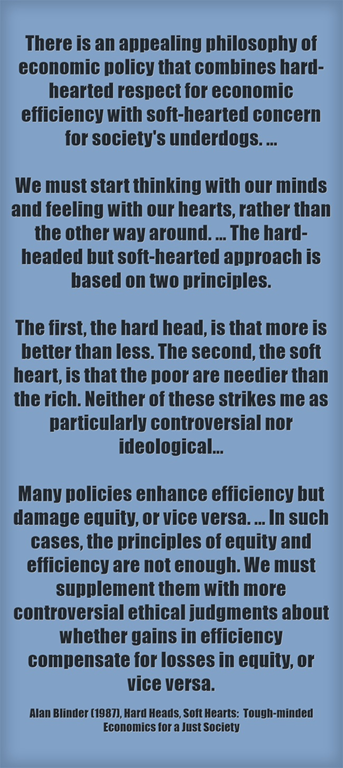
Alan blinder quote from hardheads, soft hearts

Image

Murphy’s Law of economic policy

Image

You’re an ideologue; no, you’re the ideologue!

I find that people who call out other people and opposing analysis as ideological are themselves ideologues. They cannot see political differences as other than ideological cat fights.

This is rather than an honest difference of opinion over the effectiveness of different options to achieve a common end as Milton Friedman explained:

I venture the judgment, however, that currently in the Western world, and especially in the United States, differences about economic policy among disinterested citizens derive predominantly from different predictions about the economic consequences of taking action – differences that in principle can be eliminated by the progress of positive economics – rather than from fundamental differences in basic values, differences about which men can ultimately only fight.

Hayek attributed to his opponents nothing more than intellectual error. Hayek (1948) believed that:

we must recognize that it may be genuine error which leads the well-meaning and intelligent people who occupy those key positions in our society to spread views which to us appear a threat to our civilization. Nothing could be more important than to try to understand the sources of this error in order that we should be able to counter it.

Hayek (1968) continues:

The worst mistake a fighter for our ideals can make is to ascribe to our opponents dishonest or immoral aims. I know it is sometimes difficult not to be irritated into a feeling that most of them are a bunch of irresponsible demagogues who ought to know better…

we ought to realize that their conceptions derive from serious thinkers whose ultimate ideals are not so very different from our own and with whom we differ not so much on ultimate values, but on the effective means of achieving them.

William Baumol and Alan Blinder described the role of economics in policy debates as follows:

While economic science can contribute the best theoretical and factual knowledge there is on a particular issue, the final decision on policy questions often rests either on information that is not currently available or on tastes and ethical opinions about which people differ (the things we call ‘value judgments’), or on both.

Lester Thurow said that differences in the valuation of outcomes is at the basis of most disagreements:

Liberal and conservative economists most frequently disagree on who ought to be hurt and who ought to be helped. Their technical disagreements on who will be hurt and who will be helped are much less frequent.

Karl Popper argued that who made an argument is of little value. He said that the growth of knowledge depended not on the ethics of the individual scientists but on the critical spirit to scientific community as a whole. The critical scrutiny of others polices the truth:

The genuine rationalist does not think that he or anyone else is in possession of the truth; nor does he think that mere criticism as such helps us achieve new ideas.

But he does think that, in the sphere of ideas, only critical discussion can help us sort the wheat from the chaff.

He is well aware that acceptance or rejection of an idea is never a purely rational matter; but he thinks that only critical discussion can give us the maturity to see an idea from more and more sides and to make a correct judgement of it.

Peter Drucker championed a business rule of never making a decision until there is disagreement; only then do you know what you are planning to do:

Unless one has considered alternatives, one has a closed mind.

This above all, explains why effective decision-makers deliberately disregard the second major command of the textbooks on decision-making and create dissension and disagreement, rather than consensus.

Decisions of the kind the executive has to make are not made well by acclamation.

They are made well only if based on the clash of conflicting views, the dialogue between different points of view, the choice between different judgments.

The first rule in decision-making is that one does not make a decision unless there is disagreement

Alfred P. Sloan said at a meeting of one of his top management committees:

“Gentlemen, I take it we are all in complete agreement on the decision here.”  Everyone around the table nodded assent.

“Then,”continued Sloan, “I propose we postpone further discussion of this matter until our next meeting to give ourselves time to develop disagreement and perhaps gain some understanding of what the decision is all about”.
Bassett, Brash & Hide

Celebrating humanity's flourishing through the spread of capitalism and the rule of law

Truth on the Market

Scholarly commentary on law, economics, and more

The Undercover Historian

Beatrice Cherrier's blog

Matua Kahurangi

Celebrating humanity's flourishing through the spread of capitalism and the rule of law

Temple of Sociology

Celebrating humanity's flourishing through the spread of capitalism and the rule of law

Velvet Glove, Iron Fist

Celebrating humanity's flourishing through the spread of capitalism and the rule of law

Why Evolution Is True

Why Evolution is True is a blog written by Jerry Coyne, centered on evolution and biology but also dealing with diverse topics like politics, culture, and cats.

Down to Earth Kiwi

Celebrating humanity's flourishing through the spread of capitalism and the rule of law

NoTricksZone

Celebrating humanity's flourishing through the spread of capitalism and the rule of law

Homepaddock

A rural perspective with a blue tint by Ele Ludemann

Kiwiblog

DPF's Kiwiblog - Fomenting Happy Mischief since 2003

The Dangerous Economist

Celebrating humanity's flourishing through the spread of capitalism and the rule of law

Watts Up With That?

The world's most viewed site on global warming and climate change

The Logical Place

Tim Harding's writings on rationality, informal logic and skepticism

Doc's Books

A window into Doc Freiberger's library

The Risk-Monger

Let's examine hard decisions!

Uneasy Money

Commentary on monetary policy in the spirit of R. G. Hawtrey

Barrie Saunders

Thoughts on public policy and the media

Liberty Scott

Celebrating humanity's flourishing through the spread of capitalism and the rule of law

Point of Order

Politics and the economy

James Bowden's Blog

A blog (primarily) on Canadian and Commonwealth political history and institutions

Science Matters

Reading between the lines, and underneath the hype.

Peter Winsley

Economics, and such stuff as dreams are made on

A Venerable Puzzle

"The British constitution has always been puzzling, and always will be." --Queen Elizabeth II

The Antiplanner

Celebrating humanity's flourishing through the spread of capitalism and the rule of law

Bet On It

Celebrating humanity's flourishing through the spread of capitalism and the rule of law

History of Sorts

WORLD WAR II, MUSIC, HISTORY, HOLOCAUST

Roger Pielke Jr.

Undisciplined scholar, recovering academic

Offsetting Behaviour

Celebrating humanity's flourishing through the spread of capitalism and the rule of law

JONATHAN TURLEY

Res ipsa loquitur - The thing itself speaks

Conversable Economist

Celebrating humanity's flourishing through the spread of capitalism and the rule of law

The Victorian Commons

Researching the House of Commons, 1832-1868

The History of Parliament

Articles and research from the History of Parliament Trust

Books & Boots

Reflections on books and art

Legal History Miscellany

Posts on the History of Law, Crime, and Justice

Sex, Drugs and Economics

Celebrating humanity's flourishing through the spread of capitalism and the rule of law

European Royal History

Exploring the Monarchs of Europe

Tallbloke's Talkshop

Cutting edge science you can dice with

Marginal REVOLUTION

Small Steps Toward A Much Better World

NOT A LOT OF PEOPLE KNOW THAT

“We do not believe any group of men adequate enough or wise enough to operate without scrutiny or without criticism. We know that the only way to avoid error is to detect it, that the only way to detect it is to be free to inquire. We know that in secrecy error undetected will flourish and subvert”. - J Robert Oppenheimer.

STOP THESE THINGS

The truth about the great wind power fraud - we're not here to debate the wind industry, we're here to destroy it.

Lindsay Mitchell

Celebrating humanity's flourishing through the spread of capitalism and the rule of law

Alt-M

Celebrating humanity's flourishing through the spread of capitalism and the rule of law

croaking cassandra

Economics, public policy, monetary policy, financial regulation, with a New Zealand perspective

The Grumpy Economist

Celebrating humanity's flourishing through the spread of capitalism and the rule of law

International Liberty

Restraining Government in America and Around the World