This visiting American education professor who specialises in globalisation, claimed in the linked radio interview that real wages had fallen in the USA and Mexico. Even for the bottom 20% of the USA, their after-tax household incomes increased by 40% since 1979, with most of that after the signing of NAFTA.
Women’s earnings growth has been perfectly fine over the last 40 years despite the horrors of NAFTA and the attack on unions and workers rights by a top 1% emboldened by NAFTA and globalisation, if our visiting academic is to be believed.
Gender analysis, gender analysis, where is his gender analysis of NAFTA? Few labour market statistics make sense without being broken down by sex because of the immense economic progress of women in the last 50 years. Can NAFTA claim credit for that?
Green MP Gareth Hughes today nailed the case as to why governments should never run businesses. Too many MPs simply do not understand what dividends represent and what the profits from asset sales represent.
Data out today shows the asset sales so far have cost $1 billion. https://t.co/HeDndEjINg – double blow for Kiwis facing rising power bills
Hughes was reported today saying that taxpayers lost nearly $1 billion in dividends since the recent privatisations of power companies. He is the Green party spokesman on state owned enterprises.
Does the Green Party understand that an asset sells for a price equal to its risk-adjusted discounted net present value of the stream of dividends. When you sell a financial asset, you cash out the net present value of the stream of dividends that might have come from those assets.
The Greens, who are prissy about government transparency and dishonesty of their opponents, did not mention the $4.7 billion in revenue from the asset sale. Taxpayers now receiving more in dividends as a part owner of the privatised power companies than they did as a full owner.
Hughes had the cheek to complain about the politicisation of those privatisations such as favourable terms for small share buyers. That inability of governments to even sell an asset competently is a strong reason why governments should never run businesses in the first place.
If an asset cannot be sold in the full light of day – a major issue in an election campaign and a referendum – without the sale price that is politicised, what is the chance of good management of any state-owned enterprise when it is not the central focus of opposition scrutiny?
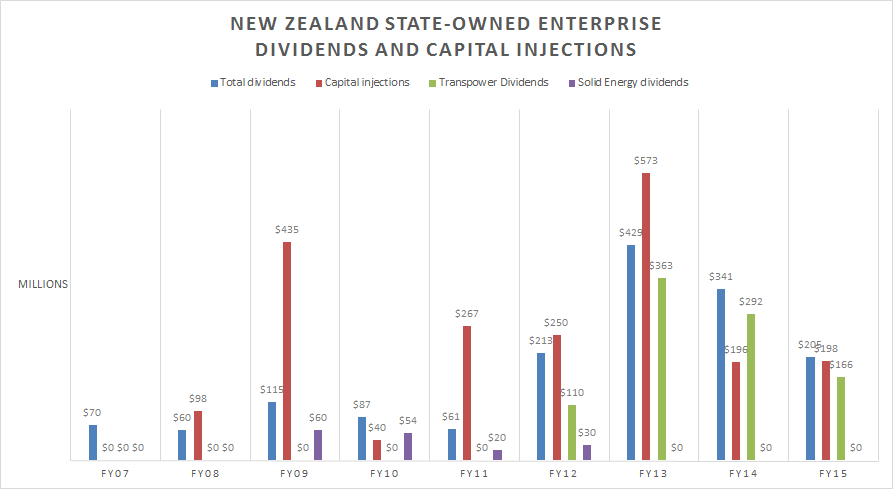
It is been many years since dividends from the state-owned enterprise portfolio has been a net positive cash flow for the taxpayer, as the chart below shows.
Source: New Zealand Treasury – data released under the Official Information Act.
KiwiRail and Solid Energy gobbled up whatever dividends came out of the power companies. Aside from power companies, state-owned enterprises not really offer much in the way of dividends to the taxpayer as the chart again shows.
Fascinating. Yawning chasm between why Labour members think they lost and why voters think they did. From @thetimeshttp://t.co/MvhZYI2CTr— Joe Watts (@JoeWatts_) July 23, 2015
Left-wingers do whinge about voters not understanding; about how if only the voters understood better their arguments than they do now. The Left thinks voters just keep getting it wrong.
The evidence—most notably, the results of the 1996 Survey of Americans and Economists on the Economy—shows that the general public’s views on economics not only are different from those of professional economists but are less accurate, and in predictable ways.
The public really does generally hold, for starters, that prices are not governed by supply and demand, that protectionism helps the economy, that saving labour is a bad idea, and that living standards are falling.
Politicians mindful of re-election must pander to these four biases.
Fortunately, for the New Zealand Labour Party and the Green Party of Aotearoa New Zealand, voters have no rational reason to correct these four biases. Voters are rationally irrational. As each individual counts so little, why spend any time correcting biased political beliefs?
Anti-market bias: The tendency to underestimate the benefits of the market mechanism. The typical voter equates market phenomena such as profitability and interest as examples of unbridled monetary confiscations by ‘greedy’ businesses. This biased against the market, despite all its successes, is a rich field to till for both Labour and the Greens
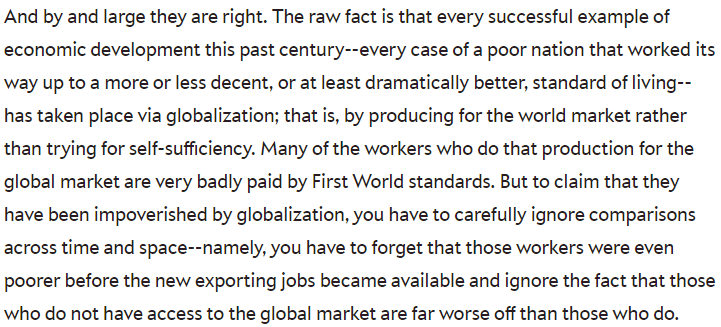
Anti-foreign bias: The tendency to underestimate the economic benefits of interaction with foreigners. This antagonism towards such trends as outsourcing employment overseas, or selling raw materials to faraway traders, is reminiscent of the mercantilism Adam Smith so brilliantly demolished but it still lives on today in the hearts of the voting citizenry. Labour and the Greens play to that bias shamelessly.
Make-work bias: The tendency to underestimate the economic benefits from conserving labour. Those who look to the visible face of job losses overlook the job gains (often by those who lost their jobs) to be made tomorrow in emerging industries. The Greens and Labour are sure-fire enemies of creative destruction.
Pessimistic bias: The tendency to overestimate the severity of economic problems, and to underestimate the recent past, present and future performance of the economy. In The Progress Paradox (2003), Gregg Easterbrook ridicules abundance denial:
Our forebears, who worked and sacrificed tirelessly in the hopes their descendants would someday be free, comfortable, healthy, and educated, might be dismayed to observe how acidly we deny we now are these things.
Many average voters seem to feel that Malthus was correct in diagnosing the allegedly poor prospects for the market economy.
CLASSIC VIDEO: Margaret Thatcher on Socialism in 1990 to the House of Commons https://t.co/iB5O3ejoaC
Where would the voting base of the Greens be without a pessimism bias? They are professional pessimists and doomsday prophets from their earliest days. Labour assumes working class Tories are dupes of what is left of fading media barons such as Rupert Murdoch.
Why Evolution is True is a blog written by Jerry Coyne, centered on evolution and biology but also dealing with diverse topics like politics, culture, and cats.
“We do not believe any group of men adequate enough or wise enough to operate without scrutiny or without criticism. We know that the only way to avoid error is to detect it, that the only way to detect it is to be free to inquire. We know that in secrecy error undetected will flourish and subvert”. - J Robert Oppenheimer.




 Utopia, you are standing in it!
Recent Comments