Is unemployment voluntary or involuntary?

Robert Lucas in a famous 1978 paper argued that all unemployment was voluntary because involuntary unemployment was a meaningless concept. He said as follows:

The worker who loses a good job in prosperous time does not volunteer to be in this situation: he has suffered a capital loss. Similarly, the firm which loses an experienced employee in depressed times suffers an undesirable capital loss.

Nevertheless the unemployed worker at any time can always find some job at once, and a firm can always fill a vacancy instantaneously. That neither typically does so by choice is not difficult to understand given the quality of the jobs and the employees which are easiest to find.

Thus there is an involuntary element in all unemployment, in the sense that no one chooses bad luck over good; there is also a voluntary element in all unemployment, in the sense that however miserable one’s current work options, one can always choose to accept them.

I agree that we all make choices subject to constraints. To say that a choice is involuntary because it is constrained by a scarcity of job-opportunities information is to say that choices are involuntary because there is scarcity.

Alchian said there are always plenty of jobs because to suppose the contrary suggests that scarcity has been abolished. Lucas elaborated further in 1987 in Models of Business Cycles:

A theory that does deal successfully with unemployment needs to address two quite distinct problems.

One is the fact that job separations tend to take the form of unilateral decisions – a worker quits, or is laid off or fired – in which negotiations over wage rates play no explicit role.

The second is that workers who lose jobs, for whatever reason, typically pass through a period of unemployment instead of taking temporary work on the ‘spot’ labour market jobs that are readily available in any economy.

Of these, the second seems to me much the more important: it does not ‘explain’ why someone is unemployed to explain why he does not have a job with company X. After all, most employed people do not have jobs with company X either.

To explain why people allocate time to a particular activity – like unemployment – we need to know why they prefer it to all other available activities: to say that I am allergic to strawberries does not ‘explain’ why I drink coffee. Neither of these puzzles is easy to understand within a Walrasian framework, and it would be good to understand both of them better, but I suggest we begin by focusing on the second of the two.

Another way to understand unemployment is to use a device at the start of Alan Manning’s book on labour market monopsony:

What happens if an employer cuts the wage it pays its workers by one cent? Much of labour economics is built on the assumption that all existing workers immediately leave the firm as that is the implication of the assumption of perfect competition in the labour market.

In such a situation an employer faces a market wage for each type of labour determined by forces beyond its control at which any number of these workers can be hired but any attempt to pay a lower wage will result in the complete inability to hire any of them at all

Suppose workers offered to work for 1 cent. Would employers accept? Many do because they have intern and work experience programmes for students, but is this result of general application?

Understanding the reallocation of labour at the end of the recession requires careful attention to the 1980s writing of Alchian on the theory of the firm. Alchian and Woodward’s 1987 ‘Reflections on a theory of the firm’ says:

… the notion of a quickly equilibrating market price is baffling save in a very few markets. Imagine an employer and an employee. Will they renegotiate price every hour, or with every perceived change in circumstances?

If the employee is a waiter in a restaurant, would the waiter’s wage be renegotiated with every new customer? Would it be renegotiated to zero when no customers are present, and then back to a high level that would extract the entire customer value when a queue appears?

… But what is the right interval for renegotiation or change in price? The usual answer ‘as soon as demand or supply changes’ is uninformative.

Alchian and Woodward then go on to a long discussion of the role of protecting composite quasi-rents from dependent resources as the decider of the timing of wage and price revisions.

Alchian and Woodward explain unemployment as a side-effect of the purpose of wage and price rigidity, which is the prevention of hold-ups over dependent assets. They note that unemployment cannot be understood until an adequate theory of the firm explains the type of contracts the members of a firm make with one another.

My interpretation is the majority of employment relationships are capital intensive long-term contracts. Employers spend a lot of time searching and screening applicants to find those that will stay longer. In less skilled jobs, and in spot market jobs, employers will hire the best applicant quickly because job turnover costs are low. Back to Manning again:

That important frictions exist in the labour market seems undeniable: people go to the pub to celebrate when they get a job rather than greeting the news with the shrug of the shoulders that we might expect if labour markets were frictionless. And people go to the pub to drown their sorrows when they lose their job rather than picking up another one straight away. The importance of frictions has been recognized since at least the work of Stigler (1961, 1962).

Whatever may be among these frictions, wage rigidity is not one of them. Wages are flexible for job stayers and certainly new starters.

See What can wages and employment tell us about the UK’s productivity puzzle? by Richard Blundell, Claire Crawford and Wenchao Jin showing that in the recent UK recession 12% of employees in the same job as 12 months ago experienced wage freezes and 21% of workers in the same job as 12 months ago experienced wage cuts. Their data covered 80% of workers in the New Earnings Survey Panel Dataset.

Larger firms lay off workers; smaller firms tended to reduce wages. This British data showing widespread wage cuts dates back to the 1980s. Recent Irish data also shows extensive wage cuts among job stayers.

See too Chris Pissarides (2009), The Unemployment Volatility Puzzle: Is Wage Stickiness the Answer? arguing the wage stickiness is not the answer since wages in new job matches are highly flexible:

  1. wages of job changers are always substantially more procyclical than the wages of job stayers.
  2. the wages of job stayers, and even of those who remain in the same job with the same employer are still mildly procyclical.
  3. there is more procyclicality in the wages of stayers in Europe than in the United States.
  4. The procyclicality of job stayers’ wages is sometimes due to bonuses, and overtime pay but it still reflects a rise in the hourly cost of labour to the firm in cyclical peaks

How do existing firms who will not cut wages survive in competition with new firms who can start workers on lower wages? Industries with many short term jobs and seasonal jobs would suffer less from wage inflexibility.

Robert Barro (1977) pointed out that wage rigidity matters little because workers can, for example, agree in advance that they will work harder when there is more work to do—that is, when the demand for a firm’s product is high—and work less hard when there is little work. Stickiness of nominal wage rates does not necessarily cause errors in the determination of labour and production.

The ability to make long-term wage contracts and include clauses that guard against opportunistic wage cuts should make the parties better off. Workers will not sign these contracts if they are against their interests. Employers do not offer these contracts, and offer more flexible wage packages, will undercut employers who are more rigid. Furthermore many workers are on performance pay that link there must wages to the profitability of the company.

How can downward wage rigidity be a scientific hypothesis if extensive international evidence of widespread wage cuts since the 1980s and 30%+ of the workforce on performance bonuses is not enough to refute it?

Alchian and Kessel in “The Meaning and Validity of the Inflation-Induced Lag of Wages Behind Prices,” Amer. Econ. Rev. 50 [March 1960]:43-66) tested the hypothesis that workers suffered from money illusion by comparing the rates of return to firms in capital intensive industries with those of labour intensive industries. Labour intensive industries were not more profitable than capital intensive industries. Employers in labour intensive industries should profit from the misperceptions of workers about wages and future prices, but they did not.  Alchian and Kessel found little evidence of a lag between wage and price changes.

In Canadian industries in the 1960s and 1970s, wage indexation ranged from zero to nearly 100%. Industries with little indexation should show substantial responses of real wage rates, employment and output to nominal shocks. Industries with lots of indexation would be affected little by nominal disturbances. Monetary shocks had positive effects but an industry’s response to these shocks bore no relation to the amount of indexation in the industry. Shaghil Ahmed (1987) found that those industries with lots of indexation were as likely as those with little indexation to respond to shocks.

If the signing of new wage contracts was important to wage rigidity, there should be unusual behaviour of employment and real wage rates just after these signings, but the results are mixed. Olivei and Tenreyro (2010) used the tendency of contracts to be signed at the start of years to show that monetary policy had significant effects in January but little effect in December because the effects were quickly undone.

Alchian (1969) lists three ways to adjust to unanticipated demand fluctuations:
• output adjustments;
• wage and price adjustments; and
• Inventories and queues (including reservations).

Alchian (1969) suggests that there is no reason for wage and price changes to be used regardless of the relative cost of these other options:
• The cost of output adjustment stems from the fact that marginal costs rise with output;
• The cost of price adjustment arises because uncertain prices and wages induce costly search by buyers and sellers seeking the best offer; and
• The third method of adjustment has holding and queuing costs.

There is a tendency for unpredicted price and wage changes to induce costly additional search. Long-term contracts including implicit contracts arise to share risks and curb opportunism over relationship-specific capital. These factors lead to queues, unemployment, spare capacity, layoffs, shortages, inventories and non-price rationing in conjunction with wage stability.

Information costs are just costs?


Yoram Barzel and Harold Demsetz pointed out that some economists want to stigmatise information costs. Armen Alchian was in this camp too.

Demsetz asked why the costs of finding, digging up and processing an ore deposit is a legitimate cost, but the costs of finding and interpreting information are illegitimate costs. There is an arbitrary classification of costs going on here according to Demsetz:

…there exists an efficient amount of ignorance in an economic system if the cost of acquiring information is positive.

The amount of ignorance that is efficient increases as does the cost of transacting (viewed as the cost of conveying information). Ignorance not only may be bliss, it also may be efficient.

One cannot claim that resources are wrongly allocated simply because information is not possessed or negotiation is absent; nor can one claim that resources are misplaced because a specific market does not exist.

None of these is free, and the costs of acquiring information and creating and maintaining markets may be so high as to make it efficient to forego some information and some markets.

A decision that something is not worth taking into account is not, because of this, a source of inefficiency. That this something is not taken into account is a reckoning if it follows from a thoughtful anticipation that it is not worth taking into account. An explicit accounting for every ‘something’ would be inefficient indeed in a world in which knowledge is not free

Alchian and Allen on the irrelevance of economists and economic principles to progress

Image

Alchian and Allen’s list of economic fallacies

  • Price controls prevent higher costs to consumers;
  • reducing unemployment requires creating more jobs;
  • larger incomes for some people require  smaller incomes for others;
  • free, or low, tuition reduces costs to students;
  • unemployment is wasteful;
  • stockbrokers and investment advisors predict better than throwing a dart at a list of stocks;
  • international trade deficits are bad and surpluses are good;
  • inflation is caused by government deficits;
  • government budget deficits reduce saving and raise interest  rates;
  • new taxes are borne by the consumer of the taxed items;
  • employers pay for "employer provided" insurance;
  • tax-exempt bonds avoid taxes;
  • minimum wages help the unskilled and minorities;
  • housing developers drive up the price of land;
  • foreign imports reduce domestic jobs;
  • "equal pay for equal work" aids women, minorities and the young;
  • very low unemployment causes inflation; and
  • the Federal Reserve Board controls the rate of interest.

Source: Universal Economics

The share market as a spy, investigator and muckraker: using share price movements to uncover secrets and solve mysteries

Armen Alchian successfully identifying lithium as the fissile fuel in the Bikini Atoll atomic bomb using only publicly available financial data. The early 1954 RAND corporation memo by Alchian was classified a few days later.

The Stock Market Speaks: How Dr. Alchian Learned to Build the Bomb by Joseph Michael Newhard, August 27, 2013 at for a replication study of Alchian’s event study of share market reactions to the Bikini Atoll nuclear detonations in 1954 updated with declassified information and modern finance theory.

An extra challenge for Alchian was not only was the component of the bomb classified, whether the explosion was atomic or hydrogen was classified too.

The share price of the supplier of lithium surged within a few days.

The replication study by Newhard found a significant upward movement in the price of Lithium Corporation relative to the other corporations. Within three weeks of the explosion, its shares were up 48% before settling down to a monthly return of 28% despite secrecy, scientific uncertainty, and public confusion surrounding the test; the company saw a return of 461% for the year.

The share market is a surprising efficient tool for discerning new knowledge.

After the Challenger space shuttle disaster in 1986, the share market identified within the hour which component supplier made the faulty part and marked it down accurately as to damages and loss of business. The blue ribbon commission of inquiry took 6-months to find the culprit.

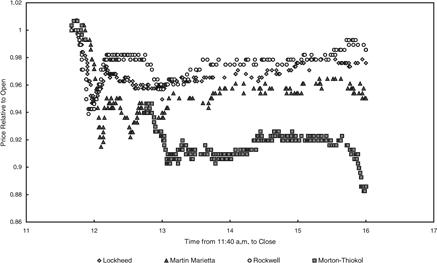
In the period immediately following the crash, securities trading in the four main shuttle contractors singled out Morton Thiokol as having manufactured the faulty component.

Intraday stock price movements following the challenger disaster


At market close, Thiokol’s shares were down nearly 12 per cent. By contrast, the share prices of the three other firms started to creep back up, and by the end of the day their value had fallen only around 3 per cent.

Morton Thiokol shed some $200 million in market value on the day. Over the next several months, the other contractors recovered and outperformed the market while Morton Thiokol lagged.

As a result of the investigation, Morton Thiokol had to pay legal settlements and perform repair work of $409 million at no profit. It also dropped out of bidding for future business.

The $200 million equity decline for Morton Thiokol in hindsight is a reasonable prediction of lost cash flows that came as a result of the judgment of culpability in the crash.

William Brown found that a group of firms that had significant ties to Lyndon Johnson increased in the market value after President Kennedy’s assassination. The share prices of General Dynamics, whose main aircraft plant was located in Fort Worth, Texas, climbed from $23.75 on November 22 to $25.13 on November 26, and by February 1964 was up over $30, a jump of around 30 per cent in three months.

Over the ten trading days following the announcement of Timothy Geithner’s nomination as U.S. Treasury Secretary, financial firms with a connection to Geithner experienced a cumulative abnormal return of about 12% relative to other financial sector firms. This reversed when his nomination ran into trouble due to unexpected tax return issues.

Pat Akey (2013) looked at the abnormal returns in share prices around close U.S. congressional elections. Firms gain on the election of a politician with whom they are connected – and they lost when he or she is defeated. The cumulative abnormal return to be between 1.7% and 6%.


Armen Alchian would have been 100 today

From Alchian’s and William Allen’s 1968 “What Price Zero Tuition?“

Since the fiasco in the Garden of Eden, mankind has suffered from scarcity: there cannot be enough goods and services to satisfy completely all the wants of all the people all the time.

Consequently, man has had to learn the hard way that in order to obtain more of this good he must forego some of that: most goods carry a price, and obtaining them involves the bearing of a cost.

Poets assure us that the best things in life are free. If so, education is a second-best good, for it decidedly is not free. But if education is not free, if a price must be paid, who is to pay it?

By developed instinct, the economist initially presumes it to be appropriate that payment of the price should be made by those who receive the good.

"Those who get should pay" is a strong rule of thumb; the economist will deviate from it only for profoundly compelling reasons.

via Quotation of the Day…. Cafe Hayek

Alchian and Allen wrote the best economics textbook ever.

Product Details

Exchange and Production: Competition, Coordination and Control in 1977

Armen Alchian on property rights

Profit maximisation gets no respect

Who would own up to personal greed and selfishness? But who sends a tip in with their taxes?

George Stigler said that if you ask business owners if they maximise profits, they say no, no, no. They are just there to provide employment, a service for their customers, and then they put a small amount aside for the education of their children.

Stigler then said that if you asked them if they lowered their prices, would they increase their profits, the answer is invariably no.

Stigler then said that if you asked them if they raised their prices, would they increase their profits, the answer is invariably no.

Stigler then said that if you asked them if they have in the last 12-months substituted some other objective for profit, they throw you out of their office.

What people do is far more important than what they say and what they say motivated them.

Alchian pointed out the evolutionary struggle for survival in the face of market competition ensured that only the profit maximising firms survived:

  • Realised profits, not maximum profits, are the marks of success and viability in any market. It does not matter through what process of reasoning or motivation that business success is achieved.
  • Realised profit is the criterion by which the market process selects survivors.
  • Positive profits accrue to those who are better than their competitors, even if the participants are ignorant, intelligent, skilful, etc. These lesser rivals will exhaust their retained earnings and fail to attract further investor support.
  • As in a race, the prize goes to the relatively fastest ‘even if all the competitors loaf.’
  • The firms which quickly imitate more successful firms increase their chances of survival. The firms that fail to adapt, or do so slowly, risk a greater likelihood of failure.
  • The relatively fastest in this evolutionary process of learning, adaptation and imitation will, in fact, be the profit maximisers and market selection will lead to the survival only of these profit maximising firms.

These surviving firms may not know why they are successful, but they have survived and will keep surviving until overtaken by a better rival. All business needs to know is a practice is successful. The reason for its success is less important.

Great store is placed in industry economics on how firms in direct competition in the same market producing even rather standard products such as cement can have far greater measured productivity than others. Some firms produce half as much output from the same measured inputs as their market rivals and still survive in competition (Syverson 2011).

As is too common, the conclusion is there is something wrong with the firms in these markets rather than with the analysis that fails to understand these puzzlingly large gaps in measured productivity.

Few ask the obvious question, which is how do these firms survive if they are so inferior to the market leaders. The important fact is they do survive. They must be doing something right for their customers that the productivity statistics miss.

One method of organising production and supplying to the market will supplant another when it can supply at a lower price (Marshall 1920, Stigler 1958). Gary Becker (1962) argued that firms cannot survive for long in the market with inferior product and production methods regardless of what their motives are. They will not cover their costs.

The more efficient sized firms are the firm sizes that are currently expanding their market shares in the face of competition; the less efficient sized firms are those that are currently losing market share (Stigler 1958; Alchian 1950; Demsetz 1973, 1976). Business vitality and capacity for growth and innovation are only weakly related to cost conditions and often depends on many factors that are subtle and difficult to observe (Stigler 1958, 1987).

An example is in Adam Smith’s study of religion. One thing he noticed was that religious sects with strict codes of honesty and intense mutual monitoring by co-congregants for the slightest moral lapses proliferated in cities. Many successful businessmen belonged to these strict religions. These highly religious businessmen were successful in their businesses because they were looked upon by the public as reliable trading partners in a time of weak law enforcement. These businessmen did not know that this was profit maximising but the businessmen with religious backgrounds slowly gained market share over rival firms that had less efficient ways of communicating both their reliability and that their personal honesty was under daily scrutiny.

Ethnic minorities are advantaged in the same way in business. Because of their extensive social interactions with each other because of their language or religious practices and inter-marriage, the costs of bad business behaviours are much higher due to the risk of social ostracism by everyone you know.  This greater trustworthiness gives them a cost advantage in the marketplace even though they may be unaware of its source.

Whatever is, is efficient – part 1

Armen Alchian would ask “If something is so optimal, why don’t we see it then?”

The best way Alchian related this discipline on thinking was to point to something like the question of optimal taxes. If optimal taxes are so optimal, why don’t we see more of these optimal taxes in practice?

There must be other costs left out of your optimal tax analysis. There might be less obvious costs in the political system in organising support or other changes that are required that are overlooked, making optimal taxes such a ‘low-cost’ option. Most objectives look better than they are if you ignore some of the costs of achieving those objectives.

Alchian asserted that “whatever is, is efficient.”

  • If the status quo was not efficient, something else would eventuate;
  • Of course, if you try to change anything that is – that too is efficient because otherwise you would not try to do so.

The key point is why are we weighing only some costs and not others? Why are these costs (involved in minimizing particular dead-weight losses that would be involved in setting a particular optimal tax) less important than other types of costs (those involved in informing people of what the options are or of organizing them to go and try to adopt the alternative option)? Optimal taxes are also decidedly less optimal if they allow governments to raise more revenue, and the extra revenue is not spent wisely.

alchian.jpg (27212 bytes)

Alchian’s analysis of institutions and processes spent a lot of time showing that many often puzzling institutions and practices arose to lower various costs of decision making and transacting in the market and within organisations and groups. Many of these costs are far from obvious and must be teased out through difficult, time-consuming analysis.

Alchian was a great teacher. He taught in the Socratic Method. He posed countless questions to force his students to think harder and deeper.

Behavioural economics is an example of a whole field that expanded not by thinking harder and deeper using standard economic tools. It explains anomalous behaviour and seemingly irrational choices as the result of cognitive quirks or short-sightedness and a range of people’s other shortcomings. That is easier than spending a few more decades getting to the bottom of the matter.

George Stigler in the 1960s made a marvellous critique of what became behavioural economics back in the early 1960s by saying that in every decade for the last 150 years, economists dabbled in psychology.

Stigler said that they missed the point of economics as a method. He argued that the simple hypothesis of rational behaviour is so powerful because it can account for so much of human behaviour. Stigler adds this in his Tanner Lectures in 1981:

Members of  other  social sciences  often  remark, in fact I must say complain, at the peculiar fascination that the logic of rational decision-making exerts upon economists.

It is such an interesting logic: it has answers to so many and varied questions, often answers that are simultaneously reasonable to economists and absurd to others. The paradoxes are not diminished by the delight with which economists present them…

The power of self-interest, and its almost unbelievable delicacy and subtlety in complex decision areas, has led economists to seek a large role for explicit or implicit prices in the solution of many social problems.

Richard Posner went further and argued that behavioural economics may not be a science in Popper’s sense of falsifiability.

Posner referred to Cardinal Bellarmine’s famous description of what he saw in Galileo’s telescope which was pointing to the moons rotating around Saturn. Cardinal Bellarmine explained it as a trick of the devil.

Behavioural economics, in Richard Posner’s view, is close to Cardinal Bellarmine’s trick of the devil methodology because it explains anomalies away either as cognitive quirks or as rational behaviour. Nothing is an anomaly for behavioural economics so nothing can falsify it. Instead of the devil making me do it, a cognitive quirk made me do it.

Posner’s key point was:

Rational-choice economics makes the analyst think hard. Faced with anomalous behaviour, the rational-choice economist, unlike the behavioural economist, doesn’t respond, “Of course, what do you expect?” Troubled, puzzled, challenged; he wracks his brains for some theoretical extension or modification that will accommodate the seeming anomaly to the assumption of rationality.

Rather than attribute odd behaviour to cognitive quirks or short-sightedness, the better explanation is the behaviour is not fully understood.

Is there media bias?

A leading characteristic of media bias is that people agree on its existence, but disagree on its manifestation.

The print media is under dire threats to its existence at the moment. A newspaper that ignores what its readers want does so only at great peril.

Armen Alchian and George Stigler both argued that realised profits are the criterion by which the market process selects survivors: those who realise positive profits survive and will grow their market share; those who suffer losses will eventually disappear unless they improve themselves. The surviving media outlets will be those firms that anticipated or adapted fastest to the current and future demands of their readers and viewers.

Any media bias is likely to be slightly to the centre-left for the following reasons:

  1. Young women tend to be one of the most marginal groups of news consumers (i.e., they are the most willing to switch to activities besides reading or watching the news).
  2. Young women often make more of the consumption decisions for the household so advertisers will pay more to reach this group.
  3. Since young women tend to be more centre-left, on average, a news outlet may want to slant its coverage that way. Media sell space to advertisers and tailor the way they cover politics to gain more readers and viewers.

Puglisi and Snyder found that:

  • Using endorsements of state-level initiatives and referendums, newspapers are located almost exactly with the median voter – the average voter – in their home states.
  • Newspapers are moderate relative to interest groups and political parties.
  • Although newspapers exhibit some variation in their ideological position, they tend to be much closer to the median voter than most interest groups.
  • Newspapers appear to be more liberal than voters on social and cultural issues such as gay marriage, but tend to be more conservative on economic issues such as the minimum wage.
  • On average, the news and editorial sections have almost identical partisan positions.

Positive profits accrue to media outlets that are better at serving their readers and viewers than their competitors. Their lesser rivals will lose money, exhaust their retained earnings and fail to attract further investor support.

There is no best practice on measuring media bias. The literature is too young. Milton Friedman put up robustness as his test. Hit the hypothesis with as many tests as possible with many different data sets.

Most studies using many different data sets and methodologies suggest that the media reflects the politics of the market they serve. Newspapers and TV stations are big businesses, and they increased readership, ratings and revenue by presenting factual and informative news with a dose of ‘infotainment’. 

Competition forces news media outlets, just like any other firm, to cater to their customers’ preferences. Why did anyone think the media industry was any different from any other?

Next Newer Entries

Bassett, Brash & Hide

Celebrating humanity's flourishing through the spread of capitalism and the rule of law

Truth on the Market

Scholarly commentary on law, economics, and more

The Undercover Historian

Beatrice Cherrier's blog

Matua Kahurangi

Celebrating humanity's flourishing through the spread of capitalism and the rule of law

Temple of Sociology

Celebrating humanity's flourishing through the spread of capitalism and the rule of law

Velvet Glove, Iron Fist

Celebrating humanity's flourishing through the spread of capitalism and the rule of law

Why Evolution Is True

Why Evolution is True is a blog written by Jerry Coyne, centered on evolution and biology but also dealing with diverse topics like politics, culture, and cats.

Down to Earth Kiwi

Celebrating humanity's flourishing through the spread of capitalism and the rule of law

NoTricksZone

Celebrating humanity's flourishing through the spread of capitalism and the rule of law

Homepaddock

A rural perspective with a blue tint by Ele Ludemann

Kiwiblog

DPF's Kiwiblog - Fomenting Happy Mischief since 2003

The Dangerous Economist

Celebrating humanity's flourishing through the spread of capitalism and the rule of law

Watts Up With That?

The world's most viewed site on global warming and climate change

The Logical Place

Tim Harding's writings on rationality, informal logic and skepticism

Doc's Books

A window into Doc Freiberger's library

The Risk-Monger

Let's examine hard decisions!

Uneasy Money

Commentary on monetary policy in the spirit of R. G. Hawtrey

Barrie Saunders

Thoughts on public policy and the media

Liberty Scott

Celebrating humanity's flourishing through the spread of capitalism and the rule of law

Point of Order

Politics and the economy

James Bowden's Blog

A blog (primarily) on Canadian and Commonwealth political history and institutions

Science Matters

Reading between the lines, and underneath the hype.

Peter Winsley

Economics, and such stuff as dreams are made on

A Venerable Puzzle

"The British constitution has always been puzzling, and always will be." --Queen Elizabeth II

The Antiplanner

Celebrating humanity's flourishing through the spread of capitalism and the rule of law

Bet On It

Celebrating humanity's flourishing through the spread of capitalism and the rule of law

History of Sorts

WORLD WAR II, MUSIC, HISTORY, HOLOCAUST

Roger Pielke Jr.

Undisciplined scholar, recovering academic

Offsetting Behaviour

Celebrating humanity's flourishing through the spread of capitalism and the rule of law

JONATHAN TURLEY

Res ipsa loquitur - The thing itself speaks

Conversable Economist

Celebrating humanity's flourishing through the spread of capitalism and the rule of law

The Victorian Commons

Researching the House of Commons, 1832-1868

The History of Parliament

Articles and research from the History of Parliament Trust

Books & Boots

Reflections on books and art

Legal History Miscellany

Posts on the History of Law, Crime, and Justice

Sex, Drugs and Economics

Celebrating humanity's flourishing through the spread of capitalism and the rule of law

European Royal History

Exploring the Monarchs of Europe

Tallbloke's Talkshop

Cutting edge science you can dice with

Marginal REVOLUTION

Small Steps Toward A Much Better World

NOT A LOT OF PEOPLE KNOW THAT

“We do not believe any group of men adequate enough or wise enough to operate without scrutiny or without criticism. We know that the only way to avoid error is to detect it, that the only way to detect it is to be free to inquire. We know that in secrecy error undetected will flourish and subvert”. - J Robert Oppenheimer.

STOP THESE THINGS

The truth about the great wind power fraud - we're not here to debate the wind industry, we're here to destroy it.

Lindsay Mitchell

Celebrating humanity's flourishing through the spread of capitalism and the rule of law

Alt-M

Celebrating humanity's flourishing through the spread of capitalism and the rule of law

croaking cassandra

Economics, public policy, monetary policy, financial regulation, with a New Zealand perspective

The Grumpy Economist

Celebrating humanity's flourishing through the spread of capitalism and the rule of law

International Liberty

Restraining Government in America and Around the World