The most detailed map of Australian population density ever* theguardian.com/news/datablog/…
(*for regional areas, anyway) http://t.co/HFVYxrkRmN—
Nick Evershed (@NickEvershed) December 22, 2014
Australia’s population density mapped
17 Jul 2015 Leave a comment
in population economics Tags: Australia, maps, population density
Poverty rates among immigrants and natives across the OECD
16 Jul 2015 Leave a comment
in income redistribution, labour economics, politics - Australia, politics - New Zealand, politics - USA, poverty and inequality, welfare reform Tags: Australia, child poverty, economics of immigration, family poverty
How many working poor in USA, UK, Canada, Australia and New Zealand?
14 Jul 2015 Leave a comment
in international economics, labour supply, minimum wage, politics - Australia, politics - New Zealand, politics - USA, poverty and inequality, welfare reform Tags: Australia, British economy, Canada, low pay, New Zealand, social insurance, welfare state, working poor
Figure 1: working poor – proportion of employed persons with income below the poverty line (50% of median disposable income) living in households with a working age head and at least one worker in USA, UK, Canada, Australia and New Zealand, 2013
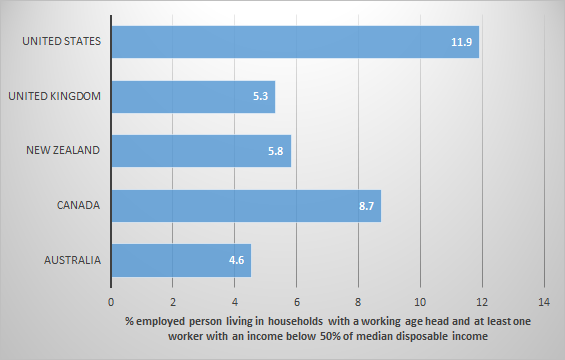
Source: In It Together – Why Less Inequality Benefits All – © OECD 2015, OECD Income Distribution Database (IDD), www.oecd.org/social/income-distribution-database.htm, Table 1.A1.1. Key indicators on the distribution of household disposable income and poverty, 2007, 2011 and 2013 or most recent year.
Immigrants and their children across the OECD
14 Jul 2015 Leave a comment
in labour economics, labour supply, politics - Australia, politics - New Zealand, politics - USA, population economics Tags: Australia, economics of identity, economics of immigration
Poverty rates by age of youngest child – USA, UK, Canada and Australia
11 Jul 2015 Leave a comment
in economics of love and marriage, labour economics, labour supply, law and economics, politics - Australia, politics - USA, poverty and inequality, welfare reform Tags: Australia, British economy, Canada, child poverty, family poverty, marriage and divorce, single mothers, single parents
Figure 1: poverty rates by age of youngest child, 2004

Gender wage gap, USA, UK, Australia and New Zealand since 2001
04 Jul 2015 Leave a comment
in discrimination, economic history, gender, labour economics, politics - Australia, politics - New Zealand, politics - USA Tags: Australia, British economy, gender wage gap
Figure 1: Gender wage gap (unadjusted % difference between median wages of male and female full-time employees)
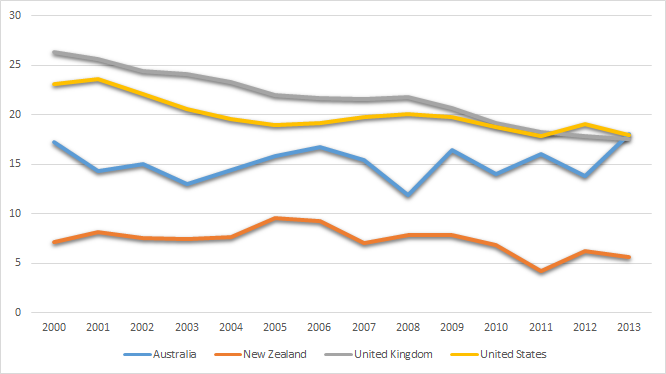
Source: OECD StatExtract.
45% of Australia and New Zealand are immigrants or their children
03 Jul 2015 Leave a comment
in politics - Australia, politics - New Zealand, politics - USA, population economics Tags: Australia, economics of immigration
Top performers in science by gender, USA, UK, Japan, Canada, Australia and New Zealand
02 Jul 2015 Leave a comment
in discrimination, economics of education, gender, human capital, labour economics Tags: Australia, British economy, Canada, Japan, lost boys, reversing gender gap
Why are Japanese 15-year-old girls as good at science as teenagers anywhere else in the world?
Figure 1: Percentage achieving the proficiency level 5 or higher in sciences by gender, USA, UK, Japan, Canada, Australia, New Zealand, 2012
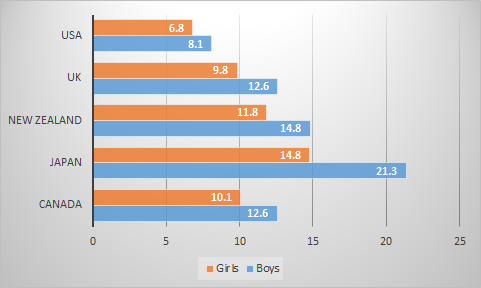
Source: OECD StatExtract.
Top performers in maths by gender, USA, UK, Japan, Canada, Australia and New Zealand
01 Jul 2015 5 Comments
in economics of education, gender, human capital, labour economics Tags: Australia, British economy, Canada, Japan, lost boys, reversing gender gap
Figure 1: Percentage achieving the proficiency level 5 or higher in mathematics by gender, USA, UK, Japan, Canada, Australia, New Zealand, 2012

Source: OECD StatExtract.
Down and out in Australia as measured by consumer durables affordability
30 Jun 2015 Leave a comment
in applied welfare economics, economic history Tags: Australia, living standards, The Great Enrichment
Economic freedom improves everyone's lives – especially the poor – as this graph from the IPA's @NovakMikayla shows: http://t.co/5qHIRcVRcN—
InstofPublicAffairs (@TheIPA) April 17, 2015
Top performers in reading by gender, USA, UK, Japan, Canada, Australia and New Zealand
30 Jun 2015 Leave a comment
in discrimination, economics of education, gender, human capital, labour economics Tags: Australia, British economy, Canada, Japan, lost boys, reversing gender gap
Figure 1: percentage achieving the proficiency level 5 or higher in reading by gender, USA, UK, Japan, Canada, Australia, New Zealand, 2012

Source: OECD StatExtract.
All in less cash transfers average income tax rates at average wage, USA, UK, Australia and New Zealand
27 Jun 2015 Leave a comment
in labour supply, politics - Australia, politics - New Zealand, politics - USA, poverty and inequality, public economics Tags: Australia, British economy, family tax credits, family taxation, in-work tax credits, social insurance, taxation and the labour supply, welfare state
Figure 1: All in less cash transfers average income tax rates at average wage, 2014
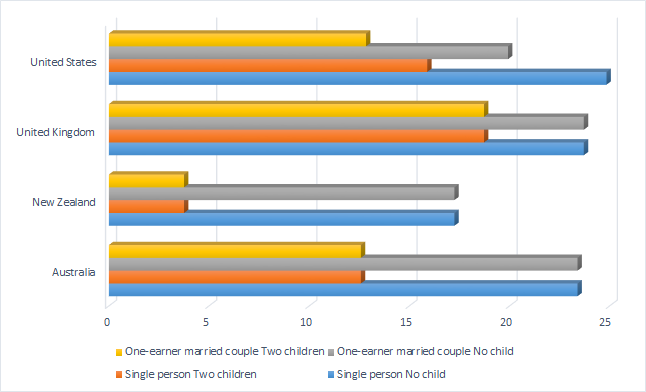
Source: OECD tax database
Why is the Australian top 0.1% far less greedy than the UK, US and Canadian top 0.1%?
26 Jun 2015 Leave a comment
in economic history, entrepreneurship, human capital, labour economics, labour supply, Marxist economics, occupational choice, politics - Australia, politics - USA, poverty and inequality Tags: Australia, British economy, Canada, Leftover Left, top 0.1%, top 1%
Figure 1: top 0.1% share of gross income, Australia, UK, USA and Canada since 1946

Source: Chartbook of Economic Inequality.
The top 0.1% in Australia is earning not much more than it did in 1946. For most of the post-war period, the Australian top 0.1% earned less than what it earned in 1946. The only spike in the earnings of the Australian top 0.1% occurred after the top tax rate of 66% was reduced to 49% in 1986.
There were major cuts in the top tax rates in Australia,the USA and UK in the early 1980s. Figure 1 shows that these top tax rate cuts were matched with a spike in the earnings of the top 0.1% subsequent to those large tax cuts.
The Green vote drops 30% after going into government
25 Jun 2015 Leave a comment
in politics - New Zealand, politics - USA Tags: Australia, Australian Greens, New Zealand Greens, Tasmania, Tasmanian Greens
The Australian Greens suffered dramatic drops in their vote when they got anywhere near the reins of power.
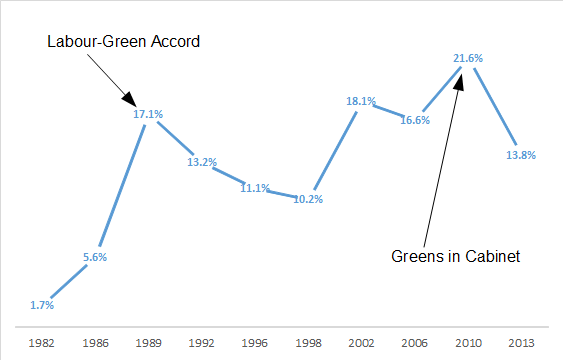
First consider the Tasmanian Greens. They were in a confidence and supply agreement in 1989 in the Tasmanian House of Assembly and then Cabinet ministers from 2010.
As Figure 1 shows, the Green primary vote dropped dramatically after each spell near power – from 21.6% to 13.8%.
Figure 1: Tasmanian Greens primary vote, House of Assembly
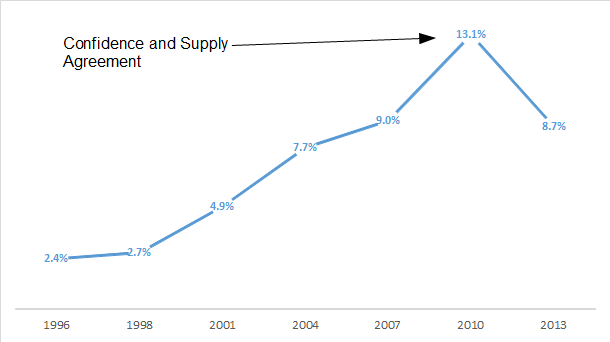
The Australian Greens suffered the same fate when they entered into a confidence and supply agreement after the 2011 Australian Federal Election. Figure 2 shows that their vote dropped by 1/3rd.
Figure 2: Australian Greens Senate primary vote
What lessons does this have for the New Zealand Greens and their ambitions for Cabinet portfolios after the 2017 election? Figure 3 shows of their part vote only got a comfortable distance from the 5% minimum threshold for list MPs after Labour lost power and popularity after the 2008 election.
Figure 3: New Zealand Greens party vote
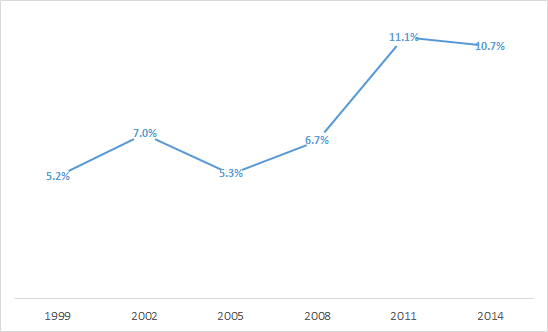
In the 2005 election, the Green party vote was below 5% at the end of election night after rose above that after early and postal votes were count P.
Part of the boost in the vote of the Greens in the 2008 and 2011 New Zealand general elections can be explained by grumpy Labour voters going elsewhere while waiting the call home to a credible Labour government in waiting.
The Greens need to buy an insurance policy and win an electorate seat such as Wellington Central where their new leader James Shaw stood at the last election. The Labour Party came third in the party vote last time but won the seat comfortably because the Greens chose not to seek the electoral vote.
Tertiary education attainment of young adults in Australia, New Zealand, USA, UK and Canada, 2000 and 2011
24 Jun 2015 Leave a comment
in economics of education, human capital, labour economics, labour supply, occupational choice, politics - Australia, politics - New Zealand, politics - USA Tags: Australia, British economy, Canada, College premium, educational attainment, graduate premium
Figure 1: tertiary educational attainment of adults aged 25 to 34 in Australia, New Zealand, USA, UK and Canada, 2000 and 2011
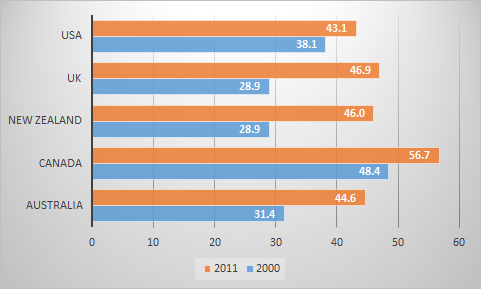
Source: OECD Factbook.
 Utopia, you are standing in it!
Recent Comments